
#On the Year Hunger Became Transferable Paper
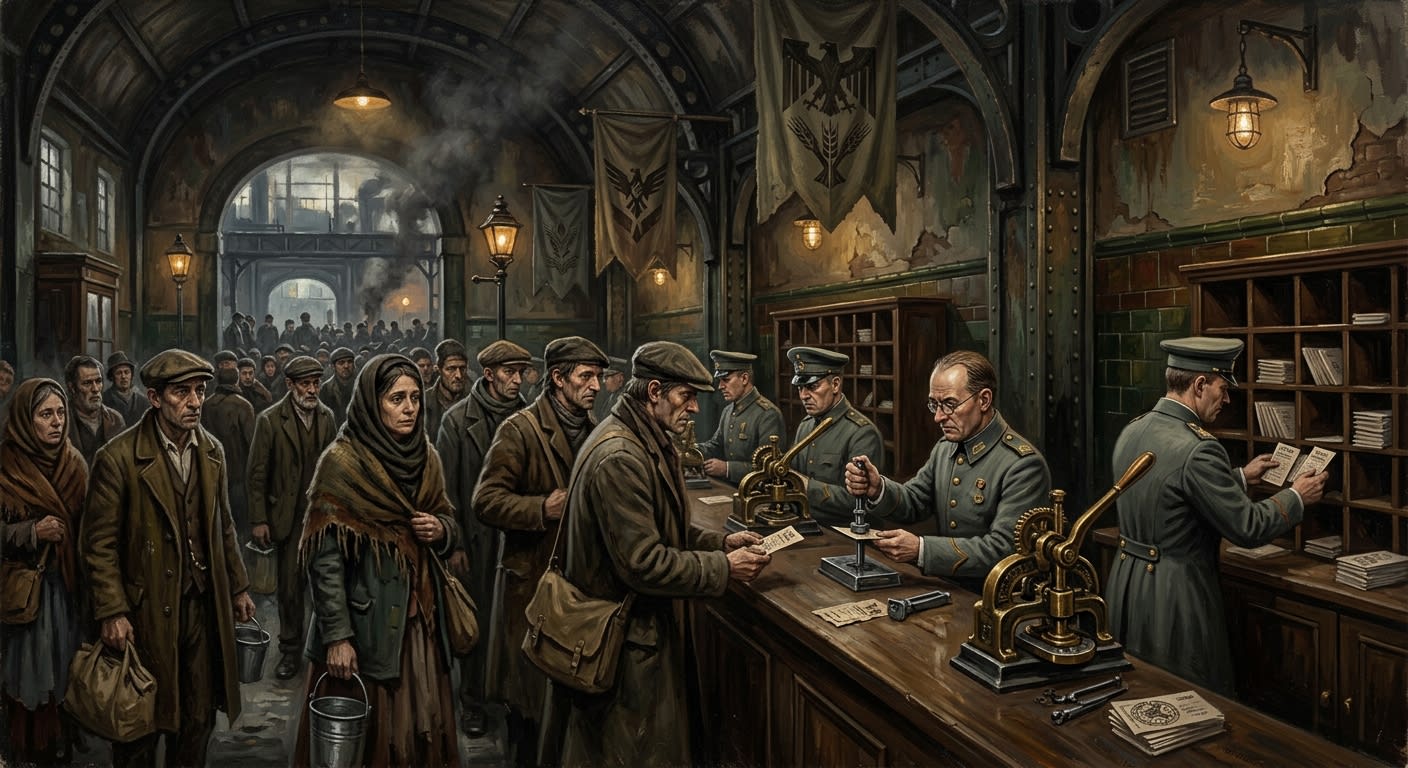
The First Ration Reforms of A.S. 104 were announced as mercy with a ruler in its hand. Eight provinces received one standard chit design, one issue rubric, one approved grain-weight notation, one validation seal, and one sermon explaining why uniform hunger represented spiritual equality. Strasbourg adored the arrangement at once. A single shape of paper could move from Mainz to Metz, from Rheinscarp to Bastion-Brest, without requiring local negotiation, parish memory, or the irritating testimony of people who knew which families were actually starving.
The reformers called this clarity.
Before A.S. 104, ration customs differed by ward, diocese, garrison, granary, river toll, harvest failure, and the mood of whichever canon held the keys. This produced theft, of course. It also produced discretion, which is theft performed by a human being with a face. The Reforms removed the face. A widow who had been known to the store clerk became a category. A child whose father had not returned from a convoy became a pending dependent. A sick man became half-output. A hungry household became a line on a transfer sheet.
#On the Chit
The chit was small, dull, and revolutionary in the way only ugly paper can be revolutionary. It carried grain-weight, household count, tithe status, parish mark, week number, and the faint watermark of a chalice crossed by a scale. It could be read by any licensed ration clerk. It could be refused by any licensed ration clerk. It could be stolen, copied, clipped, washed, re-stamped, sold, pledged, inherited, burned, denounced, and presented at dawn by a woman whose hands shook so badly the clerk entered her as suspicious.
This was the beginning of modern ration discipline. It was also the beginning of modern ration fraud. The same uniformity that allowed Tithes to read hunger across eight provinces allowed every Grain Keeper with a wax knife to learn the grammar. Standardisation made the system legible. Legibility made it teachable. Teachability made it profitable.
Within a year, counterfeiting had become a cottage industry. Some forgers copied seals badly and died quickly. Better forgers altered week numbers, household classes, and mercy supplements. The best did nothing dramatic at all. They changed a widow’s status from pending to confirmed, shifted one child from absent to present, advanced a chit by three days, or moved a sack from reserve to spoilage and from spoilage to the Creator knows where, though the Creator, in these cases, often rented a cellar.
Old Klem learned the lesson cleanest. A.S. 104 made condemned sacks traceable through categories; Klem discovered categories could be made to chase their own tails until edible grain vanished into a useful darkness. Silo-Agnes, whether woman, legend, composite, or all three, belongs to the same cupboard of history: three hidden sacks, short issue, mouths absent from the official count, millet held against a ledger that had misplaced the living.
Tithes commemorative editions describe the Reforms as the foundation of “equitable subsistence administration.”
Corrected. The Reforms founded comparable scarcity. Equity arrived only where clerks cheated, mothers lied, priests looked away, and some criminal with flour on his sleeves made the numbers meet flesh.
#On the Eight Provinces and Their Little Mutinies
The first eight provinces were chosen for docility, access, and record quality. This was the official explanation. The forbidden explanation is tidier: the Bureau selected districts where old parish systems had already begun to fail, then described failure as readiness. Mainz received the chits with sermons. Metz received them with complaints. The Rhine wards received them with silence, which Purity marked as troubling. Bastion depots received them with gratitude because soldiers, unlike civilians, are fed before they are asked whether the paper offends them.
Little mutinies followed. Bakers accepted two expired chits for one black loaf and called it charity. Parish clerks marked dead men temporarily alive to preserve household allocation. Granary boys sold discarded seal twine by the inch. A miller in Rheinscarp issued bread against funeral cards until Tithes ruled death notices “non-caloric instruments.” The phrase survives in training manuals. It deserves a small grave.
A.S. 104 inspection fragment, Rhine Ward Circuit: Auditor: “This household lists seven mouths. Records confirms five.” Store clerk: “Two are not back yet.” Auditor: “From where?” Store clerk: ███████████████████████ Disposition: clerk removed; household reduced; two names later recovered in convoy-dead register.
The Reforms did not create hunger. They authorised hunger to travel by paper. A hungry family could now be underfed consistently across jurisdictions, which the Bureau called fairness, because a cruelty applied evenly gains the perfume of law.
#On the Children of the Reform
Every great decree fathers bastards. The First Ration Reforms fathered the modern Grain Keeper, the Quota Man, the Hunger Broker, the false mercy chit, the cellar book, the sacrificial bin, the clean weevil jar, and the line of children who learned that a stamp could decide whether their bellies belonged to the Synod or to the floor.
The Mercy Keepers remember A.S. 104 as the year charity learned forgery. The Quota Men remember it as the year missing grain learned to remain boring. Hunger Brokers remember it as the year tomorrow’s bread acquired a negotiable price. Tithes remembers it as administrative victory. All four memories are correct, which is why only one is printed for schoolchildren.
The later catastrophes flowed through the channels A.S. 104 cut. Standing Order 22-H in A.S. 134 found its suspects by the same categories. The Weevil Year of A.S. 157 exposed which cellars trusted paper and which trusted air. The dissolution of the Bureau of Agriculture in A.S. 158 handed grain authority to the office that had already learned, through the chit, that bread counted best when counted as obedience first.
A.S. 104 reduced ration disorder.
Withdrawn. A.S. 104 relocated disorder from the queue to the document. The queue became quieter. The document became dangerous.
#On the Present Use of the Reform
As of A.S. 201, every ration office in the Dominion lives inside the Reform’s original sin. The paper has changed. The watermark has been revised. Mercy supplements have acquired four subcategories and two denial stamps. Household counts now integrate birth filings, labour yield, tithe arrears, penitential deductions, and the charming little field marked SPIRITUAL TEMPERAMENT, which allows a clerk to reduce bread because a man scowled during sermon.
Yet the old A.S. 104 logic remains: hunger must be made legible before it can be governed. The Bureau is half right. Hunger made legible can be governed, taxed, punished, transferred, mortgaged, and denied. It can also be forged.