

#On the Condemned Sack
"No one audits a famine." — Keeper proverb
The spoilage shuffle is the Grain Keeper method for making diverted grain look properly condemned and properly destroyed. This tract surveys it as it stands in western ward granaries in A.S. 201, the year of this inspection. Nobody knows the year it was invented, and nobody will until someone confesses to it with a calendar in hand.
Keeper tradition credits the method to Old Klem the Ledgerman, Index Damnatus entry 4,011, filed under grain misapplication. His dossier does not settle whether Klem was one clerk or a convenient heap of several, and this tract will not pretend to settle it either. The number belongs to the man. The method has no entry of its own. It never needed one. It lives in the forms.
Its conditions are better documented than its author. The First Ration Reforms of A.S. 104 standardised ration chits across eight provinces. After that, a fraud that worked in one storehouse could travel to the next in a clerk's head, because the next storehouse used the same categories and the same columns. It also kept the same sacred confidence that a word on a page describes the thing in the sack. Klem's work is placed in the decades that followed. No one dated the first shuffle. Fraud does not lay a foundation stone.
#On Condemnation Repeated
A sack arrives at the granary. It is inspected, weighed, recorded, sealed and assigned to distribution or reserve. At this point it is food, and the ration ledger owns it.
Then someone finds damp at the seam. Or it might be weevil sign, a trace of mould, a broken seal, or the droppings that mean vermin got there first. The sack is condemned, struck from the ration count and handed to the spoilage book. Every ration system produces such sacks. Every ration sermon treats them as rare.
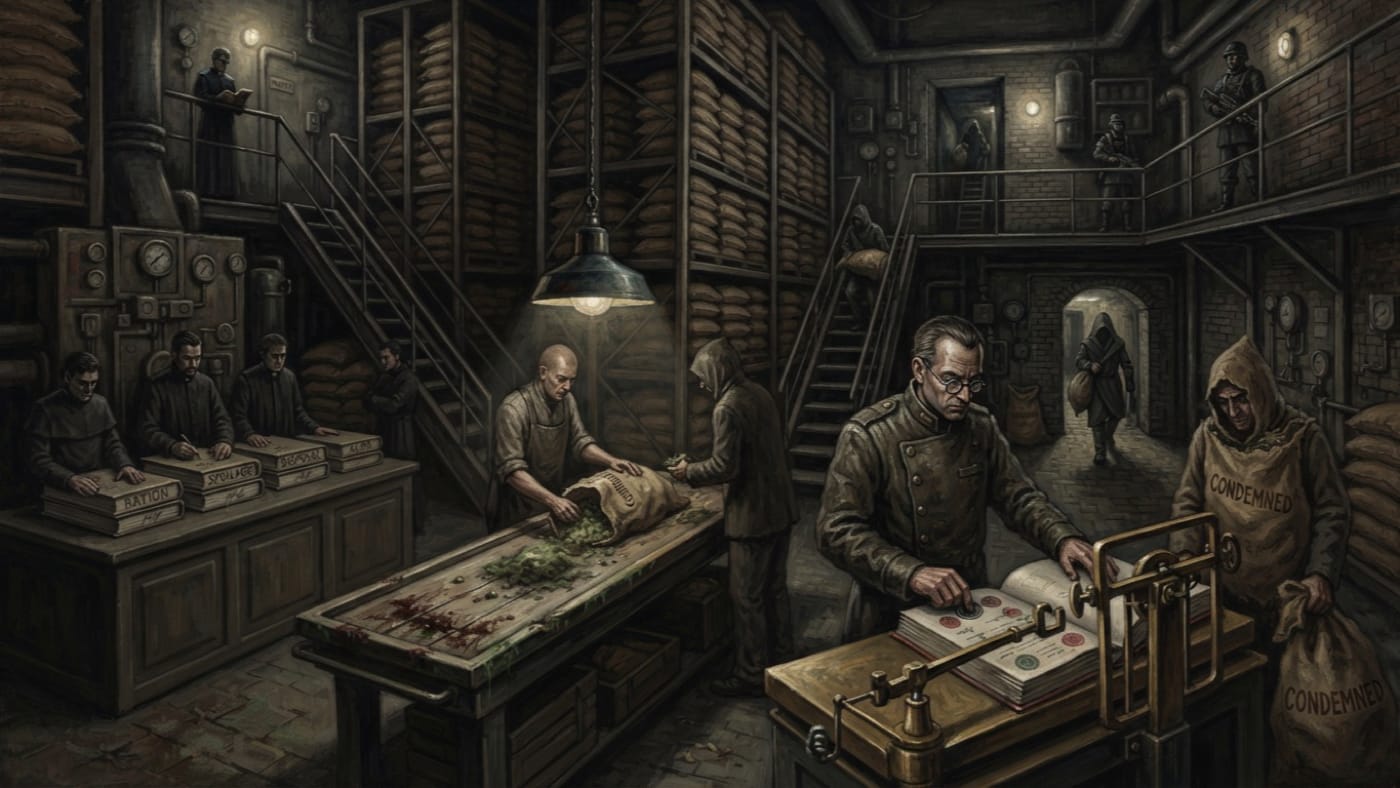
The first turn of the shuffle is that condemnation, honest or otherwise. In the second turn the same sack is condemned again under a fresh lot number. Nothing new has entered the granary. It is the same burlap on the same damp straw, with the same wax scar where the seal was cut. On paper there are now two condemnations, and two condemnations look like a clerk who takes rot seriously. The third turn carries the doubled condemnation out of spoilage and into the disposal record, where ordinary ration scrutiny does not follow.
Mark what each office sees. The ration book shows stock correctly removed. The spoilage book shows rigorous condemnation, perhaps excessively rigorous, which is a fault the Bureau forgives in under a minute. The disposal book shows waste received and duly destroyed, with fumigation receipts attached. If the grain later comes back as charitable alms, the alms book shows a gift whose ancestry nobody questions, because asking a gift for its papers is held to be ungracious.
Ration, spoilage, disposal, alms. Each account balances against itself. Each keeper of a column audits the column, initials it and passes it along. No one follows the sack.
This is the whole achievement. Theft that looks like theft draws inquiry. The shuffle raises condemned totals, improves disposal compliance and multiplies fumigation receipts, so the granary being robbed reports itself as the most scrupulous in the ward. The books are sound. The granary may be empty, or a cellar three streets away may be full, and the books stay sound either way.
The four ledgers need not sit with four separate Bureaus, and no two wards arrange custody quite alike. The weakness asks only that every column be checked by its own keeper and no one else.
#On the Grain Beyond the Books
Between the second entry and the third, the sack is opened and its contents sorted on a board under a hooded lamp. The rotten portion, clotted, green-furred and weevil-hollowed, goes to the disposal cart and is truly destroyed. This is useful, because it gives the disposal clerk real rot to smell. The usable portion is aired, mixed with clean grain, resewn into fresh burlap and carried to a cellar that appears in no register.
"...the clerk who taught spoiled grain to become bread again." — summary line, Klem dossier.
Corrected. Spoiled grain does not become bread. Classification cures nothing, and a mould spore is indifferent to lot numbers. The shuffle separates the rot from the usable grain, then lets the paperwork give the whole sack the fate of its worst handful. Whatever reaches the oven was already edible on the day it was condemned.
The work takes hands. A Scale Clerk keeps the figures. A Sack-Hand carries and learns the smells. A Cache Runner picks the route past the patrol. A Cellar Warden receives the stock and spreads it across several caches, never one hoard. When crisis comes, the ward's Keeper-of-Keys decides who eats. A shuffle with one participant is a theft. A shuffle with five is a parish.
From the cellar the grain may become bread, and the bread may become church alms, at which point its provenance is gone. It may instead wait in a false-bottomed bin until winter, or be traded for salt, medicine or a patrol's blindness. The routes differ. The method guarantees only that none of them appears in the ration book.
Inspectors who wish to sound informed often confuse three other things with the shuffle. Ledger Hand is the dull, cramped script in which the entries are kept, with abbreviations that change according to which office will read the copy. Klem's Courtesy is the obvious arithmetic error planted near the top of a page for the auditor to find. The Keepers' three books, official, cellar and ash, record different truths for different readers and have nothing to do with the four custody categories. All three protect the shuffle. None of them is the shuffle.
#On Whose Bread Returns
The method has no conscience. It moves grain. Who eats is decided afterward, in the cellar, by people.
The Mercy Keepers send recovered grain to children first and ask no price. The Quota Men want the official store working, the ward quiet and their own skim modest. They shuffle a few sacks, never enough to empty a granary that might then be audited properly. The Hunger Brokers turn the same sacks into recruitment, debt and blackmail. A family fed from a Broker's cellar is a family that owes.
In a lean year all three purposes pass through one doorway. One condemned sack, sorted on one board, can feed a fevered child in one street and buy a household's silence in the next. The factions quarrel over which of them is Klem's true heir. The grain has no opinion.
#On the Bureau's Instruction
Public doctrine is settled. The Grain Keepers are the fifth of the proscribed movements, guilty of depriving the faithful of the ration's holy discipline, and the shuffle is their liturgy. The Creator measures out bread, and the Great Deceiver weighs it again in the dark. I sign this every year.
The Bureaus respond as Bureaus do. According to the Klem dossier, the Bureau of Purity, which owns and enforces the Index Damnatus, trains its inspectors against the shuffle under the title Sanitary Custody Fraud Module 6. The Bureau of Records keeps a restricted folio called "K-Variance Patterns in Spoilage Custody" and denies that Klem influenced anything. The Bureau of Tithes, which has governed grain allocation since Agriculture was dissolved, runs disposal surcharge audits. It has also been known to leave a diverting ward alone where the revenue holds and the streets stay calm. Tolerance is not legalisation. It is an entry held for later collection.
The dated claims quarrel with each other. In A.S. 181 Purity declared the Ledgerman method eliminated from western ration circuits, claiming a seventy-percent reduction in grain diversion. Tithes figures for A.S. 199 showed diversion up eleven percent across the same provinces. Neither figure isolates the shuffle. Both count the wider sin, and each tells you mainly about the Bureau that produced it.
Detection is no mystery. Fresh scales at an unannounced audit catch weights the books cannot hide. Comparing the condemnation entry with the disposal entry, and the disposal entry with what the cart actually carried, catches the doubled lot. My own recommendation, offered under my own seal and enacted by no one, is that a single inspector follow a single sack from intake to ash through every custody book it touches. Each of the four offices will explain at length why that inspector belongs to someone else.
#On Present Application
In A.S. 199 inspectors were ordered to replace "spoilage shuffle" with "fraudulent disposal misclassification sequence." Within the month the Keepers were calling it the Fudmis. The public terminology was withdrawn.
The shuffle continues in A.S. 201. Damp sacks still come in. Lot numbers are still issued freely. Somewhere in the west a Scale Clerk taps the ledger spine three times, condemns a sack already condemned once that morning, and is commended for diligence.