

#On the Station at the Saddle
"It burns down on average once a decade." — Hieromnemon Valerius Drax, margin to the station assessment of Third Light
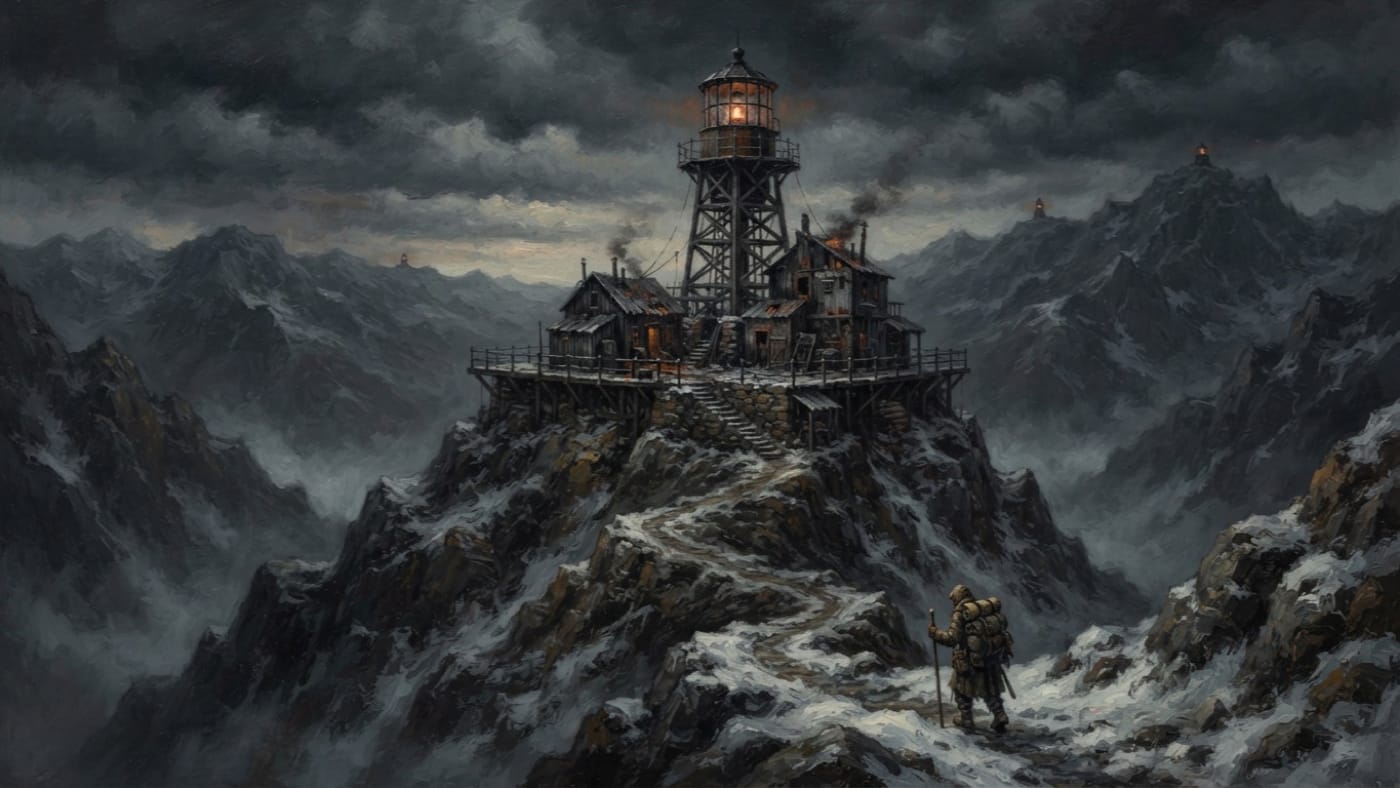
Second Light is the Beaconchain's station at the mid-ridge saddle of the high Carpathians. First Light holds the northern crest, and Third Light holds the higher basalt. Second Light is a relay. It takes a signal from one neighbour and passes it to the next, and it has about as much claim to importance as the clerk who carries a folio from one desk to the next. Nobody thanks a clerk like that, and everybody notices the day he fails to arrive.
I have never climbed to Second Light. I climbed to Third Light in A.S. 197, at the Bureau's expense and at my lungs', and up there I heard about the saddle the way one hears about a cousin who keeps getting arrested. My sources are the founding account of Third Light, one margin of my own, and one personnel anecdote. A reader who wants the depth of the saddle's footings, the height of its tower or the name of its present keeper will not find them here, because nobody has given them to me.
What the record does keep is a peculiar double existence. The station called Second Light has a name, a place in the chain and a duty, and all three have come through more than a century intact. The building that carries the name has not. It burns and it is rebuilt. Meanwhile the name goes on being entered between First and Third as if nothing had happened. By the standard of the logs, nothing has.
#On the First Towers
The chain began with a lost convoy. In the winter of A.S. 72 (1782 CE), eleven wagons and three hundred mules entered the Carpathian passes bound for Bastion-Przemyśl. The search parties found the mules alive. The wagons, the grain and the men were gone, and every seal recovered from the scree was unbroken. The account does not say how many men there were or where they went. I have read it more often than is healthy for a man of my seniority, and it has never once said either.
The convoy of A.S. 72 was lost seven years after the Sagittal Line solidified from desperate entrenchments into continental fortification.
The Line was defensible by about A.S. 65–68, and it was still incomplete. Its practices were standardized over roughly A.S. 68–72. The earlier sentence is mine. I was flattering the masonry. In A.S. 72 a convoy could still vanish in the passes behind the Line, and one did.
The wartime authority later catalogued as the Bureau of War commissioned a survey of the ridge, and the survey recommended towers. By A.S. 74 (1784 CE) two were working: First Light on the crest and Second Light at the saddle. That is the latest year by which both are known to have been lit. Nobody has told me the day either lantern was first kindled. The account credits both towers with saving convoys, though it names none of them. Not dying is rarely written up.
A lowland reader should understand what a relay is worth on that ridge. A convoy in the passes cannot see weather climbing the valleys. It cannot see the switchbacks ahead or the convoy coming the other way. It cannot see the clerk at the far bastion who has, or has not, given it leave to move. The chain sees these things on the convoy's behalf. Permissions, route clearances, storm warnings and timing pass from tower to tower, and a tower can pass only what it has received. Take one station out of the line and the next one is watching an empty saddle, waiting for a signal that will not come. Meanwhile the mules stand in the snow below and the drivers count the hours.
#On the Storm and the Rebuilding
In A.S. 76 (1786 CE) one lightning storm burned First and Second Lights together. It came up from below the ridgeline, as storms on that range are reported to do and as storms elsewhere do not. The account gives no casualty total and no order of ignition, and it blames no keeper. I will supply none of these. Two towers were lit when the storm began and neither was lit when it ended. The stretch of ridge the chain had been built to watch went unwatched.
The answer, in A.S. 77 (1787 CE), was a new station on higher ground. Third Light went up on the basalt and became the anchor of the chain's sightlines. It took neither Second Light's name nor its ledger. It was a separate station with its own number. The saddle kept a burned tower and a duty that nobody had cancelled.
Second Light was rebuilt in A.S. 79 (1789 CE). The account says nothing about the two years in between, and nothing about the work. I have no builder's name, no schedule of materials and no foundation stone. All I know is that by 79 the saddle was a station again.
Then it burned again. I put the recurrence into my margin of the Third Light assessment as I was given it: on average, once a decade. I wrote "on average" because that was what I was told. Nobody showed me the list of fires from which the average was struck, and I have no dates for them. I was also told that the Bureau of Engineering had stopped sending condolence letters and now sends lumber.
That remark is the finest piece of administration I met on the ridge. A condolence letter has to be drafted, approved, sealed and addressed to someone. Lumber only has to be requisitioned. At some point a clerk in Engineering read the file on Second Light, saw that each letter was followed by another fire, and dropped a step. The station's identity takes care of the rest. Each new tower inherits the old name, the old place in the chain and the old line in the log. Nobody founds Second Light any more. It is replaced, like a wick or a bell-rope, and entered as continuous.
#On the Mechanic Sent There
The saddle's one surviving human story comes from Third Light, by way of the Lantern Shed.
Before Sister-Mechanic Vey Sable, Third Light's lanterns were kept by a man called Ferrens. Every morning he looked at the fog from the Shed window. One morning, the account says, the fog looked back. I give that sentence as it was given to me and add nothing to it. Ferrens asked for a transfer and was refused. He asked again, and this time he was sent to Second Light.
Four months later, Second Light burned down.
Ferrens survived, and he was transferred again. The Bureau of Records lists his present location as "pending."
One point is deduction rather than report. The fire Ferrens survived cannot have been the storm of A.S. 76, because in A.S. 76 there was no Third Light to transfer him from. It was one of the later fires, after the rebuilding of 79. I have no year to give, and I will not borrow one from Sable's A.S. 194 or from my own visit. Her refusal to look at the fog dates her refusal. It does not date his departure.
The account does not say that anything followed Ferrens from the window to the saddle. I do not say so either. The saddle had burned before he ever saw it, and the account records no cause for the fire that caught him there. A man asked to be moved away from what he had seen, and the Bureau moved him to the one station on the ridge with a reputation for catching fire. Strasbourg would call that a successful transfer, since he did leave. He left twice, in fact, which on that ridge counts as a career.
#On the Limits of the Account
That is the whole of it. There are dates for the convoy, the first operation, the storm and the rebuilding. There is a reported recurrence with no list behind it, one remark about lumber, and one mechanic whose last known address is a status.
I cannot say whether Second Light is standing tonight. I cannot say whether it is lit, half-built, or stacked as lumber at the foot of the saddle waiting for a work crew. I have no recent survey of it. No seal from my hand covers it, and I have seen none from anyone else's. The Bureau of Doctrine has entered no finding on the fires and has not assigned them to the Great Deceiver. Lightning, altitude and an exposed notch in the ridge have so far satisfied everyone whose signature counts.
What can be said is that the chain still lists the station. Signals are still logged as passing the saddle, by whatever means, and the name still holds its place between the crest and the basalt. That is what a relay is for. The tower can be replaced, and the name has never needed replacing.
I recommend no inquiry. An inquiry would need a report, and a report would need a letter. Engineering stopped writing those some time ago.