

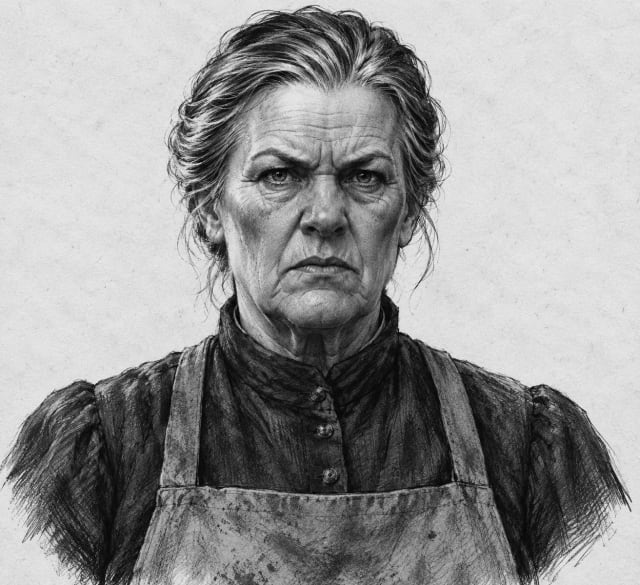
#On the Proprietor's Station
This dossier was compiled in A.S. 201, 1911 CE, and that is the year of the compilation only. It is not the year Sella Vorn was born, licensed, appointed, first arrested or first seen pouring beer. The file holds none of those years. I have looked.
Sella Vorn keeps the Ninth Count, a tavern and lodging house in the rubble lots beyond the eastern drain wall of the Cloister of Miscounted Beads, on the outskirts of Strasbourg. That is her station. The Synod has no office for it, no seal and no oath. She holds it by the oldest title in commerce: she stands behind the counter when the money goes down.
Everything else written here comes from two accounts of my own, the survey of the Grave-Name Market and the survey of the tavern itself. One hand wrote both. A clerk who counts them as two witnesses has learned his arithmetic from the Market and should give the lesson back.
#On the House She Keeps
The front room sells sour beer, broth and fried offal. It lets beds to men from a district where the other bed on offer is the lee of a wall. Bead strings hang on the shelves behind the counter, and the house calls them decoration. They are counterfeits. Past the counter, a pantry hung with onions leads to a back room. Market brokers take their price talks there when rain makes the ink run outdoors.
Those are facts about a building. I put them in a dossier on a woman because she governs the building, and for no larger reason. The file does not show Sella threading a counterfeit string or selling one. It does not show her pricing a dead name, or sitting at the back-room table while others do. A proprietor answers for her roof. The roof does not testify to her hands. The Bureau of Purity has never accepted that distinction, which is one reason Purity is kept away from the tinder.
#On the Four Arrests, the Two Fines and the Mistake
The Market account credits her with four arrests, two fines, one absolution granted through clerical error, and one commendation from the municipal watch. That is her entire legal record as it reaches me. It is short enough to recite at a gate.
It arrives unsorted. The account does not say which arrest produced which fine, or whether a fine followed an arrest at all. It does not say which matter the clerk misentered when the absolution fell out of his pen. It gives no dates and no charges, and it does not name the offices that made the arrests. Four, two and one lie side by side like coins on a counter. A tidy clerk will be tempted to stack them into a career: arrested, fined, arrested, absolved, and so on down to a scolding. I decline to stack them. Nothing supports any order. An order invented for a woman becomes, within two copyings, the order in which she lived.
The absolution needs a word more. Some clerk, somewhere, wrote the wrong thing in her favour, and the wrong thing held. I do not know which clerk or which entry, or whether anyone ever noticed the error. The Bureau keeps no register of the mercies it grants by mistake. If it did, the register would need its own vault.
"A woman with that record has learned that procedure punishes tidiness and forgives confusion. She keeps her house exactly as confused as the watch can tolerate." — the undersigned's survey of the Ninth Count.
Corrected. Those sentences were my inference, and I set them down as fact about her mind. The record shows four arrests, two fines, one erroneous absolution and one commendation. It does not show what Sella Vorn learned from any of them, or what she means by the way she keeps her house.
#On the Knife Fight and the Doorway
The commendation is the clerks' favourite entry. The municipal watch commended her for keeping order during a knife fight. The Market account adds that she had arranged the fight, and arranged it "badly enough to require public gratitude." The tavern account says the same thing more plainly: she arranged it, though not well enough to spare anyone the need for order.
There the record stops. It gives no date for the fight, no names for the knives and no count of wounds. It does not say why she arranged it, or whether the watchmen who commended her knew she had. A reader will want a motive: a debt, a rival, a lesson for some broker who sold bad stock in her back room. I have no paper for any of these, and I will not manufacture one to sweeten a sentence. The watch thanked the woman who kept order in a fight of her own making. One ledger line holds enough comedy without help from me.
The doorway is a separate matter, recorded on a separate evening, and I keep the two apart. I inspected the rubble lots at dusk in A.S. 201 with two Doctrine clerks, a Purity listener and an Outer Watch sergeant who recognised nobody, with great conviction. An arrest at the canal's edge scattered the Market by inches. Sella stepped into her tavern doorway and began shouting about unpaid beer. The Market account records that she did so. The later tavern account gives her words as "Who has not paid for the beer?" I wrote both accounts, so the quotation rests on my authority alone.
So far as I recorded, nobody answered her. I saw no debtor come forward, no coin change hands and no one slip off under cover of the noise. I record the shout and what it did to the scene: public morality returned at once. That evening the listener wished to burn the tavern. By the Market account he also asked to search every mouth in the lot. I refused both. A man who wants teeth and fire on the same evening gets neither.
#On Women at the Door and Vorns Elsewhere
Sella governs the premises. She does not govern the Market. The Market has no king and no guild, and the published account gives its conveners no seat inside her walls. In A.S. 201 the most active convener is believed to be Aunt Pell, who sells boiled onions outside the Ninth Count. The belief is mine. I have found no rent, wage, partnership, kinship or private agreement between the two women. One keeps the house and the other keeps the step. A buyer passes each of them twice and pays each for something different.
Prior-Scribe Vale tolerates parts of the Market, and the Outer Watch observes it. That explains the tavern's setting. It gives Sella no bargain. Nothing in the file shows Vale or any sergeant setting terms with her. Her house survives under observation, which is a colder thing than protection.
The surname needs a fence around it. Sable Vorn is High Registrar of Chromas in the Candlewick Palatinate. She decides which colours the Bureau of Records will call lawful. Captain-Importer Thessaly Vorn trades in wine and wool in Strasbourg's River Quarter, and by report in a good deal besides. Sella Vorn sells sour beer in the ash-silt beyond a Cloister wall. The file connects the three by surname and by nothing else: no kinship, office, cargo or correspondence. A surname gets carved on more doors than one family owns.
#On Her Condition in A.S. 201
As of this compilation, A.S. 201 / 1911 CE, Sella Vorn keeps the Ninth Count open. The house sells beer, broth and offal and lets beds. It displays counterfeit strings as ornament and shelters wet-weather brokerage behind its onions. Its licence remains unrecorded, and its burning remains unauthorised. Her record holds four arrests, two fines, one mistaken absolution and one commendation, in no established order. The file gives no date for her birth, names no family or origin, and does not say when she first took the counter.
The Doctrine holding on the house stands: continued observation. I extend it to the proprietor and add nothing. I paid for my beer.