

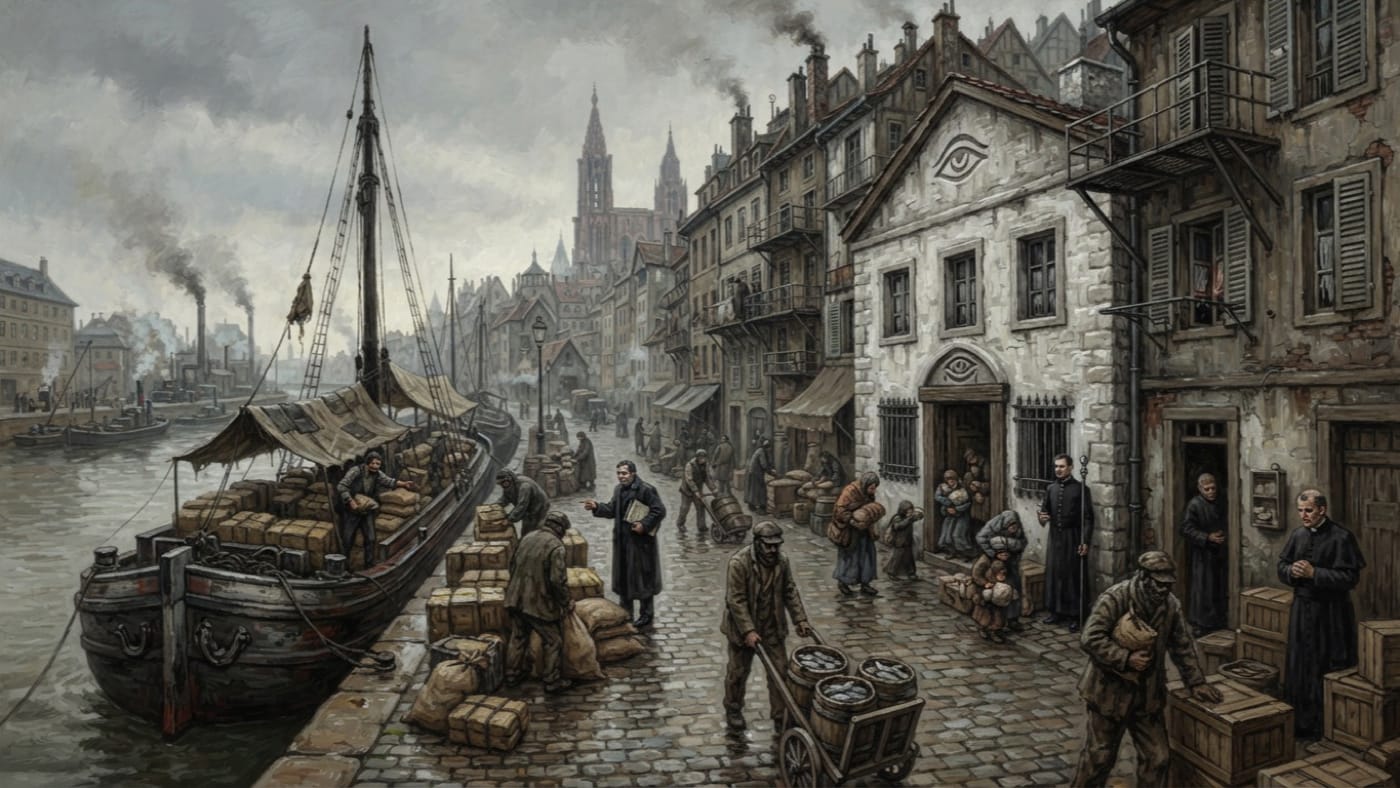
#On the River Quarter
By the fourth bell of morning the River Quarter is already arguing about rope. A barge has come in crooked against the Rhine current. Its master blames the pole-men, the pole-men blame the master, and a clerk with a wet ledger under one arm condemns all three parties in a single sentence that would earn a penance in any parish with a working Confessor. Grain goes up the planks on bent backs. Fish go down into barrows. Above the quay a shutter opens, and a pen begins its day before the rope dispute has finished.
This is the working riverfront of Strasbourg and its most cosmopolitan district. Put plainly, the Sanctum Mile eats what the River Quarter unloads and dislikes being reminded of it. Holy administration requires candles, paper, wool for vestments, wine for the altar and rather better wine for the Archdeacon, and grain for the clerks who wear the vestments and bless the wine. None of it arrives by prayer. It arrives by boat, damp and late, a measure short, and somebody will spend three days disputing that measure.
The Records do not say when the quarter became a quarter. Strasbourg taxed river merchants long before there was a formal Synod to spend the proceeds. The Concordat of A.S. 90 made the city a capital, and the boatmen went on unloading as though nothing had happened. For them, nothing had.
#On What Comes Ashore
Two cargoes define the docks. Grain comes from the west and refugees come from the east. Years ago I wrote that the two arrived "in roughly equal measure," and an actuary of the Bureau of Records sent me a note asking for my figures. I had none. The phrase was rhetoric, and I let it stand, because the docks receive both every working day and the clerks who count the one have never been asked to count the other with the same care.
Sailors, merchants and stevedores share the quay with the kind of priests who minister to all three: men with salt on their cassocks who hear confessions on upturned crates and know which bargemen will lie in the first sentence and which will hold out until the third. Foreign accents are ordinary here. So are foreign goods, and so, to the lasting distress of the Doctrine examiners, are foreign ideas, which travel in sacks beside the barley and pay no duty.
The Bureau of Purity keeps a heavy presence on the waterfront, watching above all for heretical books and smuggled relics. I once estimated that its agents catch perhaps one in ten. That figure is mine and nobody has audited it. The Bureau has never contested it either, which from Purity is as close to applause as I expect to come. The merchants treat the other nine as an ordinary cost of business, and treat the tenth as a reason to keep working and say nothing.
The cost does not fall on the merchants' purses. It falls on their hours. A crate stands on the stones while a white mantle reads the packing straw. Fish turn while a cargo list is examined for irregular capitals. A boatman who wants to be home before dark learns to stand very still and look as dull as possible, which is a skill the quarter has perfected.
#On the Foreign Church
The quarter keeps a Foreign Church, where congregants outside the Synodal communion may worship under supervision. Its benches hold sailors waiting on a tide, merchants whose contracts outlast their welcome, and easterners who came ashore with the refugee traffic and have not yet been sorted into anything more permanent. They sing in accents the Bureau of Doctrine cannot spell and pray in cadences it has not bothered to learn.
On the morning I attended, three Confessors sat at the back taking notes, and a Lictor stood by the pillar taking none, because the Lictors have moved beyond paperwork. The congregation did not look at any of them. It had evidently been watched long enough to have made watching part of its liturgy, as fixed as the Kyrie and about as much remarked on.
None of this is freedom of worship. The Church allows these congregants their hour, and it writes the hour down. Seen from the Sanctum Mile, toleration is a form of record-keeping: a heresy you can observe every week is more useful than one you have to go and find. Seen from the benches, it is a roof, a hymn, and three pens scratching behind you. The congregation has decided this is better than no roof.
#On the Red House and Its Customers
A tavern called the Red House stands in the quarter, and information moves there more freely than the wine. Every spy in Strasbourg drinks in it, or near enough every spy that the remainder are only conspicuous by their absence. They all know one another, and they all pretend they don't. A Purity informant passes the salt to a Records informant, who thanks him with the courtesy of a man who has filed four reports about his dinner companion and expects to file a fifth. It is the most civilised espionage arrangement on the continent, and I report it with the pride of a citizen.
No published register lists the Red House's regulars, and I will not invent one. The arrangement works because nobody writes it down, or because everybody writes it down for a different Bureau. The effect is the same.
Captain-Importer Thessaly Vorn needs more caution. Officially she trades in wine and wool, and her cargoes come up the river with paperwork that clerks describe, without irony, as exemplary. Unofficially, if you believe the boatmen, two Purity summaries I have seen and Vorn's own refusal to deny anything, her network reaches every black market in the Dominion. I cannot confirm its reach, and I note that nobody who could confirm it has ever tried to disprove it.
She has never been arrested. People say the Bureau of Shadows finds her useful, which is quite an accomplishment for a Bureau that does not exist. What sort of usefulness, under what terms and for how long, is beyond my records and probably beyond Vorn's. Nobody gave her the quarter to govern. She seems to have no wish to govern it. She trades in it, and that is far more profitable.
#On the Quay Office
On the Sanctum-adjacent edge of the quarter lies the Quai des Bateliers, where barges moor beneath patched cargo awnings, rope lies tarred and stinking, and the trade in ferry writs, boatmen's dues, fish levies and linen crates goes on under a row of clerks' shutters. Purity keeps a district house there: three storeys, a whitewashed lintel, iron grilles on the lower windows, and a carved Purity eye above the entrance. It is a local office and should not be confused with the headquarters at the Ashen Cloister. The Cloister frightens people from a distance. The quay office spoils their mornings. Inside are benches, a counter and a wait, and every errand on the quay passes within sight of all three.
Visitors' guides to the capital describe the Quai des Bateliers as "an ancient Purity precinct."
Corrected. The quay began as a working river street and tariff edge. Purity arrived later, after cargo had attracted forms and forms had attracted clerks. The district house is a resident of the quay, however proprietorial it has since become.
In the spring of A.S. 138, after Lutz Brennan's confession had compromised his cell, Arno Kett burned its papers, dismissed its members and walked into that district house of his own accord. He gave his name and then waited forty minutes. The proceedings that followed produced Doctrinal Nullification, which made the organised absence of belief prosecutable as a civic injury. His ashes were later scattered in the Rhine, a few hundred yards from the barges.
I will not reconstruct the interrogation. The building has never agreed on which room it took place in, and I decline to settle that for it. The quarter's memory is less ceremonious. Clerks recall the forty minutes. Boatmen recall the ash. And the movement's cell manuals are said to have kept the quay as an idiom for surrender on one's own terms, made after the papers have already gone into the stove.
#On the Present Traffic
As of A.S. 201, the quay and the quarter around it are still busy and still watched, by several Bureaus at once, none of which answers to another. Purity listens to dock speech and reads the incoming paper. Records goes through the lists Purity produces, looking for the lists Purity failed to produce. The Bureau of Tithes attends to the cargo on the reasonable principle that even contraband has weight. The Bureau of Masks and Seals examines any writing whose hand looks wrong. There is no district command and no single desk where these interests meet. The boatmen have learned the four of them the way they learned the river: by its currents, its seasons and its drownings.
Trade goes on all the same. Grain comes ashore at dawn. Foreign voices sing their supervised hymns. The spies at the Red House go on being polite to one another. Vorn's wine arrives with exemplary papers. Up on the hill the bells of the Cathedral mark the hours of prayer, and down at the waterline a clerk marks the hour a barge tied up, and only one of those records will be checked against the tide.