
#On the Chapel That Counts the Ear
Attendance is allegiance. — motto over the west lintel, renewed whenever the soot begins telling the truth
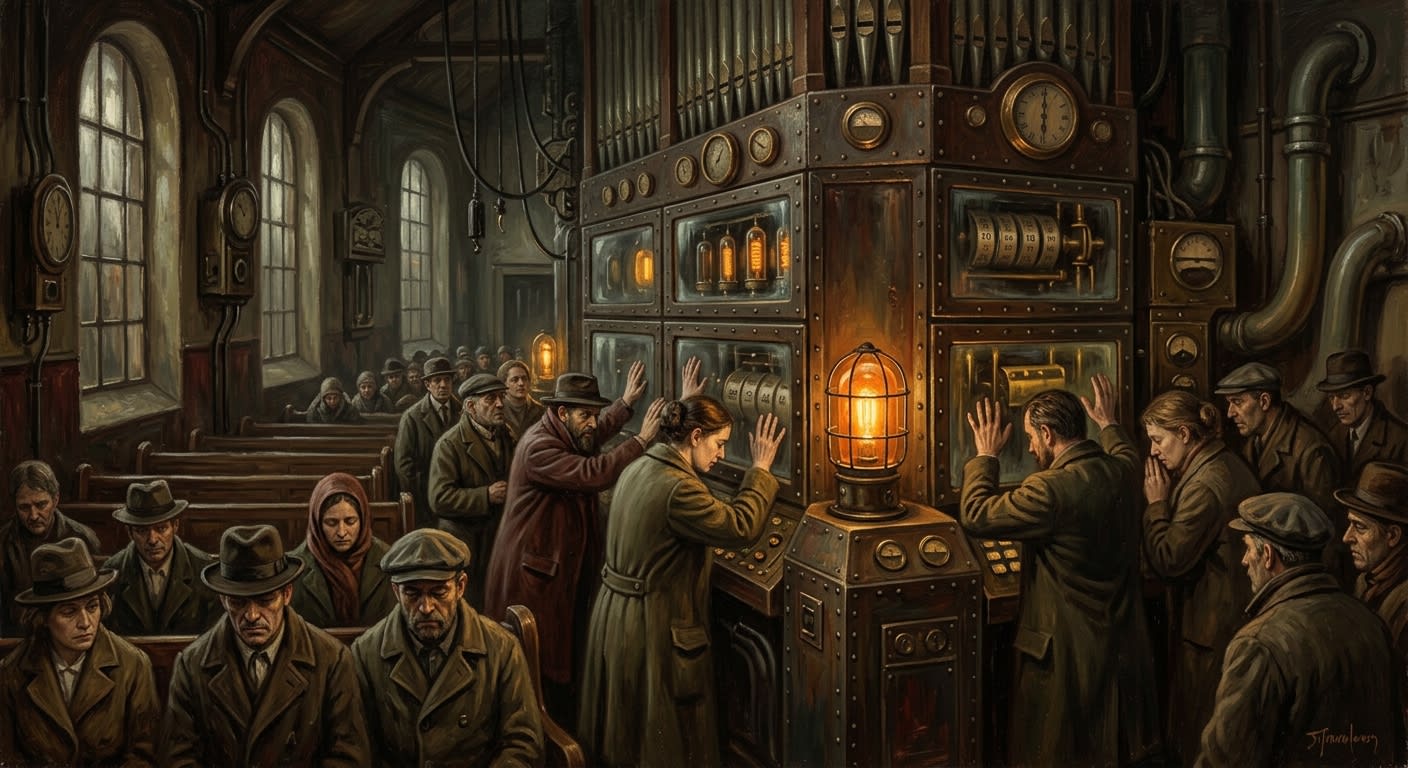
The Sermon Compliance Chapel stands in Strasbourg, near an Orison records annex, wedged between two clerical buildings that look apologetic for having windows. It is narrow-fronted, soot-stained, and carved with ears, tally marks, household tokens, little open shutters, and a row of praying figures whose mouths are open with the obedient vacancy of citizens who know the horn has begun. The tourist calls it small. The Auditor calls it necessary. I call it what it is: a counting room with incense and better blackmail.
It houses the principal relic of Blessed Edrin of the Count, patron of Sky-Sermon Attendance Auditors, Markcounters, sermon-token clerks, and all those grey-coated little mathematicians by whose mercy, cruelty, fatigue, and vocational deformation the Synod determines whether your window opened at the correct hour. The relic is a bone-and-wire counting frame: ten wires, unevenly spaced; yellowed beads; repaired side-bars; newer brass pins; a split along the lower rail where generations of nervous thumbs have pressed petitions against the glass.
The bone is pig. The wire is modern. The frame works.
The Chapel is a place because bureaucracy requires geography. A number may be sacred, a percentage may bite, a district board may bruise purple with public shame, but sooner or later a clerk must kneel somewhere, touch something, lie about why he touched it, and return to his desk with renewed authority to ruin a neighbourhood. The Sermon Compliance Chapel supplies the somewhere.
#On the House Before the Relic
The building predates its fame by several decades and its honesty by none. The earliest stable notice appears in repair accounts attached to the Orison records quarter after Compliance Directive 14-R fixed attendance as allegiance in A.S. 112. Before then, it was a minor listening chapel used by clerks whose work involved signal returns, parish response notices, and the tedious little papers by which the Synod proves that sound went somewhere. Its first name is uncertain. Records prefers Chapel of Lawful Reception. Orison prefers Edrin's Chapel, retroactively. Tithes calls it Asset Window 44-C in two ledgers and pretends not to.
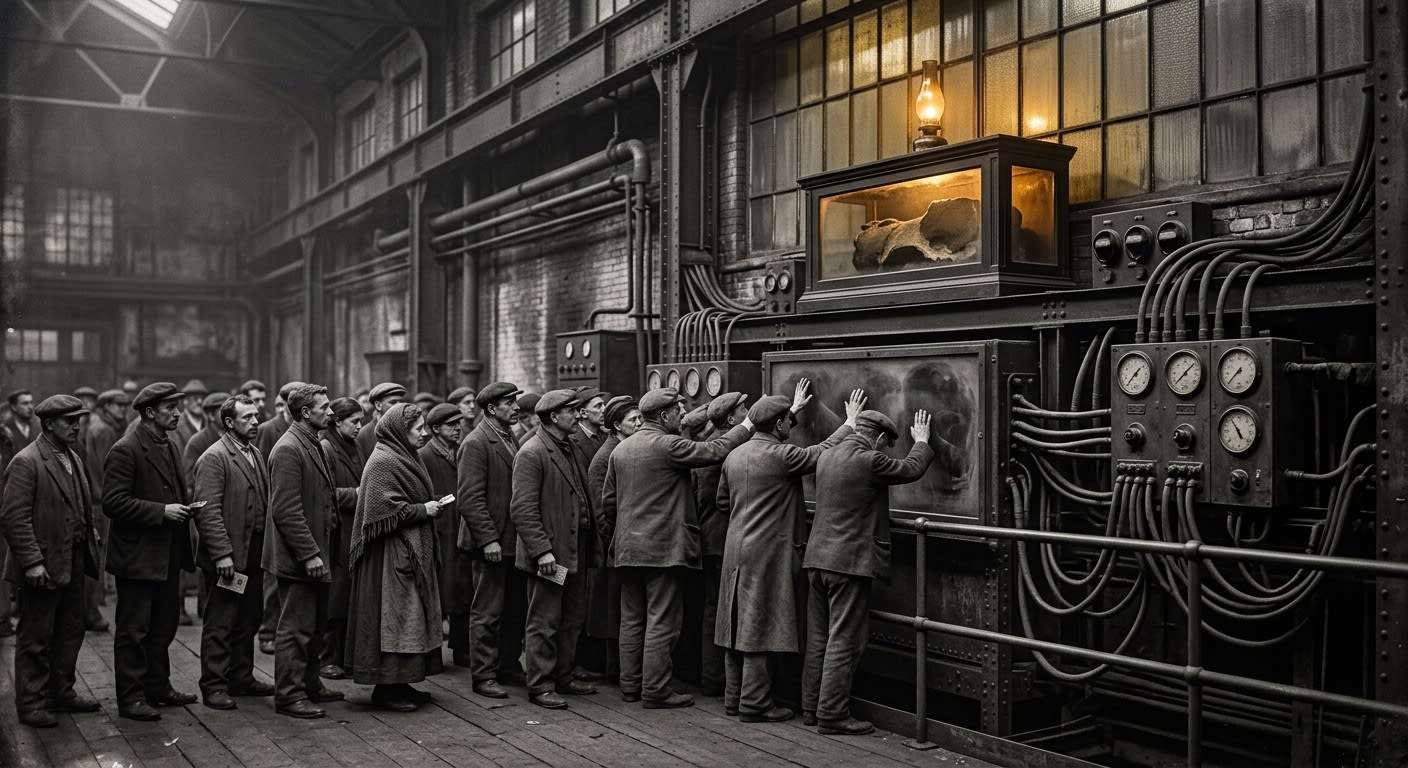
A.S. 117 matters because the oldest stable reference to Edrin sits in a damp-damaged attendance ledger from that year, repaired with doctrinal enthusiasm and the kind of glue that outlives better ideas. By that time, the chapel already had a rear alcove for counting boards, a west wall fitted with token hooks, and a little bell whose tone was described as “sufficiently admonitory.” The phrase belongs to Orison. No human being not employed by Orison has ever heard a bell and thought, with gratitude, that its admonition was sufficient.
The chapel's true rise came after the Metric Sanctification Edict of A.S. 158. Once the Choir Rate became a spiritual health indicator, a place was needed where the number could put on vestments without looking ridiculous. The old listening chapel had the advantages most loved by institutions: proximity, inconvenience, a useful saint, and walls too narrow for large public assemblies. It could be controlled. It could be cleaned. It could be described as ancient without admitting how recently the description had been drafted.
By A.S. 160, instructional sheets were calling Edrin “Patron of Perfect Belief.” By A.S. 161, the phrase had been withdrawn, because even Doctrine retains a little instinct for self-preservation. Belief hides in the skull like contraband. Attendance stands at the window with a token in its hand. The chapel kept the saint and corrected the noun.
Early Orison pamphlets identify the Sermon Compliance Chapel as “the ancient foundation where Blessed Edrin first kept his perfect count.”
Corrected. The building was an Orison listening chapel before it became the reliquary house. Edrin's alleged parish is placed in three northern quarters depending on manuscript, wine, and local fundraising need. The Chapel inherited him because inheritance, unlike truth, can be arranged by key.
#On the Door, the Nave, and the Boards
The west door is shorter than it should be. This forces most visitors to lower the head while entering, a gesture described by guides as humility and by architects as old settlement error. The Synod has kept the error, having learned the pleasing doctrine that accidental bowing is cheaper than carved instruction.
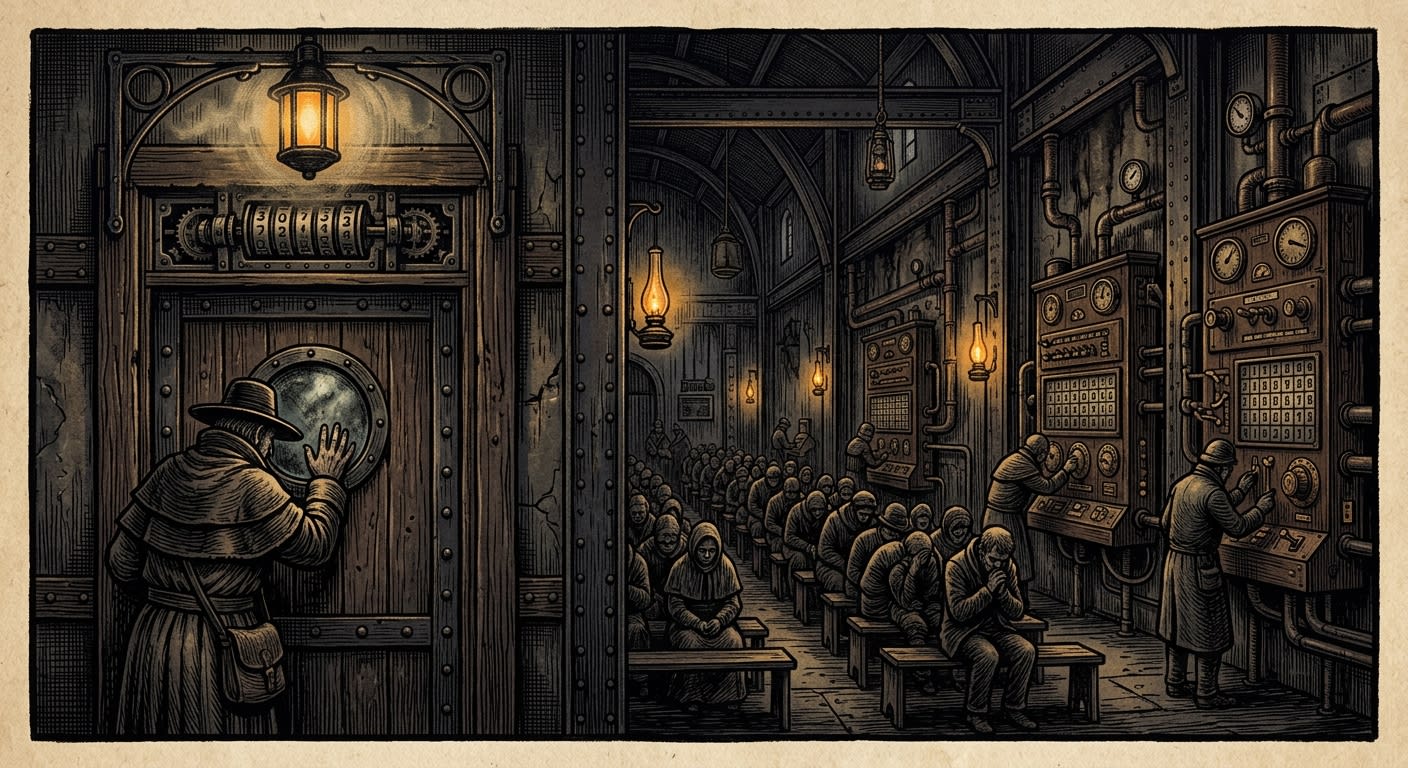
Inside, the chapel is one long room of dark stone, brass rails, soot varnish, and polish applied by guilty hands. The air smells of wax, old paper, rain-damp wool, lamp oil, disinfectant, and the faint hot-metal memory that clings to Brand Authority Officers even when they have come only to pray. The ceiling ribs are painted with listening windows: shutters open, shutters closed, shutters half-latched, shutters marked, shutters branded. Along the north wall hang brass attendance boards displaying model Choir Rates for instructional contemplation. Above ninety-two: Faithful. Eighty-five to ninety-two: Wavering. Below eighty-five: Branded. Below seventy: assembly. Children learn the colours before they learn mercy. That is efficient pedagogy.
The south wall carries petition slots by profession. Auditor. Token runner. Receiver tester. Markcounter trainee. Brander. Mercy Counter — unofficial, naturally; the slot is marked “Pastoral Variance.” Signal engineer. Retired officer. Widow of compliance action. Unclassified. The Unclassified slot is emptied twice daily by a clerk wearing gloves. The Pastoral Variance slot is emptied after dark.
The reliquary stands at the eastern end beneath a glass hood thick enough to stop an enthusiastic palm and thin enough to show the pig bone clearly to anyone impolite enough to recognise it. Two lamps burn before it: one white for exact count, one amber for adjudicated absence. Branders insist the amber lamp was added too late. Mercy Counters insist it has always been there. The maintenance accounts show a lamp bracket installed in A.S. 166 after “heat discolouration.” The Bureau of Doctrine declines to specify which doctrine discoloured first.
Beside the reliquary rests the blank sermon token bowl. No token leaves blank. This is the first lesson.
#On the Pig-Bone Frame
The frame is the Chapel's heart, insofar as a building devoted to attendance may be accused of possessing one. Ten wires run between two side-bars. The beads are uneven: some rounded smooth, some chipped, one with a little flattened face where a pilgrim allegedly pressed a fever token so hard that bone remembered paper. Relics Office sampling in A.S. 186 found porcine material in beads three and seven and wire consistent with late repair stock. The memorandum recommended authenticating function and restricting anatomy. A beautiful phrase. It should be carved over half the reliquaries in Europe.
The Bureau of Relics authenticated the object as a devotional instrument rather than a corporeal relic. This allowed everyone to live. Orison could venerate it. Records could catalogue it. Relics could avoid perjury. Auditors could keep touching the glass. Doctrine could say the word “bone” without saying “finger.” The pig, being dead, could not file grievance.
RELIQUARY SECURITY NOTE — A.S. 186, PRIVATE COPY Public phrase: “bone of the old parish frame.” Forbidden phrases: “saint's finger”; “porcine bead”; “replacement wire”; “livestock devotional continuity.” Observed anomalous property: when disputed counts are spoken aloud within three paces, bead six sometimes █████████████. Instruction: do not test during public observance. Do not permit Branders and Mercy Counters to speak alternating figures after Vespers.
There are stories. Of course there are. A Brander from the south wards swore that bead four moved by itself after he confessed to refusing nine excuses in a cholera stairwell. A Mercy Counter claimed bead seven stuck while he prayed over a rounded 84.7. A token clerk reported hearing a pig squeal during the Feast of the Exact Ear, which proves only that token clerks drink badly. The official position is that beads move only when touched by the officiant. The unofficial position is that everyone watches the beads when figures are disputed.
The frame does not forgive. It does not condemn. It counts. This is why people believe it.
#On the Pilgrim Sequence
The Chapel liturgy is brief because Auditors distrust anything that cannot fit on a slate. The visitor washes his hands at a basin shaped, with unnecessary wit, like an open ear. He receives a blank sermon token. He passes the token under the reliquary glass without touching the frame. The officiant recites one page from Against the Mercy of Rounding, though on high feast days he may choose The Square of Present Bodies if the congregation looks insufficiently miserable. The questions follow.
“What is unseen?”
“Unentered.”
“What is unentered?”
“Danger.”
Then one bead is moved by the officiant only. The token is stamped, marked with the visitor's office, and filed in a side ledger whose columns are themselves audited every quarter. The Chapel counts the counters. Strasbourg achieves symmetry and calls it sanctity.
Apprentices visit before their first field assignment. They arrive in coats still grey enough to believe washing matters, carrying ledger cases stiff from issue, eyes bright with the small cruelty of those who have not yet climbed a winter stairwell toward a grandmother with a dead receiver and no coal. The Chapel teaches them the professional posture: head inclined, token visible, hand steady, pity postponed until after entry.
Senior Auditors visit after sector branding. This is the quieter pilgrimage. They stand longer before the amber lamp. Some pray. Some count the floor tiles. Some ask for the courage to stand by a correct number. Some ask that the correct number not be true. The official rite does not distinguish these requests, because rites survive by refusing detail.
Retired Markcounters visit when sleep fails and the room has become too quiet. They sit in the rear, where Edrin allegedly preferred better sight-lines, and count arrivals with the naked stare of men who cannot stop. The Chapel vergers leave them alone unless they begin stamping their own palms.
#On the Feast of the Exact Ear
The Feast of the Exact Ear is Strasbourg's most efficient holy day, which is to say it resembles an audit with broth. It occurs in late autumn, when windows close against cold, receivers crack, rooftop shrines hiss in damp, and the first seasonal compliance disputes begin breeding in the wards like rats with paperwork. The date varies elsewhere. Strasbourg claims senior usage. Other districts claim local tradition. Records has offered to harmonise the calendar. Everyone has wisely ignored Records.
At first bell, trainees gather in the chapel courtyard while three sermons are played at once from separate horns. One is a doctrinal exhortation. One is a ration advisory. One is a penitential lecture concerning household window discipline. The trainees must record distinct phrases from all three while instructors pace behind them and mark false confidence. False confidence is the first sacrament of youth and the last defence of superiors.
At second bell, senior Auditors file past the frame with ledgers for blessing. Branders touch the glass with two fingers and swear to count without softness. Mercy Counters touch the glass with one finger and swear to hear what is counted. Both oaths are accepted. The Chapel has had long practice taking money from opposed consciences.
At third bell, bean broth and black bread are distributed in the side room. Nobody speaks until the presiding Markcounter counts bowls, spoons, hands, mouths, leftovers, and the number of persons pretending not to want a second serving. Children of Auditor families receive five-bead toy frames. Their parents call it formation. The children call it a toy until the first time they use it to accuse a sibling of stealing crust.
A civic festival guide once described the Feast of the Exact Ear as “a celebration of communal listening.”
Withdrawn after Orison objection. The Feast is an observance of count discipline, relic devotion, Auditor formation, and Choir Rate integrity. Celebration may occur in the side room if broth permits.
#On the Congress Embarrassments
The Chapel attendance ledger is audited every quarter. This has produced several delicious embarrassments, and if the Bureau did not wish me to enjoy them it should not have written them down so neatly.
In A.S. 171, during the Fourth Compliance Congress, a delegate missed the Edrin observance while arguing against environmental adjustment for fog. He claimed the chapel bell was inaudible from his lodging. The excuse was rejected. The rejection travelled through Orison offices like contraband wine. Orison Signal Engineers laughed in the correct register and filed no sympathy. The delegate later voted against the Signal Condition Index with redoubled conviction, proving that humiliation does not always improve a man but frequently improves his usefulness as evidence.
The same Congress defeated the Signal Methodist proposal to append equipment condition to Choir Rate ledgers. In A.S. 198, after the Fifth Compliance Congress defeated the emotional context column, the Chapel received widow petitions and three cracked receiver horns at the west door. One horn still hissed. The verger marked it Noted, not Approved, and sent it to Equipment. Even saints require channels.
#On Branders, Mercy Counters, and the Amber Lamp
The Chapel is neutral in the way a tribunal table is neutral: both sides may place evidence on it, and the wood will not flinch. Branders and Mercy Counters kneel before the same frame. One cites Edrin's fraction. One cites Edrin's ear. One asks permission to sharpen the number. One asks permission to soften it. The bead moves either way, and the officiant writes both names in the same hand.
Branders prefer the white lamp. They stand square, speak loudly, and enjoy words like exact, clean, faithful, threshold, and corrective. Their petitions are short. They ask for courage, firmness, clarity, the strength to reject false tears, the zeal to protect the sacred measure. They leave quickly because doubt smells bad to them and the Chapel has old stones.
Mercy Counters prefer the amber lamp. They stand sideways, as if ready to be interrupted, and tuck petitions beneath approved forms, which is both symbolism and habit. Their prayers mention receiver failure, fever, childbirth, fog, dead sons, coal, broken stair rails, and the specific terror of 84.7. They do not ask to falsify. They ask to hear the room around the number. This is better rhetoric and worse law.
The Chapel sells sanctioned copies of Edrinic maxims to both. Mercy rounds upward; discipline records the fraction. Branders underline the second clause. Mercy Counters underline the first. The shop sells two inks.
#On Deadzone Offerings
The strangest objects arrive from deadzones. Perfect compliance in a designated deadzone is hostile until proven otherwise; the sentence is wise, which explains why it is repeated in manuals like a charm against managerial courage. Auditors who survive such inspections sometimes bring offerings to Edrin's frame: a silent token, a receiver tester stuck at active tone, a scrap of curtain from an open window with no sound behind it, a slate on which every household mark has written itself in the same hand.
The Chapel maintains a locked drawer for these things under the amber lamp. The drawer is opened only by a verger, a Records clerk, and one officer from Purity who pretends to be bored. Items are catalogued, blessed, sealed, and removed through the little corridor. The drawer is never empty. The drawer is sometimes fuller in the morning than it was after Vespers.
The A.S. 199 offering register lists a blank token stamped PRESENT by no known die, a receiver tester emitting compliant tone after battery removal, and a child's frame that held five beads while three witnesses counted six. The file was transferred under black wax. The drawer remained where it was.
This is why retired Auditors sit in the rear. Not because Edrin comforts them. Edrin is not a comforting saint. He is a saint of entry, mark, witness, and the little space between hearing a thing and admitting it can be heard. They come because the Chapel acknowledges the horror in their profession without demanding they name it aloud.
#On the Present Use
As of A.S. 201, the Sermon Compliance Chapel remains active, crowded in late autumn, sour in winter, and most dangerous during Congress seasons. Trainees still receive their first blank tokens there. Senior Auditors still renew oaths after branding. Mercy Counters still slide petitions under the amber lamp. Branders still pretend not to see them. Signal engineers still smirk at the A.S. 171 appeal copy preserved in the teaching case. Records still audits the Chapel ledger quarterly. Relics still avoids the word pig.
The Chapel is small enough to be missed by anyone touring Strasbourg for grandeur. This is proper. Grandeur is for basilicas, triumph halls, martyr plazas, and other rooms where the Synod teaches citizens to look upward. The Chapel teaches the opposite discipline: look at the window, the token, the bead, the mark.
At the east end, under glass, the frame waits. The white lamp burns. The amber lamp burns. The visitor answers what is unseen and what is unentered. The officiant moves one bead.
Then the ledger opens.