

#On the Number That Learned to Bite
The Choir Rate is the percentage of registered households in a sector that demonstrably attended the most recent Sky-Sermon broadcast. Demonstrably is the knife hidden in the catechism: token collected, window opened, receiver tone confirmed, body seen, excuse adjudicated, ledger marked. The Synod does not ask whether the sermon entered the heart. The heart is damp, evasive, theatrical, and poorly ruled by ink. The Synod asks whether the ear was present when authority descended from the horn.
Before A.S. 158, the Choir Rate was an administrative figure. After the Metric Sanctification Edict, it became a spiritual health indicator, which is to say a number with canon-law teeth, ration consequences, and enough doctrinal perfume to make arithmetic smell like incense.
The rate governs the small mercies by which ordinary life is permitted to continue: ration priority, curfew duration, inspection frequency, Purity attention, forced assemblies, chapel favour, repair order precedence, and the amount of contempt a clerk may place into a household notice without overstepping format. Above ninety-two percent, a sector is Faithful. Between eighty-five and ninety-two, Wavering. Below eighty-five, Branded. Below seventy, dragged into forced-assembly sermon until ears ring, children vomit, and the compliance board recovers its manners.
#On Its Administrative Birth
The Choir Rate was born from a blunt institutional terror: the Synod could speak across Europe and could not prove Europe had listened. The Bureau of Orison and Song had tower-horns, relay wagons, rooftop shrines, Bellway repeaters, and, in later years, armed reliquary-dirigibles capable of pouring licensed sermon across streets, harbours, trenches, markets, chain-booms, and fish who had never requested theology. Sound went out. Reports came back late, partial, scented with local invention.
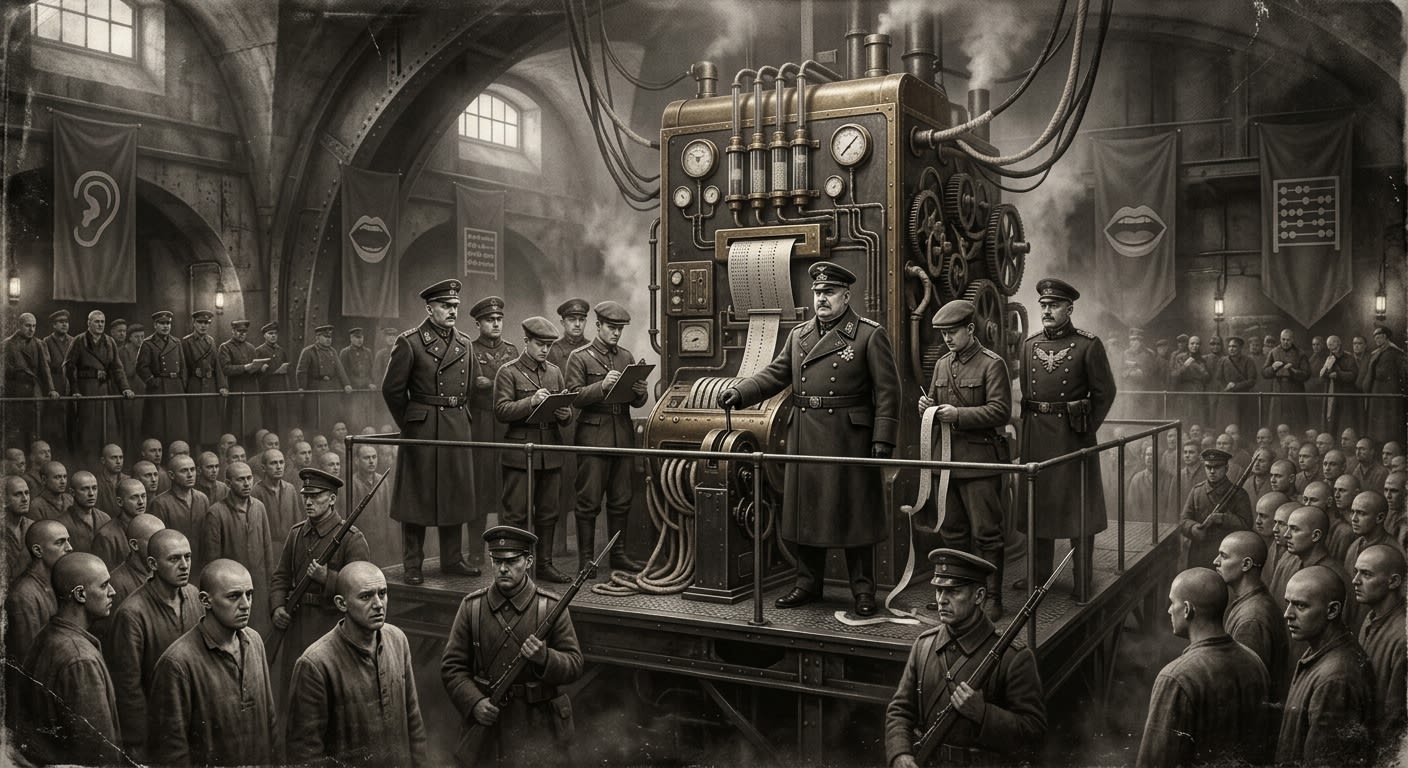
Compliance Directive 14-R, issued in A.S. 112, supplied the first hard rule: attendance is allegiance. The phrase looks plain until one holds it against a poor quarter in winter. A closed window became an argument. A missing token became suspicion. A broken receiver became, if the assessor was hungry for advancement, a soul defect.
The early Choir Rate belonged to practical governance. Ward offices needed to know which streets ignored the Orison Hour, which stairwells failed to open, which cellars had become convenient pockets of private thought. Numbers appeared on boards. Citizens learned the colour of their street's obedience. The system was cruel, useful, and still technically secular in the way a cudgel is secular before a priest blesses it.
Several training summaries state that the Bureau of Bells authored the Choir Rate system because bells marked the listening windows.
Corrected. Bells marked time and grumbled. Orison built the metric, Tithes discovered its fiscal uses, Doctrine consecrated the wound, and Records filed the same act under Liturgy and Revenue without blushing. The Bureau of Bells has requested removal from this paragraph. Request denied for historical seasoning.
Then came A.S. 158. Orison and the Bureau of Tithes issued the Edict. Compliance scores became spiritual health indicators. Adjustment of Choir Rate data became falsification of sacred measure. A ward number entered the sanctuary wearing boots, and the sanctuary made room.
#On the Calculation
The calculation is simple enough to teach to a tired clerk and cruel enough to ruin him by increments. Registered households form the base. Verified attendance forms the numerator. Excused absences may be removed, deferred, discounted, or turned into suspicion depending on category, local instructions, factional sympathy, and whether the Auditor had breakfast. The result is posted to one decimal place in ordinary sectors and two decimals in contested districts, where decimals become little bayonets.
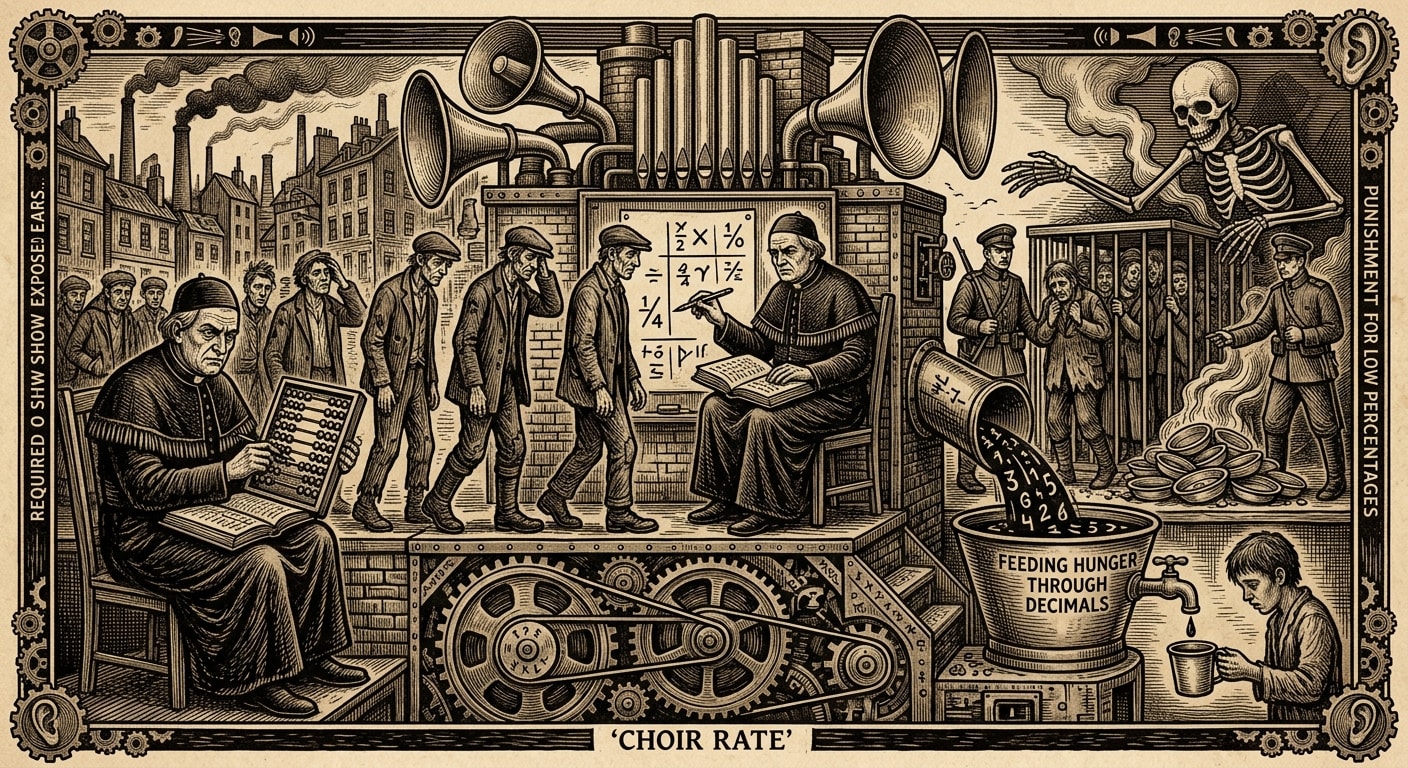
Verification comes by three lawful signs. First, the household token, stamped after broadcast and surrendered to the runner. Second, the open-window mark, observed by the Sky-Sermon Attendance Auditor or assistant Markcounter during the listening window. Third, receiver-tone confirmation, measured by portable testers that detect whether the sermon reached the household apparatus. Each sign lies in its own way. Tokens can be forged. Windows can open onto empty rooms. Receivers can hiss obediently while the family crouches in the pantry humming contraband lullabies into sleeves.
The excuses are graded with devotional meanness. Approved preserves the household entire. Noted preserves it with a warning scent. Suspicious waits like a rat behind the wainscot. Heresy-Adjacent invites visitors.
The Environmental Adjustment Protocol exists for fog, storm, horn failure, relay collapse, shrine outage, drowned wire, receiver rot, and other conditions by which the sermon fails to arrive while the household remains technically damned by arithmetic. Four thousand invocations followed the Fog Weeks. Seven were approved. This is not a failure of the Protocol. This is the Protocol performing its true function: providing a form on which mercy may exhaust itself.
#On Thresholds and Their Uses
Ninety-two percent is the great bright lie. A district above it can be called Faithful by men who have never entered its alleys and never heard what its residents mutter after the horn shuts its brass mouth. Eighty-five to ninety-two is Wavering, a limbo suited to sermons, inspections, and cowardly supervisors. Below eighty-five, the Brand comes out: bruised purple on the compliance board, public notice, ration priority lowered, curfew lengthened, Purity copied. Below seventy, the district is marched into sound.
Forced-assembly sermon is an engineered humiliation. Residents gather in a square, factory yard, chapel shell, railway shed, or whatever open cavity the Bureau can fill with bodies. Horns are brought forward. The supplementary broadcast runs three hours. The Bureau of Engineering calls the volume pastorally assertive. Citizens call it many things, most with blood in the vowel.
The Choir Rate also disciplines the Auditor. A district that falls too low implicates its Markcounter. Did he miss a cell? Did he accept weak excuses? Did he fail to mark a deadzone? Did he permit mercy to rot into politics? Supervisors read the number upward and downward at once: the district's soul below, the Auditor's competence above. This is how a decimal becomes a noose with two necks.
Public primers describe the Choir Rate as a “measure of communal devotion.”
Corrected for internal use. The Choir Rate measures exposed attendance to authorised sound. Devotion may occur, but so may fear, deafness, exhaustion, bribery, token fraud, rain, childbirth, and the old woman on the fourth landing who opens her window only because her grandson needs bread.
#On Blessed Edrin's Beads
A number made sacred requires a face, preferably one already too dead to object. Blessed Edrin of the Count provided the face: quill in one hand, counting frame in the other, mouth open in eternal sermon, eyes fixed upon a tally that never ends. His earliest stable reference appears in an A.S. 117 attendance ledger damaged by damp and repaired by pious opportunists. By A.S. 158, he had become useful enough to be venerable.
His relic sits in Strasbourg's Sermon Compliance Chapel: ten wires, pig-bone beads, modern repairs, velvet cushion, glass hood, and more honesty than most reliquaries can manage. Auditors pray before it before examinations. Branders cite his fractions. Mercy Counters cite his ear. Tithes cites his counting. Orison cites his open mouth. Doctrine cites whichever Edrin currently wins the argument.
The Feast of the Exact Ear brings Markcounters to the chapel in grey coats, carrying ledgers for blessing. They file past the pig bone, touch the glass, and swear to count without softness. Some mean it. Some have already rounded three districts upward that week and will do so again before Compline. Saints endure hypocrisy better than living supervisors. Their promotion prospects are safer.
#On Factions Around the Number
The Choir Rate produced three factions, of which two exist and one exists more loudly because it has been denied. Branders treat the number as sacrament sharpened into law. They publish clean rates, reject excuses, brand early, and sleep with office doors barred against the gratitude of their districts. Their virtue is accuracy. Their sin is accuracy without shame.
Mercy Counters commit arithmetic tenderness. They approve the doubtful excuse, round 84.7 into a meal, postpone suspicion until the receiver inspection finishes, and treat duplicate tokens as confusion rather than conspiracy when the children look thin enough. Their virtue is mercy. Their sin is that mercy after A.S. 158 is no longer a feeling but a falsified religious artefact with soup attached.
The Signal Methodists wanted the number to stand beside the condition of the apparatus that produced it. Horn reach. Relay integrity. Receiver function. Shrine uptime. Weather impedance. Deadzone risk. The proposal was modest, technical, sane, and lethal. It implied that failure might belong to infrastructure instead of souls, which is a thought every Bureau permits itself privately and executes publicly.
Their defeat preserved the number's purity. A pure number need not ask whether the horn broke. It need only ask whether the district heard. If the horn broke, the district should have heard obedience through other lawful means, such as devotion, neighbourly reinforcement, or fear. The theological elegance is impressive if one has first removed the poor from view.
#On Fraud, Mercy, and the Signal-Lie
Every measurement breeds its counterfeit. The Choir Rate has forged tokens, paid runners, borrowed children, staged windows, bribed Markcounters, false receiver hiss, dead men counted present, sick women propped near shutters, and the signal-lie device: a palm-sized box that mimics the faint obedient sound of an active broadcast. The signal-lie is punishable by erasure. Its prevalence is statistically inconvenient, which is Records speech for everyone has seen one and no one wants to print the estimate.
The Bureau calls these acts fraud. The street calls some fraud and some survival. A mother who opens a window over an empty room while her fevered child sleeps in the cellar has falsified attendance. She has also kept the child away from three hours of horn-volume scripture. The distinction matters to the Creator. It matters less to the Auditor's column.
Mercy Counters exploit the blur. Branders burn through it. Signal Methodists tried to measure it. Tithes prices it. Purity waits for it to become useful. Orison sings over it with a brass mouth.
COMPLIANCE INVESTIGATION — LOWER KANZLEIBURG, A.S. 189 Household tokens valid: 612. Bodies observed: 487. Receiver confirmations: 609. Mouths moving during inspection: 611. Audible sermon at street level: none. Secondary sound in receiver static: █████████████████ Final Choir Rate posted: 93.4%. Disposition: block sealed; population revision pending.
#On Deadzones and Perfect Obedience
A deadzone should lower the Choir Rate. Horns fail; receivers rot; tower shrines go mute; thick walls swallow the Orison Hour; the district misses the Word and sinks. This is the clean model, and like most clean models it should be handled with tongs. Deadzones sometimes produce perfect compliance. Every window open. Every token present. Every body still. Every mouth moving. No sound.
Perfect compliance in a deadzone is treated as hostile until proven otherwise. This rule is one of the few wise sentences in the compliance manuals, having been written after enough inspectors returned pale, mute, or not at all. Silence fills. The absence of Orison does not remain absence for long. Private prayer arrives first, then unlicensed melody, then cells, then the thing in the static that knows the names of the listeners and pronounces them with a grammar no living parish taught.
The Choir Rate cannot distinguish a faithful crowd from a captured crowd if every sign aligns. This is its wound. It counts attendance, not allegiance; exposed ears, not obedient souls; mouths moving, not words spoken for the right master. Doctrine knows this. Doctrine also knows that admitting it would require replacing the whole blessed apparatus with discernment, and discernment is slow, expensive, and difficult to print on a board.
#On the Present Use
As of A.S. 201, the Choir Rate remains the Synod's preferred measure of public listening in every major Orison district, Line rear-town, pilgrimage corridor, industrial ward, bastion quarter, harbour, and square unfortunate enough to possess a horn. It travels through ledgers into ration schedules, through ration schedules into kitchens, through kitchens into tempers, through tempers into riot predictions, and from riot predictions back into sermons. The circle is closed, stamped, and hungry.
The Fifth Compliance Congress of A.S. 198 defeated an emotional context column. This was inevitable. Emotional context would have allowed grief, fear, mourning, exhaustion, weather, and the little local catastrophes by which human life continually insults clean arithmetic. The Choir Rate admits a body, a token, a window, a tone, a stamp. It does not admit that the body was burying someone, that the token runner lied from kindness, that the window opened onto a room where nobody could bear another sanctioned voice.
A good rate keeps the board clean. A bad rate summons correction. A perfect rate draws quiet suspicion from the few auditors not yet gone to numbers. The wisest districts hover just above ninety-two, faithful enough to eat, imperfect enough to remain plausible.