

#On the Survey and Its Counts
This survey records the Seventh Line repair sequence as it is taught, recited, worked and audited among licensed Gasket-Hymn Mechanics in A.S. 201. It concerns present practice only. It does not claim to know who first set the sequence down, in which year, or what its complete original words were. On those questions the archives are as quiet as a well-paid witness. Where the practice disagrees with itself, the disagreement is entered here and left untidied.
Four numbers attach to the sequence, and clerks who have never held a torque key mix them up with the regularity of a bell. There are nine operations. There are seven liturgical lines of the Boundary Litany, and the last of them gives the sequence its name. In the account of Saint Orla, the flange at Seal Seven had eight bolts. Seal Seven is the name of that installation and is not a count of anything. No step is missing, and the eighth prayer that some chaplains go hunting for has never existed. An inspector who pairs seven lines against nine operations, or against eight bolts, has mistaken arithmetic for theology. Of the two heresies, that is the more common.
#On the Nine Operations
The sequence in its full numbered form runs: Diagnose; Cleanse; Align; Seat; Sing or Recite; Torque; Seal; Verify; Document.
Diagnosis reads the failure: the pattern of the leak, the witness marks left by the last hand, and the smell of counterfeit rubber. Every senior mechanic claims to detect that smell, and every stock clerk claims it does not exist. Cleansing strips old wax and contamination with solvent and chalk salt. The trade calls this erasing the lie, and the trade is right, because residual wax in a groove is a lie the flange will tell later, at a worse hour. Alignment sets the pins and the flange and checks for warp under heat. Seating places the gasket without twist and in its proper orientation. Recitation supplies the timed lines. Torque proceeds in the star pattern and leaves chalk witness lines across bolt and flange. Sealing applies the wax stamp, the purity tag and the signature. Verification puts the work under pressure and vibration and listens for knock-back. Documentation enters the work, the materials used and the names of those who watched onto the rite sheet.
A shorthand passed among apprentices puts seating before alignment. It is only shorthand. The numbered sequence governs, and a gasket seated on a misaligned flange is a rumour of a repair.
The fifth and sixth operations are numbered apart and performed together. The lines are timed to the torque steps, so the mechanic does not finish speaking, catch a breath and only then take up the key. The voice sets the pace for the hand, and the hand gives the voice something to answer. Doctrine says the recitation sanctifies the tightening. Engineering says it stops frightened men from rushing. Both statements sit in the files, and only one of them has ever been measured.
The work produces three kinds of witness, and the Bureau, which loves witnesses more than seals, keeps them carefully apart. The chalk line proves the bolts did not move after marking. The wax and purity tag prove whose stock and whose authority were used. The people named on the sheet prove that someone was present to be blamed.
#On the Closing Turn
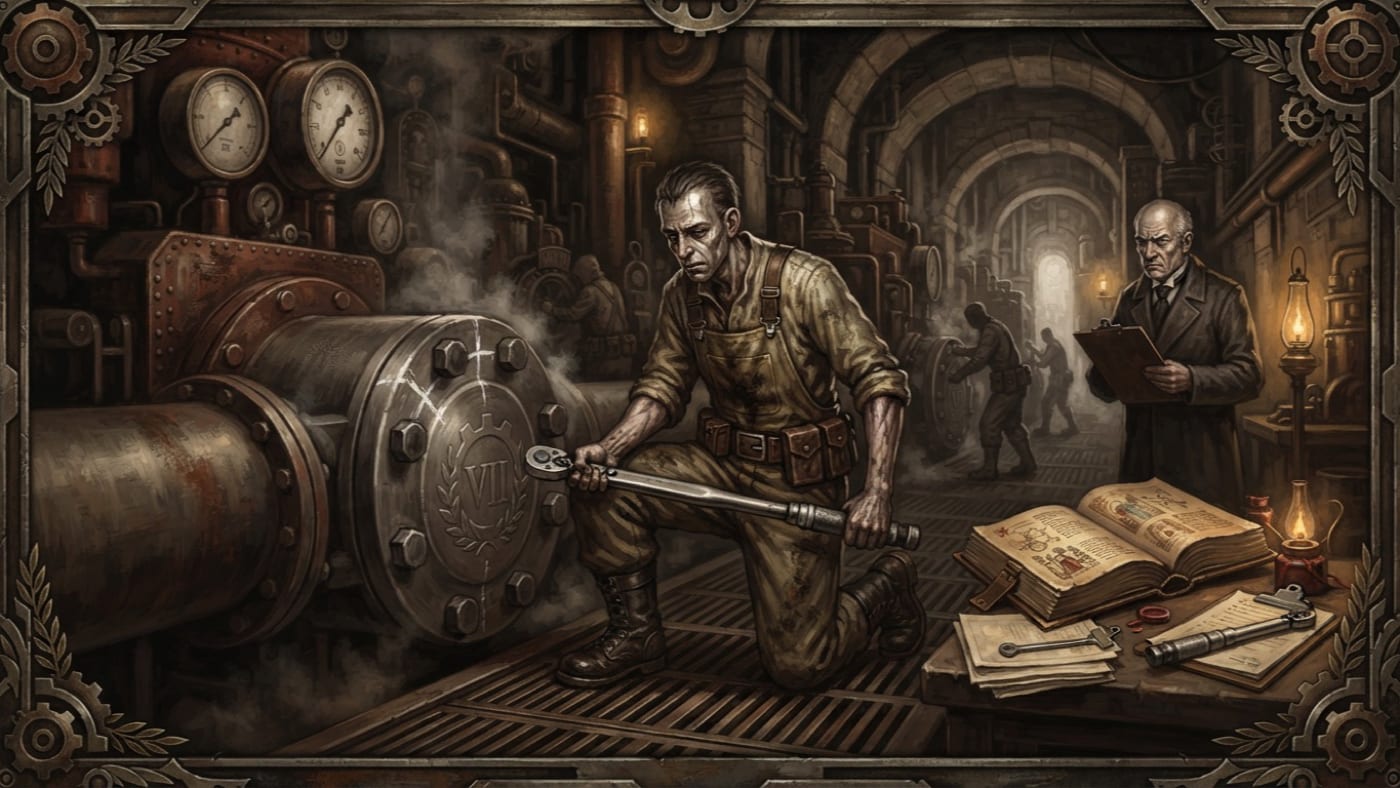
For critical hymn-gaskets in wet, cold or vibration-troubled conditions, the tightening follows the Bureau of Engineering's named specification, the Orla-Seven torque pattern. It runs three light passes, one listening pause, two opposing seats, and a final quarter-turn under the closing line. The Seventh Line is spoken over that last quarter-turn. Then the key comes off and the mechanic goes on to seal, verify and document. A repair does not end where the poetry does.
The listening pause is part of the pattern. I have found its length written nowhere, and I will not invent one for the examiners' convenience. During the pause the mechanic listens to the flange. What the flange says is a matter for Engineering. What the mechanic may do in answer is a matter for Standing Order 14-Q. A pause to listen does not give the hand leave to edit the rite.
The public form of the specification states no torque values, and this survey adds none. Values belong to the device, the stock, the bench and the master. A doctrine article that printed them would have killed someone by Lauds.
"The Seventh Line is the last phrase of the full repair sequence, spoken only after diagnosis, cleansing, alignment, seating, recitation, torque, seal, verification, and documentation have bound the repair to the Ledger."
— as given in the dossier of Saint Orla of the Seventh Line.
That wording is the devotional reading, in which the line closes the whole labour. The technical account follows the Engineering Specification: the closing line goes with the final quarter-turn, and sealing, verification and documentation come after it. Nothing appoints a second recitation after the paperwork, and no turn is to be held back until the rite sheet is signed. Both statements are still in circulation. Only the second belongs in the hand.
#On the Example Made of Orla
The sequence borrows its patron. It does not owe her its birth. The official Life's date has been spoiled by water and by clerks, so the year is my own assignment: Orla died at Seal Seven in the engine works of old Metz in A.S. 132. She completed a repair that held the pressure behind the western door and the low ward sleeping beyond it. Doctrine canonised her in A.S. 162, thirty years after the flood. Engineering attached her name to the tightening pattern after that. None of these years says when the sequence was first issued. A chaplain who cites the flood as its founding charter is citing a funeral as a patent.
The miraculous material belongs to the witness record. Wax-Hand Jerun Pell testified that the pipe knocked at the Sixth and the water paused at the Seventh. He said the key fused to her palm, and that the chalk ran across her thumb and the flange in one unbroken stroke. That is testimony, attributed and venerated. It is not a result. No apprentice who speaks the Seventh Line is promised that water will wait. A seal that holds proves that the repair was completed, and it proves nothing about whatever else may have been present.
The Split-Ring Disaster of A.S. 164 at Bastion-Przemyśl gave the sequence its present teeth. A cleansing verse was shortened, residual wax stayed in the grooves, and forty-three men died across seventeen engine pits. Operational Classification 7-G and the Sabotage Reforms followed. After 164 the craft's insistence on finished work and finished paper hardened into law. The reforms did not invent the sequence. They gave auditors a reason to read it.
#On Examination and Dispute
Masters test candidates on the closing turn while the room is made to work against them. By report, a Hymn-Gasket Master shakes the bench, calls false readings off the gauge, and makes a dry shed as unpleasant as a flooded chapel can be. A candidate who stops speaking fails. A candidate who finishes too fast also fails. A candidate who keeps the line steady, watches the gauge and brings the final turn under control may be trusted with work that kills the impatient. The test examines attention. It does not test sanctity, and to their credit the examiners do not ask candidates for visions.
From Orla, the Line-Purists teach that every line is owed and every operation must be completed: she did not skip, so you will not skip. From the same woman, the Field Pragmatists teach that she knew which words held the ring and spent her breath accordingly. Both factions read a drowned mechanic's private intention from the outside of her body. Neither has her deposition.
Standing Order 14-Q was revised in A.S. 199. Under the revision, any change to the sequence needs prior written authorization from a district Hymn-Gasket Master. In the accounts before me, spoken permission does not count, and neither does permission granted after the fact. A Pragmatist in a rupturing pit must choose between the manual and the crew, and must find a district Master with ink in time to make that choice lawfully. That is the present law, from the engine chapels of Przemyśl to those of Bastion-Irongate. I record it.
#On the Recorded Completion
The closing line is spoken and the key comes off the bolt. Then the wax goes down hot, the purity tag is fixed, and the signature goes where an auditor will later find it. The work is pressured, shaken and listened to. The rite sheet receives the materials and the names of the watchers. Inspectors check wax and witness marks first and rite sheets second, then compare the torque pattern against the vibration damage. They love a missing line. They love a missing signature more, because a missing line needs a hearing and a missing signature needs only a pen.
Doctrine calls the completed sheet evidence of obedience. The mechanic calls it the part that lets her sleep. Both are written on the same paper, in different hands.