

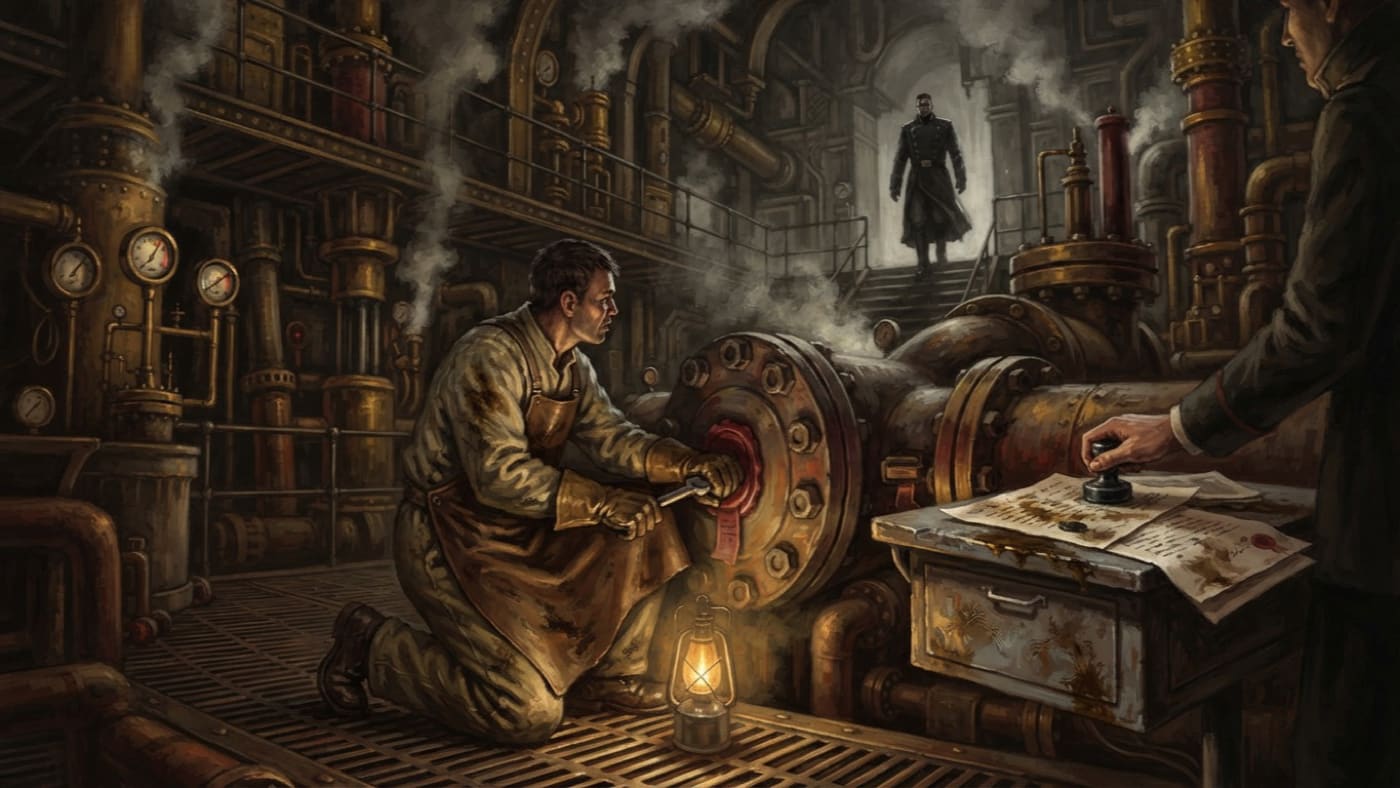
#On the Repair Entered as Sabotage
A seal can hold and still be a crime.
The Sabotage Reforms are the rules of A.S. 164 under which every repair to a critical seal must exist twice: once in rubber and iron under the mechanic's hands, and once on paper in the vaults of the Bureau of Records. They were built on Operational Classification 7-G in the same year and are enforced by the same offices. The Bureau of Engineering holds the craft. The Bureau of Doctrine holds the verse. Records holds the sheet, and the Bureau of Purity holds whoever the sheet fails to protect.
The doctrine is short enough to chalk on a gallery wall. A seal that holds and a repair that is lawful are two separate facts. Pressure establishes the first. A rite sheet filed in triplicate establishes the second. Where a critical seal has no sheet, the law enters the repair as sabotage, whether or not anyone ever took a blade to it.
#On the Forty-Three and the Commission
The occasion was the Split-Ring Disaster at Bastion-Przemyśl. A senior mechanic in the lower works was three weeks into double shifts when he shortened the cleansing verse on four repairs. The shortened verse dropped the salt-chalk scour. Old wax stayed in the grooves, and the new gaskets, which were standard, purity-certified and sound, sat on a ridge no lamp could show. Seventeen engine pits failed over nine hours. Forty-three workers died. The western pylons of the Wire Orchard lost power for eleven hours.
The safety case deserves its full weight here, since the Bureau gives it no other kind. The skipped cleansing was real, and so were the false seats. The men who froze to the metal after the heating manifolds failed did not die of theology. Anyone who calls the Reforms simple bureaucratic spite has never stood in a gallery after a seal let go.
The commission also recorded a fact that no reform could legislate away. A pressure door, seated in full sequence by a different hand, failed as well, because the shock coming through the wall was more than it was built to bear. Full compliance did not save it. Nobody found a saboteur. The word reached the law from the fears of the previous year, after the Unhymn Infiltration at Bastion-Shipka taught the Line to suspect hostile work at its joints. At Przemyśl it entered as a legal category with no culprit attached.
The joint commission of Engineering and Doctrine issued 7-G first. It licensed the Gasket-Hymn Mechanic and made the nine movements mandatory, in order. The Reforms then extended full documentation to every critical seal on the Line. The first instrument told the mechanic what to do. The second told the mechanic how to prove it had been done.
#On the Proof Required of a Seal
The Reforms do not cover every gasket. A washer on a latrine drain can fail with no consequence worse than the smell, and the law leaves it to ordinary diligence. A critical seal is a gasket whose failure can spread to an adjacent system: one manifold to the next, a manifold to a door, a door to the gallery of sleeping workers behind it. That is the Przemyśl chain, defined as a category.
For each such seal the Reforms require five proofs. The verse must be recited. A witness must be present. The torque sequence must be confirmed. Purity wax must be applied and stamped. The rite sheet must be filed in triplicate with the Bureau of Records.
Follow an ordinary repair through them. The mechanic diagnoses the weeping joint, then cleanses it, scouring the groove with salt-chalk until the old wax lifts and bare metal shows. Pins align the flange faces. The ring is seated dry. Recitation starts with the work and runs through it, and the lines of the verse set the star pattern of the torque key. The enumeration lists recite and torque as separate movements, but no competent mechanic finishes singing before touching the bolts. When the last bolt is drawn down, chalk-white witness lines are painted across each bolt head and onto the flange. Then come the seal iron, the wax and the stamp. Verification is a pressure test, a vibration test, and an ear laid against the warm iron.
Then comes the ninth movement, the one the law cares about most. At the end of a shift, with greasy fingers and a stub of pencil, the mechanic writes down the verse used, the stock and its purity number, the torque record and the name of the witness, who countersigns. This takes three copies. The Reforms require them filed with Records. They do not require anyone to tell the mechanic where the copies go afterward, and Records has never offered.
These materials obey a separate law. The Seal Standardisation Edict of the same year decides which resonance materials may go into a joint, and the Reforms decide what account must come out of it. A substitution permitted under the Edict does not release the substitute from the sheet.
#On the Finding Called Sabotage
A failed or questioned joint can land in three different columns, and the Reforms only make sense if they stay apart.
The first is interference. Someone cut the ring, mismarked the stock or set the pins a hair out of true. The trade calls this a knife hymn. A Sabotage Reader is sent for, examines the joint, records a finding and sentences nobody. If a hand is involved, the matter goes to Purity.
The second is procedural failure. An unauthorised shortening of the sequence is a sequence breach. It is a serious charge, the very fault that killed the lower works, and it is still distinct from sabotage in the law's own wording.
The third is documentary absence. A critical seal was repaired, and no sheet exists to prove it. This is the column the Reforms invented. A Reader can open such a joint, find a clean groove, an even crush and unbroken chalk, report that nobody tampered with anything, and still have to enter the repair as sabotage. The shadow mechanics working in curfew hours put repairs in this column every night. Some of those repairs hold for years. The tribunals do not ask whether they held.
The reverse case also stands. A seal repaired in full sequence, with every stamp and signature, can lift under a load it was never built for, as the Przemyśl door did. That counts as a lawful failure. The dead get no extra compensation for the paperwork being in order.
No single sentence attaches to these findings. A tribunal chooses from a familiar list: demotion to wax hand, reassignment to the trenchline generators, penance, immurement. The list is the same in every column. The likelihood of being placed in each column is not. Nothing on the rite sheet records the supervisor who scheduled the third week of double shifts, or the crate of stock that came two days late. The sheet names the person holding the key, and that person is the one the tribunal can find.
#On Wax, Schools, and the Later Orders
Once the stamp had become proof, stamps became valuable. In shortage months at Shipka and Bastion-Irongate, a mechanic with a weeping seal had two choices: an unstamped repair, which was sabotage by law, or a stamp of doubtful origin, which was a crime as well but at least a quieter one. The Counterfeit Wax Plague of A.S. 178 grew out of this. The false wax passed the Engineering assay and held its joints. Its only fault, by Doctrine's specification, was that nobody had sung over it during manufacture. Purity immured fourteen suppliers at Przemyśl, and the counterfeit wax was back within six months.
Doctrine answered with living-hymn authentication. A Bell-Accountant lays a tuning fork on the hardened wax and pronounces it true or false. Whether the wax holds any memory of the song is a claim the Bureaus make and this office files without endorsing.
Devotional summaries, and this office's own early plate on the disaster, list Bell verification of wax among the requirements of the Sabotage Reforms.
Corrected. The five proofs of A.S. 164 required a stamp and did not test it. The tuning fork arrived after the Plague of A.S. 178, once the Bureaus discovered that a stamp proves only that someone owns a stamp.
The craft's schools divided over what the Reforms were for. The Line-Purists read the settlement as proof that the sequence is indivisible: a verse was cut and forty-three died, so no verse may ever be cut. Their discipline catches tired hands, rejects reused rings and turns away doubtful sheets, and in planned maintenance their work is the best on the Line. Doctrine favours them, and they run the training benches and the audit boards. The Field Pragmatists separate the movements that touch the joint from the repetitions that only touch the paper, and they change their order of work when a pressure door is singing through its bolts. Engineering prefers them privately and never in writing.
Writing is where the later law settled things. Standing Order 14-Q, in its A.S. 199 revision, requires prior written authorisation from a district Hymn-Gasket Master for any change to the sequence. Verbal and retrospective authorisation are both inadmissible. An older plate of the 164 settlement mentions retroactive compliance under sealed dispensation. The present order shows no such tolerance, and the present order is the one in force. Nothing from A.S. 199 should be read back into the five proofs of A.S. 164.
#On Present Application
As of A.S. 201 the Reforms are in force across the Line, and nowhere do they press harder than at Irongate, the fortress in the Danube gorge that breathes through its pressure doors while the Gasket Choir keeps its resonance seals in voice. Almost every joint there counts as critical, because almost every joint has a neighbour.
Picture a door seal weeping during the Third Watch. The mechanic has a torque key, a wax sleeve and a rite card gone soft with steam. The witness is two galleries away. The mechanic can wait and let the gallery go cold, or run all nine movements with the gauge climbing, or seat the ring now and deal with the paper afterward, which the law already names. The audit will come in daylight, read the stamps first, then the sheets, and then find the mechanic.