

#On the Seal and Its Charge
Seal Seven is a joint. I say this first because the devotional trade has spent seventy years forgetting it. Before it became a station of the cross for mechanics, and before it gave its number to a saint's epithet, Seal Seven was the critical seal on an old pressure conduit in the lower engine chapel of old Bastion-Metz, a rear fortress and supply-bastion in the western supply country. The conduit fed the western pressure door. The door held back water from a low ward of sleeping families, condemned labourers, and children lodged on ration debt. An apprentice can recite the chain in one breath, flange to ring to eight bolts to door to ward, and every name in the rescue ledger hung on it.
The account describes the conduit as rebuilt over pre-Synodal stone, patched through three wars, and blessed under four incompatible rites. I have no names for the wars or the rites. The Bureau of Records has none either, which has never once stopped Records from having opinions.
Three terms must be kept apart, because the faithful merge them and the auditors exploit the merger. Seal Seven is the Metz seal and its repair station. The Seventh Line is a closing liturgical phrase associated with Saint Orla. Orla-Seven is a tightening specification the Bureau of Engineering later issued under her name. A mechanic who confuses the three is corrected by his examiner. A preacher who confuses them is promoted.
#On the Repair at Metz
The incident is assigned to A.S. 132. That assignment is mine, published under my seal. The official Life's own year is damaged, and I will not pretend a drowned folio says what it no longer says. No day, month, or river name survives in any form I would sign.
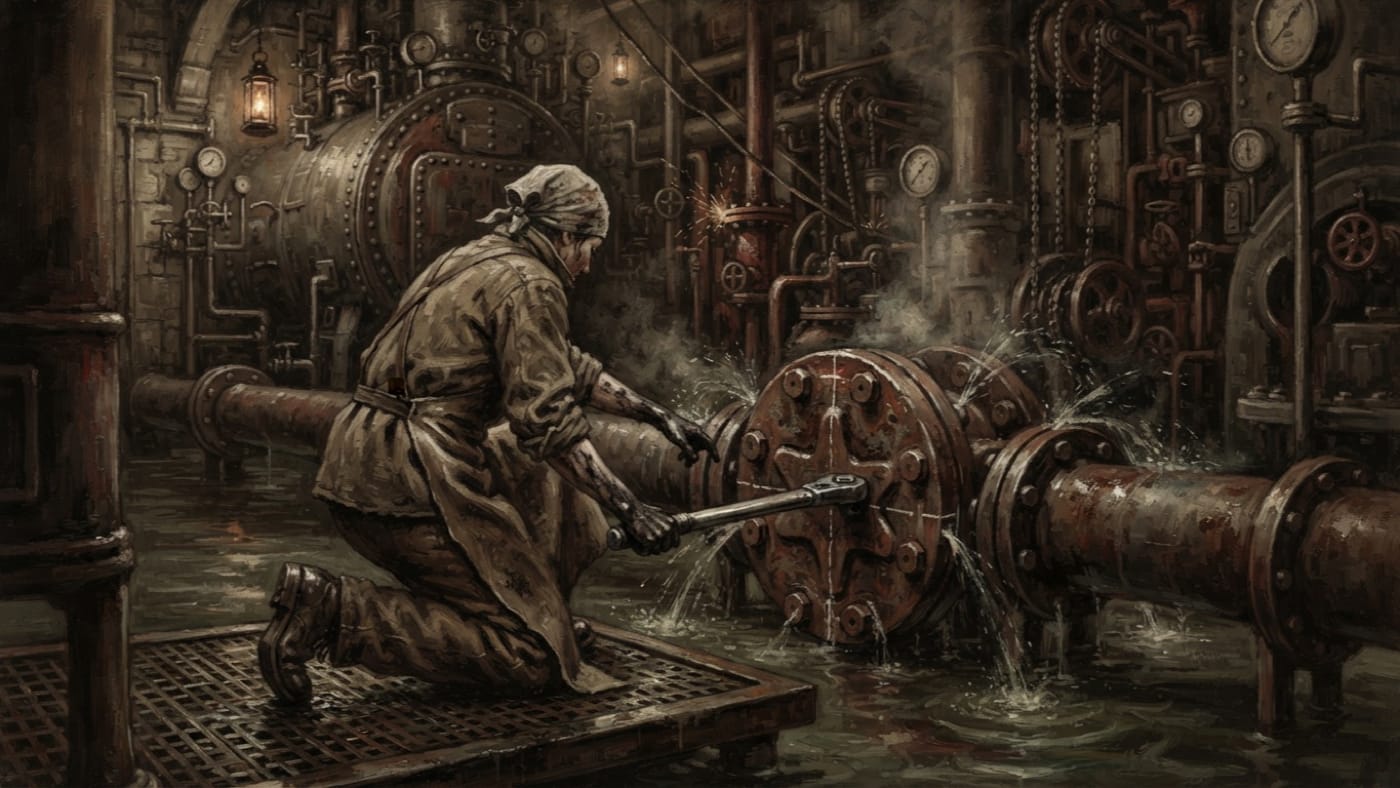
Rain began at Matins and was serious by Vespers. Water came up through the underworks. At Seal Seven the existing gasket had swollen and the seal had slipped. Mechanics dread that pairing: a swollen ring lies about its own seating, and a slipped seal cannot be argued back into place. Orla stayed. She seated a replacement ring and began the timed tightening of eight bolts in a star pattern. Each bolt came down against its opposite so the flange closed evenly and did not cock open on one side like a badly fitted reliquary lid. The recitation set the pace. A hand that is speaking verse cannot get ahead of the verse.
The seal held. The western pressure door stayed shut. The low ward survived. Orla died.
The earliest testimony belongs to Wax-Hand Jerun Pell, twelve years old at the flood. He later became a licensed Torque Technician and was later immured for unregistered sequence alteration. The Church has made worse use of a witness, though seldom with such tidy symmetry. Pell's account is the earliest. I do not call it the only one.
WAX-HAND PELL TESTIMONY — EXCERPT AS FILED She said the Sixth and the pipe knocked once. She said the Seventh and the water stopped climbing for █████ heartbeats. The key had fused to her palm. The chalk ran across her thumb and the flange in one stroke.
Pell reports a knock after the Sixth and a pause in the rising water after the Seventh, of a length someone has since removed. He reports a fused key and one witness stroke crossing flesh and iron. The description of her recovered body comes from a separate record, and I keep the two in separate drawers. Chapbooks are born when someone splices a child's testimony onto a corpse report and calls the result a reconstruction.
#On Sequence as Evidence
The craft of the Gasket-Hymn Mechanic has nine functions in its full protocol: diagnose, cleanse, align, seat, sing or recite, torque, seal, verify, document. Training plates print the list in a type size chosen to be readable by a man with water in his eyes. Every function does work a sceptic can touch. Cleansing strips old wax with solvent and chalk-salt so the new ring does not seat on residue. Alignment trues the flange faces before any load goes on. Seating keeps the ring untwisted. Torque in opposing order brings the joint down evenly. The witness mark, a chalk line drawn across bolt and flange, shows afterward whether anything has turned that should not have. Verification listens for knock-back. Documentation tells the auditor who did the work and who watched.
I do not claim Orla met every administrative requirement a modern inspector would demand. No surviving record shows it, and the profession she practised had not yet been constituted. The testimony keeps the material core: a ring seated, a star sequence, a recitation that set the pace, and a chalk stroke laid across the joint.
The Boundary Litany was codified in law in A.S. 152, twenty years after Metz. Sealing verse existed before that standard. Nobody has certified which words Orla actually spoke, and nobody can.
Popular chapbooks maintain that Seal Seven was closed by prayer alone, the bolts turning of their own accord at the saint's word.
Corrected per the Engineering addendum preserved in the published Life. Seal Seven was closed by a mechanic completing a repair: ring seated, bolts drawn in a star, chalk across the flange. The prayer was in the sequence. The bolts were turned by hand.
#On the Uses of a Successful Seal
The rescue ledger lists seven hundred and twelve names. The Bureau of Records later accepted six hundred and eighty-nine, after excluding those without proper bunk permits. Twenty-three people were pulled out of a flooding ward alive and then struck from the total by a clerk with a ruler. I keep both numbers. Nobody disputes the gap between them.
The Bureau of Doctrine canonised Orla in A.S. 162, thirty years after the flood. Engineering had spent those thirty years preferring results to sanctity. It then attached her name to a tightening specification: three light passes, one listening pause, two opposing seats, and a final quarter-turn on the closing syllable. That specification is Orla-Seven, and it belongs to later practice. Its descent from an eight-bolt flange at Metz does not oblige every later flange to carry eight bolts. Some chaplain with a drawing has to be told this every year.
Then came A.S. 164 and the Split-Ring Disaster at Bastion-Przemyśl. Seventeen engine pits failed over nine hours and forty-three men died, the cause traced to abbreviated cleansing and residual wax. Operational Classification 7-G followed, and the Sabotage Reforms constituted and licensed the profession. Thirty-two years after the flood, the Metz repair was entered as evidence in a case nobody had called it to.
The Line-Purists read Seal Seven as proof that sequence protects life. She omitted nothing and the joint held. Przemyśl omitted a cleansing and buried forty-three. The Field Pragmatists read the same seal as proof that judgment and labour matter. They see a skilled hand under impossible conditions, a ring seated on a slipped flange by someone who knew that joint, and a chapel where nobody came to relieve her. Both readings rest on a dead worker who left no statement of allegiance. Neither faction can show her name in its rolls, and each keeps her in its archive regardless.
#On the Seal in Instruction
Gasket sheds from Przemyśl to Bastion-Irongate teach Seal Seven as a test of nerve. Candidates keep the recitation steady while a master shakes the bench and shouts false readings. A candidate who stops speaking fails, and so does one who finishes too fast. As of A.S. 201 the cult and the training tradition continue, and mechanics invoke the saint before wet repairs and disputed abbreviations.
The regulations have moved on without her. Standing Order 14-Q, as revised in A.S. 199, requires prior written authorisation for any change to a sequence and refuses permission granted after the fact. A mechanic who improvised at a flooding flange today would be disciplined first and venerated afterward, if at all. The Engineering audit note excuses an omitted listening pause when death is "imminent, disputed, or already present." That note is a joke. An apprentice who treats it as an emergency exemption will learn that the Bureau's sense of humour stops at the inspection form.
I have no current inspection of the seal to report. The relic vault holds a key. The chapel, the conduit, the pressure door and the stair have produced no dated survey under my hand, and I will not invent one to give this article a handsome ending.