

#On the Lit Catwalks
"Hunger teaches holiness." — public line of the Ration Parliament of Wexel
Silo Lantern Day is the observance on which the Grain-Gray Ration Parliament of Wexel sets lights along every catwalk of the Silo Crown, permits its citizens two breaths of measured gratitude, and records more fires than on other days. Those are the three facts on file. I give them in the order a traveller would meet them from the basin road: first the lamps, then the faces, and last the smoke.
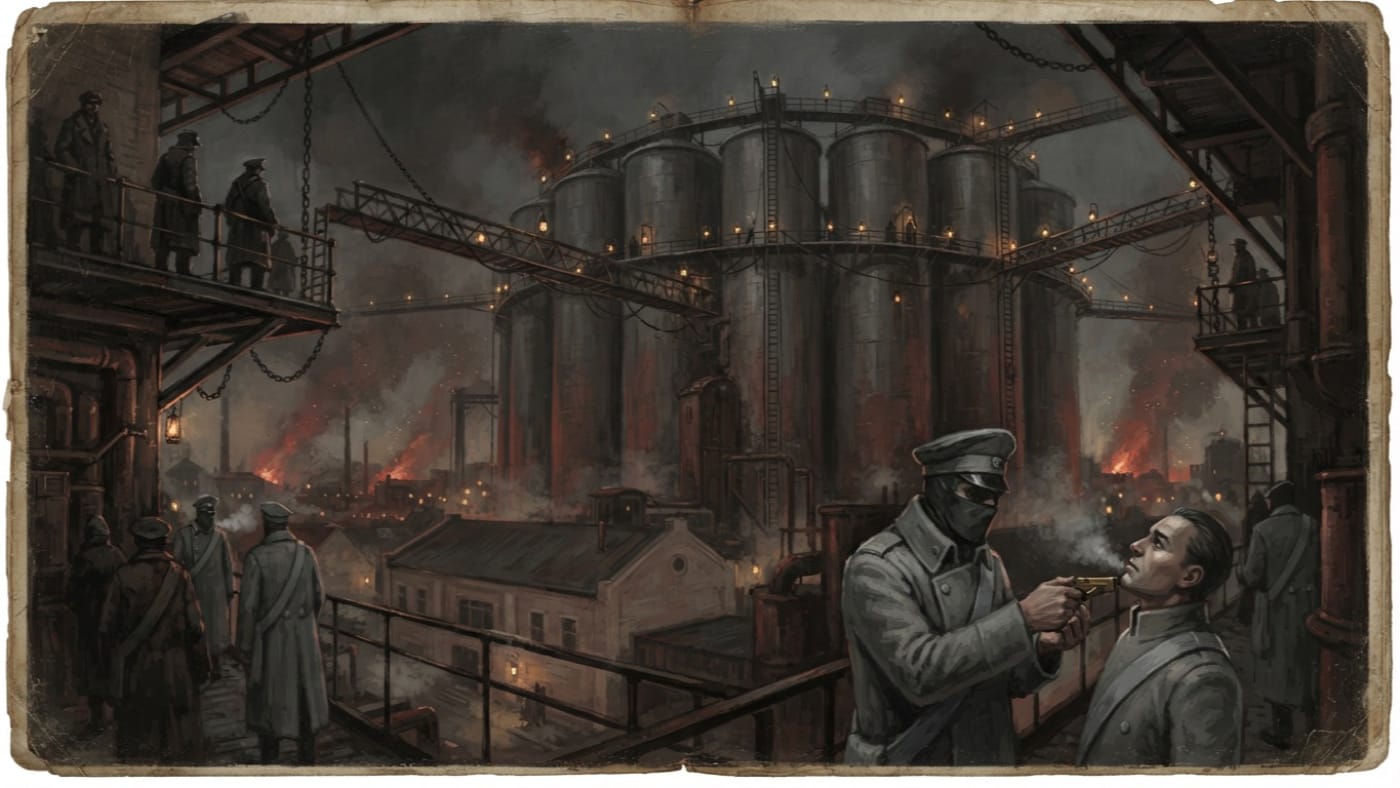
The setting does most of the work. Fourteen cylindrical steel towers stand in a ring around the pale-brick civic centre of a ration town on the flat grain basin of the Hessian lowlands, in Zone 2 of the Heartlands. Catwalks, ladders and gantry bridges join the towers above the street. Grain dust hangs in the air and the wind never stops. When it leans on the steel, the silo skins rattle in the dry cadence Wexel calls the counting. On the festival, each walk carries its lights, and the ring hangs lit above a town that has been taught to keep its mouth still.
The rest is blank, and I leave it blank. No register I may cite gives the day, the month, the season, the year of the first observance, the number of lamps, the order of their lighting, or the hand that lights them. The festival is not a feast of the Church at large. It is not recorded as an anniversary of the Dust Fire, and it does not celebrate the steel that replaced the timber, whose completion is itself undated. Wexel's other great observance, the Counting Week, comes after the harvest. Nothing in the record gives Lantern Day the same date.
#On the Gratitude Permitted
Wexel's feelings have been under regulation since A.S. 112 (1822 CE), when the Dust Fire killed three hundred and forty people in the wooden silos and the town received, within a year, a Mirth Office and a joy discipline imposed as a temporary measure of public safety. It has been temporary for eighty-nine years. Its inspectors wear grey sashes and carry small hinged brass gauges, modelled on the one belonging to Sister-Lector Neme Varr, which they hold against a citizen's mouth to decide whether the expression qualifies as measured contentment. The Office's reports set the tolerance at three millimetres. I measured it and found two. I have filed both figures and averaged neither. Averaging two official numbers produces a third, and Wexel has enough of them already.
The gauge cuts in both directions. Too much expression earns a citation for unearned joy. Too little earns one for ingratitude. Gratitude is therefore the one feeling the town both requires and fines for falling short, and on Silo Lantern Day the Parliament grants it a measured allowance of two breaths.
The adjective governs the noun. Two breaths of gratitude do not license laughter, and they do not suspend the gauge. A grateful face that strays past its tolerance is cited as a grateful face that strayed past its tolerance. The difference between gratitude and amusement is the direction a face points. Gratitude looks up toward the giver. Amusement looks at the joke, and in Wexel the joke is generally the giver.
The cost of error is entered in the household accounts. A mirth mark can shrink an allotment issued under Prefect Marwen Kile, add labour-hours, take a name from the drawer, or bring an ash bill with three days to pay. Marriage in Wexel requires merged ledgers, so a spouse's face bills the whole kitchen. The precedent is old. In A.S. 112 a mill hand paid in labour-hours, and his household lost two weeks of its allotment, for three breaths of laughter whose tone the inspector entered as "genuine." The festival grants two breaths, and only of the other kind.
Earlier compliance reports described the Mirth Office as "an advisory body with no enforcement capacity."
Retracted. The Office employs forty-three inspectors, keeps more than twelve thousand citations, and maintains a cold holding cell called the Laugh Box. Its advice comes with a ledger entry. On Silo Lantern Day the gratitude is permitted, and the Office's advice is still enforced.
#On the Watch Above the Grain
The catwalks are working ground on every other day of the year. Grain is stored beneath them. The Silo Catwalk Choir stands on them, sings sacred song over the bins, keeps the bells by which Wexel tells its hours, and watches the streets on the Parliament's behalf. Hymn and report come from the same throats on the same shift. The Bureau of Bells has never found the pairing irregular.
The festival puts its lamps exactly where the town's watchers already stand. I note the coincidence of place and decline to promote it to a policy. The record does not name the Choir as the festival's keeper, does not say the Choir trims the lamps, and does not say the watch above the Chit Market counts more heads on Lantern Day than on any other. All it says is that the walks are lit. A lit walk shows the street to the watcher. It also shows the watcher to the street. Wexel has always known where the singers stand, and on the festival it can count them.
Signals do reach the Cellar Circles from the ring: a lamp shaded at a chosen moment, a line of hymn dropped. A lookout may serve a cellar. The Choir as a body serves the Parliament. Whether a shaded lamp means more or less on a night when every lamp is burning I leave to the cellars, and I will not work it out for the Mirth Office free of charge.
#On the Fires Below
Arson in Wexel rises with Silo Lantern Day. That is recorded. Nobody has recorded why. I set down the rise and the established machinery that stands beside it, and I keep the two in separate columns because the record does.
The machinery belongs to the Ash-Fine Marshals, Wexel's collections militia. Their public office is debt collection, and in practice they foreclose. A household's arrears, whether mirth fees, labour-hours owed or unreconciled slips, become a debt, and the debt becomes an ash bill, the arson-fine notice that gives a debt its temperature. The Parliament calls the act that follows property purification. A house in arrears is impure, the cure for impurity is fire, and the fine for the fire goes on the household's ledger. The Marshals carry writs, torches and carts and work at night under curfew. The results stand in the Ash Fines District and smell of wet ash and old smoke. The ash is wet because somebody puts these fires out. A town that once lost three hundred and forty people to burning grain dust cannot let a purification reach the ring.
On Lantern Day the town keeps open flame on every walk of that ring, directly above the grain. The Bureau of Records has not explained this to me, and nobody has asked it to.
People in the streets say ash bills are issued before the fire starts. People also say oil from the Silo Lantern Shrine marks the next doors. I report both as sayings. The shrine is a separate propaganda site in town, known for its wax smoke. It shares a word with the festival, and the record gives no further connection. It is not recorded as the festival's origin, sanctuary or authority.
Arson is also a broad word. A town with lamps lit on steel, dust in its gutters and debts in every kitchen has more ways to catch fire than the Marshals have writs. Some festival fires may carry an ash stamp. Others may be grudges, accidents, or a household settling its own account before the Marshals arrive to settle it for them. No register I may cite sorts the festival fires among these causes, gives a count of the dead, or names an officer who commands the Marshals on that night or any other. No surviving charter says who commands them at all. The debt has many fathers, and none of them has signed for the lamps.
#On Laughter Carried Elsewhere
The Chaff-Winds have no use for the permitted allowance. The wind carries the old animal burst that escapes before fear clamps the mouth, and it ignores the approved civic exhalation and the measured two-breath gratitude of Silo Lantern Day. Lawful gratitude gives it nothing to carry, so it moves past the gauges toward whatever is laughing without leave.
The wind's ordinary conduct is on file. A cellar joke told in Canalback is heard in Parliament Square. Grain orders come back from the towers as questions. Mirth Office ledgers grow smiling loops of ink beside their entries. The Bureau of Doctrine's Category One belongs to that atmospheric-acoustic disturbance. It does not extend to the festival, the shrine or the silo district. No Lantern Day wonder has been reported to me, and I will not supply one for the sake of a better paragraph.
The Cellar Circles, also called the Quiet Mirth, meet after curfew, keep their mutual aid, and pass their jokes from hand to hand on folded paper. In the reclaimed houses of Ash Fines Row, contraband feasts are hidden. These are the town's standing habits. The record does not tie any one of them to the night of the lamps. Every evening of the year a joke is passed under some floor, and every evening the wind can find it.
#On the Observance Still Kept
As documented through A.S. 201 (1911 CE), Silo Lantern Day is still kept. The catwalks are lit. The grey sashes are out with their gauges, and the tolerance is three millimetres in the reports and two on the face. The gratitude lasts two breaths and is measured. The fires rise and are recorded, and their cause is not. The Chaff-Winds remain Category One, and unlicensed laughter remains actionable on the festival as on every other day.
The festival's origin is unknown. Its date has not been released to this office, and its lamps have no recorded keeper. Wexel has run without those three facts for as long as anyone has bothered to write the festival down.