

#On the Crown of Wexel
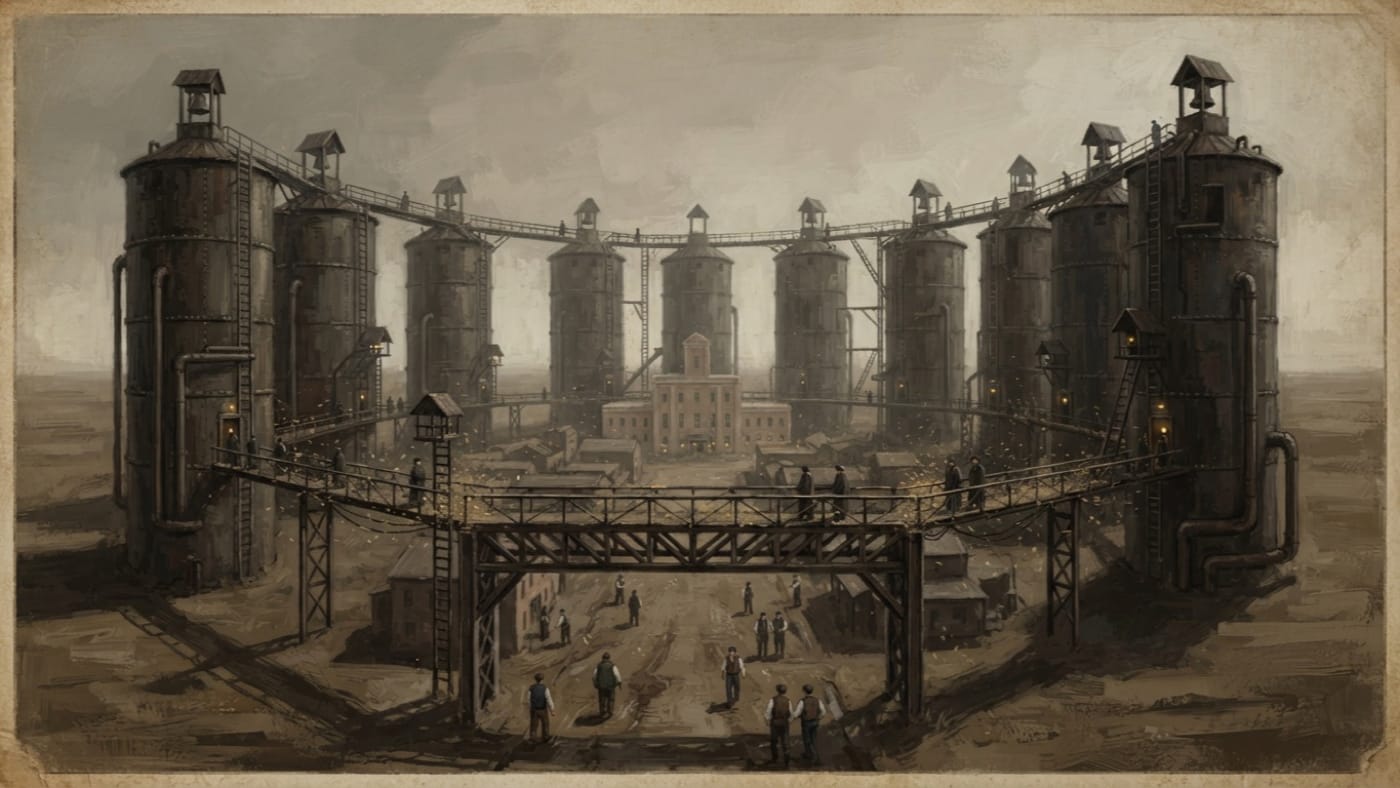
The Silo Crown is the outer ring of the Grain-Gray Ration Parliament of Wexel. It is fourteen cylindrical steel towers set around the pale-brick civic centre of a ration town on the flat grain basin of the Hessian lowlands, in Zone 2 of the Heartlands. Catwalks, ladders and gantry bridges join the towers above street level. The ring is visible for miles. On a basin this flat, so is everything else, including a man walking to a cellar after curfew.
Wexel's published account calls the Crown watchtower, warehouse and cathedral combined. The third word describes a civic habit of singing hymns over grain. It does not describe a building, and no register I may cite places a separate cathedral on the ring. The first two words are exact. Wexel stores its food in the same steel from which it watches its people, an economy of construction the Church has long admired in confessionals. A hungry town looks up at its bread. The bread has staff.
#On the Ring and Its Walks
Inside the ring lies Parliament Square, where quotas are voted, and the Scale Gate Ward, where the Scale Gate Authority weighs and inspects grain along the weighline. Strangers confuse the three. Residents never do. The Square decides how much. The Gate decides how heavy. The Crown keeps whatever has been decided and weighed, and posts singers above it to note who objects.
The district smells of dry grain dust and hot metal. On a clear day the steel throws glare down the market spines hard enough to make a ration line squint, and in Wexel a squint is one millimetre from a citable expression. Chaff blown in off the basin snags on the exposed ironwork and travels the gantries in small grey drifts. When the wind leans on the towers, the silo skins flex and rattle in a dry, regular cadence the town calls the counting. That much is weather striking a drum. A steel cylinder in wind will sound. The Creator arranged physics that way long before Wexel thought to tax it.
The hazards are older than the steel and indifferent to it. People fall from catwalks. Dust still gathers where dust gathers, and dust still burns. Silos can still collapse, and dust lung still settles into the chests of those who work the bins. Plate is less flammable than plank. A body leaving a gantry meets the street at the same speed regardless.
The Parliament maintains that every street in Wexel is visible from the catwalks. This is the official claim. Like every claim of total sight, it has been certified by the watchers and never audited by the alleys.
#On Timber and Steel
The steel had a predecessor. Wexel was founded in A.S. 98 (1808 CE), after a Hessian famine left eleven thousand dead. Published accounts place the first silos in A.S. 110 (1820 CE), raised in timber on the site of a demolished pre-Synod harvest shrine. Two years later, in A.S. 112 (1822 CE), the Dust Fire went through those wooden silos and killed three hundred and forty people. No record I am permitted to read fixes the day, the season, the hour or the spark. Doctrine attributes the fire to reckless behaviour. That is an attribution. Nobody has made it a finding.
The administrative harvest came in faster than the metal. The Ration Prefecture was constituted within the month. The Mirth Office followed within the year, and joy discipline was imposed as a temporary measure of public safety. Wexel had taxed feeling before the fire. Afterwards, feeling acquired a safety code.
Steel replaced the timber in the aftermath. The published account says the Bureau of Tithes paid. It cannot say when the last plate was fixed, how long the work took, who forged the metal, or what changed beyond the material, and neither can I. Fourteen towers stand now. No file records how many wooden silos stood before them, or how many burned.
An older Wexel inventory entry, carried into the chronology tables, states that "Steel silos replace the wooden ones A.S. 112."
Retracted. Nothing I would sign supports completion within the year of the fire. The steel came after A.S. 112, and the year it was finished is unestablished. The inventory clerk preferred a tidy year to an empty field, which is how most heresies against chronology begin.
#On the Choir Above the Grain
The catwalks belong to the Silo Catwalk Choir, a civic bell-and-song unit. Its public office is sacred song over the stored grain. Its schedule is the town's schedule: the Choir keeps the bells, and Wexel marks its working day by what is rung from the steel. Its other office is observation. The singers watch the streets and report what they see to the Parliament. Hymn and report are discharged on the same shift by the same throats, a pairing the Bureau of Bells has never found irregular.
This makes the Choir the most relied-upon body in Wexel and the least loved, in that order. Every household depends on the grain beneath those boots and on the bells that announce its release. Every household also knows that the singer above the Chit Market is counting heads between verses.
On Silo Lantern Day, lights are set along every catwalk and the whole ring glows over the basin. Arson in the town rises with the festival. The association is recorded and the causation is not. The day's place in the calendar and its origin are unestablished. The Silo Lantern Shrine is a separate propaganda site in town. It has its own wax smoke and no claim on this article.
The catwalks have a second use. Signals reach the Cellar Circles from the ring: a lamp shaded at a chosen moment, a line of hymn dropped. Nobody has published who sends them, how often, or by what key, and I decline to compose a cipher for the Mirth Office's convenience. The distinction is exact. A lookout on a catwalk may serve a cellar. The Choir as a body serves the Parliament. The first sentence frightens the Parliament well enough without the second being false.
#On Speech Returned from Steel
The counting is ordinary. What follows is ordinary only to people who have lived with it.
The Chaff-Winds return speech from the Crown. Half-syllables spoken in the Square come back from the ring. A grain order given at the Scale Gate repeats from the towers as a question. Laughter made somewhere else in town, genuine and therefore unlicensed, comes out of the steel. The winds sound through sealed spaces. Certified-empty bins are reported to hold shifting noises that resemble applause, and the silo skins answer with faint knocks when no one has struck them.
Two classifications touch the subject, and they must be kept apart. The Bureau of Bells has described the silo harmonics as "non-doctrinal but structurally tolerable," which is the opinion of a bell office on a very large bell. The Bureau of Rites classifies the Chaff-Winds as a Category One Localized Atmospheric-Acoustic Disturbance. That grade belongs to the wind. No office has graded the Crown itself, and I will not grade it for them. It is undetermined whether the towers generate the speech, amplify it, transmit it or merely catch it. Nobody has named a demon or found a device, and I would like the record to stay that way until someone climbs up with a warrant and a lantern.
The best-known report is Mirth Office ledger 199-L/CH. It records that during the harvest audit of A.S. 199 (1909 CE), the wind repeated the question WHO EATS? through all fourteen silo throats. The ledger reports it. I report the ledger.
Wexel's published account acknowledges a classified surplus ledger and grain diverted from the town's stores. It withholds the destination and the beneficiary, and so do I. The Crown's part in the matter is the part on paper: grain stored, sums disputed, bins certified empty, and an official silence that has outlasted every audit. In no register open to me has the wind's question been answered. For the smiling ink that turns up beside these reports, consult the Mirth Office's own records. The ledgers are its embarrassment, and I would not take that from it.
#On the Present Condition
As documented through A.S. 201 (1911 CE), the Crown stands at fourteen steel towers. Grain goes in by quota and comes out by allotment, the allotments falling to Prefect Marwen Kile, whose hands are always dusty for reasons the district makes obvious. Speaker Huld Bex presides over the Parliament that sets the quotas and receives the Choir's reports. The Choir sings and watches. The lanterns are lit on their day. Proposals to extend the ring exist as proposals. No fifteenth tower has risen, and the plan has the structural strength of every Wexel plan that needs money from above.
Joy discipline, imposed after the fire as temporary, has now been temporary for eighty-nine years. The accounting question is open. The acoustic question is open. The counting goes on whenever the wind leans on the steel, and on certain days the steel counts back.