

#On Their Station
"Form is Function, Function is Form." — Inscription of the Bureau of Rites, Strasbourg
The Bureau of Rites keeps clerks the way a cathedral keeps dust. They are everywhere, nobody remarks on them, and nobody has troubled to count them. The Sub-Priors of Form are a different matter. My present survey finds seventeen of them. They are the senior assistants to Liturgist-Primus Corvin Marche, holder of the Chair of Prescribed Observance, and they work beside him in the Strasbourg Cloister. Strasbourg sits in the safe heartlands west of the Sagittal Line, far enough from the Wound that a man there can kneel without first looking behind him. I can attest seventeen for A.S. 201. The Bureau has not told me whether there were seventeen before or must be seventeen after. I have learned not to ask the Bureau of Rites a question whose form has not first been approved.
Their governing law is older than any record I hold of their office. The Charter of Prescribed Observance has six hundred and fourteen articles. It was ratified in A.S. 58 under Augustinus's seal and countersigned by Kratz, in the years when the Church was still assembling its offices, three decades before the Concordat of A.S. 90 made the Synod formal. The Charter tells the faithful how long they may kneel. It does not say who will time them.
The Sub-Priors' working text is the Codex Liturgiae, eleven volumes and thirty-seven supplementary annexes. The Charter is the law, the Codex is the reference, and the Seven Pillars of Prescribed Form are the Bureau's own division of its subject. A careless writer mixes up the three. A careless writer then gets a letter.
#On the Written Query
Marche's chamber has no window, because natural light is unregulated, and the candles burn on a prescribed schedule. The room has not been redecorated since A.S. 72. The seventeen cells next to it are arranged exactly as his is. I have heard visitors call this monastic. I call it a filing system with beds.
Inside the Cloister, the Sub-Priors deal with one another through written ritual queries formatted under Bureau Standard 7-C (Revised, A.S. 187). This is an office custom, not a vow. A Sub-Prior in a parish speaks to the parish in plain, audible words. It is with one another, from one identical cell to the next, that they write. If one Sub-Prior wants to know whether a candle lit for Compline may also serve at Matins, the question goes on paper, in the approved form. Its premise has to be traced to an authorized text, and the answer comes back in the same form, citing a volume and an annex. A question that cannot cite anything is not answered. It is returned as a malformed question, which in that building counts as an answer in its own right.
I will not reproduce Standard 7-C here. The Bureau has not authorized it, and I would like my next entry accepted on the first submission. I will say this much: a man who has written his questions out in correct form for years asks fewer of them, and asks them better, than a man who has been allowed to speak.
My entry on the Bureau of Rites stated that the Liturgist-Primus "does not correspond with anyone."
The same entry records that he returned my letter with every word in its correct grammatical position, and that he answered my private disdain with a seven-page correction delivered within the hour. He corresponds. He objects to imprecision, and he answers it on paper, with references to four Councils. This office regrets the error. The Liturgist-Primus, I am confident, has already filed it.
#On the Parish Inspection
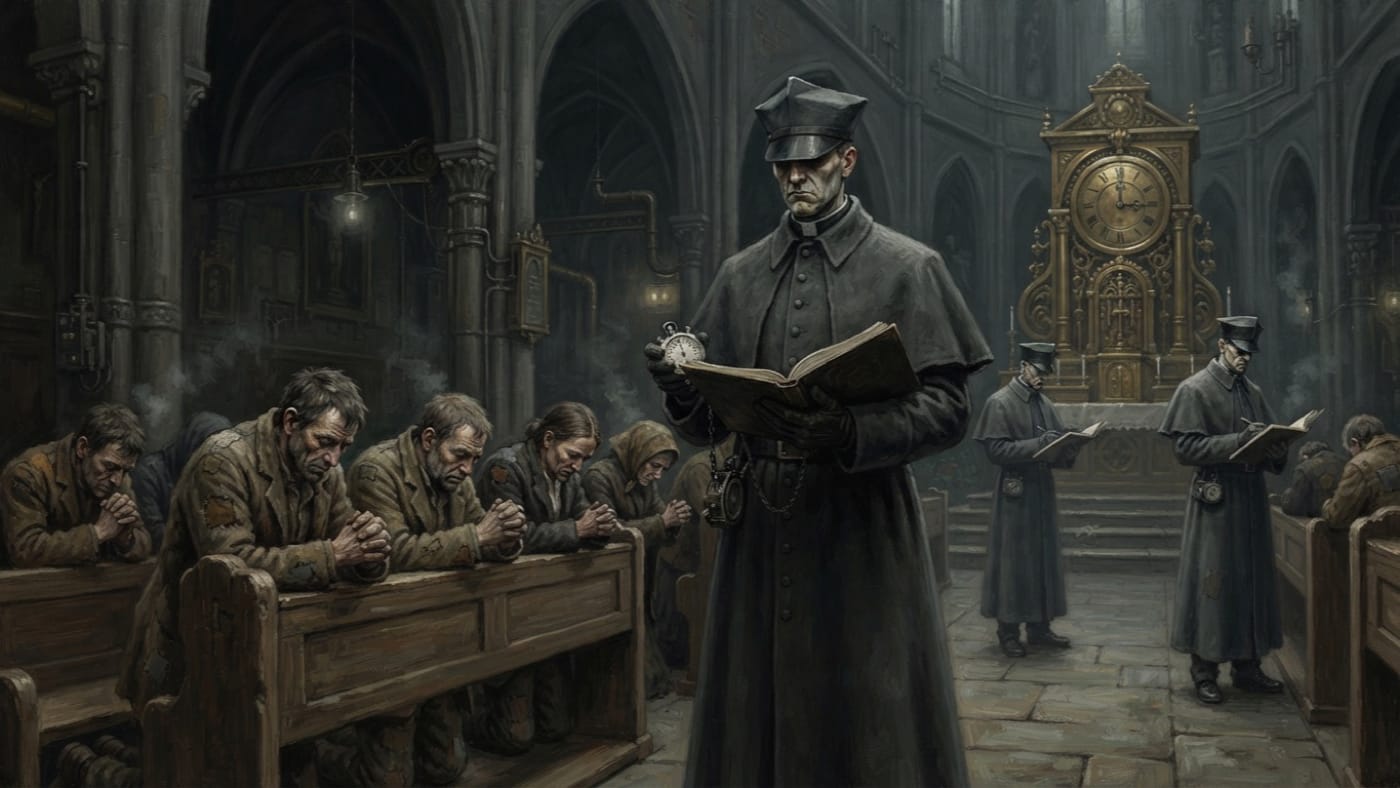
The seventeen do not stay in their cells. The Bureau's own record shows a Sub-Prior of Form conducting a liturgical compliance inspection in a rural parish. The equipment is plain and terrible: a pocket watch and a ledger.
The Charter sets the ordinary genuflection at no fewer than four seconds and no more than nine. An infirm worshipper may hold it for eleven under dispensation, and the dispensation is annotated in triplicate. The arithmetic is generous at both ends. Four seconds is lawful. Nine seconds is lawful. A worshipper who kneels for nine has broken nothing, and the inspector writes "nine" in the ledger with the same hand that would have written "four."
The countryside rarely grasps this distinction, though the Sub-Priors grasp it perfectly: measuring an act is one thing, and finding an offence is another. The watch measures. The ledger records. Whether an entry ever becomes a matter for the Bureau's procedures is decided elsewhere, by procedures that learn of it from the ledger. I have no evidence that a Sub-Prior arrests, sentences or punishes on the spot. The ledger is enough. A parish that has watched its own knees being entered in a book does not need to see a pyre to take the point.
The Bureau's engraving of an inspection in A.S. 199 shows two congregants logged at nine seconds, with a note that dispensation forms were unavailable. Nine seconds needs no dispensation. The caption's author seems to have forgotten this. The congregants were lawful, I suspect neither of them felt it, and they will kneel for seven next year out of pure caution. That is how compliance spreads across a parish: nobody punishes anyone, and everyone learns to stay well inside the limit.
The eleven-second dispensation is harder. A woman whose hip will not give her four clean seconds of descent needs the extra two, and to get them she needs a form, three copies of the annotation, and an officer with the authority to annotate. She also needs to have all of this before the Mass, because the watch is already running during it. Mercy exists in the Charter. It is filed in triplicate, and it has to be requested in advance.
#On the Account of Grace
The heavier duty is the account. The Lore Book is exact here, and so am I: each act of grace takes something from the obedient, whether a fast, a tithe, a service or a vow. When repayment fails, the deficit builds. Spending grace and falling into debt are separate events. A parish can spend a great deal and stay solvent. It goes into debt when the spending outruns what it gives back.
The Bureau records three symptoms. The first is dulled taste, when bread turns to ash on the tongue. The second is insomnia hymns, when phantom bells ring in the ears at night. The third is brittle joy, laughter that breaks like glass in the throat. The Bureau has measured these, filed them and cross-referenced them against parish records and tithe schedules. The measuring belongs to the Bureau. What the measurements finally mean, the Bureau does not publish, and I will not supply.
Two obligations are involved, and the faithful confuse them at their own cost. The first is the quarterly assessment, Form 14-C, which goes to every parish in the Dominion and grades it on a seven-point scale. I can give you only three of the grades. "Spiritually Solvent" is the top. The Bureau has never awarded it to a community of more than forty persons. "Provisionally Indebted" is the fourth. "Devotionally Overdrawn" is the bottom, and it is nearly universal along the Line, where the Wound drives miracles and debt to heights the original scale was never designed for. The Bureau has published the names of the other four grades to the parishes that hold them, and to no one else.
The second obligation applies only to qualifying indebted parishes, and it is heavier. They owe three supplementary masses a week and a monthly penitential procession. Once a year a team of Sub-Priors arrives with ledgers and portable scales. They weigh the congregation's collective spiritual credit against its accumulated liturgical expenditure, with the patience the Bureau of Tithes brings to a disputed harvest. The scales are calibrated to Bureau standard. What they weigh, the Bureau alone is qualified to say.
Look closely at the prescription and you will find its joke inside it. The debt comes from devotion that has not been repaid, and the Bureau's remedy is more devotion. A parish whose bread already tastes of ash adds three masses a week. A parish that lies awake hearing bells that are not ringing gets up for a procession through the cold. The faces in such a parish are grey before the audit and greyer after it. They kneel lawfully, between four and nine seconds, and their knees ache every time. The Bureau calls this course of treatment a devotional maturation curve. The parish has no name for it. The parish is tired.
I once asked Marche whether such a debt could be forgiven. He gave the question nine seconds. I counted, and nine is lawful. "The Bureau does not forgive," he said. "The Bureau balances." The Sub-Priors are the hands that hold the scale level, and they hold it in parishes whose bread they will not stay to eat.
#On Their Present Employment
The Bureau of Rites sits among the Holy Bureaus as their grammar, and the other Bureaus feel it. Bells cannot alter a peal schedule without Rites' countersignature. Purity cannot open a trial until Rites has certified the judges' oaths. Doctrine argues about what the Church believes, and Records files what it claims, while Rites keeps the account of what the Church actually does when it kneels. Those are powers of the Bureau. I do not assign them to any Sub-Prior personally, and a Sub-Prior would correct me in writing if I did.
The seventeen's own work is narrower and closer to the body. They carry the Codex out of a windowless room and into the knees of the faithful. Every syllable of the Charter that reaches a parish has passed through a Sub-Prior's watch or a Sub-Prior's ledger on the way.
I have been unkind to the Bureau in print, and the Bureau has repaid me in triplicate. I will grant it this much, and only this. When the Grey wears faces at Bastion-Königsberg, the soldiers reach first for the prescribed prayer, in the prescribed cadence, and it holds the wall nine times in ten. The Great Deceiver looks for the loose syllable. The Sub-Priors have spent their careers making sure there isn't one. It is a grey-faced parish that pays for this, three masses a week, so that a garrison it will never see can keep its cadence.