

#On the Registrar's Station
The Synod Doctrine Registrar is the office to which the district returns of the Bureau of Doctrine, Third Division, Public Compliance, are signed upward. This survey was compiled in A.S. 201. It treats the chair and leaves the occupant alone. The papers consulted give no name, no term of years, no date of appointment and no founding instrument. The present compilation records where the office stands. It does not claim to know when the chair was built or who built it.
The position itself is plain. A Creed Runner checks purity tokens and carries correction slips between chapel annexes. A Doctrine Street-Vicar halts a square, hears the Eternal Creed recited badly and chalks a doorframe. A District Doctrine Officer supervises eight to twelve of those Vicars and reports directly to the Synod Doctrine Registrar. Above the Registrar stands the Bureau of Doctrine, whose seat is Strasbourg. That leaves two signatures between a chalked lintel and the Bureau, the Officer's and the Registrar's.
The Bureau calls this a short chain. So is the drop beneath a scaffold.
#On the Districts Reported
The Officer is a person. The District Doctrine Office is everything that has piled up around that person: ledgers of patrol returns, a shelf of exception filings, a cupboard where confiscated chalk is counted by colour, and a bench where a Vicar waits while a supervisor reads. Field observations, completion records, marking entries and exception filings come in from a dozen hands. The Office's work is to lay them side by side and see where they fail to meet. Whose white restorations match the annex signatures? Whose arrive alone? Which lane has gone quiet, and is it the quiet of obedience or the quiet before a riot?
The Officer signs beneath that comparison. What travels upward is the district as one Officer has read it.
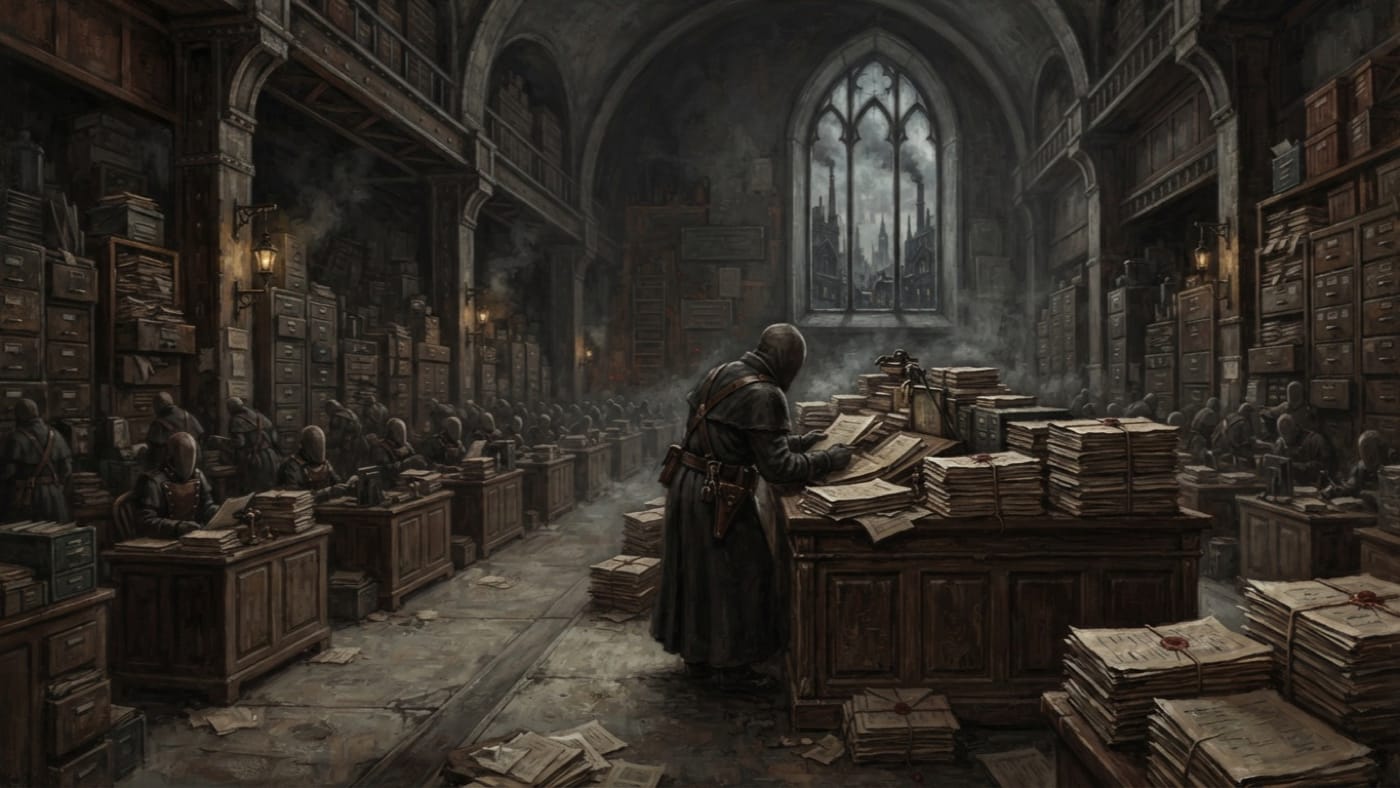
This is the whole of the Registrar's attested contact with the street. No record consulted places the office at a square-stop, a chapel annex or a doorframe. The Registrar gets the street on paper. By then a Vicar has walked it, a Runner has carried it through the fish-market gutters, and an Officer has dried it by a coal fire and passed judgement on it. A morning in which fourteen households were heard, tested and chalked reaches the Registrar as a column. The column is accurate in the way a death certificate is accurate: correctly filled out, and of no help to the deceased.
#On What the Figures Contain
The Corps measures its Vicars by stops made, corrections completed, attendance recovered, riots incurred, doors marked accurately and tokens kept in order. Each of these can be counted, and none measures belief, which the Creator has not yet agreed to submit quarterly.
Every one of those figures can be produced honestly or bought. A Vicar who picks easy stops in pious lanes, which the trade calls the crowd wash, brings home a stop count as fat as a prebendary. A Vicar paid in lamp oil returns a street of white lintels. A Marker who reddens a rival's bakery for a competitor's flour posts excellent deterrence, because the wrong household was punished and the punishment worked. The Office is expected to catch all of this from a ledger line. Often it cannot. Whatever it misses goes up the chain in a clean hand under the Officer's signature.
The Vicars have an idiom for it: a clean door lies. The idiom stays in the district. The figure carries no trace of the lane it came from.
The Corps' own working lore asks a blunt question: who can ruin your life with one signature? Its answer names the Doctrine Registrar first, ahead of the Codex Auditor and the Inquisitor. The same lore lists the Registrar beside the District Prelate as the profession's political figure and patron, and it counts patron satisfaction among the unofficial measures of a Vicar's worth. None of this lists what the Registrar's signature may legally do. It records something else: the people under that signature are afraid of it. In the Bureau, the fear does much of the supervising, and it is cheaper to maintain.
#On Mercy and Marking
The Mercy Vicars correct in private: a word at the elbow, a recitation spoken together on the corner, the slip handed over without an audience. The Marking Vicars hold that one yellow lintel catechises a whole street, and that mercy without consequence is permission with a kinder face. Both schools serve in the District Offices, sometimes in the same grid and on the same bench, and neither speaks to the other.
Neither will name the other in writing either. Their quarrel goes through the quarterly compliance figures filed with the Bureau of Records, in phrases the clerks have learned to translate. Visible compliance recovery is a Marker boasting. Marking density above six households per patrol correlates with adverse crowd consolidation is a Mercy Vicar sharpening a knife on the Trier file.
So two descriptions of the same streets leave the district. The quarterly figure goes to Records. The Officer's signed returns go up the chain to the Registrar. A Marker's district shows stops multiplying and tokens in order. A Mercy Vicar's shows fewer marks and steadier attendance. Both accounts are true and neither is complete. The Officer is judged on riot incidence, on attendance recovery and on what the next desk up will make of the page. No record consulted shows the Registrar ruling between the schools, holding a school's allegiance, or keeping any procedure for weighing one account against the other. What the records do show is Officers writing as if someone above them were keeping score.
#On the Limits of the Chain
Seniority in this chain is the right to receive paper. It is not the right to take over another office's work, and the boundaries are worth setting down before anyone assumes otherwise.
The correction slip has its own route, and neither the Officer nor the Registrar is on it. A citizen who stumbles on the third article owes a corrected recitation at a chapel annex within forty-eight hours. The presiding cleric signs, and the slip returns to the issuing Vicar for filing. If it never comes back, the matter passes to a Codex Doubt Auditor. No senior permission comes into that referral. The Auditors' branch was constituted under the Bureau of Purity in A.S. 114. It examines the Corps as readily as it takes the Corps' referrals. Purity enforces whatever must be enforced. In Echo Season, the Cadence Examiner with his blessed tuning fork decides whether a crowd's cadence has drifted more than one-eighth of a beat, and a desk in Strasbourg has no say in that.
The seventh door belongs to the district too. The Corps was chartered at Strasbourg in A.S. 104 under the Catechism Third Revision, after the Market Drift Years of A.S. 98 to 103 showed the Bureau that chapel compliance was not street obedience. In A.S. 119 an unnamed Vicar in Trier marked fourteen doorframes red in one afternoon and was in the Moselle by dawn. The Chalk Riots that followed spread to Cologne, Halle and three districts of Strasbourg. In A.S. 120 the Corps standardised soft-marking chalk. Beside that reform a custom hardened that no statute ever wrote down: a Vicar who marks more than six doorframes in one patrol files a justification with the District Doctrine Office. The seventh door may still be marked. The justification goes on the Office's shelf, with the Officer's name as the second name on any riot that follows. Nothing in the custom moves that shelf upstairs.
The Bureau of Doctrine previously attributed the Trier disturbance to "heretical agitation by elements sympathetic to the Rationalist remnant."
Corrected. The Bureau of Records established that every participant held current purity tokens and unblemished confession records. The attribution now reads "excess of zeal in application of marking protocols." Zeal does not show up in a column, so whoever reads the columns reads them knowing that.
#On the Present Compilation
As of this A.S. 201 survey, the office of Synod Doctrine Registrar is entered as standing. District Doctrine Officers report to it, and it answers to the Bureau of Doctrine. The materials consulted give it a place in the chain, a signature the Corps fears, and a desk where the districts arrive already read. They give it no name, no founding, no staff roll, no room and no powers beyond that. Those entries are left blank. In the Bureau a blank entry is safer than a wrong one, and this survey has made no wrong ones.
Somewhere in Zones 1 to 5 a Vicar is chalking a lintel white this morning. The lintel will be described to someone who has never seen it. It will be correctly described.