

#On the Licensed Voice
"Finding: private devotional authority produced overlapping obedience commands." — Purification Inquiry, Santiago, A.S. 121
As of A.S. 201, the Tongues of the Blessed Way are a licensed translation desk working under the supervision of the Bureau of Pilgrimage. They put a Galician widow's confession into words a Route-Stamper can read. They put a Flemish wool-merchant's Creed into syllables an inspector will pass. A supervisor countersigns their work, and the Bureau holds their licence. If any of them still carries a knife, the Bureau has no record of it.
Eighty years ago they were the Santiago road faction, a smaller Iberian pilgrimage guild. They were one of the private powers that held the roads of the Church in the decades after the Belgrade miracle, until Strasbourg decided that roads should have one owner. They had translators and chanters. They also had banner-bearers, marshals and knife-men, which is more than a linguistic service needs and roughly what a jurisdiction needs.
Their founding year is unrecorded, and so is their founder. The Bureau of Records has no list of their masters that I would sign. What survives is a single claim, entered in their defence and preserved in the inquiry papers. They held that no pilgrim could approach the shrine at Santiago without correct canticle pronunciation, and that correct pronunciation required their licensed voices.
That claim is the whole guild. Everything else about them is the apparatus that grew up around it.
#On the Work Before the Window
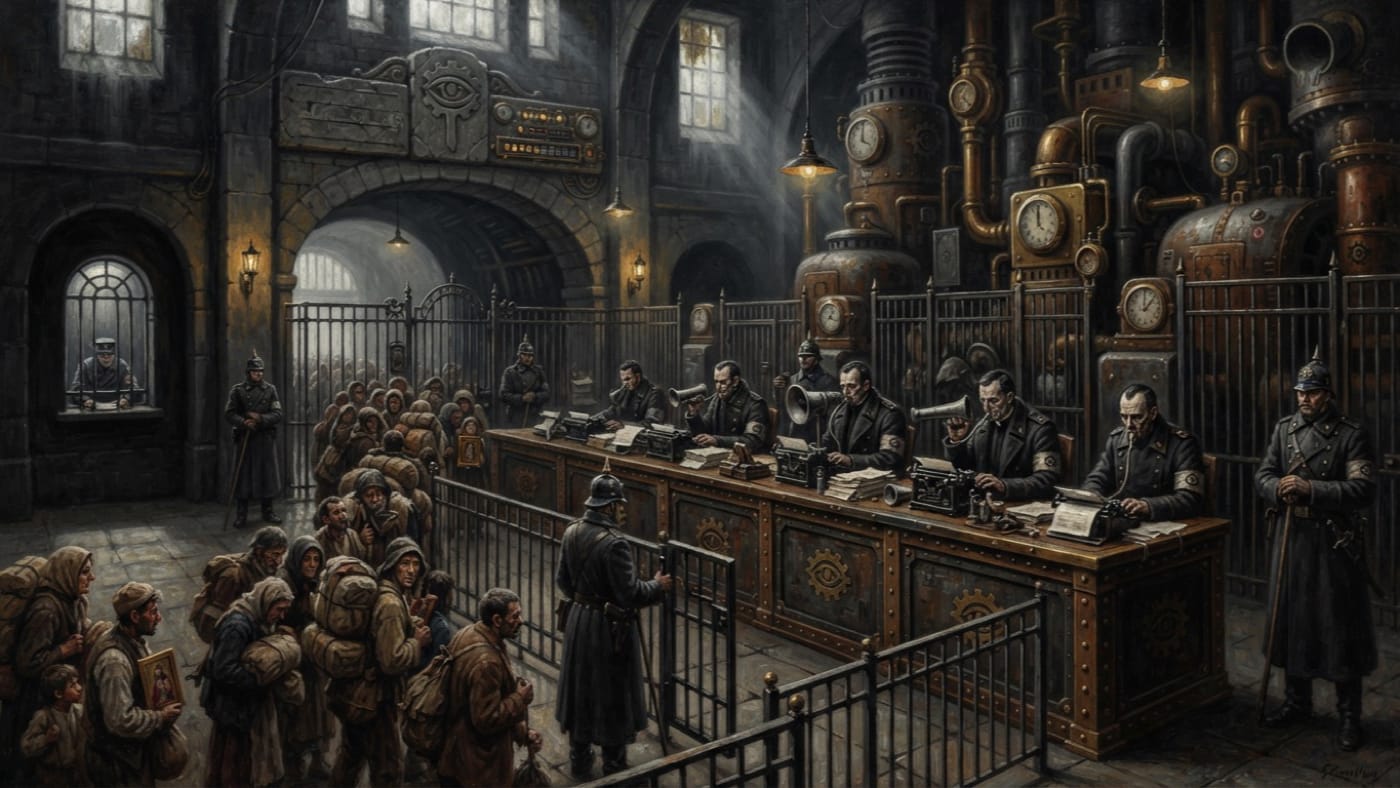
The usefulness of an interpreter needs no argument. The roads into Santiago carried farmers from Galicia and widows from Castile, along with merchants from the Low Countries and veterans from the Rhineland who wanted sleep and absolution in that order. A tithe-gate asked each of them for coin and Creed. The Creed had to be recited aloud, and recited correctly. Correctly meant whatever the man at the gate decided it meant.

I once watched a caravan of Iberian traders held for seven days at a tithe-gate because their interpreter pronounced the third syllable of the Creed with insufficient reverence. Nothing in my notes says the interpreter belonged to the Tongues, and I will not enlist him posthumously. I mention him because he shows what a mouth was worth on those roads. One syllable cost a week, and the olives spoiled in the carts. The traders wept for mercy, and by the end of the week they would have paid any voice that promised the syllable would come out right.
The Tongues sold that promise. A pilgrim arriving at Santiago with a valley dialect, a garbled canticle and a confession the local canons could not follow found a translator ready to render him and a chanter ready to teach him the approved sounds. After that came the instrument that turned the service into a toll: a pronunciation writ. The writ certified that its bearer had been taught, examined and found fit to approach. It was issued under private road custom, and under that custom it was genuine.
The banner-bearers marked where the Tongues' authority ran. The marshals moved their pilgrims through it in order. The knife-men took care of objections. I know of no rank ladder among these functions, and no muster roll survives. The guild's numbers are unknown, and I will not invent them to make the faction look more dangerous. Translators who are certain of their indispensability are dangerous enough at any number.
At the inspection window the guild ran three things together: the language test, the devotional test and the fee. Dialect was a matter of the throat, confession a matter of the soul, and toll arithmetic a matter of the purse. The Tongues set themselves up where all three met and charged once for each. A pilgrim could not tell which of the three he was failing, and the Tongues did not explain. Explanation would have been a separate service, and they would have charged for it.
The nearest later comparison is the Choir-Broker Hall of Peregrine Row, where the canyon echoes a prayer back with one vowel wrong and the brokers charge for the correction. I have walked that defile three times. I record the likeness of method and nothing more. No document connects the Hall to the Tongues by branch, by purchase or by inheritance, and the Bureau of Records would not thank me for supplying one.
#On the Other Lawful Voices
The Tongues were never alone on the Santiago road. That fact is the centre of their history, and it eventually ended it.
The Peregrine Brotherhood held the broad Iberian coast. Their claim rested on escorts, hostel lists, mule yards and the bridge turns that decided which road stayed open in a wet season. Their marshals had carried staves long enough to forget that a staff is a walking aid. Their argument was the argument of every road-keeper: we kept the way open, so the way owes us precedence.
The Edrasian proxy house came through the western roads on purchased influence, attached to the Confraternity of Saint Edras but not identical with it. The Confraternity's own strength lay in the Carpathian passes. In Iberia it worked through brokers, and the brokers dealt in hardship. Pilgrims under their rolls had walked under fast-credit and blister tally, and the house argued that accumulated suffering decided who went first. Their pilgrims' knees, the brokers said, outranked the Brotherhood's escorts and the Tongues' throats alike.
So there were three claims, each with a different basis. The Tongues claimed the mouth, the Brotherhood the road, and the Edrasians the body. Each claim worked, in a narrow sense, as long as it was the only one being made. A pilgrim could pay the Brotherhood for the road, pay the Tongues for the canticle and still reach the shrine. Lawyers would call the claims severable, and pilgrims would call them expensive. I call them a rehearsal.
Every guild had paid local wardens and bought lodging guarantees. Each one also promised its pilgrims a place near the reliquary platform. In a pilgrim economy that kind of promise is a debt, and a debt the steward has already accepted payment for cannot be withdrawn from the saint's hearing. The steward said as much in writing later, in a sentence the Bureau of Tithes now uses in training.
#On Santiago
The Riots of Santiago have their own entry in this Codex, with the full casualty arithmetic. I give here only what the Tongues contributed to the event and what it cost them.
In A.S. 121 all three processions entered the shrine-city on the same feast day. All three held valid papers. The city magistrates tried to stagger entry by bell-hour, and the guild marshals went for the bell rope. The canons tried to shut the north door, but it was old and swollen and would not close.
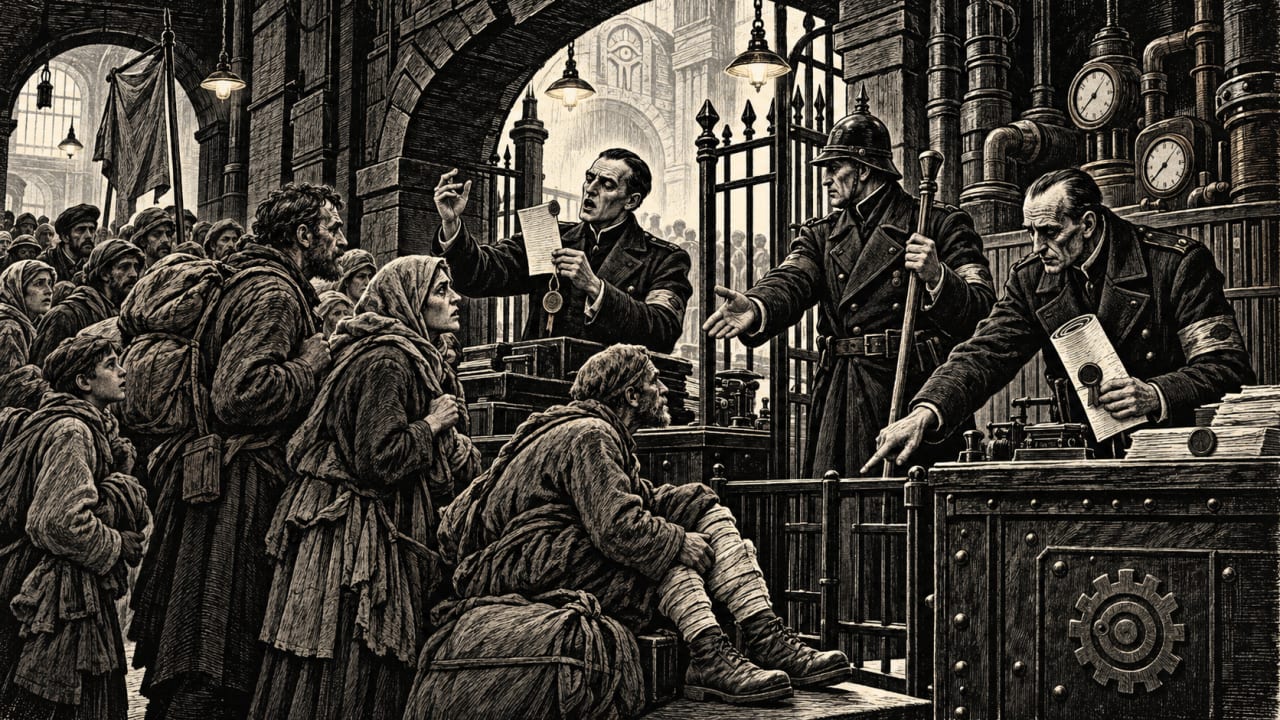
The Tongues set up their inspection at the token window beneath the arch. They demanded recitation before passage, as their writs entitled them to. At the same moment the Brotherhood pushed its coastal procession through the same arch, as their escort contracts entitled them to. One authority told the crowd to stop and be examined. Another told it to move. Both orders were lawful, and the crowd was faithful enough to try to obey both.
A woman from León was crushed at that window. Records gives her name three ways: Mariela, Mariella and María-Ela. The Bureau of Pilgrimage later chose Mariela because it fitted the memorial stone. I keep all three spellings, as the people of Santiago do. Nobody can say which hand killed her, because she died between two commands, and two commands have no single hand.
After her fall a Peregrine marshal struck a Tongues chanter across the mouth. The chanter lost two teeth and kept chanting, blood and all. The crowd was impressed, the chance of retreat was gone, and the guild had its martyr-image within the hour. I do not doubt his sincerity. I note that a chanter has two reasons to keep singing through broken teeth. One is devotion. The other is that the writ in his master's satchel was worthless the moment the canticle stopped.
The second crush brought the shrine damage. A Brotherhood escort clearing the nave for his banner drove a staff butt into the carved screen of the western transept, and the screen cracked. A Tongues knife-man shouted that the escort had struck the saint. The accusation crossed the court faster than the facts could. By Sext the Brotherhood were saint-strikers and the Tongues were blood-singers. Every pilgrim who had paid twice was hunting the man who took the second coin.
By Vespers forty-one pilgrims were dead. The total belongs to the riot. It does not belong to the Tongues, or to their knife-men, or to any one guild, and any history that claims otherwise has chosen its villain before reading the testimony.
The Tongues defended themselves the way guilds with clerks do. They produced their pronunciation writs. The Brotherhood produced escort contracts, and the Edrasian house produced fast-credit rolls and a road privilege whose wax had gone the colour of old liver. The Bureau of Purity examined each document separately and found nothing wrong with any of them. Read together, the papers were a procedure for killing the obedient.
#On Harmonization
Strasbourg took the Santiago packets as a legislator takes a precedent. The Holy Bureaus each found their own concern in the blood. Doctrine saw spiritual disorder, Records saw contradictory tokens, and Tithes saw unlicensed fees. The Tongues gave every Bureau something. Their writs were a form of private certification that Records wanted abolished. Their fees were extraction outside Tithes' tariffs. Their claim that a voice could grant or withhold access to the Creator's shrine was the kind of claim Doctrine allows only to itself.
In A.S. 123 the Harmonized Routes Edict was ratified at Concordat Hall in Strasbourg. Eight private pilgrimage guilds were summoned, and the Tongues were among them. Their masters came expecting to negotiate and were offered absorption, sentence or flight. Three signed and were sent to route inspector posts far from any comfort. Three refused and were immured in the foundations of the new southern headquarters at Marseille. Two fled to England.
I do not know which of those three courses the master of the Tongues took. None of the papers I hold names him. The aggregate settlement is recorded and the individual sentences are not. A clerk with less discipline than mine would choose the most colourful fate and assign it to him. I leave the space blank, and that space is one of the few honest things in the Edict's archive.
The Lore Book's survey of the Holy Bureaus records the suppression of the eight guilds as "the Harmonized Routes of 238."
CORRECTED — The Harmonized Routes Edict was ratified in A.S. 123, two years after Santiago. A.S. 238 lies thirty-seven years beyond the present and cannot hold the Tongues' suppression, because it has not happened yet. The rejected A.S. 38 dating remains rejected as well. Bureau of Doctrine, A.S. 201.
The Edict did not need to destroy the Tongues' skill, because skill was never the offence. It destroyed their standing. No private writ could now certify a pilgrim for any approach. No guild marshal could hold a lane. No banner except the Bureau's could mark a jurisdiction, and no knife could carry a road's authority. The Peregrine Wardens enforced this in their first season. Guild banners came down along the Iberian roads and Bureau waystones went up. At Santiago the authorised token gained sequence marks that a Pilgrimage clerk could read. The shell, the painted bead and the strip of road-cloth knotted in a valley's dialect were driven out of the token and into the songs.
The Tongues lost their toll, their writ and their sovereignty over the canticle. The Bureau kept their ear.
#On the Desk That Remains
The Bureau of Pilgrimage processes about three million permits a year, and pilgrims do not arrive speaking the Bureau's language. They come with Galician and Catalan, with Basque that defeats every clerk north of the Ebro, and with the Flemish of merchants and the German of Rhineland veterans. Some arrive with confessions in dialects that have never been written down because nobody thought to write them. The Creed must still be spoken at the gate and the confession still understood at the window. The Synod centralised the roads and found, as it always does, that a monopoly still needs people who can do the work.
So the Tongues survive as a desk. I cannot give the year of the conversion, and I cannot name the instrument that licensed it. Records holds no charter I can cite, and I will not make one up to tidy the chronology. The A.S. 201 survey records the present state only. A translation desk carries the old name and does the old specialist work under Pilgrimage supervision. Nothing in that record shows that today's translators descend from the A.S. 121 guild by blood, oath or apprenticeship. A name can be licensed to anyone, and so can a function. Descent would need evidence, and nobody has submitted any.
The difference between the guild and the desk is clear enough to state. The guild translated and then decided whether the pilgrim could pass. The desk translates and a Bureau officer decides. A pilgrim at the Santiago window today still needs a voice to carry his Creed into acceptable form, and the Tongues still provide that voice. Their rendering is evidence, and the decision belongs to the Bureau. A writ from the desk certifies only that a translation was made. The earlier writs certified that a soul had been made fit to approach. The Bureau of Pilgrimage keeps the right to declare fitness, along with the fee that goes with it.
The surviving desk keeps no inspection lane of its own and posts no marshals at the arch. It runs no fee schedule I am permitted to publish, and I have seen no current tariff that would let me publish one anyway. Rumours about knife-men are the kind tavern guides sell to frightened pilgrims along with the immured masters' names. I do not repeat them.
Pilgrims still lower their voices at the token window in Santiago, where the guides point out the spot. The cracked western screen has been repaired with a visible seam. A translator from the desk may stand a few paces from where Mariela, Mariella or María-Ela fell, putting a widow's prayer into Bureau Castilian for a Route-Stamper who could not pronounce the widow's village. The translator's work is accurate, and it makes no promise the translator cannot keep.
The Tongues of the Blessed Way once held that a pilgrim's mouth belonged to whoever held a writ for it. The Edict agreed with the principle and changed the holder.