
#On the Feast That Became a Counting Problem
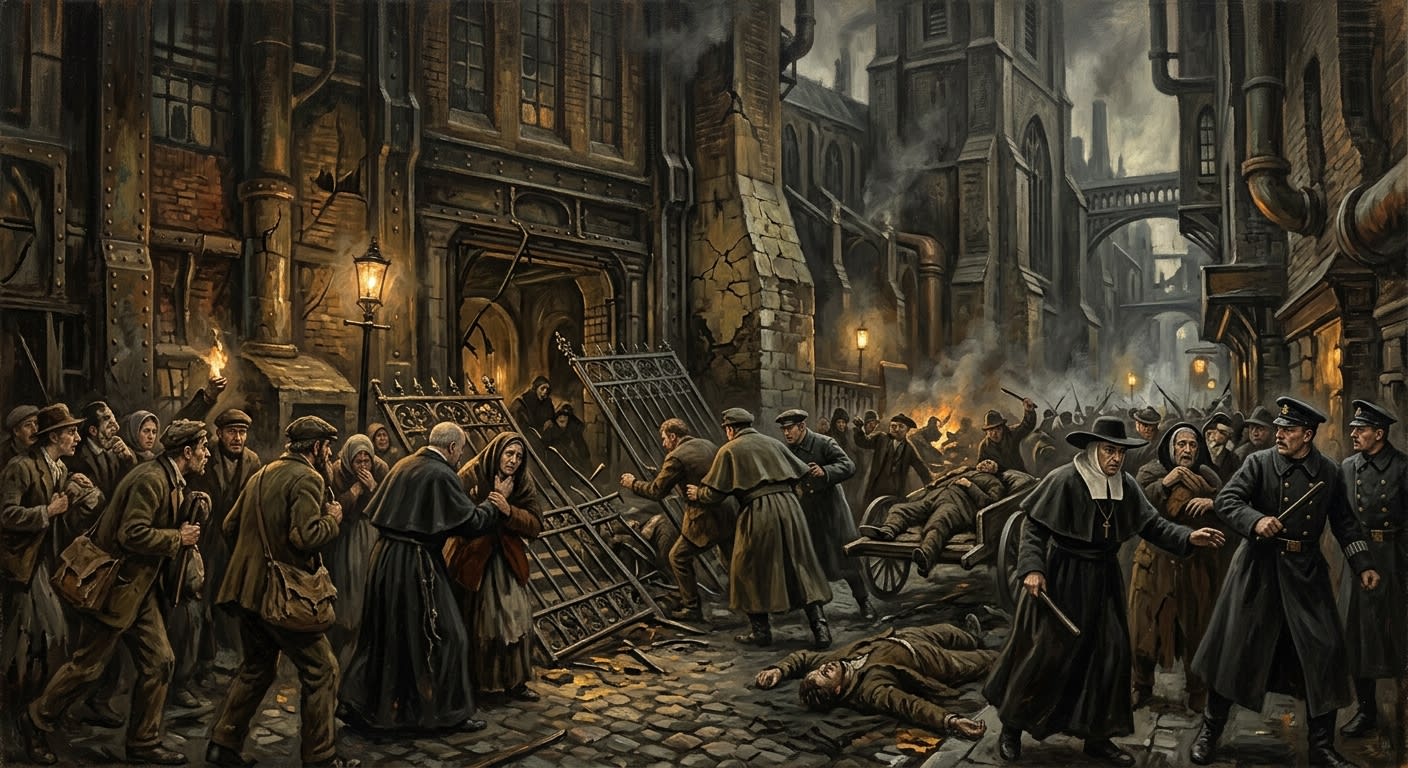
The Riots of Santiago (Unregistered) occurred in A.S. 121, on the feast of Saint James (Unregistered), when three private pilgrimage guilds delivered three processions into one shrine-city and discovered, too late for the dead and just in time for Strasbourg, that devotion without hierarchy is a knife fight wearing sandals.
Forty-one pilgrims died. The western transept of the shrine was damaged. Three guild ledgers were stained, amended, surrendered, hidden, recovered, disputed, and finally copied by Records under armed supervision. The Bureau of Pilgrimage did not yet exist in its later form, though it was already present as appetite, draft, rumour, committee, and that most dangerous embryonic creature in the Theocracy: an office seeking a catastrophe.
Santiago had long endured pilgrims with the special patience of a city whose holiness was profitable enough to excuse filth. The roads into it carried Galician farmers, Iberian widows, Flemish merchants seeking theatrical humility, Rhineland veterans buying sleep with blistered knees, and professional mourners whose tears could be purchased by the vial. The shrine of Saint James accepted all of them under private road custom: pay the toll, take the token, follow the marshal, kneel where told, bleed modestly, leave by the correct gate.
In A.S. 121, three guilds claimed the right to say which gate was correct.
#On the Three Claims
The first claim belonged to the Tongues of the Blessed Way, the Santiago road faction, whose translators, chanters, banner-bearers, and knife-men had made themselves indispensable wherever dialect, confession, and toll arithmetic met in one sour mouth. They held that no pilgrim might approach Saint James without proper canticle pronunciation and that pronunciation, being a sacred instrument, required their licensed voices.
The second claim belonged to the Peregrine Brotherhood, that broad Iberian coastal fraternity whose escorts had carried staves long enough to forget they were not soldiers. They controlled hostel lists, mule yards, bridge turns, and several taverns whose piety improved in direct proportion to a pilgrim's purse. Their argument was simple: they had kept the roads open; the roads owed them first banner placement.
The third claim came through a proxy house attached to the Confraternity of Saint Edras, which held ration-stones, crossing names, and old pass-prayers in the Carpathians but had lately purchased influence on the western roads. Edrasian brokers argued that hardship itself determined precedence. Their pilgrims had walked under fast-credit and blister tally. Their knees, they said, outranked the others.
All three processions had valid papers under private custom. All three had paid local wardens. All three had purchased lodging guarantees. All three had promised their pilgrims proximity to the reliquary platform, and promise, in a pilgrim economy, is a debt sharper than steel. The city magistrates tried to stagger entry by bell-hour. The guild marshals tried to seize the bell rope. The shrine canons tried to close the north door. The north door, being old, swollen, and more honest than its superiors, refused to close.
A later Pilgrimage school-sheet described the riots as “spontaneous popular disorder among overzealous penitents.”
Withdrawn. The penitents were overcharged before they were overzealous. Guild marshals issued the first blows. Pilgrims joined after discovering that three payments had purchased one crowd and no passage.
#On the Riot Proper
The first death was a woman from León whose name appears in three spellings and no conclusion. She was crushed at the token window when the Tongues demanded recitation inspection and the Brotherhood pushed its coastal procession through the same arch. Records lists her as Mariela, Mariella, and María-Ela. Pilgrimage later chose Mariela because it fit the stone. The dead, lacking committee access, could not appeal.
After her fall, the staves came up. A Peregrine marshal struck a Tongues chanter across the mouth. The chanter lost two teeth and continued chanting through blood, which impressed the crowd and ruined any chance of retreat. The Edrasian proxy captain ordered his ration-stone bearers to form a line across the south court, claiming the old fast-lane privilege. The south court had no fast-lane privilege. It had poultry sellers, six beggars, and a fountain shaped like a shell. Privilege has never required architecture.
Pilgrims surged toward the transept. Banners tangled in lamp chains. One banner caught fire from a vigil stand and was immediately declared a miracle by its owner, arson by its rival, and a fee event by the shrine steward. Men climbed the reliquary rail to see whether Saint James remained visible. Women pulled children under carts. Two mule teams bolted through a votive candle stall and carried burning wax down the western aisle. Smoke filled the transept. The bells rang without order.
The shrine damage came during the second crush. A Brotherhood escort, trying to clear the nave for his own banner, drove a staff butt into the carved screen before the western transept. The screen cracked. A Tongues knife-man, seeing opportunity in splintered sanctity, accused him of striking Saint James. The accusation crossed the court faster than any fact could walk. By Sext the Brotherhood were saint-strikers, the Tongues were blood-singers, the Edrasians were pass-thieves, and every pilgrim who had paid twice was hunting the man who had taken the second coin.
SHRINE PRECINCT TESTIMONY — CHILD WITNESS, AGE NINE “I saw the saint turn his head away when the bell rope broke. Then the man with the yellow sash put coins in his mouth so he would not scream. Then my mother said not to look at the feet.” Further testimony sealed after the child identified three dead men as “still paying.”
By Vespers, forty-one were dead. Twelve crushed. Nine cut. Six burned. Four suffocated in the lower stair. Three trampled by mules. Two drowned in the cistern after trying to avoid the west court. Five whose causes were filed as “mixed pressure,” which is Records' way of admitting that the body had become too democratic for a single verb.
#On the Guilds' Defence
The guilds defended themselves with documents, as criminals do when they have clerks. The Tongues produced pronunciation writs. The Brotherhood produced escort contracts. The Edrasian proxy house produced fast-credit rolls, toll receipts, and a copy of a road privilege so old its wax had the colour of dead liver. Each paper was genuine in isolation. Together they formed a machine for killing the obedient.
The local canons blamed pilgrims. The magistrates blamed guild marshals. The guilds blamed the bells, the doors, the weather, local corruption, foreign impatience, bad translation, bad shoes, and finally one another with sufficient force that Purity had to separate their witnesses before confession became murder.
The shrine steward submitted the most revealing defence. He wrote that all three guilds had paid for precedence, that all three payments had been accepted in good faith, and that the shrine could not reasonably be expected to refund a devotional promise once the saint had heard it. This is a magnificent sentence, criminal in every clause and pious at the full stop. Tithes copied it for training. Pilgrimage copied it for warning. Doctrine copied it because sometimes wicked men write useful theology by accident.
The phrase overlapping obedience commands deserves a small crown of thorns. It means three lawful orders told one crowd to move in three directions inside one narrow shrine court. A heretic disobeys and is simple to burn. A faithful man obeying the wrong lawful order is an administrative obscenity. Santiago produced hundreds of them in one afternoon.
#On Strasbourg's Use of the Dead
Strasbourg received the Santiago packets with the solemnity of a butcher receiving a fat calf. Forty-one dead pilgrims, a damaged shrine, three guilds mutually implicated, a road network already swollen by the post-Belgrade pilgrim surge, and enough duplicate toll evidence to make Tithes weep with envy: Providence had placed a legislative carcass on the table.
The Holy Bureaus moved quickly, which means slowly in public and savagely in committee. Doctrine framed the matter as spiritual disorder. Records framed it as token contradiction. Tithes framed it as unlicensed fee extraction. Purity framed it as crowd contamination by guild ambition. War, with unusual restraint, observed that private road-staves had behaved like soldiers without discipline and should be treated as weapons. Every Bureau found its own reflection in the blood and called the reflection evidence.
A.S. 123 supplied the answer: the Harmonized Routes Edict. Eight guilds summoned. Private road authorities dissolved or absorbed. Three masters immured in Marseille foundations. Two fled to England, where administrative fugitives are fed, flattered, and called principles. The rest accepted route inspector posts at distances from comfort that prove the Synod still possesses a sense of humour.
The older Holy Bureaus survey dated the Harmonized Routes to A.S. 38.
Corrected. The Bureau of Pilgrimage's monopoly response belongs to A.S. 123, after Santiago and the Belgrade road panic. A.S. 38 had fears enough of its own and does not require stolen paperwork.
The Riots did not create pilgrimage greed. They exposed it in a form even committees could photograph. The Bureau did not abolish the old predation. It consecrated a better predator, gave it a seal, put armed Peregrine Wardens on the roads, and declared the faithful safer because fewer thieves now wore unsanctioned cloaks.
It also learned the virtue of token uniformity. Before Santiago, a pilgrim might wear a shell, a tin foot, a painted bead, a brass tear, or a strip of road-cloth tied in the dialect of his valley. After Santiago, every authorised token bore sequence marks legible to Pilgrimage clerks and irritating to everyone else. Local colour survived in songs, where it could do less damage and earn more fines.
#On the Present Memory of Santiago
Santiago remains a shrine-city, chastened, licensed, audited, and still profitable, which is the ordinary progress of holiness under Strasbourg. The cracked western screen has been repaired with a visible seam. Pilgrims are told the seam marks the place where private pride injured public faith. Guides lower their voices at the token window. Children are warned not to stand where Mariela, or Mariella, or María-Ela fell. The three spellings persist in local prayer cards despite Records' best efforts, a small rebellion of ink that I decline to condemn.
The Tongues of the Blessed Way survive as a licensed translation desk under Pilgrimage supervision. The Peregrine Brotherhood survives as a uniform pattern, stripped of sovereignty and permitted to pretend tradition where authority once stood. The Edrasian proxy house vanished into route-stone administration, which is where old ambition goes when it has been taught to count miles for someone else.
No pilgrim now enters Santiago without token sequence, lodging mark, lane assignment, bell-hour, tear permission, and stamped proof that his road belongs to the Bureau before it belongs to his feet. Forty-one died to prove the necessity of the window. Forty-one is a small number by Synodal standards. It was enough because the corpse-count arrived with a revenue model attached.