


#On a Cell Remembered for the Wrong Crime
The Unmeasured were a Rationalist remnant cell at the Palatine Switchyard of Lorn, and the Synod's files remember them mainly for a crime they did not commit. In A.S. 112 they were charged with causing the Silent Derailment. They were arrested, questioned, made to confess, and executed. The charge was later withdrawn. The execution stood.
Readers of a sentimental temperament will want to stop here and weep. I advise against it. The Unmeasured were heretics before the derailment and remained heretics after the correction, and the Bureau of Doctrine has never pretended otherwise. What deserves study is the hinge on which the case turned. A causal accusation failed. A doctrinal condemnation then rose from the same chair, brushed off its sleeves, and kept the sentence.
The surviving papers do not say whether the cell chose its name or whether some provost's clerk supplied it for convenience and it stuck like wax to a thumb. The name fits either way. They refused to be measured by the bell. Lorn obliged them with a measure of its own.
#On Private Counting and the Monopoly of the Bell
Before the Yard required larger offences, their stated offences were two: rejection of bell-time authority, and possession of private tally marks. That is the whole of their documented programme. Anyone who wishes them to have been engineers of revolution must bring their own documents.

In Lorn, neither offence is trivial. The yard was founded in A.S. 104 as an engine for turning freight into schedule. By A.S. 110 it dispatched seven hundred trains a day under a regime in which time belonged to the bell, movement to the stamp, and the stamp to whoever controlled the Manifest Basilica. Bell authority over the hour long predates the Bell Codex ratified in A.S. 115. The Codex standardised what towns and yards already obeyed. A worker in Lorn was permitted to know the time. He was not permitted to own it.
A private tally is a small thing: chalk on a lintel, notches on a rod, a count of wagons kept in a pocket book against the official count. Yet whoever keeps their own tally has appointed themselves a second ledger, and a second ledger is a court of appeal the Synod never chartered. If the private count disagrees with the manifest, one of them is lying. The manifest has a seal. The tally-keeper has a pencil. Doctrine understood that arithmetic before the tally-keeper did.
I do not read the Unmeasured as enemies of measurement. The tallies prove the reverse; they counted with the devotion of novices at their beads. Their heresy concerned jurisdiction: the claim that a measure taken by a private hand might be as true as one rung from a sanctioned tower. That is the Rationalist disease in its local form, the old conceit that the instrument outranks the office. I condemn it without hesitation. I also observe, with the dry professional interest of a man who keeps notes, that in A.S. 112 the official count was about to be very badly wrong.
#On the Accusation After the Slag Wall
The derailment has its own plate in this Codex, and I will not reprint it. In brief: during night operation, a munitions train entered an unregistered siding that ended at a slag wall. Forty-one yard crew and train personnel died. Every stamp was genuine, every available signal agreed, and the manifests denied the siding that killed them. Later sealed analysis found that Tower Nine had answered one measure late, in the colour expected from Tower Three. In the first days, nobody admitted to knowing that.
A catastrophe with correct paperwork is the most dangerous kind, because it implicates procedure itself. The Yard needed a culprit outside procedure, and needed one quickly, before the city drew its own conclusions about the schedule. A cell already on file for refusing the bell's authority over time was an answer cut to the measure of the question.
The charges grew in the telling. Rejection of bell-time authority became temporal insolence. Private tallies became conspiracy, and conspiracy became Rationalist sabotage. The worst feature of the derailment was that no crash bell or alarm sounded. That became murder by silence, as though the accused had stolen the noise from the wreck and carried it home in their pockets.
Note the economy. Each charge was built from some part of the disaster the Yard could not otherwise explain. The silence needed an author. The wrong count needed a counter. The siding that did not exist needed someone who believed in places the manifest refused.
The forty-one dead were not of the Unmeasured, and the Unmeasured were not among the forty-one. I set this down because careless copyists have run the two together. The crew's names lie behind oathglass in the Basilica's memorial register, revised quarterly. The cell has no register. Its names became an instructional footnote, which is where a state puts people it intends to cite without remembering.
#On Confession and the Six-Week Exhibit
The Unmeasured were arrested before the second public circular. Between the first printing and the next, the Yard acquired prisoners. Whatever investigation preceded the arrests moved fast enough to outrun the press, and I have met very few investigations in the Synod that can outrun anything.
They were questioned under the supervision of the Bureau of Purity, and they confessed. The confessions were coerced, and the published account does not pretend otherwise; it remarks only on how fluently the prisoners recited the answers pain had taught them. The sealed file I am permitted to quote cites no transcript, and I will not supply one. Invented confessions are a Purity speciality. Doctrine prefers to forge with better materials.
They were executed under yard authority. The detail matters. The sentence was carried out through the Yard Tribunal's power over the schedule and its offences, the same jurisdiction that destroys forgers of master-manifests. Their bodies were not returned. In a theocracy that weeps at the thought of a death unrecorded, withholding a corpse is a second sentence, served on the family.
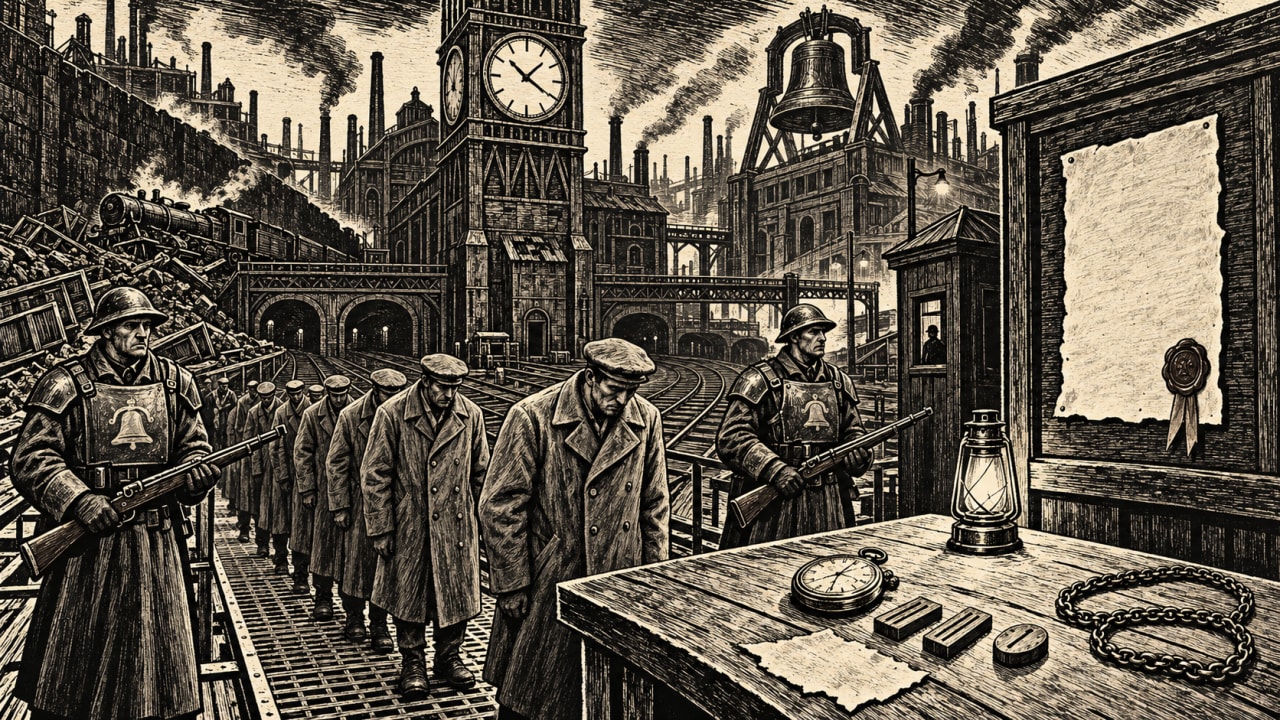
Then came the exhibit. For six weeks, beside the Yard Tribunal docket board, the Yard displayed the supposed tools of the crime.
Look at them as the prosecutor hoped you would not. A cracked chronometer is one person's claim to keep their own hour; it moves no rail. Route tallies record trains that have already passed; they throw no switch. A pamphlet fragment proves reading, which in a Rationalist is the original sin and in a saboteur is merely preparation. A measuring chain measures. None of these objects can steer a munitions train onto a siding, and the exhibit never tried to show how one might. The file does not establish which prisoner owned which article, whether any article was ever used, or where the four now rest.
The exhibit was meant to instruct. Workers coming off shift walked past the docket board and saw what private measurement looked like once the Yard had laid it out on cloth: small, brass, cracked, foreign. Suspicion was arranged on a table until it resembled causation. The people of Lorn had not been told about Tower Nine, and they drew the conclusion the table proposed.
#On the Corrected Cause and the Retained Sentence
The attribution did not survive. The file does not say when it was withdrawn, and I will not decorate the gap with a date.
The Silent Derailment of A.S. 112 was caused by Rationalist sabotage committed by the cell known as the Unmeasured, who silenced the yard's warnings and misdirected the munitions train to its destruction.
Withdrawn. The Bureau of Doctrine has determined that the incident resulted from "accumulated procedural drift in an unsanctioned tonal environment." Sealed reports go further and attribute the derailment to a large Hymn-Phase event involving Tower Nine, unsanctioned tonal conditions, and an unregistered siding. The Unmeasured are cleared of the derailment. They are not cleared.
Two corrected wordings now exist, and readers will ask which is true. Both are, at different depths of the archive. Doctrine's public phrase is the version fit to circulate: drift, environment, nobody's hand. The sealed reconstruction names the tower, the late answer and the tonal conditions. Related reports call the buried clock beneath Tower Nine the probable source of resonance. It is only probable, because nobody has excavated it, and nobody will while the seal remains the most honest object in Lorn. Neither version restores sabotage. They differ only in how much they are willing to say, a skill in which my Bureau has had a century of practice.
And the sentence stood. Doctrine held that the existence of the Unmeasured was a separate offence, enough for the penalty whatever had happened on the siding. I record this without the outrage a provincial reader expects. The ruling is sound in law. A cell that denies the bell's authority over time is guilty of denying it whether or not a train dies afterward.
The order of events is what fails. The prisoners were never tried for existing. They were tried for killing forty-one men, made to confess to killing forty-one men, and exhibited as the killers of forty-one men. The offence that kept them dead was found only after the offence that killed them collapsed. Doctrine did not hold the trial again. It changed the label on the verdict and refiled the folder.
No pardon followed. No compensation was paid, no bodies were returned, and no burial rights were restored. No rehabilitation of any kind is recorded. The correction concerned causation, and causation is a matter of record. Guilt remained a matter of Doctrine, and Doctrine had already been paid.
#On What Else Grew From the Same Grave
The Unmeasured were the derailment's shortest-lived consequence. The others are still with us. None of them descends from the cell; I set them beside it only because they share a grave.
The Bureau of Bells drew the public lesson. Voiced procedure existed in the yard before A.S. 112, as it did in half the dispatch offices of the Heartlands. After the derailment, Bell Marshal Gerren Stahl proposed that it be made mandatory, and within a season the Yard agreed: no switch without a sung measure from a certified cantor, no signal without a confirmation hymn. The reform answered the heresy of the Unmeasured with an excess of the very thing they denied. If a private count was suspect, every count would be public, sung aloud and logged by a tower caller.
The Manifest Basilica gained the power to correct. The Bureau of Records had filed the disaster as a terrain reclassification error. The Basilica learned that paper which describes the world wrongly may be amended until it describes it rightly, a power of some convenience.
The switchmen formed burial funds by A.S. 113 and oath funds by 115. By 119 they had become the Thrown Hand, whose oldest article holds that the hand that throws may refuse if the hymn is false. Below ground, the Hush Tunnel Runners learned that silence moves what song condemns.
I note one irony and pass on. The Thrown Hand keeps a Crushed Book of workers killed after correct orders. The Hush reads Tower Nine's late blinks through drainage grates and keeps its own count. Lorn executed a cell for keeping tallies and then raised a whole city of tally-keepers. Nobody has been executed for it lately. So far as I can tell, the difference is numbers.
#On the File in A.S. 201
The case of the Unmeasured would be a closed antiquarian matter if Lorn had stopped misrouting things. It has not. Since A.S. 199, sealed relic-payroll crates have left the Payroll Spur with correct seals, correct measures and correct stamps, and arrived empty. It is the grammar of A.S. 112 with richer nouns, and the city's first instinct has been the same: find a culprit outside procedure. The street blames the Runners. The Runners blame the tower. The tower answers late.
Inquisitor-Regent Veyl Hark is studying the Payroll Spur ledgers, the Tower Nine codes and the sealed Hymn-Phase reports ahead of her audit of Lorn. Her commission does not name the Unmeasured, and nothing in it reopens their execution. But an auditor who reads the derailment file in order will reach the docket-board exhibit before the correction. She will see that the Yard has done this before: laid out a table of small brass objects and invited a frightened city to call it a cause. I expect her to notice. I expect her to say nothing about it in writing.
No record suggests survivors. Nothing connects any present loss to a cell destroyed nearly ninety years ago, and I would sooner see that theory burned than entered. The Unmeasured survive as a struck-through line in the derailment file and a footnote whose names I am not authorised to print.