

#On the Designation
"The pilgrims call it Bead-Row. The soldiers call it Vowel-Tax. The brokers call it revenue." — From the survey of Peregrine Row, A.S. 201
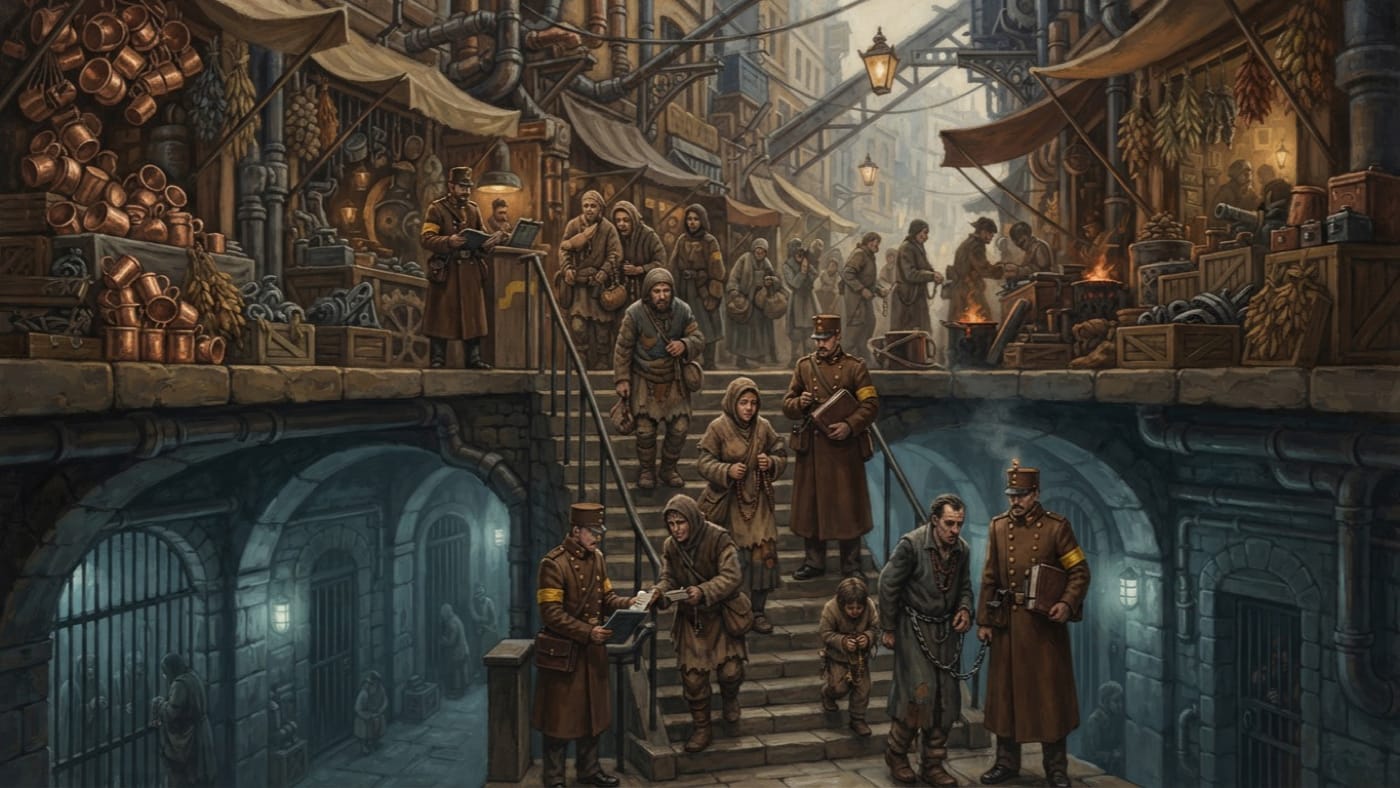
A staircase goes down into the canyon floor beneath the Tinmarket Arcade of Peregrine Row, somewhere between a stall selling hammered cups and a stall selling whatever the cups are meant to hold. The locals call it the Vowel-Stair. At its foot lie the Quiet Pens.
Beyond that, the stair has no official existence. No dedication survives for it. There is no builder's mark, no year of cutting and no surveyed plan. The name appears on no Road Chapter instrument I have been shown. It is market usage, and the market does not file. Persons of no rank have asked me who named it, and why. I tell them the name explains itself to anyone who has stood at the Gate of Clean Tongues. Who coined it is a question for the canyon, and the canyon would only hand it back with one letter changed.
Above is the arcade, which smells of hot tin and rotting spice at every hour, its trestles wedged into every gap the Row's grander establishments left unclaimed. Below are stone rooms that smell of lye and of people kept close for longer than people should be kept. Between the two, a local ordinance of aromatic compliance requires every stall to smell strongly enough to cover what lies beneath it. The ordinance holds as far as the head of the stair. After that, the lye wins.
#On the Grounds for Descent
Nobody goes down the Vowel-Stair on a whim. Every descent follows a finding, and every finding is made somewhere else, by someone better spoken.
The commonest finding comes from the Gate of Clean Tongues. A pilgrim recites the Seventh Catechism aloud, at volume, before a proctor and a scribe. The proctor judges the vowels deficient, and the scribe enters the judgment on a carbon-backed receipt. The stair takes its name from this traffic, which is unjust to all the other kinds.
The second comes from the Bead Courts. There a clerk works in chalk on slate, comparing the pilgrim's string of bone, wood and glass against confession receipts, passage stamps and tithe credits. When the session closes, the slate is wiped. Only the result is filed, and the result is one of two words: reconciled or unreconciled. An unreconciled pilgrim arrives at the head of the stair carrying a verdict whose arithmetic no longer exists anywhere in the Creator's world.
The third comes from the road, in the form of escort contracts that lapsed mid-passage and pilgrims sent back to the Row without the paper that insured them. The fourth comes from nowhere at all. The survey records the detention of pilgrims whose faces displeased a gate proctor on a bad morning, and I cannot improve on the phrasing.
The machinery began smaller. In A.S. 101 bandits ambushed a convoy of six hundred pilgrims in the eastern canyon and killed two hundred and fourteen of them. The survivors were fined for doctrinal negligence. The Road Chapter answered with creed-testing, compulsory escort and the reconciliation of beads, and by A.S. 110 the daily audit was complete. Detention had been a holding room for the openly heretical. It widened to take the merely mispronounced. The stair stayed the same. Only its traffic grew.
Previous editions of the Peregrine Row entry stated that bead-count reconciliation was "voluntary."
CORRECTED by order of the Cantor-Auditor's office, Peregrine Row, A.S. 200: reconciliation has been mandatory since A.S. 104, and voluntary participation was never offered, discussed, or theologically plausible. No pilgrim has ever declined their way down the Vowel-Stair. Filed.
#On Custody and Its Charges
At the foot of the stair, the finding passes to the Quiet Pen Wardens. Their authority comes from the Road Chapter and their wages from the Broker Compact. They should not be confused with the Peregrine Wardens, who patrol the roads. These Wardens patrol a staircase. Their saffron armbands signify mercy. The detained cannot see the armbands from inside, so the mercy is mostly on view to the arcade.
The Wardens judge nothing. The finding comes down with the body it describes, and they open an account. The first entry is the processing fee, charged at entry and assessed on three measures: sin-count, passage status and ability to pay. Only the third calls for discernment, and the Wardens are said to be very discerning.
The rooms hold between forty and three hundred souls at any one time. I give the range as the survey gives it. It records who was found there on the days someone counted, and it says nothing about what the rooms can hold or how many feet pass the stair in a day. Anyone who quotes it otherwise has been taking figures from brokers.
#On the Ascent
The record allows two ways back up the Vowel-Stair. Both are priced.
The first is payment of the discrepancy, the processing fee and every charge added since. Families come for this. They cross the arcade with coin and water chits, past the cups and the spice, and the ordinance does what it can for them until the last step.
The devout prisoner usually tries supplementary confession first, and the system has anticipated the devout. A confession produces a supplementary receipt. The receipt must go up the stair to be reconciled at the tables. The reconciliation carries its own processing fee, and that fee comes back down the stair to join the account. A soul may well be cleansed before the Creator this way. The account is not, and the account is what the Wardens hold.
The second way up is the service assignment, in which the debtor's labour is contracted out against the debt. It goes to the Bead Courts, to the Escort Yards or, for those held longest, to distant bastions on the Line. The quartermasters there have never been particular about how a contracted hand came to be contracted. A pilgrim goes down the stair as a debtor and comes back up as labour. The sources do not record which roads the labour takes from the head of the stair, and I will not draw the map for them.
#On Vowels and Quarterly Standards
"Standards are standards." — Internal Memorandum 7R-201, in its entirety
The canyon west of the Row returns every syllable spoken in it, amplified and slightly wrong. The Bureau of Alchemical Standards classifies the Echo Creed as a Category Two Localized Acoustic-Doctrinal Disturbance. The classification belongs to A.S. 143, the Year of Ash Rain, after which the disturbance is reported to have grown worse. The records disagree about when it began. The Bureau of Doctrine has settled the disagreement by declaring every version correct.
At the Gate, the proctor hears two recitations a vowel apart, one from the pilgrim and one from the stone, and must decide which is which. Training is supposed to decide it. The quarter decides it more reliably. Each quarter the Road Chapter sets targets for detentions processed, labour extracted and fees collected, and a proctor short of the figure need only listen more strictly. The canyon will supply the evidence and the Wardens will open the account. The stair takes the pilgrim down.
The Bureau of Doctrine has been told of this arrangement. Its reply heads this section.
To prevent rumour, I note that no file in the Row gives the stair any property of its own. The canyon's habit of answering is not attributed to it. Neither is the way contracts left overnight in the Choir-Broker Hall rewrite themselves by morning. The Vowel-Stair is cut stone with a destination, and it needs no anomaly. The quota is enough.
#On the Present Condition
At the survey of A.S. 201, Peregrine Row is still under Amber status, as it has been since A.S. 199. That year a ledger leaked from the Compact's internal audit. It showed that certain demonstration ambushes in the eastern canyons had been contracted and paid for by brokers. The Road Chapter investigated and found "no evidence of systematic coordination between licensed brokers and unlicensed hostile elements." It fined the clerk who leaked the ledger for administrative indiscretion and remanded that clerk to the Quiet Pens.
So the clerk went down the Vowel-Stair like any pilgrim with a bad vowel, on a finding from upstairs, and paid the processing fee at entry. I have not learned the clerk's name. The current file reads processing. The word does not say whether the clerk is alive, still below, or on a contract somewhere east. It says only that the account is open.
Under Cantor-Auditor Selm Peregrin, the review goes on and the Pens stay in operation. The slates are wiped at every close. The proctors keep listening to the canyon. The arcade smells as the ordinance requires. Traffic on the stair runs both ways: debtors going down, labour coming up, and now and then a family that goes down with coin and comes back with someone.