

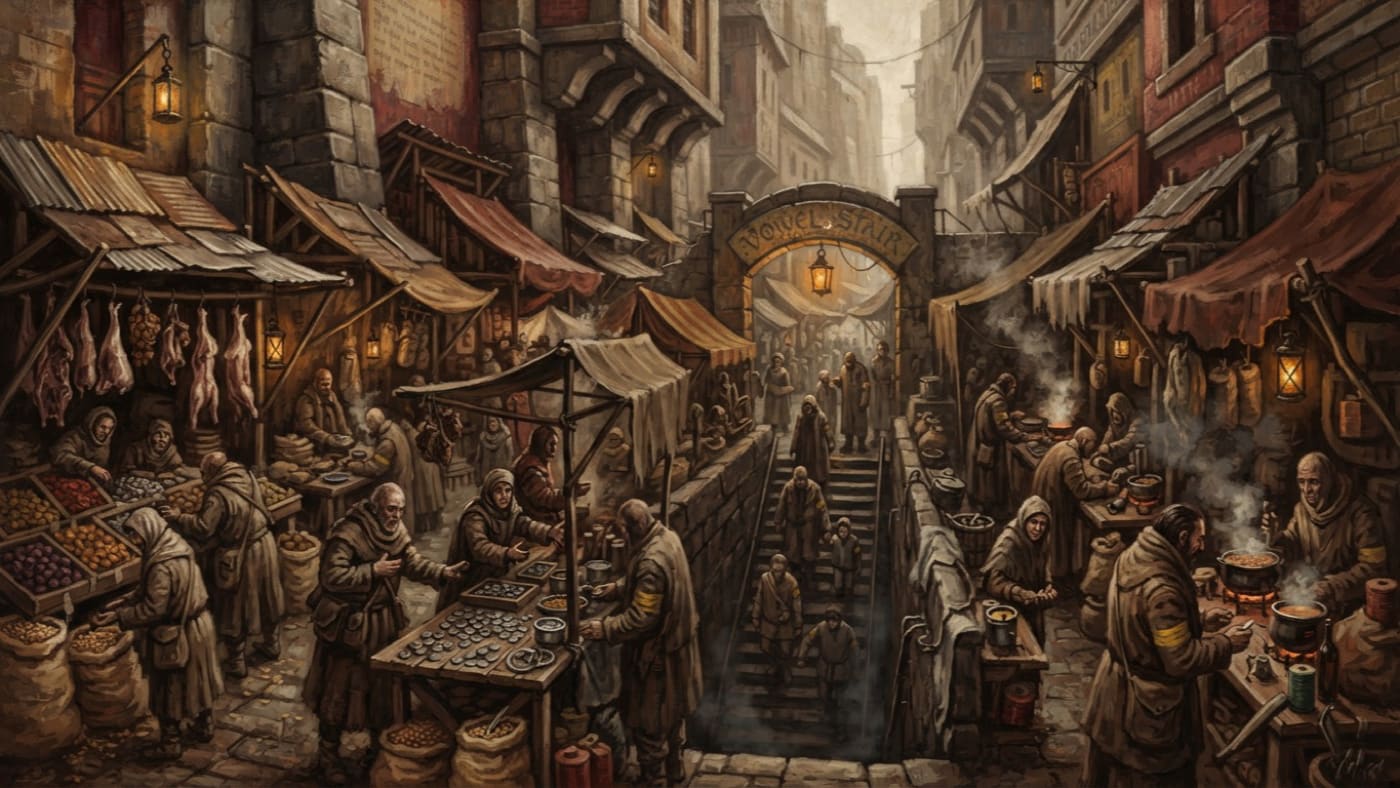
#On the Arcade's Situation
"A clean tongue buys a clean road." Peregrine Row proverb, most often quoted by men selling the tongue.
Peregrine Row was laid out by necessity and filled in by appetite. The Choir-Broker Hall holds the centre of the canyon road. The Bead Courts take the northern arcade, the Escort Yards the southern, and the Cistern Chapel the only natural hollow the stone allowed. Whatever remained became the Tinmarket Arcade: every recess under a hymn-painted eave, every lean-to wedged against a buttress, every yard of brick wide enough for a trestle and a man to stand behind it. It has no façade worth describing and no single roof. It is the gaps, licensed.
The materials are the Row's own. Sun-baked brick, salvaged slate, ropewood awnings, tallow-wax, hammered tin. The tin gives the arcade its name and its first smell, hot metal under a canyon sun. The second smell is spice rot. Both are lawful. Both, as will be shown, are required.
Beneath the stalls, reached by a staircase the locals call the Vowel-Stair, lie the Quiet Pens. A pilgrim may buy salted goat at the head of those steps in the morning and be processed at the foot of them by afternoon. The traders regard the arrangement as a feature of the premises, comparable to drainage.
#On Supplies and Payment
The Row's economy runs on delay. Passage east requires an escort contract. The contract requires a safe window. Safe windows are auctioned daily by brokers whose income rises with the wait. A pilgrim held three days at Peregrine Row must eat for three days, and the Tinmarket feeds him at whatever price the third day will bear.
The stalls trade in what the Pilgrim Roads consume. Dried provisions for the eastern canyons. Lentil mash ladled from iron pots, dried fruit, salted goat. Lamp oil, grain, cloth, ink, and spare cart parts for wagons that came down the switchbacks on three wheels and a prayer. For those whose contracts are already paid, real tea and honey-wax candies, the only sweetness on the road not sold under a grief clause. Water belongs to the Cistern Chapel and its ration clerks. The arcade sells everything a pilgrim needs to survive the wait for it.
Its customers are everyone. Stall traders and bead workers sit one rung above the pilgrims and two above the detained, and they live on that margin. Escorts provision here between contracts. Residents gather here because the Row has no other commons, and the canyon wind carries every word spoken under the awnings to someone paid to listen.
Payment takes every form the Row recognises. Coin. Water chits. Stamped paper contracts. Oath-notes from escort captains, worth exactly as much as the captain's next safe window. Bead strings, most dangerously of all, for the beads are denominated twice: once as money, once as sin. Bone counts for a minor offence, wood for a moderate one, glass for a grievous one. A pilgrim who pays for lamp oil with a glass bead has spent a grievous sin, and the Bead Courts will want to know where it went. The arcade does not reconcile. It accepts.
The Peregrine Row entry on which this filing relies previously described bead-count reconciliation as "voluntary."
CORRECTED by order of the Cantor-Auditor's office, Peregrine Row, A.S. 200. Reconciliation has been mandatory since A.S. 104. The correction extends to every arcade transaction settled in beads, whether or not the purchaser understood it to be a confession.
No rates are posted. The custom of the Row is general.
#On Aromatic Compliance
"Any scent strong enough." The operative standard, in full.
A local ordinance requires every stall in the Tinmarket Arcade to maintain what it calls aromatic compliance, defined as any scent strong enough to disguise the underlying odour of the detention pens directly below. The date of its enactment has not reached this office. Its effect reaches every nostril on the road.
The definition is a small masterpiece of drafting. It names no approved perfume, sets no inspection schedule and appoints no assessor. It asks only that the market smell louder than the prison. Hot tin qualifies. Spice rot qualifies. Whether the spice rots through neglect or through civic duty, the ordinance does not ask, and no trader has volunteered the answer.
What it conceals is lye and fear. The Quiet Pens are stone rooms holding between forty and three hundred souls at a time. Some recited deficiently. Some carried bead strings that failed reconciliation. Some held escort contracts that lapsed mid-passage, and some merely had faces a gate proctor disliked on a bad morning. The pens lie under saffron paint. The wardens who take prisoners down the Vowel-Stair wear saffron armbands, the colour of mercy, which the detained cannot see from inside.
The Quiet Pen Wardens act under the Road Chapter's authority and on the Broker Compact's budget. A processing fee is levied on entry, scaled to the detainee's assessed sin-count, passage status and ability to pay. Release requires full payment of accumulated fees or a service assignment: labour in the Bead Courts, labour in the Escort Yards, or labour sold onward to Line depots that ask few questions about consent. Families who come to buy back a relative's vowels must cross the arcade to reach the stair. The ordinance spares them the smell until the last step.
#On Counterfeit Syllables
The Tinmarket Arcade sells counterfeit syllable tokens in plain sight. They lie among the hammered cups and lamp-trimmers, cold to the hand, priced by the same unposted custom as everything else.
The distinction between the arcade and the black market is one of lighting. Below the Row, in the cistern tunnels the ridge lanterns cannot see, a separate trade moves forged escort vouchers, quiet-passes for slipping the gate checks, and false tokens of its own. The tunnels conceal. The arcade displays. Where the two trades meet, and by which passages, nobody has mapped for this office, and I distrust anyone who claims to have.
Peregrine Row keeps three red lines: forging a Road Chapter seal, teaching alternate Creed syllables, and moving relics without bead reconciliation. A counterfeit token, by its seller's careful reckoning, is none of these. It certifies nothing a proctor is bound to honour. It purchases no genuine absolution, for true Synod absolution after a public creed failure cannot be bought anywhere on the Row, at the arcade or in the tunnels. It commands no echo. Its value is the purchaser's confidence, sold back to him in tin at a markup.
Theft is the arcade's native crime, as fraud is the Hall's and extortion the Pens'. Bead strings, water chits and oath-notes are all portable, and the press under the awnings is close enough that a cut string can change necks between two stalls. Those who lose their beads to a thief must still reconcile them.
Somewhere in the tunnels a syllable forger teaches pilgrims to swallow the third syllable and breathe through the vowel. His trade is instruction, carried on below. Nothing in the record establishes that the tokens on the arcade's trestles come from his hand, and this filing does not assert it.
#On Hearing and Accounting
The road to the Vowel-Stair begins at the Gate of Clean Tongues. A pilgrim recites the Seventh Catechism. The canyon wall returns it two breaths later with one vowel shifted. The proctor hears both, man and stone, and must decide which belongs to whom. Training is supposed to settle the question. The quarterly detention quota settles it more reliably.
This is the Echo Creed, classified by the Bureau of Alchemical Standards as a Category Two Localized Acoustic-Doctrinal Disturbance and under continuous review since A.S. 143, the Year of Ash Rain. Its origin is unresolved. Its arithmetic is not. An altered penitential line raises a pilgrim's sin weight. The weight unbalances the bead total. An unbalanced total yields unreconciled status, and unreconciled status yields a warden, a saffron armband and the stair.
The same disturbance reaches documents. Contracts left overnight in the Choir-Broker Hall change by a vowel or a consonant, and the changed term is seldom in the signatory's favour. That is the Hall's affliction. The arcade's trestles, tins and spice sacks are not recorded as participating, and I decline to invent a haunted lamp-trimmer for the reader's entertainment.
The arcade takes no part in the hearing. It sits on top of the verdict and sells it lunch.
#On the Present Condition
Peregrine Row has held Amber status since A.S. 199, when a ledger leaked from the Broker Compact's internal audit indicated that certain "demonstration ambushes" in the eastern canyons had been contracted and paid for by the brokers themselves. The Road Chapter investigated itself and found no evidence of systematic coordination. The clerk responsible for the leak was remanded to the Quiet Pens for administrative indiscretion, which means he crossed the arcade on his way down. His status is filed as "processing."
As of A.S. 201 the arcade trades as before. The trestles stand in the gaps. The tin is hot by mid-morning. The spice rots to ordinance. Pilgrims waiting on a window buy oil and goat and dried fruit with coin, with chits and with their sins. Tokens that guarantee nothing sell steadily beside cups that hold water, and the Vowel-Stair takes its daily intake under saffron while the awnings above it argue over the price of cloth.
The ordinance remains satisfied. So does the Chapter.