

#On the Captain's Station
"Kline is not paid to insist. Kline is paid to patrol." — this Codex, on the Crownwright Diehouses, A.S. 201
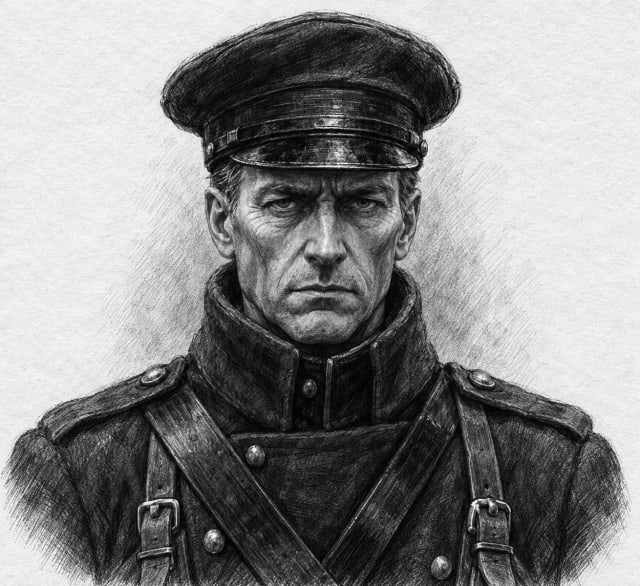
Warden-Captain Joss Kline holds no office the Mint-Chapter would admit governs anything. He signs no recall. He cuts no die. He sits on no bench of the Mint Tribunal and has never pronounced a face corrected. On paper, the Crownwright Diehouses of Sable Court are run by the Mint-Prelate, the Master-Engraver Council and the Tribunal, with each office auditing the next in perpetuity. On that paper the Warden-Captain is a man in a black sash who walks on roofs.
Real power in Sable Court sits elsewhere. The quarter's own assessments of where it lodges name three persons. Mint-Prelate Varo Sable holds lawful recognition, meaning what a coin is permitted to mean. Master Engraver Irena Coilhand holds the craft: which faces are struck into permanence, and under whose veiled fingers. Kline holds what remains, which is vault access, raids and disappearances. The first two decide who is real. The third decides who is found.
What remains is larger than it sounds. A recall signed in the Tribunal Hall of Corrections is only wet wax until someone at a gate refuses the coin. A facehold is a clerk's opinion until a black sash stands between the held citizen and the bread counter. The Chapter writes the sentences of Sable Court. The Wardenate carries them out at street level, and its captain sets the pace of that work.
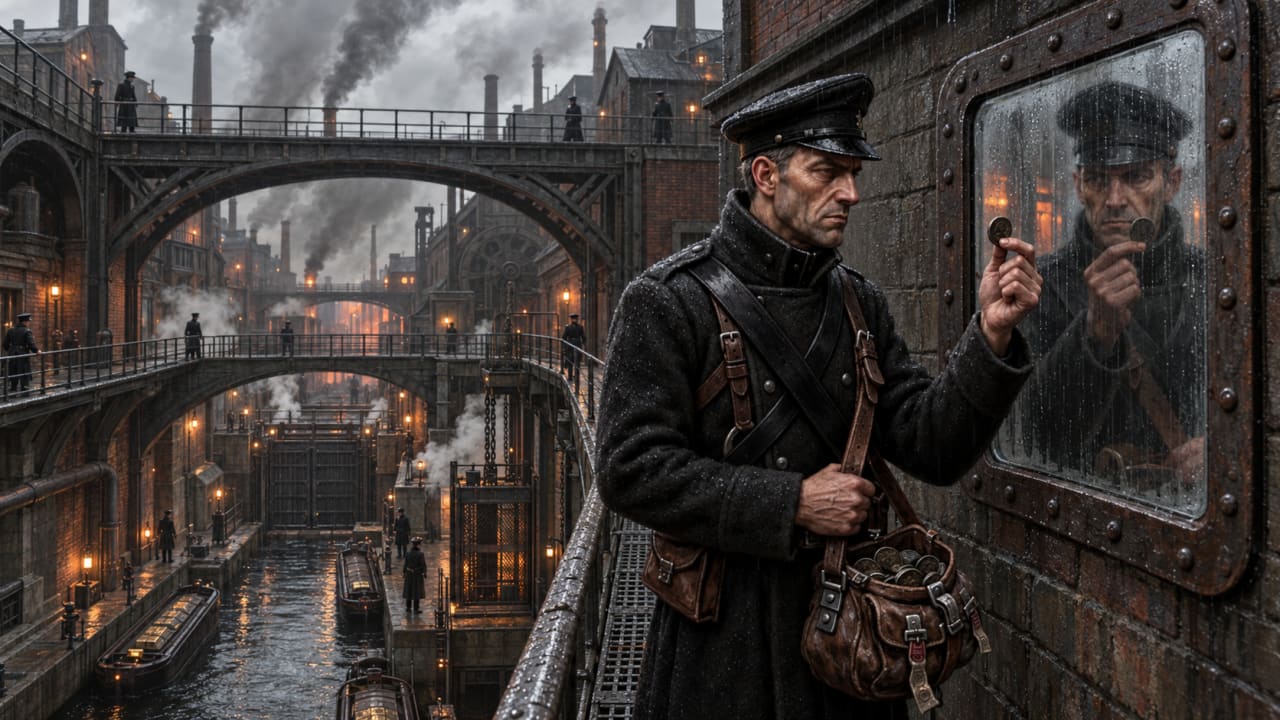
He is also an officer with an embarrassing private holding. Kline keeps a pouch of coins that he calls impossible. He has disputed the Chapter's view of the memory anomaly that these coins appear to illustrate. The Bureau of Doctrine has not changed its classification because of his objection, and this dossier makes no recommendation that it should. The dossier records him because he is useful, active and inconvenient, and in Sable Court that combination outlasts most others.
#On Gates, Walks, and Vaults
The Wardenate's public charge is to protect bullion. Its methods are raids, holds and disappearances, and its territory is everywhere a citizen of Sable Court has to stop, wait or be looked at.
Every entry to the quarter has its face-check clerks, its clean-hand inspection and its Warden toll. Guild papers, assay appointments, labour warrants and canal manifests are all presented, examined and presented again. The Mint-Chapter's Wardenate liaison lists gates, walks, seizures and crowd discipline as its business. That is how a chapterhouse describes the moment when a man's coin is taken from his palm, turned once under the clerk's lens and not handed back.
The Warden Walks run above the gates. These rooftop bridges carry the black sashes over the streets, so the patrols never have to come down among the coined. Slits are cut into the bridge floors. Some look onto the lanes, and some, by long and undenied custom, look into rooms. The Walks smell of wet stone and gun oil. Patrols move in counting circuits, timed routes whose boot-fall carries to the street below. A household in the outer arcs knows the hour without a bell. Three steps over the bakery, a pause above the dye-vat, nine steps to the corner of the soap-stall roof: the Wardenate has made surveillance into a calendar.
The vaults lie below. Lift cages drop into cold, dry air that tastes of iron filings and stored silence. Kline's leverage starts there, since whoever controls the vault doors controls what is counted, what is seized and what is later described as never having been present. The Black Canal enters through the southern wall as a single spur from the Rhine barge network to the bullion intake locks. The lock-house is garrisoned at every hour. When the quarter is threatened, standing defence doctrine is to shut the lock, choke the vaults and cross the fire of the watchwalks. Every Warden learns that sequence before learning anyone's name.
The Wardenate's private work, the correction schemes it runs behind its public charge, uses the same gates, walks and vaults. Seen from the street, a hold placed in good faith and a hold placed for a fee look the same. Both close the same door.
#On the Coins Without Plates
What makes the pouch impossible needs a short lesson in the chain it offends.

In Sable Court, and across the Theocracy, a face on a coin stands for a name, and the name opens an account in the Great Ledger of Souls. Since the Face Registry Compact of A.S. 94, four years after the Concordat of Strasbourg, every face struck into coin has needed a master plate. Since A.S. 102 those plates have been held in the Face Archive under triple lock and cross-referenced to the Ledger through the Bureau of Records. Losing a coin costs a man nothing, because coins are minted in batches. Losing his face costs him his place in commerce, confession, contract and memory. The coin is a copy. The plate is the original authority. The Archive's whole claim is that every lawful face goes back to a plate and every plate goes back to a soul.
The published account says each coin in Kline's pouch bears a face that corresponds to no living person and to no archived plate. Recalled faces still have their plates in the Archive's history, so these are not recalled faces. Clipped coins are shaved, not originated, so these are not clipped coin. They are images of persons who answer to nothing in the record, struck in metal and carried in a Warden's purse.
How many coins there are is unrecorded. So are their denominations, their makers, the dates and circumstances of their acquisition, any assay results and what they ultimately mean. This office lists those gaps because each is a temptation. A dossier that filled them would read more cleanly and be worth less.
The pouch also proves less than the Chapter fears or Kline intends. It does not show that the Archive has failed in general. It does not show where the coins came from. It does not show that they spend, or that they ever did. Nothing in the record exempts the pouch from the anomaly it seems to document. Faces drift on metal, and nothing has shown that the Creator exempts a captain's purse from what happens in a widow's drawer. A collection of evidence about altered evidence is still subject to alteration, and anyone who calls the pouch an infallible reference archive has never carried coin through Sable Court in the rain.
What the pouch does is make the Chapter's language difficult to sustain. The Mint-Chapter calls the memory anomaly minor and manageable. Kline disputes that. The Mint-Chapter's own account has him calling it otherwise "in rooms where men stop writing," and he has not got it written anywhere that matters. The classification has stood since A.S. 194.
#On the Choir and Its Permissions
Kline's work brings him into the underworld as reliably as it takes him onto the roofs. The Clipped Choir, the counter-mint of clippers, brokers, face-swap artists and canal assayers working out of Clipper's Market and the shadows of the Black Canal, is the quarter's oldest and best-organized crime. It is also the only institution in Sable Court, other than the Archive, that understands correspondence in detail.
The Choir's own published account describes his conduct toward them with unusual exactness. He hunts them "with almost tender precision." He trades with them, raids them, warns them and bleeds them. Each of those verbs is a separate instrument, and he uses each at the moment it pays best. The trade buys information. The raid reminds the Choir what the information costs. The warning keeps a source alive for the next season, and the bleeding keeps it frightened.
The same account says his impossible coins give him purchase on "every Choir throat he cares to squeeze." It does not say how, and this office will not invent a method. The Bureau of Purity will supply an interrogation rite of its own soon enough, with candles.
There is one plain reason why a criminal's expertise matters to an officer concerned with failures of lawful recognition. Face-swap artists cannot make faces out of nothing. That belongs to the Archive and to heresy with proper funding. What they do is borrow correspondence: a jawline from one recalled merchant, eye-spacing from another, softened with acid and circulated until a tired gate clerk believes it. Choir assayers test fidelity as closely as the Chapter's own assayers and with more practical motive. When a face appears that matches no plate, the Choir will notice before the Archive does, because a face nobody can borrow is a threat to the business of borrowing.
On two recorded occasions Kline has let a broker pass through a Warden cordon because the broker carried news of a face corresponding to no archived plate. The count is two. The brokers' names, the dates, the cordons, the words exchanged and what became of the brokers are all unrecorded. Two occasions are enough to show a practice and too few to show a policy.
Opening a cordon in this way does not make Kline a member, an ally or a pensioner of the Choir. The Choir's account is plain on this point: Kline does not trust the Choir; he trusts their fear. A cordon opened to an informer is still a cordon. The broker passes because his news is more useful to the captain than his arrest, and a broker who knows that knows exactly where he stands with the Warden-Captain.
This office previously advised that the Clipped Choir could be dismantled through market arrests and seizure of clipping instruments.
Corrected, as the Choir's own entry records, and repeated here for officers who skip faction tracts. Arresting clippers reduces clipping and leaves brokers, assayers, canal judges and plate thieves untouched. The Warden-Captain's recorded practice of trading, raiding, warning and bleeding is the working proof that in Sable Court the hand has to be worked, because the fingers can always be replaced.
#On the Emergency He Patrols
The Face Theft campaign began in A.S. 199. Citizens of Cologne's outer districts found their coins changed: familiar faces with wrong eyes, wrong mouths, a jaw that belonged to someone else. More than four hundred complaints reached the Mint Tribunal within three months. Then the complaints stopped, because the complainants could no longer remember what their faces had looked like. The Mint-Chapter ordered emergency recall across seventeen denominations, and recall produced exactly the confusion recall always produces.
Kline's work changed shape from that year. Warden circuits were doubled, so every counting route was walked twice and every slit in the bridge floors was watched twice as often. Doubt inspections were placed at every gate. The Assay Cloisters began testing face fidelity as well as metal, using blind clerks who compare the hymn-frequency of a struck coin against an archived plate they will never see. The Face Archive itself was sealed to all access below Mint-Prelate clearance.
That last order bears on Kline directly. The officer who holds the quarter's most awkward evidence about the Archive is barred from the Archive by the same emergency. Vault access is his leverage. The Archive is not one of his vaults. The Mint-Chapter has thereby protected its plates against a great many dangers, among them comparison.
Responsibility for the crisis is divided, and the division matters to a man whose work is deciding whom to squeeze. The Choir did part of it. Choir brokers supplied washed coins to three outer districts. Choir assayers certified two counterfeit batches that passed outer-gate inspection, and gate inspection is Warden business in the plainest sense. The record names no gate, shift or officer, and neither will this dossier. The Choir did not do all of it, and its own Candle Tribunal has since banned traffic in faceless blank metal on pain of cold coin, which is what frightened specialists do when the danger is bigger than their trade.
Other parties are claiming the crisis for their own purposes. The Unface Society, a heretic circle working from the furnace tunnels beneath the Anneal Courts, claims authorship. The Bureau of Purity doubts that six engravers and a disgraced archive scribe could manage a contamination this wide, and it has sent an Inquisitor-Assayer under File 1104-SC. The Mint-Chapter has denied the master die in four separate depositions, each more emphatic than the last. The Bureau of Engineering wants to reopen its sealed A.S. 187 survey of the vaultwork beneath the Black Canal.
Each of these parties puts pressure on Kline's patrol. Purity wants a burning, the Bureau of Records wants a list of names, Engineering wants a stair down, and the Chapter wants calm. None of them has asked for the contents of a Warden's pouch. Nothing establishes that his coins were struck from the master die, or that the master die exists, or that the pouch has any connection to the canal vaults. Keeping those questions apart is the dossier's main discipline, and the quarter will not keep them apart for it.
#On His Test and the Glass
The quarter's own assessment of its three real powers gives each holder a fear. Varo Sable fears a die bearing his own unauthorized face. Irena Coilhand fears losing the feel in her fingers. Joss Kline fears a counterfeit that passes his own test.
The assessment does not describe the test, and this office does not know it. The fear is enough to read the man by. An officer whose authority depends on telling true metal from false, at a gate, in the rain, with a queue pressing behind the suspect, cannot survive a forgery he would himself have passed. If such a coin exists, every hold he has placed becomes a question, and so does every release, including the two brokers.
He works accordingly. The published accounts give him two registers. On the Walks he says nothing to anyone. With the Choir he trades, warns and bargains. Neither is the whole man. The silence on the roofs and the dealings in the canal shadows are equally professional. Precision is the one quality the record gives him without qualification. Tenderness, where the Choir's account mentions it, refers to his precision and says nothing about his heart.
During the late watches Kline has been seen holding individual coins up to the mirrored inspection windows and studying the reflections.
The glass in question is Crownwright work. It lets a watcher inside see out while it shows a watcher outside his own face. The Bureau of Doctrine spent eleven years on the theology of that arrangement and then classified it as architecturally devotional. A Warden on the Walks who lifts a coin to such a window therefore sees, at least, the coin and his own face behind it, wet with rain and lit by whatever the furnace haze lets through.
What else he sees he has not reported. The Bureau has not asked. One illustration in this Codex has the reflection subtly wrong. That was the artist's suggestion; an illustration is not a witness.
#On the Present Holding
As of A.S. 201, Warden-Captain Joss Kline remains in service within the Crownwright Diehouses while the Face Theft investigation goes on. He walks the doubled circuits. He holds the vaults. He hunts, uses and frightens the Clipped Choir in roughly equal measure. He carries the pouch. He disputes the Chapter's account of the anomaly. When the night is late enough, he holds metal to the glass.
The Mint-Chapter has no reason to remove him. His raids justify its gates, his cordons supply its intelligence, and his dissent costs it nothing while Doctrine's classification stands. The Bureau of Doctrine has no reason to promote his objection. A Category Two anomaly can be managed by officers like him, and a Category One would require officers like me. Purity has not yet found a use for him, and has therefore not yet found an accusation.
The useful course is to leave the evidence where it is: in a Warden's pouch, uncatalogued, untested by this office, and carried along the roofs of Sable Court in the hand of a man who is paid to patrol. If the coins mean what he fears, the Bureau will hear of it through the Archive, the gates or the Ledger. If they mean nothing, the Bureau will have spent nothing on them.