

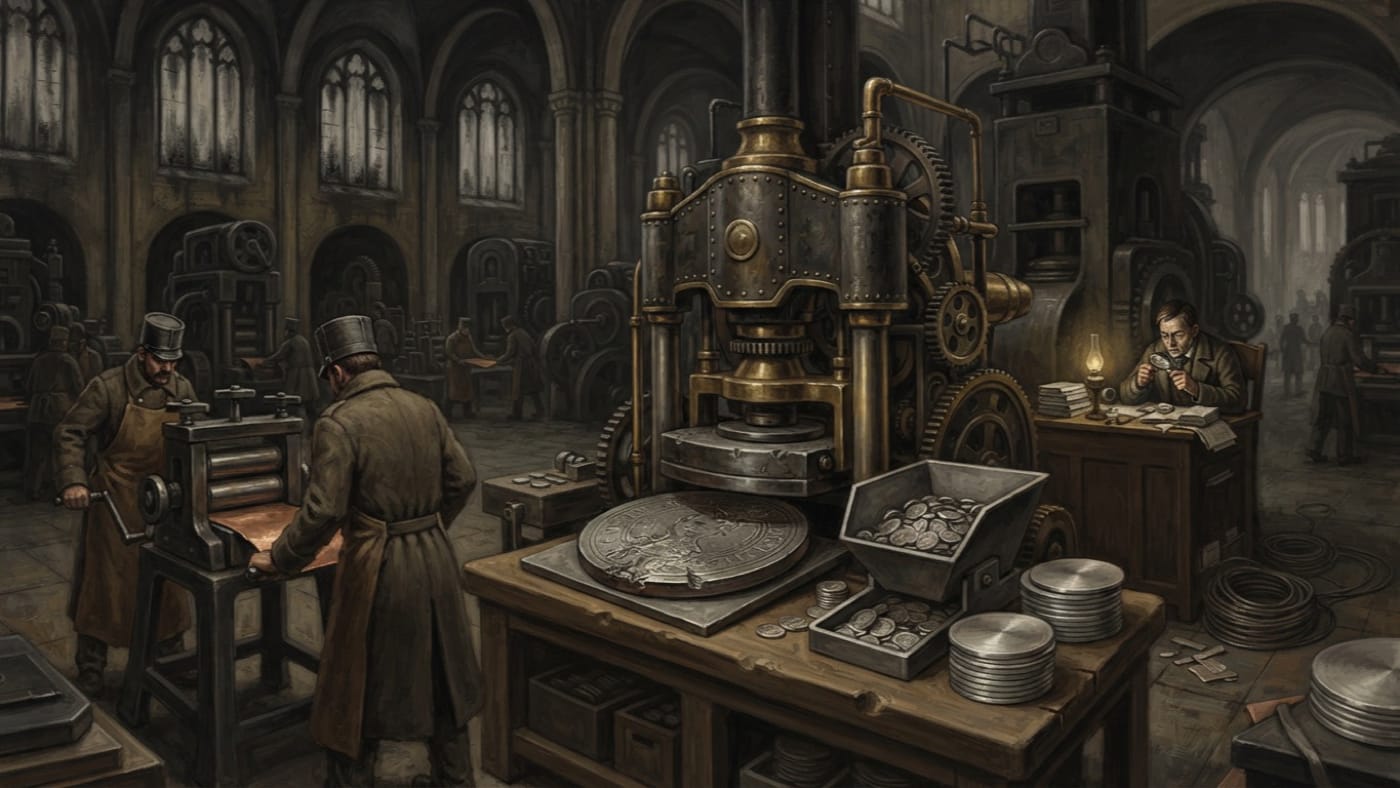
#On the Face Withdrawn
A man who has been unfaced still has a face. It sits where it always sat, above the collar and below the hat, and it still works perfectly well for weeping. What he has lost is its authority. Somewhere in Sable Court that face has been struck from plate authority and withdrawn from active denominations, and the coin that bore it has been replaced by blank, corrected or reassigned issue. The Mint-Chapter calls this its final instrument. The Crownwrights have a craftsman's contempt for euphemism, and they call the person left standing an unface.
This tract is a documentary survey compiled in A.S. 201, which is 1911 CE. That year belongs to the survey. No record I have examined gives the year unfacing was first ordered, and I will not invent one from the nearest convenient catastrophe. The Face Registry Compact of A.S. 94, under Mint-Prelate Albrecht Sable, bound face, name and coin into one instrument. The Compact is an institutional milestone. Nothing in the record says it also invented the final withdrawal.
#On What Is Withdrawn
The machinery has to be understood before its silences can be. In the Crownwright Diehouses of Cologne, the Crownwright Guild cuts the dies by hand and the Chapter licenses the strike. The Face Registrars keep plate, coin and the Great Ledger in agreement, and the Mint Tribunal hears the disputes. Every face struck into coin needs a master plate in the Face Archive, and every plate answers to a Ledger number. The coin carries the face and the face confirms the name. The name opens the account, and the account is what admits a citizen to wages, a lease, marriage, the tithe and a burial category.
Unfacing cuts that sequence at its source. The published account names three removals: the face loses plate authority, it leaves the active denominations, and the coin that bore it is replaced. The account also names three kinds of replacement. Blank issue carries no face. Corrected issue carries an amended one. Reassigned issue carries something, and the record does not say what, or whose. I have asked. The question was received, stamped and filed in a drawer that does not open from my side of the counter.
The steps between the order and the blank are also unpublished. Who strikes the plate, at what bell, before which witness and under what seal are particulars the Chapter keeps to itself. I keep them too, by the simple method of not having them.
#On Three Instruments Not to Be Confused
Clerks blur the Chapter's instruments because it is convenient. The people who suffer them blur them because they have not slept. The Bureau may do neither.
A face recall orders the surrender of coins bearing a disputed face. The Chapter's own list of occasions runs from a disputed plate or a suspected counterfeit, through debt, inheritance, marital petition and anonymous accusation, down to the bad luck of standing near a larger investigation. Once the order is out, merchants stop taking the coin, employers suspend wages, landlords question leases and bread sellers refuse change.
A facehold is the lesser instrument, and the interim one. It freezes exchange pending review. It may last a bell, a day or six months, or it may last until everyone who cared has died and the file can be closed as resolved by attrition. It reaches no verdict.
Unfacing is the final instrument. It is the only one of the three whose published description ends with the face gone from authorized issue.
Every facehold is the first rung of an unfacing, and every recall the second.
Corrected. No statute I have found sets out that ladder. A hold may be lifted. A recall may end in correction. The record calls unfacing final, but it does not call it inevitable, and it does not list what a Tribunal must find before ordering it.
The one Sub-Registry extract usually quoted on this subject proves the point, and it embarrasses anyone who quotes it carelessly. It records a temporary hold on a father's face pending denomination review. The children could not buy bread with their father's coin. By the third bell the mother could not recite his full name-history. The neighbours' testimony failed once the coin was surrendered. The disposition is redacted. What the extract records is a hold, filed under a recall heading, with no verdict visible. Anyone who cites it as proof of what unfacing does is citing a different instrument with an unknown ending. The household stays unnamed here, as the Chapter left it.
#On the Doorway
The Chapter's own published account reports what follows an unfacing, and I give its particulars without improving them. Families remember poorly afterward. Witnesses hesitate. Marriage contracts blur. Debt claims mutate. The account offers one picture, and it is the most terrible sentence the Chapter ever let into print: a man standing in his own doorway while his children argue, with real terror and decreasing certainty, about whether he used to belong there.
Look closely at what the account says and what it leaves out. It says families remember poorly. That is a matter of degree, and it does not claim that every unfaced man is wholly forgotten. It says contracts blur and claims mutate. Those words describe what the parties to a contract or a debt run into afterward, and they do not say whether the ink itself has moved or only the confidence of the people reading it. The account names no household, no year and no Tribunal docket. It offers the doorway as typical, and it may well be. A Hieromnemon who filed it as a case record would deserve the Index.
The commercial consequence needs no metaphysics at all. Nobody will enforce a marriage contract that cannot be checked against a recognised face. A debt claim against a face with no plate authority has to attach to something else, and the Chapter's account does not say what. Creditors, being creditors, have doubtless found out.
#On Category Two
In A.S. 194 the Bureau of Doctrine formally classified the memory effect as a Category Two Localized Identity-Scribal Anomaly. A.S. 194 is the year of the classification. It dates the Bureau's paperwork. It dates neither unfacing itself nor the first family to forget a father.
Read the designation the way a clerk would. Localized means the effect is said to stay where it was put. Identity-Scribal means it touches both persons and documents. Category Two means it was serious enough to be given a number and too inconvenient to be raised any higher. The classification describes a pattern of reports and states no cause. The Bureau has filed no explanation I would sign. Older lore of the Crownwright craft holds that the engravers can erase faces from money and from memory, and talk in the quarter calls coins memory anchors. Those are claims about a craft. They are no finding on how this instrument acts on any particular household.
The Mint-Chapter calls the anomaly manageable. By the Chapter's own account, Warden-Captain Joss Kline calls it something else in rooms where men stop writing. His dissent is therefore evidence of an unusual kind: his opponents report it, and nobody has written it down.
#On the Present Holding
As of this A.S. 201 survey, the Chapter keeps its instruments, and it keeps its Archive under triple lock. The Face Theft crisis, which began in A.S. 199 and continues now, has brought an emergency recall across seventeen denominations. That is a recall of denominations, and it is no individual unfacing. Readers who see seventeen ruined doorways in it have mistaken a currency measure for a sentence. The two may share a strike floor. They do not share a docket.
At Clipper's Market, the Clipped Choir will warm a held husband's coin so his household gets one more day of bread. The record does not say whether any broker, face-touch or basin hymn can restore a face that has been withdrawn from plate authority. I advise no widow to pay for that experiment on my word.
The Chapter has published no procedure for restoring the unfaced. In my own note on the Compact I allowed that an unface may petition, and that the fee is payable in coin. Nothing in the published record shows a petition succeeding, and nobody has explained where an unface is meant to find spendable coin.
The doorway is still in the Chapter's account, unnamed and undated. The argument inside it has no recorded verdict.