

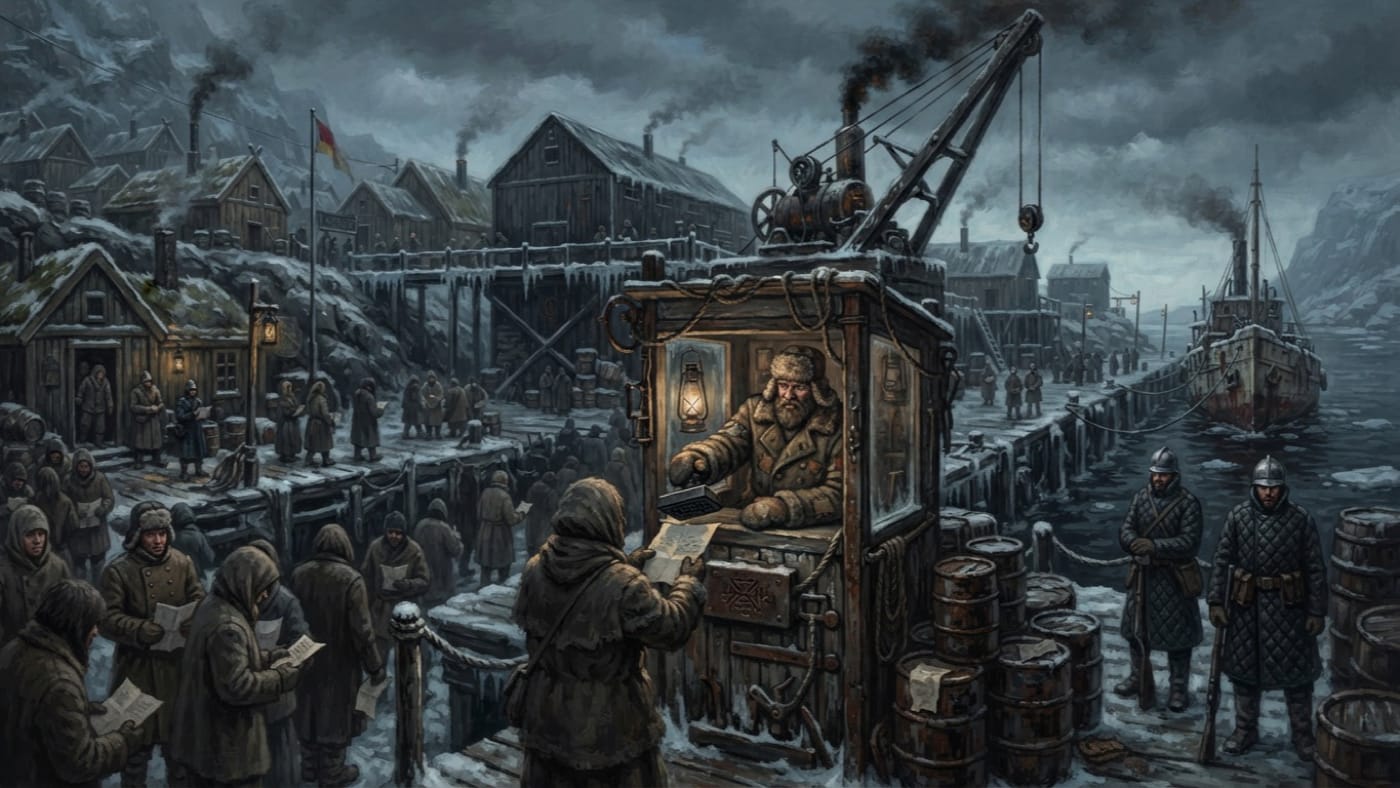
#On the Name and Its Uses
A sheet of rag folded twice, and on it the question of who may move.
The Bureau has a word for the documents that carry a traveller from one Northern settlement to the next. The word is warm-papers. The Bureau never explained the adjective when it adopted it, and I have found no file in which anyone asked. In the Northern administrative sense, a warm-paper is any stamped sheet that a gatekeeper at the far landing will accept: a passage permit, a letter of standing, an elder's mark on a scrap that came north in a grain hull and went damp in a coat. There is no single form and no central office that issues it. There is only the stamp, and the question of whose stamp it is.
At Hrafnvik the word covers more. The shrinefjord calls any southern document that buys survival a warm paper: identity proofs, passage permits, exemption writs, ration stamps. A Bureau clerk uses the term for movement. A Hrafnvik mother uses it for her children's place in the count. The Norwegian Sea entry records both meanings and lets them stand. That is correct, and I do the same. Both usages are accurate. They are two ledgers kept in the same ink, and the harm comes where they overlap.
#On the Paper and the Passage
Paper comes north. Permission does not come with it.
The Fractured North has no paper mills, and the Bureau of Records insists on paper documentation. The whole trade sits between those two facts. Fish and seal-oil go south. Grain, iron and paper come north. At Hrafnvik the hulls also carry medicines and documents already finished, stamped and folded by southern hands. The stock is southern and the recognition is local. A community may print on imported sheets, copy on them or forge on them without contradicting the absence of a mill. What it cannot do is make the sheets. In every winter when the hulls run thin, Strasbourg holds more firmly the material of its own authority.
Recognition belongs to the elders. A warm-paper that carries a traveller between settlements must be honoured at the far landing, and the far landing answers to its own clan gatekeepers, its own count and its own grudges. An elder's stamp admits a stranger to a settlement the way a confessor's absolution admits a penitent to the rail: by being recognised by whoever stands there. Hrafnvik's gatekeepers keep shrine bead-clerks at their elbows. By local report they accept a further consideration in salt, needles, spare wicks or more warm paper. Unstamped southern coin is refused at the landing because it causes disputes.
None of this governs the ice. A paper accepted in perfect order is still a sheet of damp rag in a mittened hand when the ice road is rotten, the narrows chain is drawn, or the cliff path needs a guide nobody will lend. Acceptance is a judgment of the document. Passage is a judgment of the weather, and the weather keeps no register.
A southern clerk who confuses these papers with the Transit Writ should be corrected gently and then reassigned. The Transit Writ is a specific Synodal instrument for ordinary civilian passage between zones, with its own procedure and its own office. Warm-papers are a regional umbrella under which a dozen kinds of sheet shelter from the wind. The Writ's rules stay south of the Skagerrak.
#On the Price of Recognition
A stamp weighs nothing. The barrel it costs weighs about as much as a winter.
At Hrafnvik, the broader warm paper is a household's claim to its own existence. An identity proof decides whether a name is counted. A counted name can claim grain, inherit a render share, or prove to a southern quartermaster that a widow's husband died and did not desert. An exemption writ excuses a household from a fast it cannot survive. The fast calendar does not shrink to match a thin seal week, and a household that breaks a fast without sanction can lose its lamp-aid. A passage permit can send a son south before the freeze, or out from under a draft he will not live through. A ration stamp claims grain from a skiff. It is worth more than the grain, because grain can be stolen and a stamp can be argued over.
Genuine papers exist. Exemptions leave the Shrine Chapter under Prior Malthus's seal. Genuine permits and stamps come north in the southern maritime trade out of Hamburg and the ports that feed it. The Warm Paper Brokers at the Slipways deal in the confirmed crooked end of the same traffic: forged exemptions for oil barrels, counterfeit passage writs for lamp-time. Few Hrafnvik papers are forged, and no two are interchangeable. The Bureau treats them all as one contraband because that is easier to file.
Payment comes out of warmth. A barrel rolled downhill for an exemption feeds the children this week and shortens the lamps next month. Lamp-time pledged for a passage writ sells nights the household has not yet lived. The rate moves with the temperature, the seal harvest and whoever needs what from whom. I found no tariff during my inspection of A.S. 197 and have seen none since. One payment is barred. Clan prohibition protects a child's lamp, and a broker who takes a child's lamp-pin may find the whole longhouse at his door to collect.
Three authorities stand over the transaction, and none of them countersigns for the others. Malthus and the Chapter hold the stamp, the exemption register and the fast calendar. Elder Sigrun Half-Wick and the Clan Moot hold the render schedules and the communal oil. Rauk One-Eye and the Winter Watch hold the escorts and decide which route is walked. A paper can satisfy the first and still meet the other two at the narrows. This arrangement belongs to Hrafnvik. I would not wager a dry stocking on finding it intact in the next fjord.
A Northern Office abstract of A.S. 195 described Hrafnvik's oil allocation as "managed jointly by Shrine Chapter and Clan Moot under Synodal advisory order."
Corrected after direct inspection, A.S. 197, as already entered in the account of the Warm Paper Brokers. The Shrine Chapter blesses, stamps and reports. The Clan Moot allocates. A warm paper drawn on the Chapter's seal is paid for out of the Moot's count.
#On the Investigation
Every inquiry needs a door. This one needs a paper to reach the door.
The published Northern account records that the Bureau of Purity opened its investigation into forged Northern transit documents in A.S. 174. It records no arrests. I hold no independent case file and repeat the account as the Northern administration filed it. By the present year the inquiry has run for twenty-seven years, long enough for a suspect elder to have trained a successor in the use of the stamp.
The obstruction is procedural and flawless. An investigator who suspects an elder of forging warm-papers must travel to the elder's settlement. Travel between settlements requires a warm-paper, and a warm-paper requires the elder's stamp. The Bureau of Purity has burned men on thinner evidence. In all those years it has never drafted a form by which a suspect certifies his own investigator, and no elder has offered to draft one for it.
Two cautions belong in the file. The inquiry's opening date tells us when Purity began to look. It does not tell us when warm-papers began, and it does not date the Paper Hut. Hrafnvik's brokers arrived at a time no ledger I have seen records. Malthus came to the Chapter in A.S. 192, eighteen years after the inquiry opened. He did not inherit the investigation. He inherited the weather in which it stalls.
#On Present Application
Where the seal catch thins, the paper thickens.
By A.S. 201, the reports reaching the Northern Desk describe a Hrafnvik more dependent on southern paper than the one I inspected. The seal seasons have thinned. The fasts have not, and every fast the Chapter keeps raises the price of the exemption that excuses it. Königsberg still burns Northern oil and still expects it in barrels. Genuine papers still come up the strait in grain hulls, and counterfeit ones still cross the planks at the Slipways. Households still pay for both in oil they will want in February.
The limits have not moved. An elder may refuse a stamp, a gatekeeper may refuse a stamped paper, and the Watch may refuse the road. A warm paper confers no immunity and no citizenship, and it guarantees no safe crossing. Where the identity ledger and the travel ledger share a word, a forged stamp can misdirect more than a traveller. The Norwegian Sea entry warns that it can send a rescue party to the wrong door. I record the warning. I record no instance.