
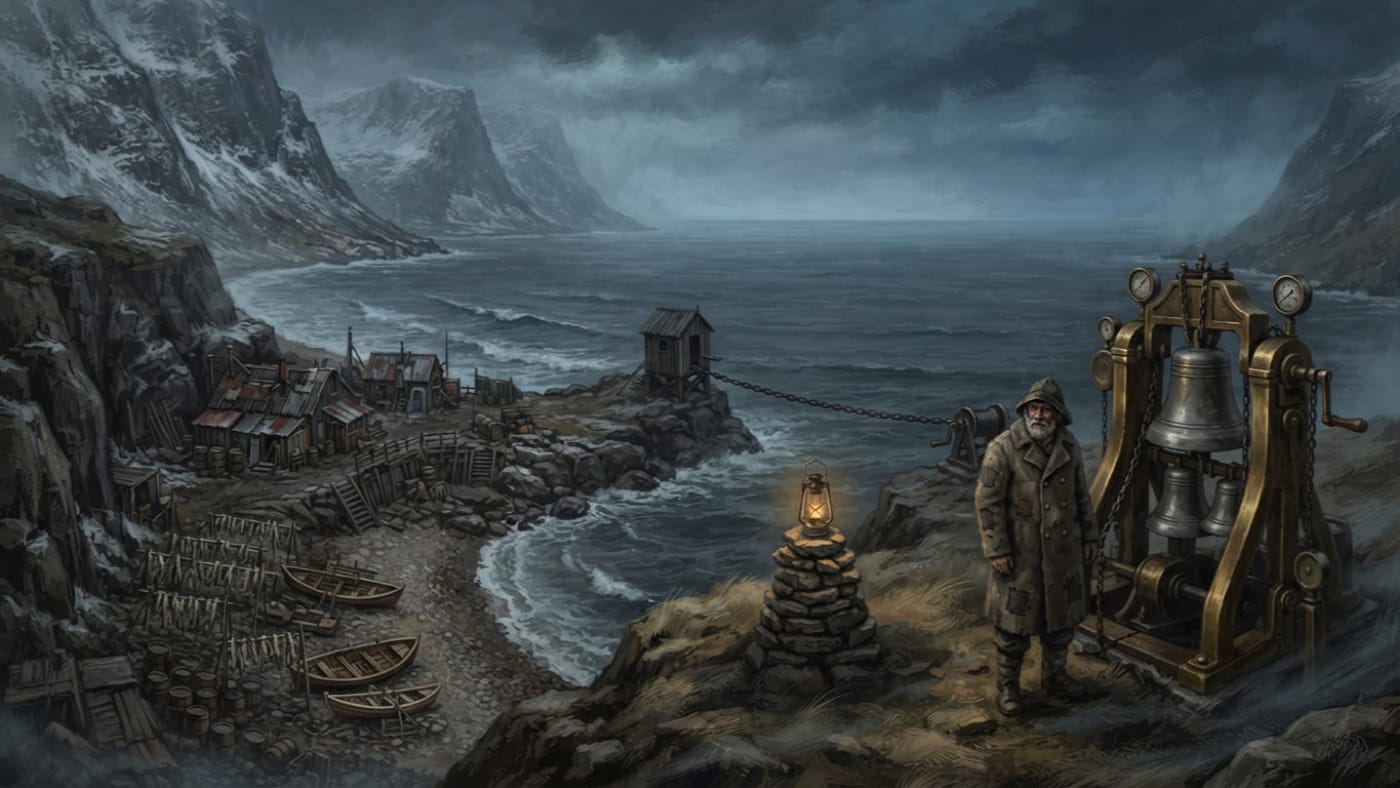
#On the Water and Its Uses
"A lamp is a promise." — Saying of the Hrafnvik coast
The Norwegian Sea is the cold, open water off Norway's western face. The Fractured North lives with its back to the mountains and its face to that water, since the water is the only direction from which anything edible arrives. The Bureau of Records maps the sea as a margin. The coast uses it as larder, road and parish wall, in that order of urgency.
The arrangement takes one sentence to describe and a lifetime to endure. Beyond the fjord mouths the swell runs long and grey and offers no shelter whatever; within them, between walls of wet rock, the water stills enough to permit a slipway, a smoke-hut and a few households on the shingle between cliff and tide. Every settlement on that coast is built on the seam between those two waters. The open sea feeds them. It also bars the grain barge, the inspector and the supply convoy, and for most of the year it bars the Bureau's correspondence too, which the households bear with a fortitude I have rarely seen in Strasbourg.
The Lore Book records that the seas which once carried raiders now serve the North as a barrier, hemming its people in from commerce and corruption alike. I endorse the sentence. The Bureau reads it as praise of northern virtue. It is equally an audit of the Synod's supply office, and the supply office has not asked for a copy.
#On the Fisheries
The fisheries are the reason anyone lives there at all. The published survey of the North groups the North Sea and the Norwegian Sea together as the waters that yield cod, herring and halibut enough to feed the settlements and leave a surplus for southern trade. The Bureau has never established which water yields which fish, in what season or in what quantity. I will not improve on its ignorance by guessing. A Hieromnemon who invents a catch-figure is no better than a fisherman who invents a psalm, and the fisherman has the better excuse.
What the record does establish is the diet: fish and seal-flesh, meagre in a good year and absent in a bad one. Grain does not grow on that coast. Everything a household eats from autumn to spring was hauled out of cold water by people whose fingers had stopped reporting to them, gutted on the shingle, salted, hung, smoked or packed into stone pits, and counted. The counting matters. At Hrafnvik the families owe oil, wick-dues, watch-hours and fast days, and the line between a fast and a famine is drawn by the sea, not the shrine. The Synod's chapter there calls the fasting voluntary penance. In a thin season the coast calls it January, and both parties stamp the same ledger.
The sea decides when a boat may go out. The guide decides whether it comes back. Northern authority belongs to the elders who know where the fish run, when the weather turns and when the narrows will close, and that knowledge exists nowhere in writing. The Bureau of Records finds this offensive, and the elders find the Bureau's offence entirely bearable.
#On Cargo and the Narrows
Surplus leaves by water, which is the only way it can leave. Fish goes south, and so does the produce of the seal: rendered oil in barrels, wicks, cured hides. North come grain, iron tools, medicines and paper, the last of which the coast cannot make and the Bureau will not stop requiring. Hamburg takes in a great deal of what Scandinavia sends and passes it east along the Northern Corridor. Beyond that the record is silent. The North's oil reaches Bastion-Königsberg through intermediaries, and no Bureau chart I have seen names the route, the hulls or the hands. The intermediaries prefer it that way, and on this one point the Bureau has proved remarkably accommodating.
Two kinds of levy must be kept apart. The first is local: at Hrafnvik every household owes oil and wick-dues to the clan and the shrine, recorded in the shrine's ledgers, notched into barrel staves when a storm makes paper useless, and enforced by the withdrawal of communal light. The second is southern. The Bureau of Tithes has tried six times to tax the export trade. Six times the shipments stopped until the tax was withdrawn. The coast taxes itself, the Bureau's tax does not hold, and the two facts should never be confused in a report to Strasbourg.
Every cargo passes through a narrows. At Hrafnvik this is a choke of ice and tide, chained across, which governs every shipment in or out. Elder Sigrun Half-Wick sets the render schedules and decides what there is to send. Prior Malthus holds the papers. Watch Captain Rauk One-Eye decides who is escorted, and on the ice that amounts to deciding who is rescued. A skiff that arrives at the chain without all three has arrived at a wall.
The papers need a word. The coast calls them warm papers: permits, exemptions and proofs of identity that come north in the grain trade and are rationed like medicine. The Bureau uses the same phrase for the transit documents that carry a traveller between settlements. Both meanings hold, and the overlap does real harm. A family can trade oil for the stamp that proves it exists, and a forged stamp can send a rescue party to the wrong door.
#On the Watch Above the Water
Governance on this coast is conducted from the shore and directed at the sea. The clan moots decide. The Priors appointed under Synodal authority say Mass, issue papers and send reports to the Bureau of Doctrine, and they govern nothing, a posting they endure with varying grace. Since A.S. 92 the Bureau has classified the North as compliant in substance and deviant in form, and it extends that classification to the coast without troubling to extend it to the water. Zone 8 is a ruling about people. The Norwegian Sea has been asked for nothing.
The Watch keeps the shore. Its people stand rotations on the cliffs, tend the signal cairns, mark the lamp-coded paths and work the narrows chains. They read tide, fog and the colour of the water with a fluency the Bureau of War cannot certify, because the Bureau of War has no examination for it.
The coast also reports things it cannot account for. At Hrafnvik the inhabitants describe a fog that answers: prayers come back from it wrong, lamps gutter in still air, and names are spoken that no one said. Their rule is short. If the flame leans seaward, do not follow your own thoughts. I record it as local observation and local testimony. On the cliff above that fjord I heard the Watch ring an old sequence while fog stood at the narrows, and I watched the fog withdraw. Rauk One-Eye afterwards called it courtesy. That word is his interpretation, and I enter it under his name.
None of this licenses the conclusion that the Grey holds the Norwegian Sea. The Grey belongs on the record to the Baltic approaches opposite Königsberg, under Absolute Suppression, and it is distinct from the Nameless Tide at Brest. The Bureau has not certified what moves in the western fog, and this entry certifies it no further. The northern bells ring tunings older than the Bell Codex the Synod ratified in A.S. 115. Whether they can be harmonized with it remains unresolved under Investigation 447-N. One demonstration at sea is held in a sealed file. I may confirm that the file exists.
ERRATUM — BUREAU OF RECORDS, CARTOGRAPHIC SECTION.
General atlas entry, Scandinavia: Spiritual Character — "Heretical, pagan, dangerous."
Corrected: the inhabitants of the northern coast worship the Creator, acknowledge the Great Deceiver, and keep the liturgical year as their latitude allows. Their status is "compliant in substance, deviant in form," as filed by the Bureau of Doctrine. The word dangerous is retained and now refers to the water.
#On the Present Condition
The sea has not changed, and that is the trouble. It feeds the coast exactly as well as the coast can still work it, and the work depends on things that cannot be shipped north with the grain: sound boats, crews who know them and guides who carry fjords, currents and weather in their heads, because nobody has ever written that knowledge down.
Those people are leaving. The published survey records the young going south to Königsberg for coin, to Hamburg for the shipyards and to the Line for the Bureau of War. They seldom return, and the watches grow thinner. A boat without a crew is firewood with a keel. A narrows without a chainman is a drowning someone has scheduled. When a guide leaves for Hamburg, what she knows of the coast goes with her and is lost to the Bureau's records.
Meanwhile the Synod's demands on the coast stay where they were. It still wants oil at its own terms and papers in its own form, and it still requires reports from Priors whose letters wait at the narrows for the ice to allow them through. Since the Concordat Strasbourg has treated the northern coast as a place that will always be there to be audited. It will be there for exactly as long as someone is willing to row out past the fjord mouth before dawn, haul cold line with dead hands and row back.