

#On the Name and the Paper Hut
Strasbourg prints paper. Hrafnvik burns oil. Sooner or later someone was going to set up a table between them.
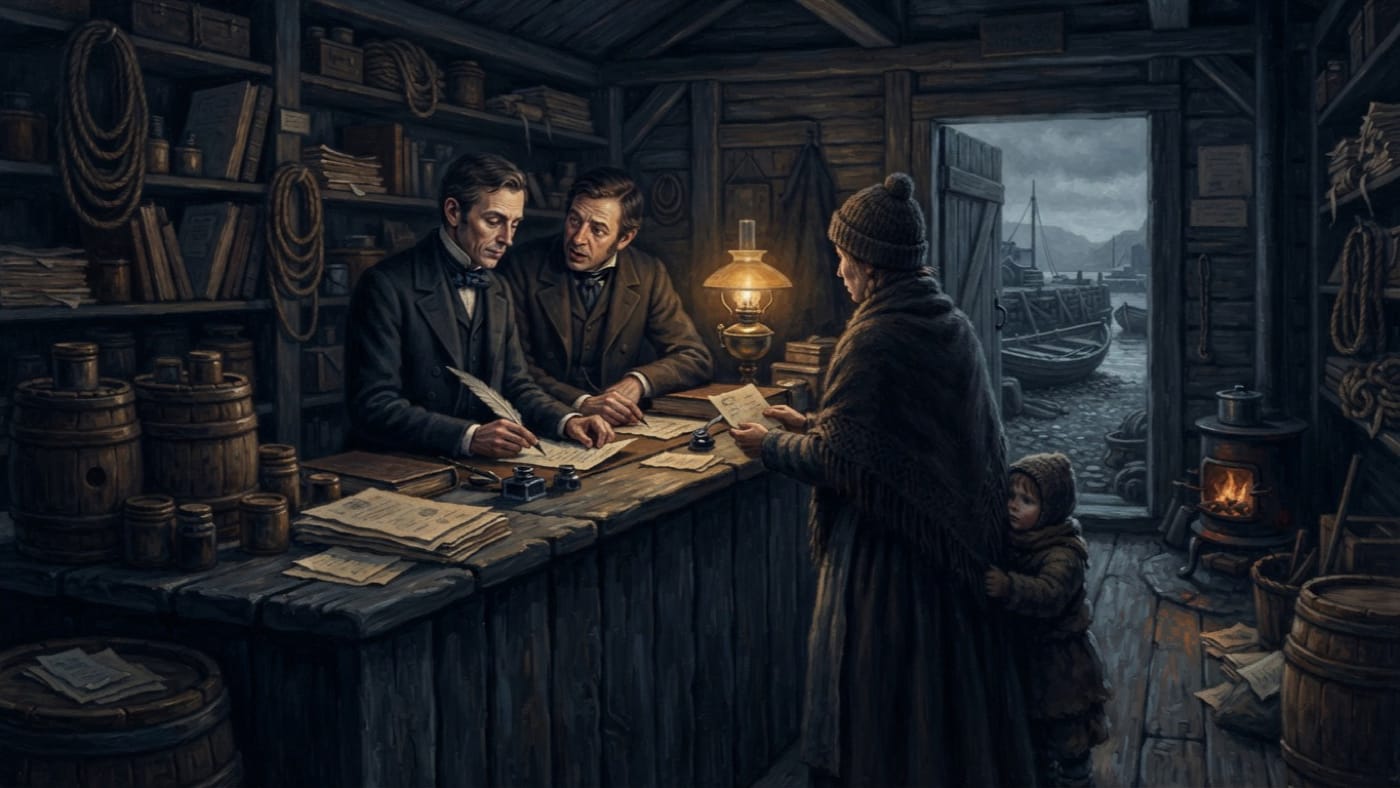
The Warm Paper Brokers are a cartel of document-dealers who work out of a single timber building at the Slipways of Hrafnvik, where the skiffs are hauled up the shingle and the tar never quite dries. They call their trade legal assistance. A household that cannot read a southern form, cannot meet a southern deadline, or cannot persuade a southern clerk that it exists may carry its trouble to the Paper Hut and leave with a paper. What it leaves behind is oil.
The name is local. Hrafnvik calls any southern document that buys survival a warm paper: identity proofs, passage permits, exemption writs, ration stamps. The warmth is a figure of speech, and an accurate one. A paper that excuses a house from a fast keeps food in the pot. A paper that sends a son south keeps him off the cliffs. A ration stamp is a winter meal folded small enough to hide in a boot. Nobody in the fjord thinks the paper itself gives off heat. They believe it can keep them warm, and in the Fractured North that belief costs more.
I stood inside the Paper Hut during my inspection of A.S. 197. It smells of ink and damp wool, of tar carried in on boots, and of the particular fear of men who have come a very long way to commit one narrow kind of fraud. Barrels stand along one wall, some notched, some freshly scraped. A counter of split planks divides those who need from those who sell. On the customers' side, the floorboards are worn pale by waiting.
The brokers are mostly southern men, with clean hands, quiet coats and the patience of usurers. They wear no badge. They answer to no name I could enter in a register. When I asked one of them for the cartel's charter, he asked whether I wished to buy one.
#On the Papers and Their Buyers
A warm paper is given like medicine: in small doses, to the sick, at a price the healthy would refuse.
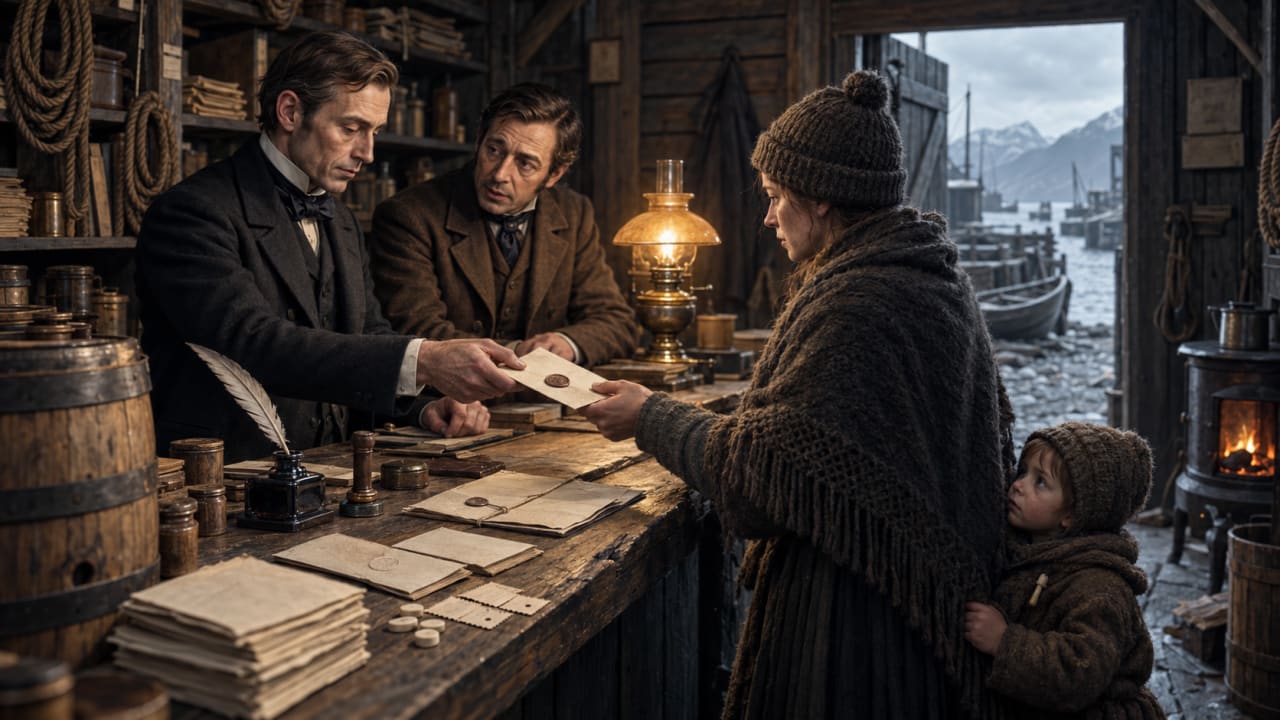
Four kinds of paper cross the counter, and each one answers a different fear.
The exemption writ answers the fast. The Shrine Chapter of the Blessed Wick keeps a calendar of fasting days, lengthened by local custom and enforced by clan honour. A household that breaks a fast without sanction becomes un-counted: struck from the communal tally, refused lamp-aid, pushed toward dark-house status. After a thin seal week, the calendar does not shrink to match the catch. A mother whose children are already wick-sick, shaking from hunger and ready to confess to anything, needs a stamp saying that her house may eat. Prior Malthus issues such stamps. He issues them slowly, and to households whose confession ledgers please him. The brokers issue them faster.
The passage writ answers the draft and the ice. Sons are claimed for Winter Watch duty in storm season, and worse drafts arrive by southern post. A writ that moves a young man south before the freeze is the commonest prayer in the Longhouse Rows. Refugees from worse places want the same paper for the opposite reason: to stay somewhere that asks fewer questions. Deserters want it most. A deserter holding a forged passage permit is a fisherman. A deserter without one is a corpse on a road better documented than he is.
The identity proof answers the census. To be counted in Hrafnvik is to be taxed, and to be uncounted is to be cold. A properly entered name can claim grain, inherit a render share, or prove to a southern quartermaster that a widow's husband died rather than deserted. Ration stamps, the last and humblest kind, answer the grain skiffs. They are worth more than the grain they claim, because grain can be stolen and a stamp can be argued over.
Not every warm paper in the fjord is forged. Genuine exemptions leave the Chapter under Malthus's seal. Genuine permits and stamps come north on hulls out of Hamburg and the ports that feed it. The brokers' confirmed share of this traffic is the crooked end: forged exemptions traded for oil barrels, counterfeit passage writs traded for lamp-time. A buyer of a forged writ seldom knows it is forged and seldom asks. A drowning man does not check where the rope came from.
#On the Price of a Writ
Paper is light to carry. What it costs is heavy.
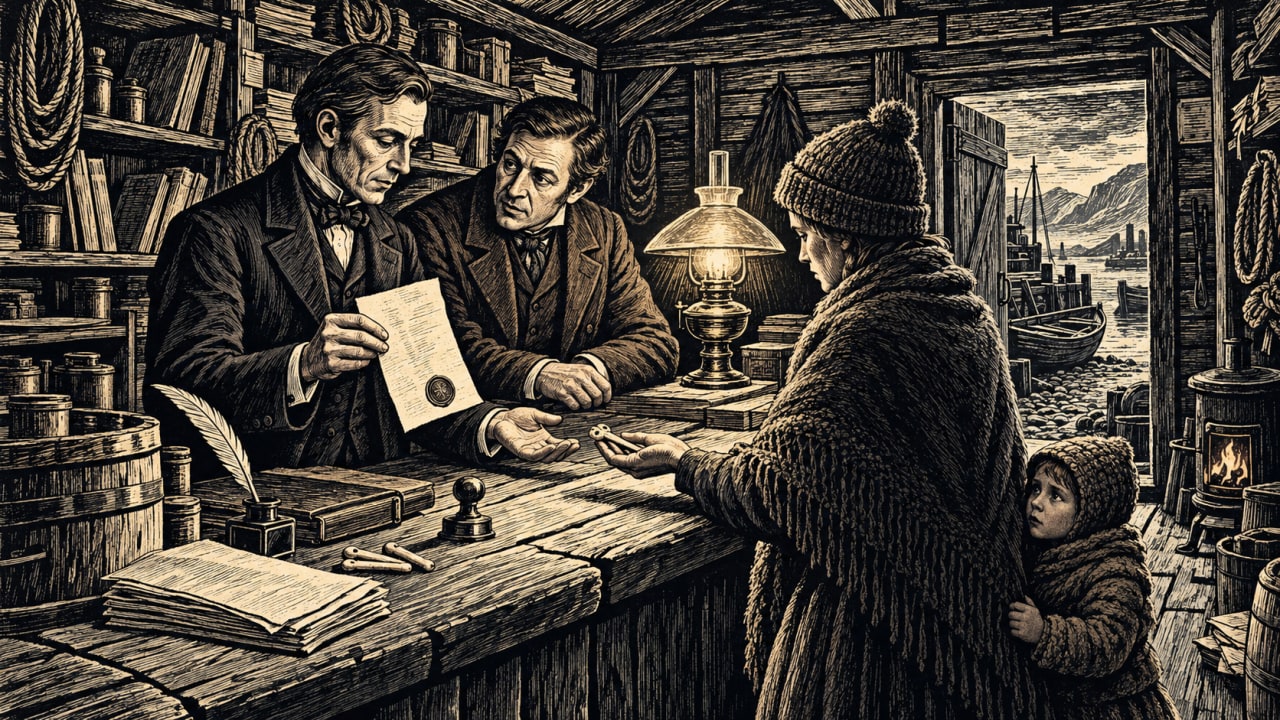
The brokers take payment in the only coin Hrafnvik respects. Oil comes first: whole barrels, notched at the Render Yards, tithed in theory and rolled down to the Slipways in practice. Lamp-time comes second. Each household is allotted hours of light from the communal lamp, and that allotment can be signed over, traded or pledged against future rendering. Oil-chits and bone tokens make change. Where paper rots, the debt is cut into a barrel stave with a knife, and the notch lasts longer than the bargain.
Follow one barrel. A household holding three weeks of winter oil gives up a barrel for an exemption. The exemption spares it a fast, and the children eat. Now its lamps burn shorter, the house is colder, and the reserve that might have carried it through a late thaw has rolled downhill to a southern counter. If the household pledges lamp-time instead, it is selling nights it has not lived yet. In deep winter, when darkness runs twenty hours, those nights come due.
The buyers know this when they agree. Hunger is certain this week. Cold is only likely next month, and a household that reaches next month has a month in which to get lucky. The brokers understand this arithmetic better than any confessor and price by it: by the temperature, by the seal catch, by the look on the customer's face. I found no tariff. The rate is set at the counter, by the oldest method in commerce.
Local report names three methods, and each needs its own entry. Forgery supplies the papers no chancery would issue. Bribery eases through the papers a chancery might issue: a word to a shrine-clerk, to a chainman at the narrows, to a quartermaster on a southern quay. Hrafnvik calls the bribe it pretends is a toll the narrows-tax, and brokers pay it as readily as smugglers do. I record hostage favors exactly as I received them: a phrase, attached to no case I could verify. A favor held over a household is a claim on how that household behaves later. The fjord knows what the phrase covers. I was not shown the details and will not invent them.
#On the Three Authorities
A paper is only a request. In Hrafnvik, three powers decide whether it is granted.
The brokers sell access. They cannot sell what the access is for. Sooner or later every warm paper has to be shown to someone with the power to honour it, and in Hrafnvik that power is split three ways, with all the tenderness of a will contested by cousins.
Prior Malthus holds the documents. The stamp, the exemption register, the fast calendar and the confession ledger all live in his Chapter. He keeps two ledgers, one for the Bureau of Doctrine and one for the fjord. He can condemn a forged writ in a single sentence, and he rarely does. The brokers bring southern paper into a settlement that runs on it, and a Prior who shut the Paper Hut would have to explain to the Northern Office at Bastion-Königsberg why the oil had stopped coming. The Chapter's reach extends to the Paper Hut. Who owns the timber, who collects the rent and who drinks with the tenants are questions on which neither ledger was opened to me.
Elder Sigrun Half-Wick holds the oil. Her render schedules decide which households have barrels to spend, and her Clan Moot decides which households get communal lamp-aid. She also holds the narrows chain, the escorts, the render shares, and the loyalty of every cousin with a hook. The brokers fear her more than they fear Malthus, which speaks well of their intelligence. Malthus can declare a writ false. Sigrun can declare a broker unwelcome, and in a village where every barrel passes through her count, that ends his trade and may end him.
Rauk One-Eye and the Winter Watch hold the roads. A passage writ sealed in perfect wax is still only a sheet of paper when the ice is rotten, the narrows are chained, or the fog has started repeating names. The Watch decides who gets an escort and who gets rescued when the whiteout comes. No broker has yet managed to forge a safe crossing.
A Northern Office abstract of A.S. 195 described Hrafnvik's oil allocation as "managed jointly by Shrine Chapter and Clan Moot under Synodal advisory order."
Corrected after direct inspection, A.S. 197. The Shrine Chapter blesses, stamps and reports. The Clan Moot allocates. The brokers price their papers by the second fact and quote the first.
The cartel lives in the gaps between these three powers. Malthus tolerates it because it multiplies paper, and oil follows paper. Sigrun tolerates it because warm papers keep sons out of bad drafts and mothers out of impossible fasts. The Watch tolerates it because a writ settles nothing on the ice, and Rauk loses nothing by letting men buy one. Each authority has the means to break the brokers. None has found it worthwhile to use them all at once.
The south's own appetite finishes the case for tolerance. Hrafnvik oil lights garrison lamps and Bureau offices far from the fjord. The Bureau of Records has never sent an auditor north who came back with complete books, except me, and nobody has asked to see mine. An accommodation like this carries no charter and grants no immunity. It is simply cheaper than reform.
#On the Child's Lamp
In Hrafnvik everything is for sale except one small thing, which is therefore offered daily.
Papers-for-oil is always for sale in the fjord. So is passage priority. A child's lamp is never for sale, and touching one is the single transaction that can start a blood feud.
The token of it is a pin of bone, cut small for a child's cloak. What exactly the pin secures varies by longhouse and by whom you ask. What it means does not vary: the child's place among the counted, and its claim on the common warmth when a hard week decides who is fed first. A child without a pin is a child the ledger can forget.
Brokers have taken such pins. The published accounts of Hrafnvik say so plainly: sometimes, when desperation is bad enough, a broker accepts a child's lamp-pin as payment. The rule gets broken the way rules always get broken in the north, by someone who calculated that the parent would keep quiet and the elder would never hear. Sigrun forbids the payment absolutely. The last broker who tested her left Hrafnvik with both ears. The fjord considers this lenient. I asked his name. Nobody could remember it, which in Hrafnvik is a second sentence.
The blood feud is how the rule is enforced. A child's lamp touched by an outsider brings out every cousin of the house, and cousins in Hrafnvik arrive carrying gaff-hooks. A broker who accepts a pin takes on a debt the whole longhouse will collect.
Southern clerks with tidy minds sometimes confuse this rule with the work of the Dark-House Circle, since both move warmth outside the ledgers. The confusion is lazy. The Circle steals wicks, hides oil in the Frost Pits under false tags, and keeps silent routes through the unlit coves so that no child freezes because a clerk drew a line through a name. It takes no payment. The brokers take nothing but payment. Each may sometimes find the other useful, and sometimes in the way. I saw no alliance and no war, and I record neither.
#On Their Present Use
Where the seals fail, the paper multiplies.
The reports reaching the Northern Desk by A.S. 201 describe a fjord more dependent on southern paper than the one I inspected. The seal seasons have thinned. The Synod wants tighter quotas, because Königsberg burns oil and the north is expected to deliver its faith in barrels. The clans want fewer fast days, because fasting makes the weak disappear, and every fast day the Chapter keeps makes an exemption worth one more barrel. Warm-paper brokers multiply in the Slipways like lice with better coats. The settlement's conditional compliance was renewed in A.S. 201, pending review. Nobody renewed the brokers. Nobody had to.
Hrafnvik has a saying no southerner believes: a stamped paper can kill faster than cold. I believe it. I have watched the barrel roll downhill. A forged exemption that spares a household a fast while emptying its oil store has saved that household from one death by selling it another on credit. The brokers did not invent this exchange. They gave it a counter, a quill and a fee.
Malthus stamps and declines to stamp. Sigrun counts. The Watch decides who crosses. And at the Slipways, in a hut that smells of ink and damp wool, a southern man with clean hands explains to a frightened mother, in excellent legal terms, what her children's winter will cost.