

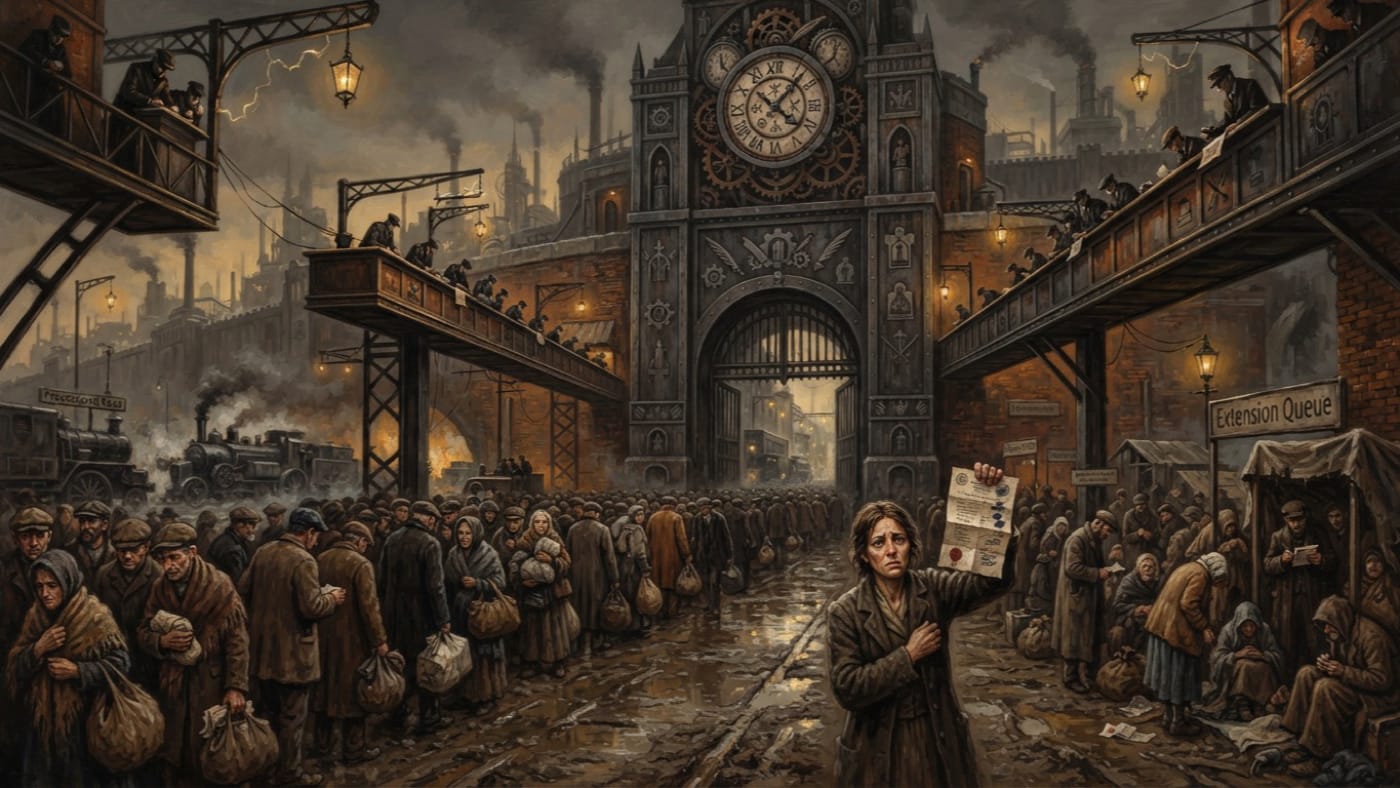
#On Standing and Passage
"The permit says where you are. The writ says where you are going. Neither says you will arrive."
A Transit Writ is the Synod's licence to be elsewhere. It allows an ordinary civilian subject to pass from one zone into another for a fixed term, through checkpoints that will recognise it, and to stop being a traveller at the far end by handing the paper back. Its mercy ends there. Everything else written on it is a condition.
Soldiers, foreigners, smugglers and the mothers of soldiers confuse it every day with the Zone Permit. The permit is standing: lawful presence at an address, fixed to a ration class, a tithe bracket and a household box. The writ is passage. Standing does not travel. A subject with a perfect permit for a Zone 2 market town has no more right to walk into Zone 3 than the town's parish church has to follow. Passage, once granted, says nothing about how the destination will treat the traveller's standing when the walking stops.
Military movements, quarantine permissions, pilgrimage licences and cargo slips travel under their own seals and their own miseries. This tract concerns the civilian with a bundle, a reason, and thirty days.
#On Origin, Countermark, and Surrender
The writ has three custodians, and it passes through their hands in strict order.
The Bureau of Settlement stamps it at the origin. Settlement decides where a subject may exist, so only Settlement may declare that the subject may, for a season, exist in transit. The origin stamp is the writ's baptism. Without it the leaf is stationery with ambitions.
At each checkpoint on the road, the Bureau of Records countermarks it. Records grants nothing. Records witnesses that passage happened at this gate, on this day, by this person, whose face and name still agree with the copies on file. Each countermark is a small certificate that the traveller has not yet turned into someone else. The Great Ledger of Souls has never allowed that, and its gate clerks do not mean to start with you.
At the destination the traveller surrenders the writ. Surrender closes the account. The paper goes into a box, and the body goes wherever the destination's own papers allow.
Between origin and surrender, the writ spoils like bread. Rain lifts its ink. Wax cracks in the cold and slides in the heat. Fold it too often and a countermark splits along the crease, which the clerk will want to discuss. Lose it to a thief and it joins the stock of the Black Ledger's cellar trade. The Bureau holds the traveller answerable for the paper's condition. This is reasonable, since the Bureau has no means of holding the weather answerable. Practised travellers wrap the writ in oilcloth and carry it flat against the breastbone, under the shirt. There it shares the body's warmth and, among the poorer classes, its lice.
#On the Thirty Days
"Validity is a gift. Extension is a petition."
An ordinary Transit Writ is valid for thirty days. The thirty days are the writ's whole life. The count ignores the length of the road and the speed at which anyone is permitted to travel it.
A traveller who sees the thirty days running short may apply for an extension. The application is filed in triplicate. Settlement promises to process it within twenty-one working days, and the promise is true in the narrow way most promises are. Working days exclude feast days, fast days, bell-days, Purity review days, and any Tuesday after a Zone 4 incursion alert. The Line sounds incursion alerts as regularly as a cathedral clock. The calendar supplies feasts with all the generosity of clergy who compiled it.
So a writ lives thirty days and an extension takes forty. I leave the arithmetic to the subject.
The extension form does not ask what becomes of the traveller in those ten unaccounted days. The traveller waits. The waiting happens in a hostel bunk rented by the night, or in the doorway of a cousin whose household permit forbids lodgers, or in a parish yard that has stopped pretending to be anything but a queue. Bread goes first, then coin, then temper, then the paper. A writ that expires while its extension lies in a Settlement tray is an expired writ at the next gate. The gate clerk cannot see the tray. The gate clerk can see the date.
Standing can fail while passage goes on. A permit renewal falls due at home while its holder is three gates east. A household is revised in its member's absence. The destination's line is redrawn while the traveller is still walking towards it. Then the papers disagree with one another, and papers that disagree are reconciled at the traveller's expense.
Over wine, Settlement's officers will tell you that most people do not move. They do not say it sadly.
Earlier Settlement summaries, repeated in this Codex, described "seven administrative territories," with Zone 7 as the Line itself and Constantinople inside it.
Corrected. The theatre map runs from Zone 1 to Zone 8, and the independent territories are filed as Zone 0. The Sagittal Line is Zone 4, No Man's Land Zone 5, the Charnel Lands Zone 6, the Southern Coast Zone 7, and the Fractured North Zone 8. The sevenfold scheme belongs to the internal civic ledgers of Bastion-Constantinople: White, Crimson, Black, Grey, Blue, Ochre, Green. A Crimson resident found in White without a transit stamp is in trouble of a local kind. Whether that stamp follows the full procedure of the thirty-day writ is for the city's sub-Archons to say. They have not written to me.
#On Passage Through Latchford
The writ authorises a journey. Opening a gate takes other machinery, and Latchford shows the difference. The Latchford Permit-Yards lie on the Line's rear approach. Three miles of wagons and people wait there on a causeway beside a single muddy ford, under catwalk offices that hang over the queue like choir galleries over a flooded nave.
At Latchford the writ meets machinery that was running before it arrived and will keep running after it is surrendered. Records clerks check papers in the Hall of Seals, where the counters smell of hot wax, iron and sweat, and the countermark is pressed there. The Bureau of War checks cargo and sets convoy priority along the paved Processional Road. By every measure the yard recognises, a column of shells outranks a family. Wardens check faces. Above all of it stands the Master Gate Clock. At dawn it posts the bell windows, and through the day it decides, minute by minute, who passes the gate and who is still standing in the mud when the lanterns narrow for curfew.
A countermarked writ in perfect order may still go days without a window. The window is a separate instrument, and so is the queue position. So is a War priority stamp, which no civilian will receive. The writ stays valid through all of this, and its thirty days keep running.
The locals never say "tomorrow." They say "next window." The habit starts as slang and ends as theology.
So three offices share the road. Settlement grants the right to go, Records witnesses the going, and the Directorate sets the price of the wait in between. Each office says the others cause the delay. Each, in its own share, is correct.
#On Borrowed Seals and Exceptional Persons
Wherever a document is scarce and slow, someone will offer a faster one. Forged writs circulate in every zone that has checkpoints, which is every zone. The forgers deal in borrowed origin stamps, false countermarks, and paper soiled to look as if it had travelled honestly. The Black Ledger carries such goods alongside its corrected birth leaves and duplicate vacancy holds. Many forgers have no connection to it. Some are only a clerk's widow with a steady hand and a son on the wrong side of a line. The trade exists because the lawful writ is slow. The Bureau responds by making the lawful writ slower and adding countermarks, which has done wonders for the forgers' prices.
Gate clerks are trained to read seals, and no amount of training holds out against the fourth bell. A competent forger studies the clerk's shift more closely than the stamp.
I hold a permanent multi-zone permit, granted by the Bureau of Doctrine in consideration of the places it sends me. It does not expire. I have never filed an extension. I have stood in the Long Queue at Latchford only to observe it, and on that occasion a clerk climbed down a catwalk ladder to collect my papers so that I would not have to cross the mud to the counter.
#On Present Application
As of A.S. 201, the Transit Writ is still the required instrument for ordinary civilian movement between zones throughout Synod territory. Settlement stamps it, Records countermarks it, and the traveller surrenders it. The thirty days are unchanged, and in practice an extension still takes forty. The Assignors who fix addresses at either end of the road have received no instruction to coordinate with the gates in between. Settlement still issues the Zone Permit separately, and a subject who holds one still needs the other.
Instruction to the subject: apply early. Keep the writ dry, flat, and against the body. Count the days yourself, and count Tuesdays twice. Never fold across a countermark. Never buy minutes from a man who will not show you his hands.