

#On the Compilation and the Missing Date
The Bureau of Doctrine commissioned this assessment, and I compiled it at my desk in A.S. 201 / 1911 CE. The year belongs to the compilation. It does not belong to anything that happened at the Hook. No document filed with me gives the Week the Schedule Lied a year, a month, a season or a day, and I decline to lend it one of mine.
My sources are two published accounts, the survey of the Vire River-Belt Interchange and the register of the Vire-Lorn Toll War. Both carry my name as submitter. The second was written with the first open beside it, so two copies of one story are not two witnesses. The other source is the Lorn switchyard's register of its neighbours, which names the Week and dates nothing at all.
The Week belongs to the Toll War, which opened in A.S. 187 and had not closed by A.S. 201. The corridor advisory for those years describes the dispute, and the Week is only one episode within it. The Fading Winter of A.S. 199 is a separate calamity with ink troubles of its own. Any clerk who assigns the Week to that winter because both involve unreliable paper will explain his method to a Records tribunal, and he will pay for the bench.
#On the Authorities of Passage
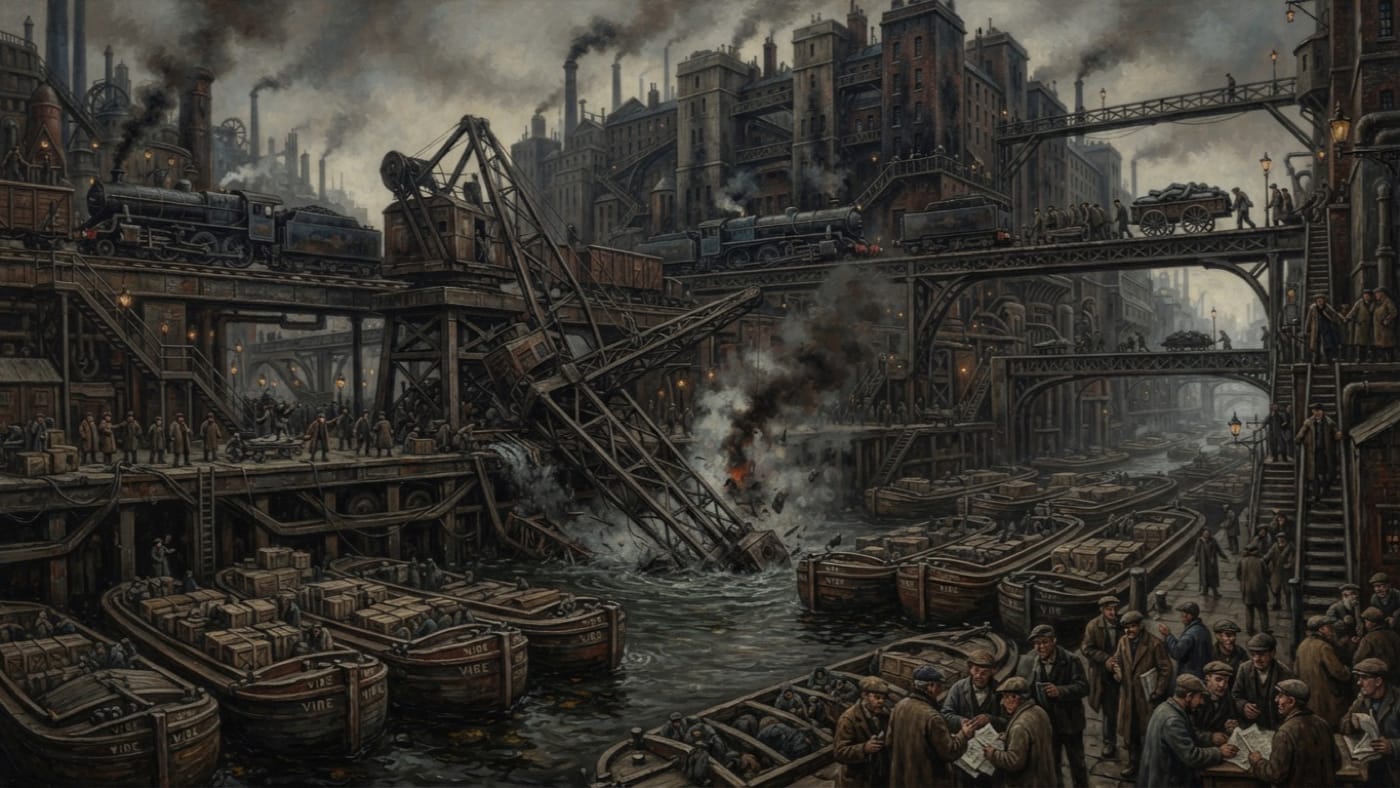
Boatmen call the Interchange the Hook, and the dock children call it Mud-Saint. It stands between Lower Vire and the inland canal roads that serve the Archivolt Causeyworks, two days by rail from the Palatine Switchyard of Lorn. It is built in tiers. The barges lie at the bottom, the crane decks sit above them, the rail platforms above those, and the offices above everything. Cargo climbs that stack, and at every level an authority waits with a different instrument.
The locks decide whether a barge may pass. The Bridge-Scribes certify its cargo and hear its claims in the Lock Courts. An appeal requires a stone token, and the token is sold by the court that refused the claim. The toll offices collect. Lorn divides its powers with equal care and less damp, into track priority, bell certification of procedure, and the manifest. In A.S. 201 those offices belong to Yard Palatine Odrin Kessel, Bell Marshal Sister-Calder and Prefect Halden Wry. No source shows any of the three holding office during the Week, and I put none of them there.
The Bureaus stand above both houses. Records claims the right to regularize, the Bureau of Tithes claims the right to assess, and the Bureau of War claims the corridor, because the front consumes whatever Lorn sends it. Each Bureau can make a contradictory entry expensive. None of them can make one true.
For the war itself, its register will serve. The short version: Vire imposed a wet-transfer fee in A.S. 187. Lorn answered by withholding priority windows from Vire-tagged loads. Vire then detained Lorn-bound soap, grease, candle wax and clean seal stock. Finally the Manifest Basilica corrected arrival dates so that Vire's delays were on file before Vire had committed them. A sorter standing beside a spoiling consignment needs none of this history. He needs a window.
#On the Recorded Week
The accounts report three discrepancies. I keep them apart, since the corridor's clerks have spent the whole war blending them.
First, seven Vire barges reached the Hook on dates their manifests had already passed. The paper declared them late before the barges could say anything for themselves. No account says whether a clerk erred, a clerk lied, or a clerk wrote what an interested house told him to write. The Basilica's habit of correcting dates in advance is documented for the war. Nothing documents it for these seven.
Second, three Lorn trains were entered as departed while their cargo still stood unloaded on the platform. The crews could see the trains. The register assured them the trains were gone. A departure entry is a claim about a train, and I have never seen one pull a wagon.
Third, a corpse convoy reached Lower Vire carrying death receipts dated for the following day. According to the war register, the Bone-Tag clerks of Candle-Sump refused the receipts, accepted the bodies, and charged storage on both.
Then there is the testimony. Two Bridge-Scribes swore under oath that the Vire flowed upstream for nine minutes. The Bureau of Engineering rejected the claim. Every boatman in arrears accepted it, because a river that runs backward might be argued to have carried his barge past a toll before the toll fell due. The record establishes two oaths and one rejection. It does not establish a river running backward. The war register's verdict that neither account is true is my own rhetoric, and I would not ask an engineer to sign it.
Lorn's register of its neighbours associates the Week with the High Heartlands Capital Spur, the city Lorn feeds with manifests, munitions and ration trains. It says nothing more, and I add no fourth irregularity to it.
None of the accounts gives a cause for any of the three discrepancies. I file them as irregular records, and the line for their cause stays blank.
Three Lorn trains departed before their cargo was unloaded.
Corrected. The Interchange survey's wording made a fact of the register. The war register records that three trains were entered as departed while their cargo stood on the platform and the crews looked on. The entry left. The trains, as far as any filed account shows, did not.
#On the South Hook Settlement
According to both accounts, the tariff dispute had ended by the close of the week. A crane fell at the South Hook. No account says which of the Chain-Gantry's six it was. A magistrate of the Lock Courts was found drowned in six inches of water, and the Interchange withholds his name. Beneath his body lay the disputed fee schedule in its final form, signed.
The accounts report the signature as his. They also report that his hand was not recovered. Neither says when he signed, what became of the hand, or how those two particulars relate. I set them side by side because the sources do, and I make nothing of the arrangement.
Both houses call it an "accident," and both supply the quotation marks themselves. No culprit has been named. The war register observes that withheld windows produce hurried lifts. That describes a hazard of the corridor and does not explain why this crane fell. The schedule lay beneath the dead man. The record chose that preposition, and I will not promote it to a motive.
The settlement settled one fee. Clerks who read "the tariff dispute had ended" as the end of the war have mistaken a receipt for a treaty. The war took in the signed schedule, revised its neighbours, and continued. In A.S. 201 the corridor advisory still reads active.
#On the Present Application
Some things the compilation does establish. In this corridor an entry can bind cargo, crews and corpses before any fact arrives to support it. Detained soap spoiled on the platforms. Storage was charged on the early dead. A signed schedule was enforced over the body of its signatory. None of these consequences requires the water to run backward or the calendar to slip. It is enough that three offices held the same freight and kept no common ledger.
Other things it cannot establish: the date of the Week, the cause of any discrepancy, a culprit, a mechanism, which crane fell, the magistrate's name, and the circumstances of the signature. My only inspection in that country was of Candle-Sump, in the autumn of A.S. 197, and it stopped at the Candle Bridge toll. I never stood at the South Hook. I was not present for the Week, whenever it took place.
Archivolt keeps a Week the Locks Closed of its own. It is a different week with different locks, and it does not belong in this file.