

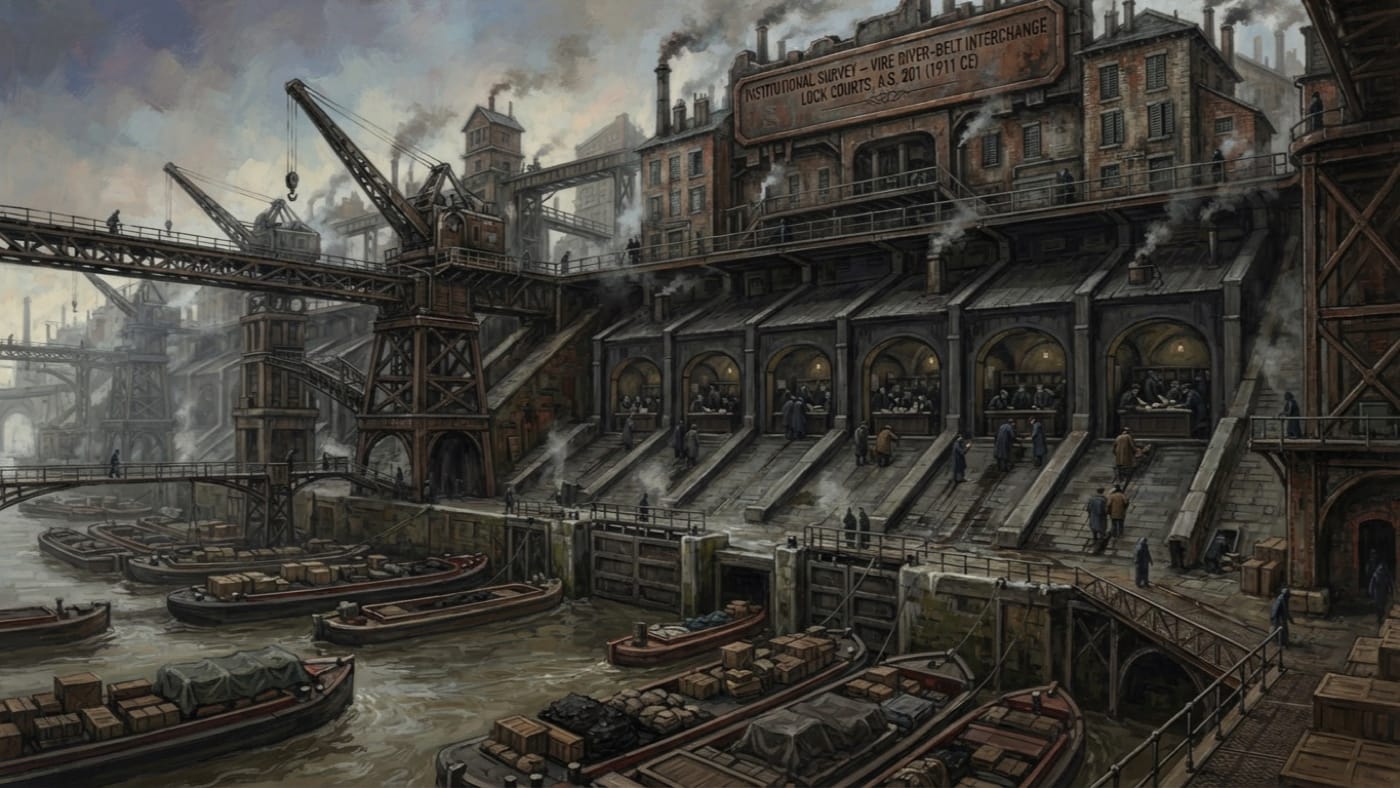
Present compilation, A.S. 201 (1911 CE). Assembled from published Codex accounts of the Vire River-Belt Interchange and its neighbours. The year belongs to this survey. It founds, charters and inspects nothing.
#On a Bill That Arrives Before the Barge
A barge on the Vire may owe money for a lock before it sees one. The published Zone 1 plate says so in a single sentence: the Lock Courts turn water into fees so precisely that a barge may be charged for passage before it reaches the lock. The master learns of the debt at a bench. The lock learns of it later, if at all.
The Lock Courts are a class of local bench rather than a single institution. They hear disputes over lock passage and tariff along the River-belt, wherever water and paper meet at a gate, and they assess passage before it is made. The best-documented of them stand at the Vire River-Belt Interchange. Bargemen call the place the Hook and dock children call it Mud-Saint. It is a rail-port between Lower Vire and the inland canal roads, two days by rail from Lorn. Most of this survey concerns the Hook because most of the record does. Where I describe the Hook, I describe the Hook. No document lets me promote its habits into river law.
For the courts at the Hook the archive gives no charter, no founding year, no list of judges and no published tariff. It also gives no account of the law under which a passage not yet made may be assessed. I record these absences once. They are the most stable features of the institution.
#On the Bench, the Receipt and the Token
The Interchange is built in strips. The river runs at the bottom, the crane deck sits above it and the rail above that. The offices are on top, where officials can look down on water, labour and evidence with equal comfort. The Lock Courts occupy the middle tier, a row of damp halls. The published account says their floors slope by design, so that floodwater, spilled ink and blood all run to the same drains. I report the slope as the account gives it. I have not stood on it.
Cases are heard by Bridge-Scribes, whom the account describes as men with waxed cuffs and excellent memories for fees. They hear disputes over whatever the Hook carries: coal, soap, food, paper, candle wax, salvage iron and bone-tagged dead, along with bodies quiet enough to pass as cargo. At the Hook every river cargo becomes a manifest, every manifest becomes a toll event, and any toll event can become a dispute before a bench that charges for its seats.
The appeal is the court's masterpiece. A party refused at the first hearing may appeal if he holds stone tokens, and the tokens are sold by the same court that refused him. The record does not say how many tokens an appeal requires, what they cost or who hears the appeal. Nor does it say whether anyone has ever won one. I would pay a modest sum to learn that last fact. The court would doubtless sell me the token.
The record shows no procedure. No published account explains how a Bridge-Scribe fixes a fee before the passage, what evidence he must hold, or whether the money comes back when a barge turns around. The Bureau of Tithes, the Bureau of Records and the Bureau of War each claim an interest in the Hook. None of them has published the rule. On this point, and on few others, the three Bureaus agree.
#On the Grain Barge of A.S. 106
The oldest dated case is the First False Toll of A.S. 106 (1816 CE). At the Interchange, a grain barge bound for Wexel was charged for passage through a lock it had not reached. The master objected. A Bridge-Scribe produced a receipt bearing the master's mark, and the master denied the mark. The bench, which the account simply calls the Tribunal, held that marks are more reliable than mouths, since mouths lie and marks can be archived. The master paid twice. The account names neither the sum nor the scribe.
Clerks have blurred three distinctions about this case, and each needs restoring.
First, the case does not date the courts. A bench sat at the Hook in A.S. 106 and gave judgment, which proves it existed that year. It says nothing about when the bench began.
Second, the falsity lay in the mark. On the published account, what made the toll false was a receipt the master swore he had never signed, preferred over his own testimony. Charging before arrival is the ordinary practice the Zone 1 plate describes. Nothing in the record makes every advance assessment a forgery. Some may be honest, though the record offers no way to tell which.
Third, the case belongs to the Interchange. Its scribe produced the receipt and its bench upheld it. No document shows the River-Belt Chapterhouse ordering the charge or commanding the Hook.
The Interchange's published entry gives its foundation as "A.S. 92 timber cranes and toll shed; stone quay A.S. 104," and lesser registers have since given those years as the founding of the Lock Courts.
Corrected. By A.S. 92 (1802 CE) the Chapterhouse had built three timber cranes, a toll shed and a lock-facing chapel at the barge turn. The first stone quay was laid in A.S. 104 (1814 CE). Both are building milestones. Neither founds the Chapterhouse, the Interchange's courts or any authority they exercise. A toll shed is a roof over a man collecting money. The record does not say whether he was a court.
#On Neighbours Who Are Not Masters
The Chapterhouse built at the Hook, but no surviving instrument shows it ruling there. Its documented authority lies elsewhere. After the Lye Flood of A.S. 84 (1794 CE), the early Church administration acted through the Chapterhouse to install the Sluice Prefecture in Candle-Sump. That was six years before the Concordat of Strasbourg made the Church's offices a formal Synod. The Prefecture times gates and releases floods for one district, and it holds no bench at the Hook. The Chapterhouse's own charter, seat and founding year are still unknown.
Lower Vire keeps its own offices, and they are not part of the courts. Its Registry seals the dead, its kitchens ration broth, and its passage receipts buy the crossing at Candle Bridge. The Hook's cranes, platforms and Lock Courts belong to the Interchange, and the Interchange is not Dockchain Quay. Lower Vire takes part in the courts' quarrels only by paying the surcharges.
Upriver, the Archivolt Causeyworks runs passage through its own Toll Chapterhouse, its own Bridge-Scribe Collegium and its own Lock Authority, the wardens of the Triple Lock. A Bridge-Scribe at Archivolt shares a title with a Bridge-Scribe at the Hook, and nothing else the record will certify. Archivolt's scribes accuse the Hook of exporting forged stone tokens. The Hook denies everything and raises handling fees.
Farther off are the Seal Locks of the Candlewick Palatinate and the Saint-Dust Cooperage of Mournwater. There, lock provosts and the interests of Records, Passage, Tithes and Purity fight over every chamber. Candlewick's practice hardened after A.S. 92, and the record shows it extended to Mournwater by A.S. 104. Those dates belong to the Seal Locks. They govern Candlewick wax and Mournwater dust, and they did not travel downriver to the Hook in anyone's luggage.
The published account of the Seal Locks lists the Vire Interchange's lock courts among the "lesser Seal Locks" that "breed across the River-belt" from the Candlewick and Mournwater doctrine.
Corrected. The account reports a resemblance. It produces no instrument showing that the Hook's courts derive from Candlewick, answer to Mournwater, or took over the offices of either. Similar gates breed similar clerks, but similar clerks are not one jurisdiction.
#On Lorn, Paper and the Present Docket
The rivalry with Lorn gave the courts their busiest years. The toll war opened in A.S. 187 (1897 CE), when Vire imposed a wet-transfer fee on cargo entering Lorn by canal-road exchange. The rate has never been published. The courts are reported to hold that it is self-evident to anyone who has paid it. Lorn refused priority windows to Vire-tagged consignments, and Vire delayed Lorn-bound soap, grease, wax and seal stock. The Manifest Basilica at Lorn is said to have corrected arrival dates so that delays became Vire's fault before Vire caused them. Every move in that exchange produced a disputed manifest, and at the Hook disputed manifests end up on the middle tier.
The war's worst episode, the Week the Schedule Lied, has no established year. Barges arrived on dates their manifests had already passed. Two Bridge-Scribes swore that the river had flowed upstream for nine minutes. The Bureau of Engineering rejected the claim, and every boatman who owed arrears accepted it. The dispute ended with a crane down at the South Hook and a Lock Court magistrate drowned in six inches of water, the signed fee schedule beneath his body. The Interchange withholds his name. I assign no cause beyond the account's, and I will not have the river reverse on my authority.
The Fading Winter of A.S. 199 (1909 CE) brought a newer trade. Text vanished from documents whose paper, seals and signatures survived. River licences written in ink from before A.S. 199 are said to trade like relics. According to the Interchange and Seal Lock accounts, Vire's scribes now hold newer permits over steam, read them aloud twice and weigh them on coin scales. The local belief is that a fading document loses weight before it loses its words. The record reports the practice. It does not establish whether paper loses weight, or how the text disappeared.
One inquiry is abroad. Veyl Hark's scrutiny concerns Lorn and the false manifests of its freight network. The published accounts say the Lock Courts are already rehearsing where to point if that scrutiny reaches the Hook. No document says it has reached the Hook, named a Bridge-Scribe or convicted a court. The courts are preparing. The record goes no further.