

#On the Fee and the Freight
Boatmen, switchmen and the less careful sort of clerk call it the Vire-Lorn Toll War. It is the quarrel between the Vire River-Belt Interchange and the Palatine Switchyard of Lorn. The Bureaus prefer "corridor-priority hostilities," which fits more neatly on a docket and frightens fewer creditors. The war opened in A.S. 187. As of A.S. 201 it has not closed, and no office of the Synod has yet been brave enough to print the form on which its closing could be recorded.
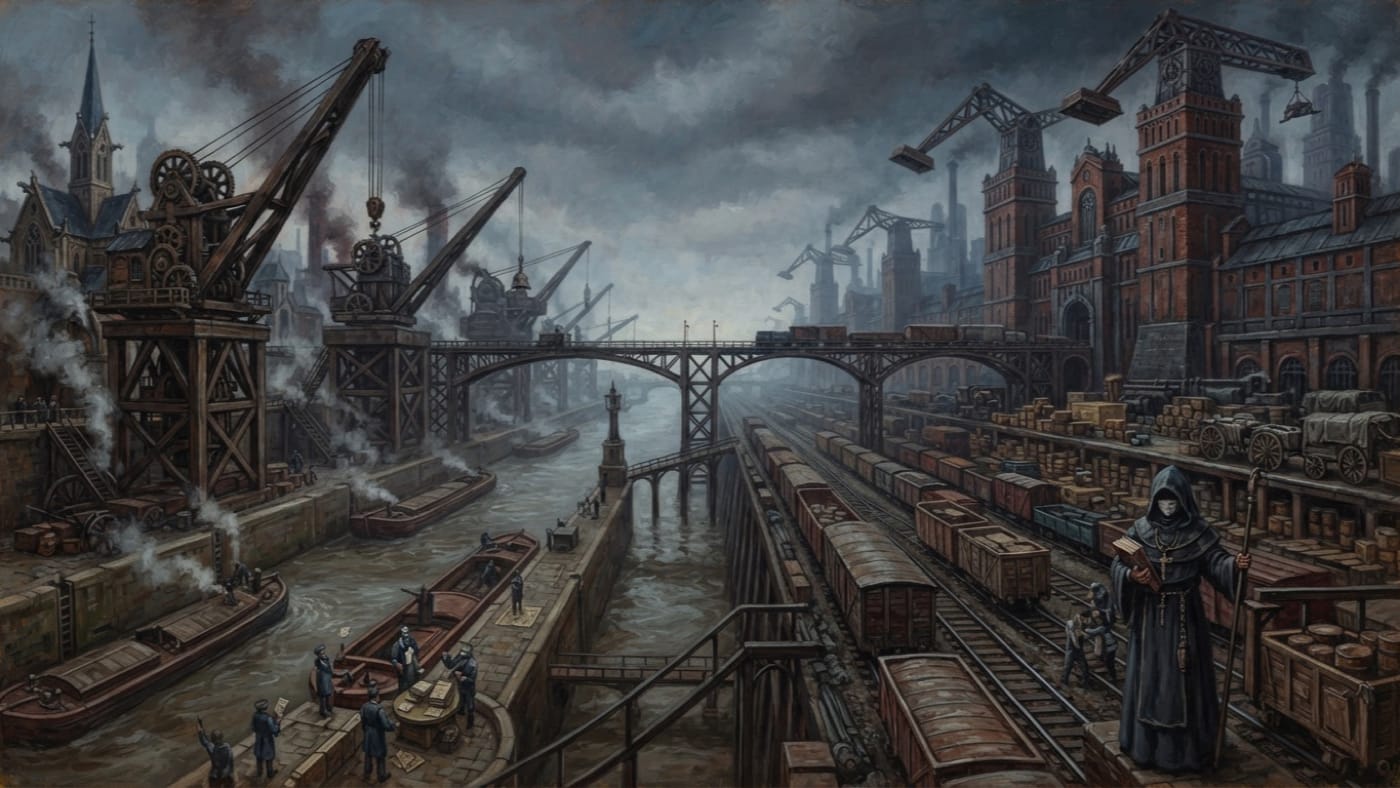
Two days of rail separate the parties. The Hook, which the dock children call Mud-Saint, lowers river cargo out of barges and lifts it into rail consignments. Some go east to Lorn and some go south along the canal roads that feed the Archivolt Causeyworks. Lorn decides what moves, when it moves, and whether the paper riding with it is real. Each can strangle the other. Neither can survive the strangling. Coal, soap, grain, candle wax, paper, salvage iron and the bone-tagged dead all pass between them. Every blow these two indispensable houses trade lands first on someone who owns neither a crane nor a stamp.
#On the Older Receipts
The Hook began modestly, as extortion generally does. In A.S. 92, two years after the Concordat of Strasbourg, the River-Belt Chapterhouse raised three timber cranes, a toll shed, and a chapel whose altar faced the locks. The first stone quay followed in A.S. 104. That was the year Lorn shed its market-town name and began drawing the continent's rails into its throat. River authority and rail authority grew up together, like two foundlings who share a cot and keep a knife beneath the straw.
Vire found its method early. In A.S. 106 a grain barge bound for Wexel was charged for passage through a lock it had not yet reached. A Bridge-Scribe produced the receipt. The receipt bore the barge master's mark, and the Tribunal preferred the mark to the man. Chroniclers call this the First False Toll. It belongs to the war's prehistory. No Lorn officer took part, and the grain reached Wexel late and paid for twice.
What the First False Toll taught Vire, and what Lorn learned by watching, is that a document may arrive before the thing it describes. Eighty-one years later both houses had perfected the lesson and turned it on each other.
#On Priority and Correction
In A.S. 187 Vire imposed a wet-transfer fee on cargo entering Lorn by canal-road exchange. The Interchange has never published the rate. Its Lock Courts maintain that the rate is self-evident to anyone who has paid it.
Lorn answered with the instrument it loves best. It withheld priority windows from every Vire-tagged load. These are the narrow minutes in which a consignment may enter the yard throat ahead of its rivals. Track priority at Lorn belongs to the office of Yard Palatine Odrin Kessel, a man reputed never to have set his immaculate gloves upon gravel. No record says who drafted the refusal, and the Yard Palatine's office does not say anything for free. A consignment refused its window does not vanish. It sits on a siding while ration trains pass it, and wet cargo that sits begins, in the Interchange's phrase, to negotiate with the weather.
Vire's reply was surgical and therefore filthy. Lorn-bound soap, grease, candle wax and clean seal stock began to wait at the Hook. A switchyard runs on grease as a liturgy runs on breath. Without it the points seize and the axle boxes heat. The Bell procedures that keep Lorn's crews from being crushed in the dark must then be sung over dry iron by men who know exactly what dry iron does. Soap is the only hygiene in a city of soot and coughing. Candle wax lights the dispatch desks. Clean seal stock is what makes a Lorn manifest a manifest, so withholding it struck at the Switchyard's capacity to be believed.
The Manifest Basilica then performed the war's most elegant act: its clerks corrected the arrival dates. A Vire delay could now be recorded before Vire had committed it. When the soap came late, it came late against a date already entered, sealed and filed as Vire's fault. Prefect Halden Wry holds manifest authority at Lorn and is said to smile only when a stamp lands. No source assigns the corrections to his hand, and I assign nothing a source has not.
#On the Week the Schedule Lied
No year, month or season has been fixed for the Week the Schedule Lied. The Codex places it inside the war and nowhere more exact. Records calls this restraint admirable and the boatmen call it cowardice. Both may file.
Seven barges came down to the Hook on dates their manifests had already passed. At Lorn three trains were entered as departed while their cargo still stood on the platform. The crews could see the trains and were assured by paper that the trains were gone. A corpse convoy reached Lower Vire carrying death receipts dated for the following day. The Bone-Tag clerks of Candle-Sump have certified the dead for generations without once being asked to certify them early. They refused the receipts, accepted the bodies, and charged storage on both.
Two Bridge-Scribes testified under oath that the river ran upstream for nine minutes. The Bureau of Engineering rejected the claim. Every boatman in arrears accepted it at once, since a river that runs backward may be argued to have carried a barge past its toll before the toll existed. The testimony stands on the record, and so does the rejection. The Codex certifies that both exist and that neither is true.
Lorn's own registers associate the Week with the High Heartlands Capital Spur, the city Lorn feeds with ration trains and munitions. Those registers say nothing further about the Spur's share in the confusion, and I add nothing to them. A schedule that lies is careless about whom it lies to.
By the week's end the tariff dispute had ended. At the South Hook a crane came down. A magistrate of the Lock Courts, whose name the Interchange withholds, was found drowned in six inches of water. Six inches. He was a grown officer, trained to stand in floodwater and hear cases about it, and he perished at a depth a child would wade to recover a dropped toll token. Beneath his body lay the disputed fee schedule in its final form, signed.
The signature was his. The hand was not recovered.
The records of both houses call it an "accident," and both supply the quotation marks themselves. No killer has been named. No account explains how the crane fell, how six inches sufficed, or how a man without his hand came to have signed. I have been invited to supply an explanation. I have declined, being fond of my pension.
By the week's end the tariff dispute had ended, and with it the Vire-Lorn Toll War.
Corrected. The signature settled one fee. The war absorbed the settlement, revised it, and went on charging for benches.
#On the Corridor's Cost
Neither house counts the war's casualties. It is the one economy both practise without fail. The cost can be found all the same. The Chain-Gantry's six river cranes run on hymn-timed gearhouses, whose bell-card readers listen for the difference between lawful strain and profitable panic. Every withheld window means another lift made in haste when a window finally opens, and the South Hook has shown what a hurried crane may do. On the rail-flood platforms, sorters stand among detained freight that spoils by the day. At Lorn, switchmen work points that want grease. Their procedures are certified by Bell Marshal Sister-Calder, who keeps a book of missed measures and does not accept a shortage of soap as an excuse for one.
Beyond the two houses the corridor bleeds more quietly. Lower Vire's soap-boilers and paper-makers wait on rail that Lorn will not prioritise. The Archivolt bridge-scribes keep their own Toll Chapterhouse and their own grievances. They accuse the Hook of exporting forged stone tokens and price their services accordingly. Grain moves late. The dead move late, or early, as the receipt requires.
Two parties have profited in the open. The Hush Tunnel Runners buy Vire lamp codes at inflated prices, since a lawful route closed by dispute is a smuggler's route opened by default. The Thrown Hand watches the wet-transfer crews with what the Switchyard's informers describe as professional envy.
#On the Present Dispute
As of A.S. 201 hostilities continue. Since the Fading Winter of A.S. 199 both houses have mistrusted new ink. River licenses written before it trade at the Hook like relics. Newer permits are steamed, read aloud twice, and weighed on coin scales, because Vire's clerks hold that a fading document loses mass before it loses shame. Records disapproves of the practice and has copied it privately. At Lorn, where dispatch is sung, the dispatchers have come to mistrust any paper bearing a Hook seal, and they voice that mistrust in plainsong.
The Interchange prepares its next round: toll revisions, lock closures, witness rentals, and the reliable disappearance of pages. Lorn admits to preparing nothing, which at Lorn amounts to preparation. Should Veyl Hark reach the Switchyard and ask where the false manifests learned to swim, both houses have their answer ready, and each will name the other. The Bureau of War continues to class the two nodes as indispensable to the Lorn corridor. Strasbourg reserves that word for things it cannot yet safely destroy.