

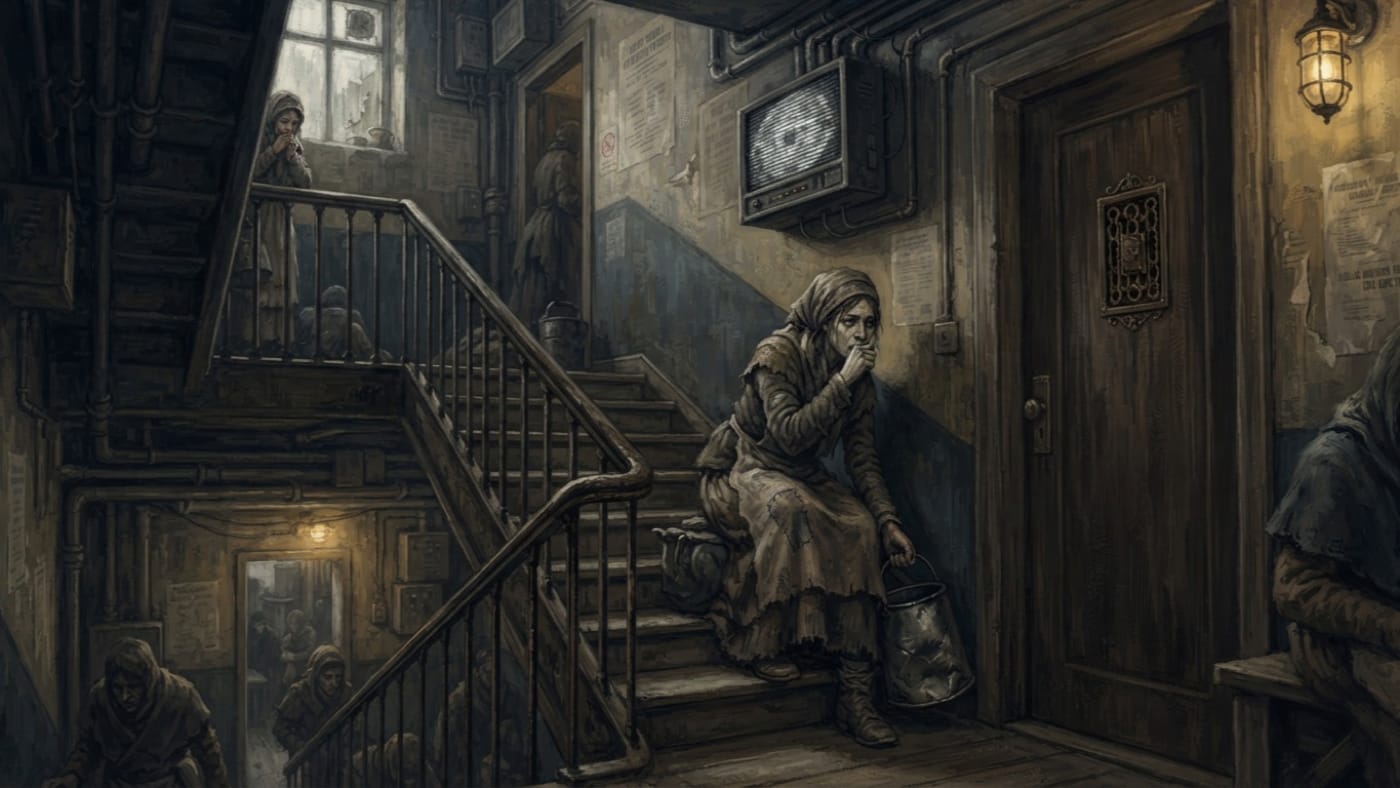
#On the Smallest Mouth in the Trade
A Whisper Runner carries the opening of a forbidden song and nothing after it. That may be four notes, or five, or only the rhythm of four notes with the pitch left for someone else to supply. The runner climbs a Strasbourg tenement stair with a coal scuttle, a basket of wet aprons or a sack of ration turnips. On the third landing the runner stops because the scuttle is heavy, coughs twice into a sleeve, and goes on up. Behind a door, a woman who has waited all week for that cough now holds the first bar of a lullaby her grandmother sang before the Concordat.
That is the whole transaction. The melody-smuggling trade lists the runner as its entry rank, below the Stitch-Score Couriers and the Listening Cell Hosts, and far below the route-owning Melody Smugglers, who decide which tunes travel and who carries them. The runner decides very little. A runner is given an opening, a landing and a signal, and is told to forget the face at the door. Most obey the first three instructions.
#On Why the Song Was Cut in Three
The Orison Licensing Acts of A.S. 94 made every unlicensed cadence Criminal Sound and gave the Bureau of Orison and Song jurisdiction over the air between one skull and the next. That same season Purity seized complete lullabies copied onto laundry receipts in Strasbourg's Candlewick district, and the Eleven Laundry-Women of Candlewick went to the scaffold with their songs whole on paper. The trade drew the obvious conclusion faster than the Bureau did. A whole song can hang a whole woman. So the song was cut.
The disciplined cell cuts it in three. The runner delivers the opening cadence. The stitch-score courier carries the middle bars in cloth. The Listening Cell Host teaches the ending in a room whose walls are padded with coats. The song moves in that order, but orders do not. A runner answers to whoever owns the route, and the host at the far end may never learn the runner's name. Four notes cannot hang a woman, the trade tells its recruits, and the recruits believe it because they are young and the stair is dark.
No record names the first runner, the first delivery or the year the rank got its name. The rank simply appears in the trade after A.S. 94, the way rats appear after a granary: nobody signs for them. I have seen archivists invent a founding cell on thinner evidence. I decline to. The archive already holds enough invented mothers.
#On Carrying the Opening
The opening travels in the body. Four methods are documented: the mouth, the cough, the finger tap and the work phrase. The mouth is the oldest and the stupidest. It means a few notes hummed behind a hand, close enough that the runner can smell the listener's breakfast. The cough is better: two short, one long, a pause, a clearing of the throat, each interval set to a rhythm the listener half-knows already. The finger tap is quieter still. It is struck on a table edge, on a ration tin, or on the cold iron of a stair rail where the listener's palm rests a hand's width below. The work phrase is the craft at its most insolent: a coal-hauler's grunt, a laundress calling wring and turn, a dock count that fits so neatly between the official bells that no Orison clerk thought to license it, because it sounds too stupid to be anything but labour.
Runners inherit the trade's general discipline, though no school or codebook issues it. They test the ear first, offering a harmless folk cadence and watching the listener's face, breath and timing. They deliver under sanctioned noise: the Orison Hour coming through a cracked public receiver, a convoy on the cobbles, the Sky-Sermon drone that lets the city pass off its clatter as piety. Let the sermon cover you. They ask the listener to confirm only a safe subset, two notes tapped back, never the whole phrase and never sung. A runner who makes a mother rehearse the full opening on a landing has staged a performance, and performances have witnesses.
The rank's great danger is generosity. Some runners know a little more than the opening, because an aunt once hummed the turn or a courier talked in drink, and they are tempted to give it away. The mother is desperate. The child screams through the wall. Two more bars would spare her the wait for a stitched cuff. Two more bars also make the runner the second carrier of the same song, and the cell's division collapses into one throat. The trade calls a client taught too much at once incompetence. Orison calls it evidence.
#On Clients, Payment and Ownership
An opening does nothing by itself. The mother on the landing holds four notes until the middle reaches her on a broth girl's cuff, and the ending comes later from a host behind the coats. Only then does the household own a lullaby, and the runner who started it will rarely hear the result. Mothers buy because the Dormition Canticle, approved by Orison and the Bureau of Mercy in A.S. 134, puts children to sleep about as well as a clerk clearing his throat. Infirmary attendants buy openings the same way. So do grieving households who want a deathbed cadence that does not sound like a ration announcement, and trench personnel in rear towns who want a fragment of home. In the Underchords of Bastion-Irongate, down in the Danube's Iron Gates gorge, an opening can serve as password or bond: proof that the bearer knows somebody who knows somebody.
Payment comes as food, filters, medicine, a favour at a checkpoint, or a night of safe shelter. Coin turns up sometimes and is resented, because coin can be traced. There is no tariff for an opening, and anyone who quotes one is selling you a decoy. The runner rarely keeps the whole fee. The route owner takes a cut, the district boss takes another, and a single rescue delivery can tie a runner to a family for years through what the trade calls ear debts.
The runner owns no route, edits no tune and encodes no cloth. Cadence Surgeons bend forbidden airs into bell-safe ranges. Couriers turn middles into knots and colours. Hosts keep the rooms. The runner keeps a stair. The ladder runs from runner to courier to route owner, for those who live long enough and manage not to become interesting.
The runner also cannot judge what the opening becomes. Some forbidden cadences really do draw attention from beyond the Sagittal Line. Most are only comfort and inheritance, which Orison prosecutes with the same appetite. Four notes on a landing give no hint which kind the assembled song will be. If it comforts too fast, it kills, the trade says, and the runner is the one member of the cell who never hears how fast it comforts.
#On Detection and Consequence
"Four notes cannot hang a woman," as stated above in this survey.
Corrected. Melody Intent requires no completed performance. An audible fragment, a recognitional correction, a bait-cadence response, a witness or a confession can each support the charge. The division protects the song. It has never protected the runner.
Tone Inquisitors, constituted in A.S. 96, hunt runners with the bait-cadence. An Inquisitor plays or hums a doctored opening in a stairwell and watches who flinches, who hums along, who corrects the rhythm. The runner is the most exposed member of the cell to this test, because the runner's whole profession is the opening, rehearsed until it lives in the jaw. A trained ear hears the throat close a beat early. A runner who has coughed the same cadence on forty landings may cough it in a holding cell out of nothing but fear.
Sky-Sermon Attendance Auditors log acoustic anomalies during broadcast hours, which are exactly the hours runners prefer. Informants are worse. A former runner knows which coughs are only coughs. A mother caught later with the middle can trade the runner's face for her children. Memory leaves no paper to seize, but the body testifies on its own: lips cracked from not humming, finger-taps counted under a table, two fingers drifting to the throat. That last is the gesture of Saint Hessa of the Closed Mouth, the trade's folk patron, whom some runners invoke and more deny.
The penalty follows the charge, not the rank. Flogging, imprisonment, forced sermon labour and tone quarantine are all on the books. Tongue-branding was already in use at the Vienna Incident of A.S. 112, when five thousand mothers were burned over a lullaby about rain and barley, and it was standardised in A.S. 118. Distribution can bring immurement. Erasure from the Great Ledger of Souls is reserved for network leadership whose client lists implicate more than twelve households, and runners seldom rise high enough to earn it. The trade keeps a penalty of its own that no court imposes. When pressure rises, the route owner sacrifices a decoy carrier, and the cheapest decoy in the cell is the one who knows only four notes and a landing.
#On the Present Rank
As of A.S. 201, runners work the tenements and laundries of Strasbourg, the pilgrim quarters of Vienna, the docks of Marseille and the rear wards behind Bastion-Przemyśl: anywhere a stair, a queue or a public receiver gives a cough somewhere to hide. They have no register, no guild and no badge. They have coal scuttles, bitter tea for rinsing the mouth, chapped lips, and four notes they are forbidden to finish. If arrested, they can surrender only an opening. Orison has hanged people for less, and with better paperwork.