

#On the Standard Entered
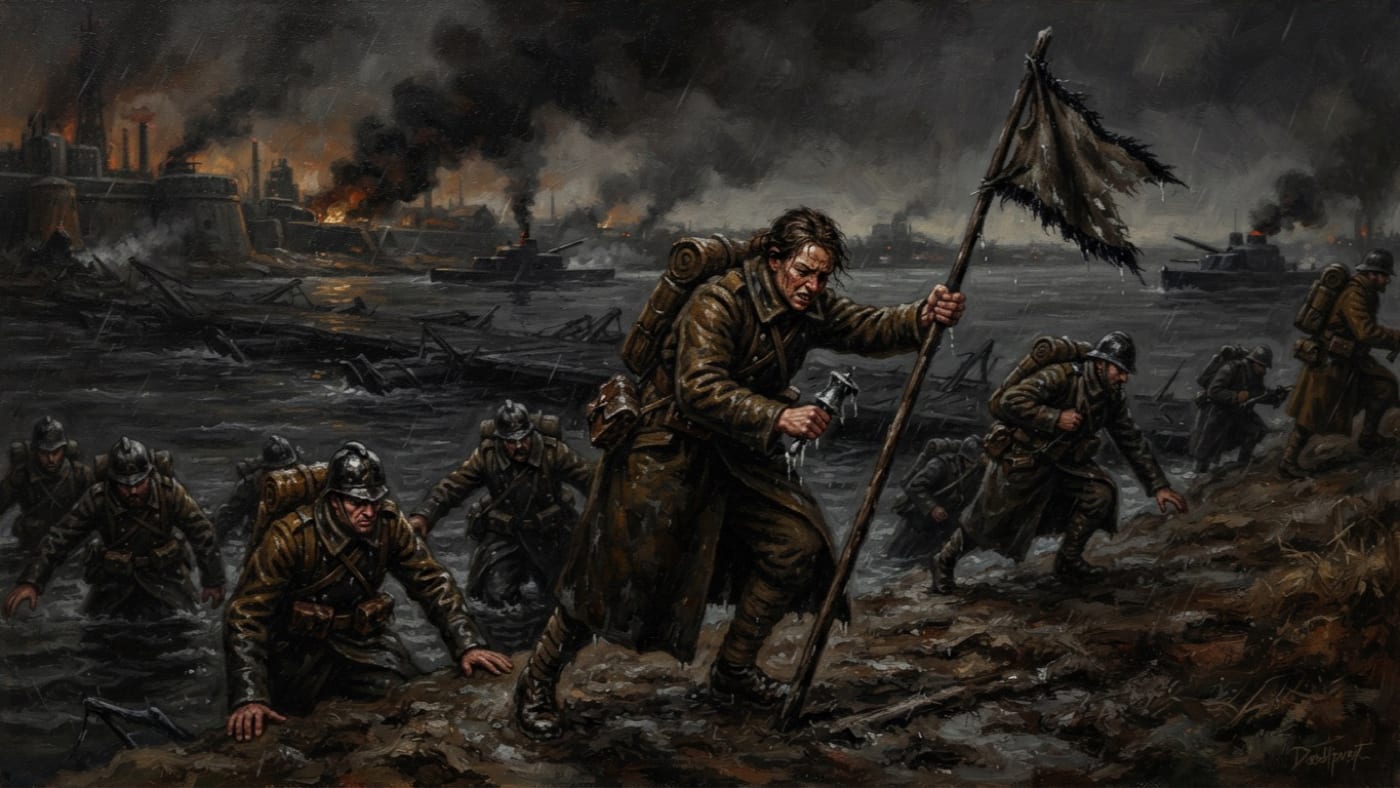
Widow's Rag is a small river campaign standard with a black edge. Sister-Vexillator Anje Rusk carried it across Mark Seven during the Night of the Three Bridges in A.S. 172, which the civil calendar renders 1882. It has two names. The soldiers gave it the first. A clerk gave it the second: Standard 14-D, Hydrological Operations. Every dispatch that mentions the cloth uses the soldiers' name. None of them says how the soldiers came by it.
I have been offered explanations: a dead husband, a sewing-circle of bereaved levy wives, a border dyed in mourning for some earlier river. Each arrived without a document, and each was sent away without one. The file does not make Anje Rusk a widow, and I will not marry her off to improve a nickname.
War's statement about provenance covers all three standards chosen that night together. Each, it says, was consecrated at Strasbourg and stitched with fragments of pilgrim-cloth from the Continental Levy musters. I enter that as War's account. No maker is named and no consecration date is filed. Nothing records which fragment went into which seam, or when. The Bureau of War knows its standards are holy the way a mint knows its coins are silver: by policy, and in bulk.
#On Cloth in River Service
A standard exists to be found. Smoke takes the eye, guns take the ear and shell-fragments take the officers. When all three are gone, the men steer by whatever sanctioned cloth is still held high. The Vexillators are drilled for that hour. War's doctrine goes further than the drill-yard: a standard does more than mark a formation, it creates one. To the Bureau, a crowd of wet men who can all see the same cloth is a regiment.
Function and miracle share the pole here, and I keep them in separate columns. Any sergeant can observe that cloth gives men a direction. The claim that sanctioned cloth commands terrain belongs to Doctrine, which is welcome to it.
River work punishes cloth. Wool and linen take on the river by the pint. A standard of reasonable weight on the muster-field becomes an unreasonable one after the first wave. Widow's Rag was small, which on a drowned deck was a mercy. It came out of the Danube soaked, frozen and torn. Those three words are its entire certified condition.
The corps manuals prescribe iron-cored staffs and weighted sockets for river service, inspected before muster under Form 9-V. That is the general equipment of the trade. No clerk inspected this standard's fittings in A.S. 172 or entered them anywhere, and I will not furnish them from the manual.
#On Mark Seven
The Night was fought for freight. Forty-seven wagons were trapped against the western bank of the Danube, on the forward corridor between Budapest and Bastion-Irongate. They carried cartridges, consecrated bridge-chain, bell-frames, sealed reliquaries and grain, and the southern works at Irongate needed every crate before winter. The enemy held the eastern bank. The bridges were gone. Warden-Submarshal Calev Rohn sent the Vexillators of Strasbourg into the water at three places at once.
Three standards went in together. The Crimson Pennant of Saint Marcellus took Saint Hadrien's Ford, where Litany-Engineers strung guide-cords across the current. The Brass-Lipped Banner took the Chain-Pier Ruin with Lorn of Metz. Widow's Rag took Mark Seven. The enemy batteries could not choose among them, and that hesitation won the crossing. Any account that makes Mark Seven the whole Night was written by somebody with a pamphlet to sell.
Mark Seven had been a pontoon. It sank where it lay, with its barrel-floats trapped below the surface and its decking still in a rough line under black water where nobody could see it. Men crossed by putting a boot down and learning whether a plank was there. Some found the gap instead. Several of those surfaced downstream, climbed out and rejoined the line. The rest are in the totals.
Mark Seven had no guide-cords. The men had a plank underfoot, the river at their chests, and the small black-edged cloth ahead. Whatever line they kept, they kept by that cloth.
Widow's Rag reached the eastern bank first of the three. Rusk planted it in the mud and rang a hand bell until the striker froze to the rim. The cloth showed the men where to go. In smoke too thick to show a black edge, the bell told them someone was standing on the far side. The file gives no minute for her arrival and no length for the ringing.
The clocks of the Night belong to the whole operation. The assault crossings were done inside seven minutes. A ragged line stood on the eastern mud by the ninth minute, and the wagon chains were hauling by the fourteenth. By dawn the column was across. The dispatch does not say how the wagons crossed or by which passage. They did not roll over a deck that swallowed men on foot.
#On the Cloth Made Exemplary
War had its favourite miracle in print before the casualty figures dried. Tribune-Clerk Othmar Vey, writing under a wagon, said the men were borne forward "in a manner exceeding ordinary locomotor explanation." The sermon offices refined this into the miracle of locomotion: They did not swim. They were carried. Veterans east of Lyon say the current pulled them sideways, and that they followed banners because nothing else in the smoke could be followed. A pastoral tolerance clause lets them say so. I find both readings fit the same cloth without much strain. If Providence carried them, it carried them toward Widow's Rag.
Doctrine numbered its wonders carefully. Sign One belongs to the Chain-Pier, where Lorn's banner stood ninety seconds with no hand on the staff. Sign Two belongs to Mark Seven, but it was awarded to the men who went between the planks and came up downstream, and the standard has no share in it. Widow's Rag has no number. Neither does the bell. Pamphleteers who write of "the Sign of the Rag" have created a third sign without Doctrine's leave, and Doctrine is particular about its arithmetic.
The cloth got a broadsheet instead.
Popular broadsheets of the Danubian commemoration report that Widow's Rag crossed Mark Seven unwetted, the river parting from the cloth out of respect for its consecration.
Corrected. Widow's Rag reached the eastern bank soaked, frozen and torn. In the words of the published correction, it was afterward stiff enough to stand in a chapel corner without a staff. The river showed it no deference. A dry standard on the far bank would only have proved it had never been in the Danube.
The correction names no chapel, and I have found no corner that claims the honour.
The Night gave the Vexillators their cult, and the little river standard sits near the middle of it. After A.S. 172, river work became a discipline of its own. Hydrological standards now carry weighted sockets, waxed seams, bell-rings and recovery tags inked to stay legible after three days under water. The regulation cites no precedent for the bell-rings, and it has never needed to. It was written after the Night, and I decline to fit it backward onto a cloth that went into the river before anyone drafted it.
#On Survival and Custody
Three standards survived the Night. The record says so in one line, and Widow's Rag is one of the three. That line establishes that the cloth came out of the Danube. It does not establish that it came out on the same staff it went in on, or where the cloth went afterward. A surviving standard says nothing about its bearer, either. Anje Rusk appears in neither the casualty column nor the column of martyrdom-translations, and no canonisation has been entered for her.
Her bell is in Strasbourg. The placard says it froze from sacred cold. A quartermaster's note in the same file says it froze because it went into the Danube. I file both. Neither document puts Widow's Rag beside the bell, and the case holds one object.
The standard's custody record is blank in the clerical sense. There is a heading and a designation, and beneath them white vellum where a repository, an accession number and a keeper's name ought to be. I have asked for the page that fills it. I have been shown the heading again.
Each year the Night is kept with three bowls of river water, three soaked banner-cloths and one empty pair of boots set before the altar. Visitors assume the three cloths are the three standards. The file does not say so.
The cloth did its work in the river. On dry land, Records did less of its own.