
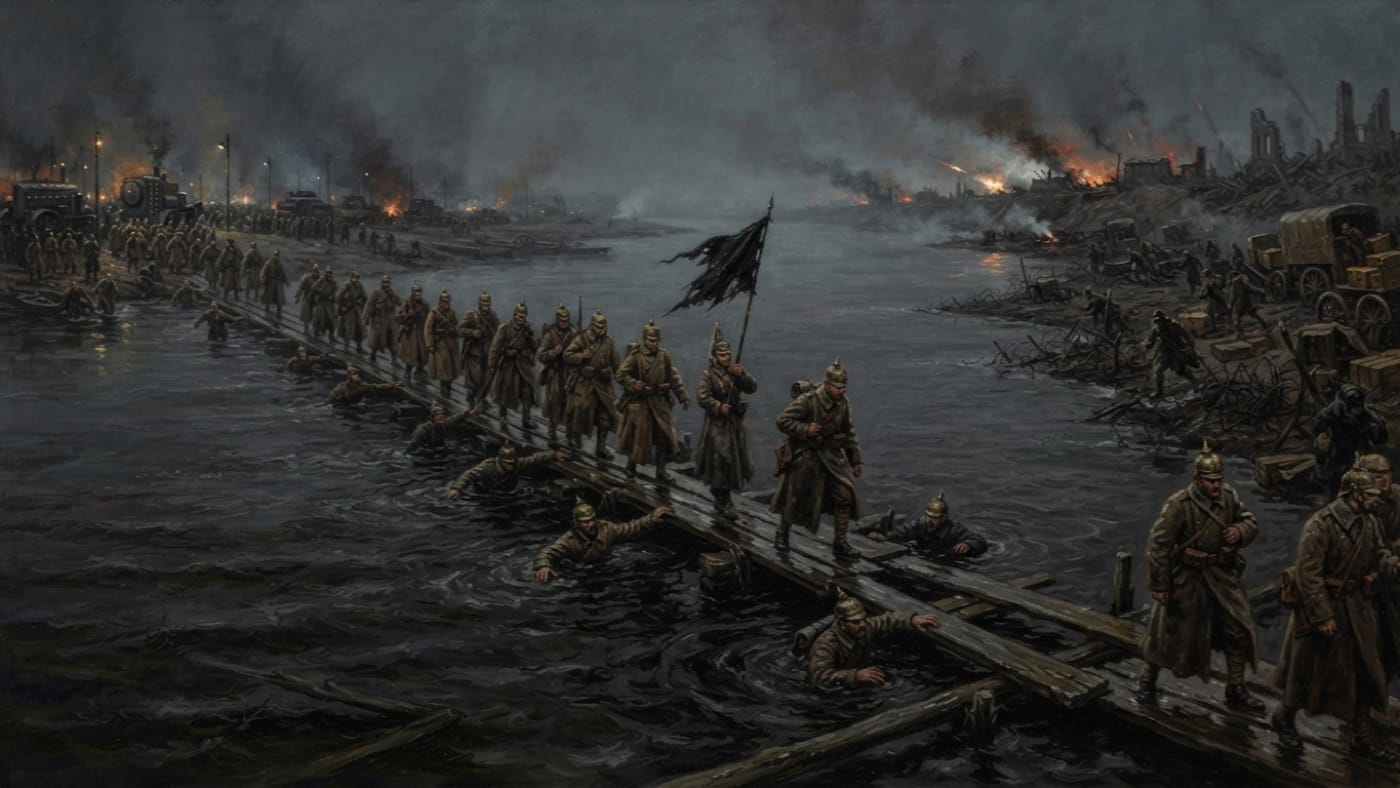
#On the Drowned Pontoon
The third name in the dispatch, and the only one whose floor had to be taken on faith.
Mark Seven was a sunken pontoon on the forward corridor of the Danube, somewhere between Budapest and Bastion-Irongate. In A.S. 172 it became one of the three passages by which the Vexillators of Strasbourg carried the Night of the Three Bridges. The dispatch lists it third, after Saint Hadrien's Ford and the Chain-Pier Ruin. That order is the clerk's. It does not tell us which passage lay upstream or how far apart they lay, and I have no wish to promote a clerk's list to a map. Budapest was the staging hub for the Sibiu–Irongate corridor. Irongate holds its gorge. Mark Seven lay somewhere on the water between them, and the file gives no coordinates. I will not lend it the fortress's.
The pontoon had sunk in place. Its barrel-floats were trapped beneath the surface, and they held up a deck that no longer reached the air. Soldiers crossed the Danube on it by stepping on planks they could not see. There were gaps between the planks, and several men went down through them.
The designation is a small scandal of its own. I have looked for Marks One through Six and found none. Seven might have counted pontoons, river-miles, or the chalk figures on a quartermaster's board. The archive does not say which, and on this point I agree with it.
#On the Need to Cross
A sudden enemy advance had pinned forty-seven supply wagons against the western bank. They carried rifle cartridges, consecrated bridge-chain, three portable bell-frames, two sealed ossuary reliquaries, and the grain that kept the Sibiu–Irongate corridor from eating its own boots. The river was high and the far bank hostile. The bridges were gone. The Bureau of War says "gone" the way a widow does.
The east bank was pressed from several sides. Velmora's assessors had been found near the crossings. Morwen, whose envy works the Danube approaches opposite Irongate, sent her influence up from the south. Maldrake's forward batteries ranged the exposed flats. Farther east, the Blightmarsh was stirring. The record shows no alliance among them and no combined command. The Great Deceiver keeps no minutes and has never needed a staff meeting to be thorough.
Warden-Submarshal Calev Rohn ordered the Vexillators forward under Bureau of War authority at all three passages at once. The simultaneity was the whole tactic. Three standards entered the water together, and the enemy's guns and sorcery had to divide themselves among three targets. A deck no one could see was a poor road for a column. It was an excellent place to draw a third of the enemy's fire.
Mark Seven was given the smallest standard of the three. It was black-edged river cloth, called Widow's Rag by the men and entered by the clerk as Standard 14-D, Hydrological Operations. Vexillator doctrine holds that a standard creates a formation where none exists. On a deck under black water, nothing else was available to create one.
#On the Eastern Bank
At Saint Hadrien's Ford, the Litany-Engineers drove iron pegs and strung guide-cords along the current. The dispatch gives Mark Seven no such apparatus. Its men had the plank under one boot and the hope of another plank under the next.
Picture it plainly. The men carried cartridges, rations and rifles, and wore wool that took on river water by the pint. The Danube ran cold and high. Under it lay timber that had once been level and was now whatever the river had made of it. A man found the deck by putting his weight on it. Where he found a gap, he stopped being a man in the column and became an entry in the column's paperwork. The current took him under, and the men behind kept moving because there was nothing else they could do.
Some of those who went between the planks surfaced downstream. They climbed out and rejoined the line. Not all of them did. I put the matter that way because the dispatch puts it no more precisely, and I have learned not to improve on a dispatch with bodies in it.
Widow's Rag reached the eastern bank first of the three standards. Sister-Vexillator Anje Rusk carried it out of the water, planted it in the mud, and rang a hand bell until the striker froze to the rim.
Everything the record holds about her comes down to those two acts: the planting and the ringing. Pamphleteers have given her more. The Codex declines it.
The clocks of that night belong to the whole operation. By the official account, the assault columns crossed in less than seven minutes, a ragged line had formed on the eastern mud by the ninth, and the first wagon chains were hauling by the fourteenth. By dawn the supply column was across. Popular recitation has paired the seven minutes with Mark Seven because both contain the numeral. I declare the pairing void. Nor did forty-seven wagons roll across a submerged deck that swallowed men on foot. The dispatch does not say how the wagons crossed or by which passage, and I will not invent a carpentry miracle to fill the gap. The cargo reached Irongate. The southern works held through the winter. That much was real, and it was paid for.
#On Sign Two
War classified the downstream return as Sign Two. Sign One belongs to the Chain-Pier Ruin and its unattended banner. Mark Seven's claim to the miracle of locomotion lies in the men who went under and came back. The surgeons attending the eastern bank put it differently: hypothermia, concussion, and soldiers who refused to die on schedule.
Both accounts are on file. Both were written by men who had seen the bodies. Only one is read aloud at commemorations. Doctrine does not require me to choose between them, and I have accepted that kindness.
The Night's casualty roll first recorded 4,200 men dead, drowned, missing, frozen, or otherwise removed from formation. The Bureau of Records, on War's petition, later revised it to 1,800 casualties and 2,400 martyrdom-translations. Both figures cover the entire Night. Records keeps no subtotal for Mark Seven. A man who went down between the planks and never came up is somewhere in those numbers. Which column holds him depends on a petition he never signed. As a casualty, his family is owed a pension. As a translation, they are owed a ribbon.
A Rhineland digest placed the drowned pontoon among the bridge demolitions at Mainz, Worms and Cologne and dated the whole affair to a year the Church has not yet reached.
Corrected. Mark Seven lay on the Danubian forward corridor between Budapest and Bastion-Irongate, and the crossing took place in A.S. 172. The Rhineland legend may keep its own bridges. It may not borrow this pontoon.
#On What Returned
Anje Rusk's bell is displayed in Strasbourg. Its placard says the bell froze from sacred cold. A quartermaster's note says it froze because it went into the Danube. I report both and endorse neither. The placard was composed for visitors. The note was written for an inventory, and inventories are written in a hurry by men who expect never to be quoted.
A year later the Bureau of Shadows filed something less easily displayed.
Bureau of Shadows memorandum, Danubian Patrol Annex, A.S. 173: "Recovered personnel from Mark Seven continue to report hearing the Psalm of Iron beneath moving water. ███████████████████████████. Two witnesses identify voices belonging to men certified translated. One voice gives current tactical instructions. Recommendation: do not publish; do not silence; listen quarterly."
I reproduce the memorandum as filed. I do not name the voices, and I will not supply the missing line. The memorandum states what the witnesses reported. It does not say why the Psalm of Iron should be audible under the Danube, and neither will I. Two of the voices belonged to men the Bureau of Records had already certified translated. Translated men are supposed to stay where the certificate put them.
The file does not say whether anyone went on listening every quarter after the memorandum was filed. If someone did, the reports went to a drawer I have not been shown.
Each year the Night is commemorated with three bowls of river water, three soaked banner-cloths, and one empty pair of boots. The rite honours the whole Night and no single passage. Mark Seven has no shrine, rite or keeper of its own. Its timber lies wherever the river has taken it, in whatever condition the river prefers.