

#On the Formation and Its Command
The Vexillators of Strasbourg enter the Codex wet. They were the formation of the Vexillary Arm that Warden-Submarshal Calev Rohn commanded under Bureau of War authority on the Night of the Three Bridges, in A.S. 172 / 1882 CE. Everything I can certify about them happened on one river. No calendar day survives. The year does.
Readers write to the Ledger asking for the formation's charter, its regimental number, its strength on the morning roll, its barracks and its founding. They may keep writing. The Codex holds none of these. Strasbourg gives the formation its name, and by War's account it consecrated the formation's standards. Neither fact makes the city its permanent quarters. A name on a door is no lease.
The Night did not make Rohn master of every Vexillator in the Church. The Arm is larger than one night's command. The Submarshal held this formation, on this bank, for this crossing. Copy the rank exactly. Clerks who promote officers by misspelling them are reassigned to the drowned-goods inventory.
#On the Column and the Three Hands
The work began with freight. On the Danubian forward corridor between Budapest and Bastion-Irongate, a sudden enemy advance pinned forty-seven wagons against the western bank of the Danube. They carried rifle cartridges, consecrated bridge-chain, three portable bell-frames and two sealed ossuary reliquaries. They also carried the grain the Sibiu-Irongate corridor needed for its next rotation. They were bound for Irongate's southern works. The enemy held the far bank. The river was high. The bridges were gone.
The enemy pressed by proxy. Velmora's assessors had been found near the crossings. Morwen's influence had turned guide-posts against their own directions. Maldrake's forward batteries ranged the exposed flats. No source puts any of the three Sin-Generals at the water's edge in person, and I decline to cast them in the scene for the benefit of the recruiting posters.
War answered with three professions, each assigned one sense of the frightened body. The Vexillator holds the eye. When drums drown and officers become fragments, a standard held above the smoke tells a rank where forward lies. War's doctrine goes further and teaches that sanctioned cloth marks a formation and also keeps one in being. The Tribune-Chaplains hold the ear, keeping prayer-command and cadence going for men who can no longer hear an order but can still hear a verse. The Litany-Engineers hold the riverbed with iron pegs and guide-cords. The hand on the cord was not the hand on the pole, and neither belonged to the mouth at the psalm. A formation that confuses these offices loses all three together.
#On the Three Passages
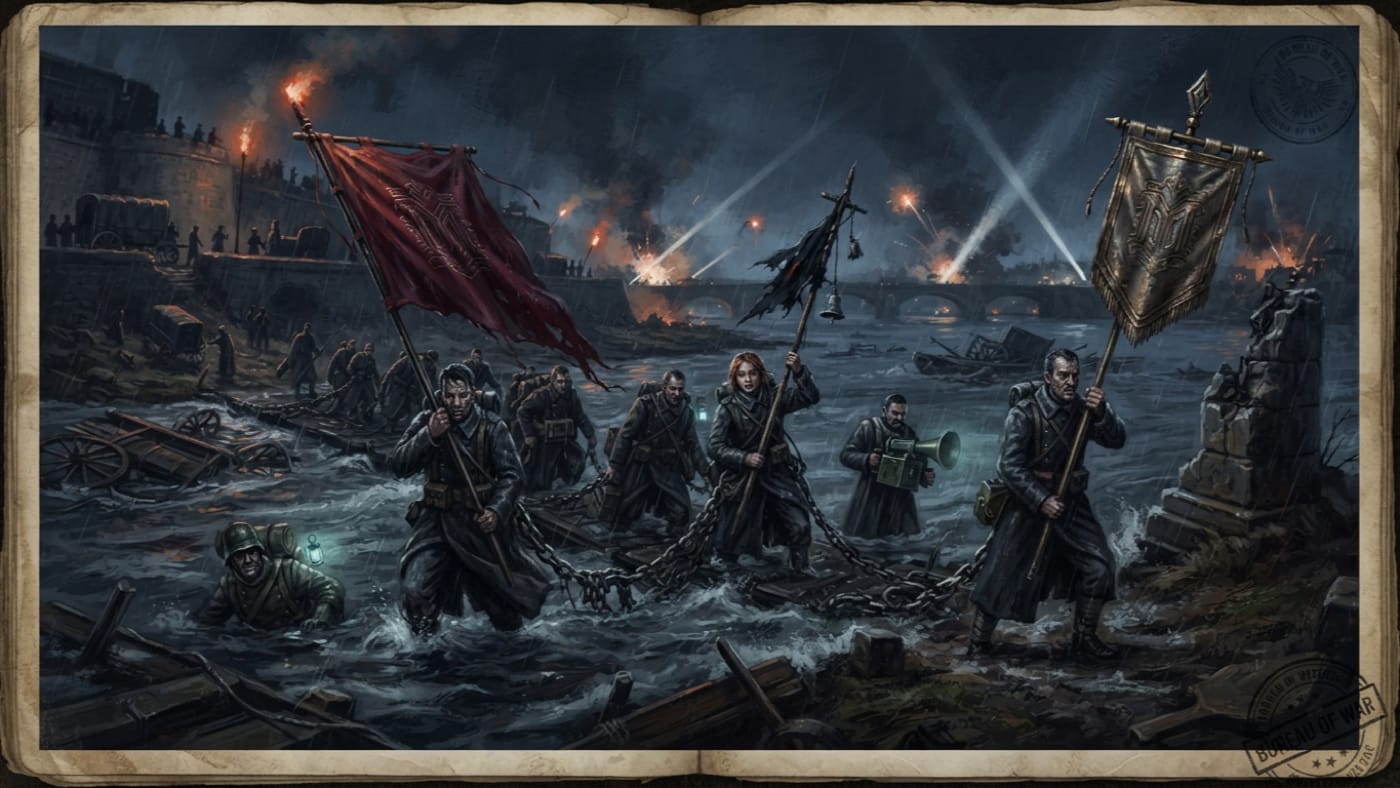
Rohn chose three passages and three standards and sent them into the river together. War records that each standard was consecrated at Strasbourg and stitched with pilgrim-cloth from the Continental Levy musters. The sentence is War's, and War's name stays on it. The Levy decree of A.S. 110 licensed those musters sixty-two years before the Night. It does not date any needle, seam or consecration.
I write the passages one after another because a page has a single column. The river had three. Each ford drew guns that would otherwise have found the next, and that simultaneity was the whole cleverness of the order. Rohn's act was the order. The rest belongs to other hands.
At Saint Hadrien's Ford, the Crimson Pennant of Saint Marcellus went into water that reached the men's chests within ten paces. Its bearer is unrecorded. The cloth outlived the name. The engineers drove iron pegs into the mud and strung guide-cords along the current. The first cord snapped. The second sang. The third held. Tribune-Chaplain Sorellus began the Psalm of Iron and lost his lower jaw in the fourth verse. The ranks sang on without him. Sorellus carried the psalm and nothing else. Devotional prints that put the pennant in his hands rob a nameless bearer to decorate a known chaplain. The record is silent on what became of him. The saint who named the ford is another person entirely and should not be confused with the chaplain who sang in it.
At the Chain-Pier Ruin, Lorn of Metz climbed the broken pier under fire and fixed the Brass-Lipped Banner of the Sixth Levy between two stones. For ninety seconds it stood with no hand upon it. Doctrine filed those seconds as Sign One. The veterans credit the weighted socket and Lorn's balance. Both readings are on file, and the Codex rules on neither. No one can place the ninety seconds at a particular minute of the night's clock. No one has established which Sixth Levy the banner commemorates. The byname "of Metz" proves neither a birthplace nor a training house. Lorn's later fate is not entered.
At Mark Seven, the drowned pontoon lay where it had sunk, its barrel-floats trapped beneath the surface and its planks under the water. Men crossed by stepping on what they could not see. Some vanished between the planks. Several surfaced downstream and rejoined the line, and War filed their return as Sign Two. Sister-Vexillator Anje Rusk brought Widow's Rag to the eastern bank, planted it in the mud and rang a hand bell until its striker froze to the rim. The clerk's designation is Standard 14-D, Hydrological Operations. The men's name for it is better. It was a small black-edged river cloth, and it arrived soaked, frozen and torn. Rusk's later fate is uncertified. I will not lend her name to any voice the river is said to keep.
#On the Clock and the Wagons
War's clock runs as follows. The assault crossings took under seven minutes. By the ninth minute a ragged line held the eastern mud. By the fourteenth the wagon chains were hauling. By dawn the supply column was across.
That paragraph holds two clocks, and enthusiasts keep winding them together. The seven minutes belong to the bearers in the water. The forty-seven wagons belong to the whole night: to wagoners, to chain, and to whatever bodies still had working arms. The record names the chains and stops there. It describes no ferry, no new span and no hauling engine, and the Codex will not build one out of admiration.
The column reached Irongate. The southern works held through the winter, and the enemy advance stalled long enough for the Central Corridor to reinforce. That is what the crossing achieved. What a withdrawal would have cost is a question for sermon-writers, who are paid by the hypothetical.
#On the Report and the Roll
Tribune-Clerk Othmar Vey wrote the first after-action report under a wagon, in rain. The soldiers, he wrote, were borne forward in a manner exceeding ordinary locomotor explanation. War, Doctrine, Records and the sermon offices worked that sentence over until it came out as miracle of locomotion, with its approved formula: They did not swim; they were carried. The veterans tell of freezing water and a current that pulled sideways. They tell of rear ranks shoving the front ranks forward, and of banners followed through smoke because nothing else could be seen. The official account names the Creator as the carrier. The veterans name the men behind them. I file both and certify neither. The Ledger records what was ratified. It has no authority over the river.
Popular broadsheets report that Sister-Vexillator Anje Rusk carried Widow's Rag across Mark Seven without wetting the cloth.
Corrected. Widow's Rag reached the eastern bank soaked, frozen and torn. The broadsheet mistook sanctity for laundry.
The cost belongs to a separate ledger, and the formation's name does not head it. The original roll counted 4,200 dead, drowned, missing, frozen or otherwise removed from formation across the whole operation. That figure is neither the formation's strength nor any one ford's share. After War petitioned for doctrinal review, the Bureau of Records kept 1,800 as casualties and reclassified 2,400 as martyrdom-translations, hydrological theatre. Add the two columns and the sum is still 4,200. The revision moved names between headings and found no one alive. No source puts Rohn's hand on it.
Families of the reclassified may apply under Form 172-Bridge-G for a commemorative ribbon in lieu of pension. Mark the word apply. A ribbon is not promised. The form reclassifies nobody. It follows the reclassification with a pen. Its issuing office and its original issue and seal dates are unknown.
#On What Survived
All three standards survived. The record says that much and no more. It says nothing of intact staffs, gives no custody chain and names no shelf. A cloth that lived through the night is no evidence that the hand carrying it did.
The Arm built a cult on the Night. Vexillary schools teach it, levy officers invoke it at musters, and river discipline and river equipment were tightened afterward. Those consequences belong to the Arm at large. The record assigns none of them to the Strasbourg formation in particular. I will not stitch later waxed seams and recovery tags onto three standards that crossed before anyone required them. The Codex also knows of no formation answering to this name in A.S. 201. Its file holds one night, three passages and a column of wagons.