

#On the Rise and Its Uses
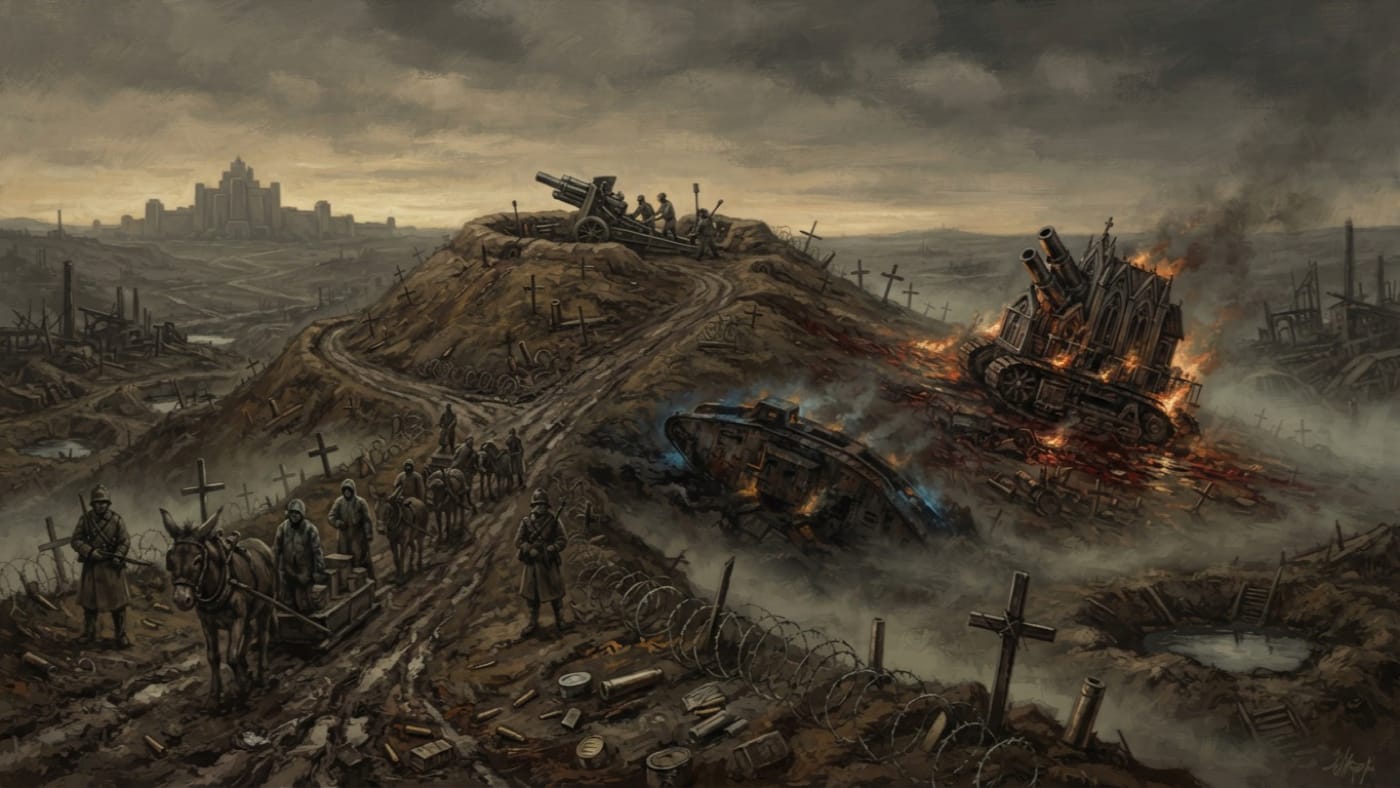
The Codex holds Wormwood Hill as a place. That has to be stated first, because most readers meet the name already fastened to a disaster and assume the disaster is the whole of it. It is a rise of ground with a slope that armies have climbed and a valley below it that armies have filled. Supply columns have crossed it. Batteries have fired from it. The dead have been put into it, sometimes by burial detail and sometimes by less orderly means. Those three uses are attested. The ledger has nothing on the rest of what a reader might want: elevation, contour, the road a column takes up the slope, the bastion whose writ reaches the summit.
I have examined the absence with some care. Nothing is missing from it.
No zone is entered against the name. The Sagittal Line runs north to south through seven bastions with properly ratified names, and in no register I have opened does any of them claim Wormwood. Some readers have placed the hill by reasoning from the fuel, or the fog, or the city where distillers are most often arrested. They did so without the Ledger's help and may keep the conclusion at their own risk.
What remains is a battlefield in the plain military sense. The ground is high enough to be worth taking, close enough to the supply roads to be worth fouling and soft enough to dig graves in. Its soil holds mud, track-cuts and spent brass, and it takes oil and keeps it.
#On Supply and Forbidden Heat
On a slope, an army fights the slope as well as the enemy. Every shell, ration and canister has to be carried up it, by mule or by men, and the ration allotments of the Bureau of War have never been calculated for gradients. Hymn-blessed fuel from the Chrismole Furnaces of Brast covers part of the shortfall. Anatolian pit-sludge covers the rest. It is condemned eleven times over, distilled in cellars and carried in packs, and the Black Diesel Distillers supply it to anyone whose lamp the Bureau has forgotten. Anatolia is where the fuel comes from. It tells us nothing about where the hill is.
The Codex records that the tank of A.S. 163 burned black diesel. It does not record how much of the remaining traffic on Wormwood did the same. Any Hieromnemon who has eaten in a garrison mess in February can supply the figure himself, and none of us will write it down. The arrangement is familiar from every other front. Twenty per cent of the contraband is set aside to be confiscated where the Bureau of Purity can be seen doing it. The other eighty per cent goes up the hill in the dark.
#On the Sealed Campaign Names
The ledger keeps two older catastrophes under the hill's name. It gives a year for neither, and it puts them in no order relative to each other or to anything else.
The first is the Echo at Wormwood. By the received account, troops under siege heard their own voices in the night chanting treachery. They panicked and executed one another. One soldier survived, unnamed, with his ears torn out, and he maintained that the voices went on after his deafness. The Codex holds no roster, no casualty count and no tribunal finding. It does not say whose hand took his ears. Most of all, it holds no mechanism. I have read the theories and declined to sign any of them.
The second is the Tithe of Wormwood Hill, and it belongs to the counting-house. The account says a convoy delivered relics that glowed with an inner fire. The tariffs on them were miscalculated, and the relics were burned in a plaza as contraband. The flames consumed the convoy and three neighbourhoods beyond it. The Bureau of Records classified the loss as "efficient purification." The account never says which plaza, which town or which neighbourhoods. It does not say whether the relics were genuine, whether the miscalculation was an accident, or what made them glow. The Bureau of Tithes has never volunteered its working.
Set side by side, the two accounts describe different kinds of loss. In the Echo, soldiers killed soldiers because of what they heard. In the Tithe, civilians died because a column of figures said the burning was lawful. Nothing in the file connects the two through one cause, one campaign or one demon, and I will not draw that connection to make a tidier page.
#On the Engine of A.S. 163
The Ledger holds one date for the hill with confidence: A.S. 163, 1873 by the old reckoning, thirty-eight years before this survey.
A tank running on black diesel caught fire and burned its crew alive inside it. It did not stop. For three days it kept advancing, while its hymn-vox played a canticle distorted out of all doctrinal recognition, and its treads ground through its own supply column. The 7th Orison Battery ended the advance with concentrated relic-shot. The wreck then leaked oil that caught fire on its own at every dusk for eleven days.
The Bureau of Engineering declared the burning "consistent with residual thermal signature." The Pit-Masters of the supply district said it was "the fuel remembering what it ate." Both statements are entered. Neither is certified. Nothing in the file establishes that the fuel thinks, that the crew survives in any other form, or that a named power took the controls. Those who want the full sequence of the fighting will find it in the Wormwood Hill Tank Incident entry. That entry has the patience for it.
This entry is concerned with what the eleven days did to the ground. A supply route had been wrecked by its own escort. A slope was soaked with fuel that would not stay out, under a wreck nobody wanted to approach at dusk. From then on the name stood for an outcome that every quartermaster feared and every distiller could recite.
Earlier compilations of material under this name dated the Engine to A.S. 263, the Echo to 263, the Tithe to 259 and the Ladder's ascent to 361. The calendar has not reached any of those years. The Engine is corrected to A.S. 163 on the strength of its own record. The other three dates are withdrawn and not replaced. No year has been produced by subtracting a convenient century, and any reader who does the subtraction privately does so without a seal.
#On the Ladder's Ascent
The Pilgrim's Ladder was commissioned in A.S. 110. That date belongs to the machine and to the doctrine of the Processional Arsenal that grew out of it. It does not date the hill or the climb. The Ladder's action at Wormwood came later than the Engine of 163. Beyond that, the year is held.
The account is straightforward and unpleasant. The Ladder went up a slope slick with gore, and its engines failed under it and stalled. The choirs aboard kept their cadence throughout, as Shrine-Deck Crew drill requires, because choir-timed mortars do not fire on schedule once the singing falters. Below, in the valley, a perfume fog was rising, and the record attributes it to Lust. The mortars fired into it, and the account holds that the psalm broke it. Velkara's craft can be blamed for the fog. Nothing in the file puts the Sin-General on the hill in person, and I will not take her there to improve the composition.
The record disagrees about the outcome. One account has the machine burning out by dusk while its hymn held the line. The Ladder's own file says the hill was held by dusk and that the machine was badly damaged and towed away. Both accounts describe a single afternoon. Neither tells the reader who holds the ground now, and neither says that every Ladder ever linked to the name went into the scrap-yards.
#On the Hill in the Record
Where the hill survives, it survives as words. The pilgrims' approach chant is attributed to the Ladder's climb: "Step by step, shell by shell." The chant has outlasted the action. The Ledger does not record whether the people who chant it still walk the slope.
Distillers say "Wormwood drip" when a batch has gone wrong, and their storage rule is dark, cold and sealed. The rule is taught to every Wick-Kid with the tank as its reason. The 7th Orison Battery preserved the firing cord of its third shell from the A.S. 163 engagement and touches it before deployment. The cord stays with the battery. No shrine on the hill holds it, and I will not build one here to give it somewhere to hang.
So the administrative picture runs as follows. There is a place with four accounts filed under its name, one firm year and three withdrawn ones, and the attested uses are supply, artillery and burial. Its present garrison, if it has one, has not reported to this office.