
#On the Authorized Collapse from Sleep
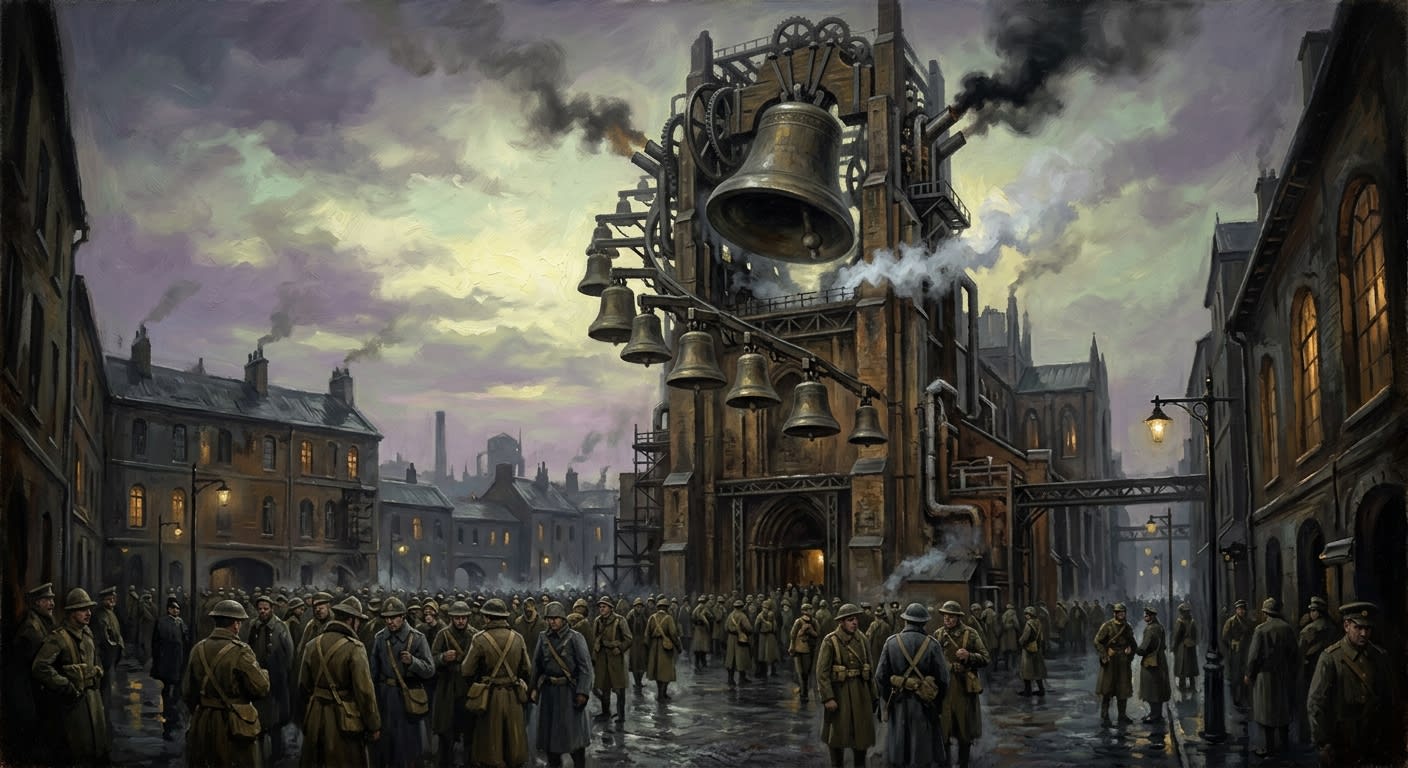
Ninefold Matins is the first daily violence of lawful bronze. At dawn, across every city obedient enough to possess a tower and every camp frightened enough to hang a field bell from timber, nine strokes descend in pitch, each lower than the last, each more intimate, each less negotiable. The peal does not invite waking. It annuls sleep.
The Bell Codex defines the sequence with its usual cold beauty: nine descending strokes, separated by intervals measured under the seven-second tolerance of the Bureau of Bells, struck at first civil dawn unless Line conditions, fog drift, active siege, acoustic contamination, or sanctioned local addendum require alteration. One hears the first stroke as sound. One hears the ninth as instruction. The body rises before the mind has finished inventing excuses.
The Synod's day begins with Ninefold Matins because all government worthy of the name must seize the citizen before the citizen remembers he is private. A man waking naturally belongs, for one filthy instant, to himself. A man woken by bell belongs immediately to Order. His first breath enters a schedule. His first curse becomes an unfiled devotional response. His first step toward the basin repeats a continental rhythm struck from Calais to Constantinople, from Strasbourg's carillon to the pump-bells under Shipka, from school dormitories to artillery yards where boys learn to shave with hands already shaking from powder dreams.
This is why counterfeit Matins terrifies more deeply than counterfeit curfew. Curfew closes a day already wounded by choice. Matins opens a day before choice can put on boots. A false dawn peal can send garrisons to the wrong wall, children to locked schools, kitchens to ration release before stock-count, Purity patrols into districts still shuttered, and Index packets into validity before the ink has accepted its own authority. Timing is not decoration. Timing is custody.
The old catechism says: At the first stroke, rise; at the second, face east; at the third, wash; at the fourth, name the Creator; at the fifth, name the Synod; at the sixth, name the bell; at the seventh, name your station; at the eighth, take your tool; at the ninth, begin. Children recite this before they can tie their shoes. Soldiers mutter it in trenches. Clerks hate it because it gives the bell more credit than the desk. The clerks are correct to hate it. The bell works faster.
#On the Nine Strokes
The Bureau insists the nine strokes descend because the soul must be lowered from dream into obedience. I suspect the committee chose the pattern because rising intervals at dawn made infants scream and horses kick stable doors. Theology often arrives after practical men have solved the problem with rope.
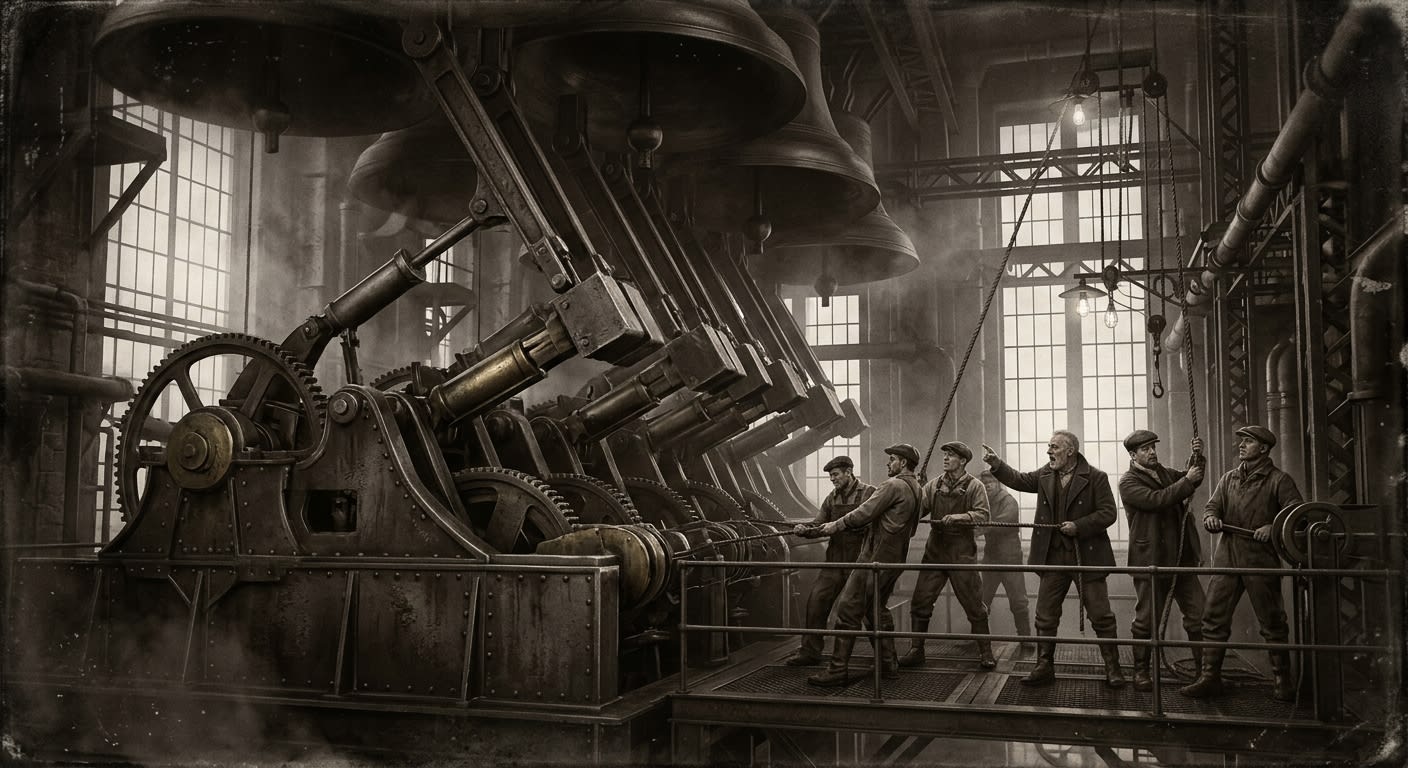
Each stroke bears a licensed meaning, though the meanings differ slightly between civil and military schedules. The first stroke is Witness: the day exists and has been observed by bronze. The second is Flesh: the body must move. The third is Water: wash, cleanse, cool the mouth before speech. The fourth is Creed: the first line of the Eternal Creed may be spoken. The fifth is Labor: kitchens, factories, offices, and yards begin preparation. The sixth is Record: registers open; yesterday's temporary silences expire. The seventh is Gate: controlled movement may start. The eighth is Tool: trade, weapon, quill, ladle, seal, shovel, or rosary enters lawful use. The ninth is Submission: all prior hesitation becomes evidence.
In garrisons, the meanings harden. Witness becomes Sentry Confirmation. Flesh becomes Muster. Water becomes Mouth-Seal and brine rinse. Creed becomes unit response. Labor becomes magazine check. Record becomes casualty adjustment. Gate becomes patrol release. Tool becomes arms custody. Submission becomes the first order of the day, usually shouted by a sergeant whose voice has spent twenty years losing arguments with bronze.
At Bastion-Brest, the ninth stroke is held a fraction longer during mud season because sound sinks in the Bug flats and returns with a wet delay that has fooled three generations of sleepy artillerymen. At Bastion-Przemyśl, ridge echo requires a clipped fourth interval lest the Creed-stroke answer itself from the wrong slope. At Bastion-Irongate, the Gasket Choir hums under the descent so the gorge does not throw the lower tones back as hostile reply. At Shipka, bellwardens strike early when Syrion's fog thickens, because time there becomes a parish child: slow, dishonest, and in need of public correction.
At Constantinople the peal is imperial in spite of itself. Twenty-three bells hang over the Bosphorus, and Ninefold Matins moves through them like a magistrate through a crowd that has already been warned. The first three are high tower bronze. The next three pass through the old western cage. The last three come from throat-bells cast with reliquary filings after the Burning of the North Gate. Men on the water say the ninth stroke makes oars hesitate. The Bureau has not licensed hesitation. The oars persist.
A popular school broadside states that all Ninefold Matins sequences are identical across the Dominion.
Corrected. The doctrine is identical. The bronze is local, the air is treacherous, the towers are vain, and the Enemy listens. Identical obedience requires different strikes.
#On the Origin Claimed and the Origin Used
The Bureau of Bells prefers the Miracle of Cologne. Of course it does. Every Bureau wants a birth that smells of incense rather than committee sweat. The story says that after the miracle bells scattered Wrath's Host from the gates, an unnamed Cantor heard the rhythm of salvation still trembling in the cracked air and wrote the first Matins descent before the city finished counting its dead. His quill scorched the vellum. His hand bled. The margins, naturally, glowed.
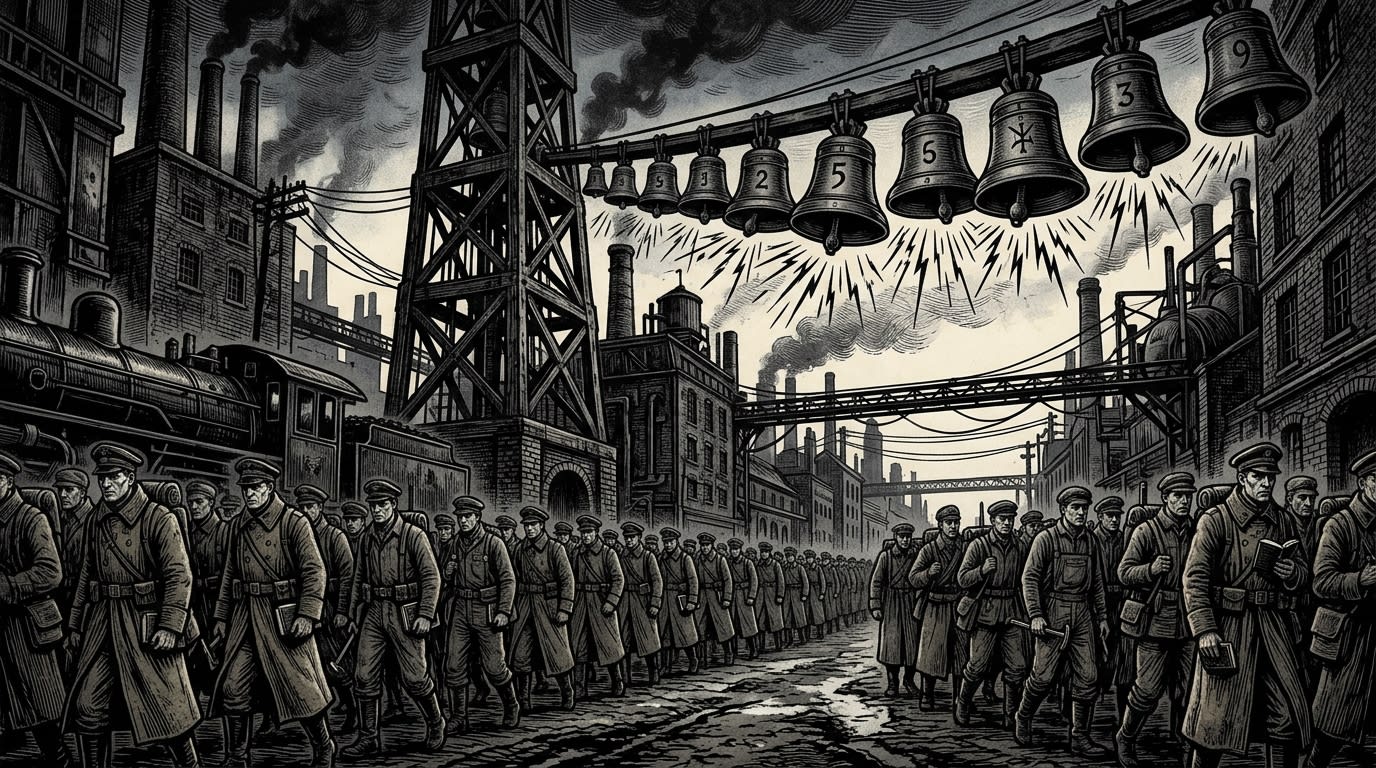
Doctrine prefers a committee of twelve working from older monastic offices, siege watches, cathedral dawn-rules, and practical bell schedules already in use along the western dioceses. This version contains fewer glowing margins and more arguments over clapper diameter, which makes it less beloved and more likely. The Codex of A.S. 25 preserved the sequence before the Bureau itself existed. The Bureau of Bells, constituted in A.S. 52 and ratified under the Concordat in A.S. 90, inherited its scripture after the scripture had already begun governing bodies.
The useful origin is neither miracle nor committee. The useful origin is fear. After the Sundering, after the first city reports arrived with bells silent in the east and ringing in the west, dawn became an exposed nerve. A sleeping population could miss alarm, muster, ration distribution, purification order, evacuation, Mass, execution, or the fact that its neighbour had ceased to have a face during the night. The day required a legal wound to open it. Ninefold Matins supplied one.
The nine strokes also solved the old quarrel between parish time and military time. Monks rose for prayer; soldiers rose for survival; factories rose for quota; clerks rose because ink dries badly when neglected; peasants rose because animals are tyrants with hooves. Matins made these motives answer one sound. The peal did not abolish local habit. It chained habit to a common bracket and called the bracket holy.
By A.S. 115, during the Bell Codex recension now taught to every schoolchild with ears intact, Ninefold Matins sat first among the great peals: Ninefold Matins, Widow's Toll, High Angelus, Iron Vespers, Silentium. Dawn wakes the body. Grief receives its licensed note. Noon disciplines the mouth. Evening arms the walls. Silence swallows catastrophe. A citizen who knows these five peals knows the skeleton of the Synod's day. A citizen who does not know them is either foreign, deaf, infant, condemned, or being watched.
#On Civil Use, Which Is a Kinder Name for Possession
In Strasbourg, Ninefold Matins begins in the cathedral and is answered by lesser towers in a sequence so exact that even the Bureau of Records has stopped pretending it finds errors. Windows tremble. Water in basins wrinkles. The Tower of the Quill opens its lower doors. Confession booths unlock. Street sweepers step into alleys. Bread ovens are inspected. The first queue forms before the second echo has left the stone. The city does not wake like an animal. It is stamped awake.
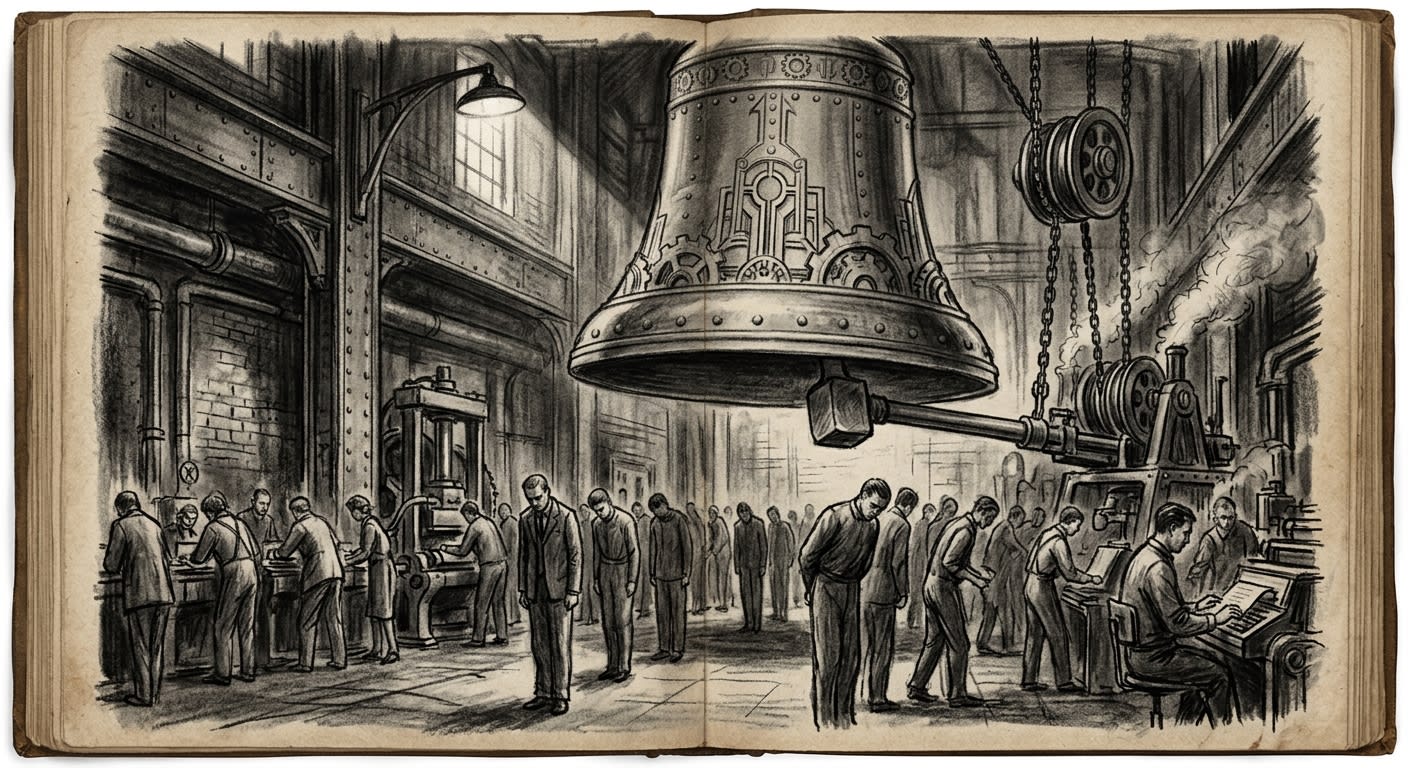
The peal permits the first lawful actions of the day. Ration halls may heat broth after the fifth stroke but may not distribute until the local ration-bell confirms. Schools may assemble children after the seventh but may not begin recitation until Prime. Markets may raise shutters after the ninth unless a festival exception, mourning cordon, plague notice, or doctrinal street-stop delays commerce. Prisoners may be moved after Matins because movement before dawn carries the scent of Shadows, and the Bureau of Shadows dislikes competition.
The poor know Matins by stomach. A kitchen that misses the peal loses rhythm for the whole day. Soup arrives late; work crews curse; factory masters file delay claims; Tithes recalculates lost productive grace; Mercy sends a conciliatory note; Records asks for the note in triplicate; the kitchen head is corrected for failing to honor dawn. Hunger is punctual because bells made it so.
Factories adore Ninefold Matins because it lets greed wear a halo. A shift begun at dawn under licensed peal is not merely labor. It is participation in the rhythm of salvation, which sounds finer than making children sort rivets until their fingers bleed. Factory masters have requested extended Matins in several jurisdictions, citing fatigue reduction, quota sanctification, worker morale, and other lies with well-combed hair. The Bureau usually denies extension outside special license. Toledo sells minutes. Strasbourg sells doctrine. Both take coin.
The citizen learns to measure sincerity by promptness. A man late after Matins is lazy. A household silent after Matins is suspect. A district unresponsive after Matins is ill, rebellious, bewitched, dead, or inconveniently private. The Doctrine Street-Vicar enters such districts with chalk and a pocket chime, converting dawn failure into names. The bell wakes the city. The Vicar wakes the file.
#On Military Use and the Enemy's Ear
On the Sagittal Line, Ninefold Matins is less a devotional peal than a daily assertion that the night has not won. Men stand up because the bell says the wall remains. Watch logs turn. Powder ledgers breathe. Field kitchens cough smoke. Wounded men pretend they slept. Officers pretend the men believe them. Dawn lays its hand on the parapet and finds it still there.
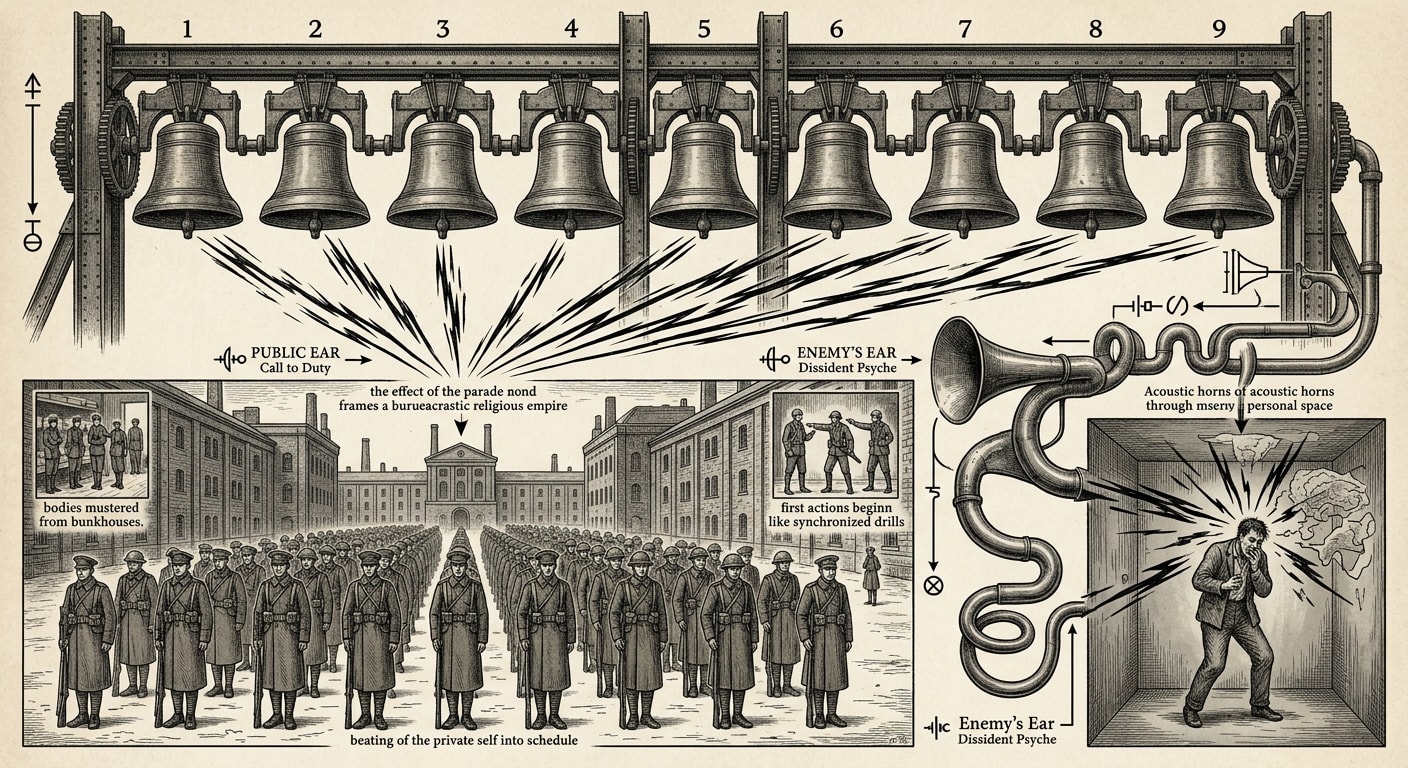
The Enemy listens. This fact explains half the ugliness of modern bell practice and excuses the other half poorly. The Pale Chanters have learned the edges of lawful sound. They push unhymn against peal, cadence against command, memory against training. The prescribed countermeasure is brutal: Ninefold Matins at triple volume, Iron Vespers sustained beyond its window, Silentium reversed into roar, reliquary wax in ear canals, gesture orders, written commands, and the theological fiction that a man who can still hear through wax is a casualty rather than a prophet.
At Vienna in A.S. 190 the countermeasure failed. The Chanters sang through the bells. Sound bent. Orders inverted. Left became kneel, kneel became fire, fire became confess, confess became reload. The bells were melted and recast a quarter-tone sharp. This works. Nobody credible knows why. The Bell-master claimed a dream from Saint Cecilia's severed hand. Records objected to the hand's travel status. Doctrine accepted the dream under provisional miracle procedure, which is the Bureau's way of saying ignorance has found a cassock.
After Vienna, Matins was treated as a weapon with recoil. Triple volume is no longer ordered casually. Prayer-jam tables accompany forward bell schedules. Counter-Toll Operators drill on Matins forgery by the third stroke. Cadence Examiners listen for enemy pressure in the interval between sixth and seventh, where dream residue most often clings. The Bureau of Orison and Song laces certain sky-sermon corridors with saint-dust, claiming consecrated ash weighs down corrupt frequency. Tithes grants one and a half allotments where four are requested, proving once again that sanctity is finite wherever accountants can reach it.
The demonic variants have forced local tests. Morwen-touched Gore-Slinger mist at Irongate duplicates voices; exposed soldiers must recite service number, mother's name, and the third verse of Ninefold Matins. The protocol catches half the impostors. The other half pass. Syrion-variant barrages at Shipka put soldiers to sleep so sweetly that bellwardens strike Matins into their skulls until some wake and some smile on. Velmora's greed-mist turns comrades into suspected thieves; Matins discipline has been revised at Sibiu so men answer the fifth stroke by opening their hands before taking tools, showing no coin hidden in the fist. The gesture is devotional, humiliating, and useful. A perfect Synodal invention.
Earlier field manuals described Ninefold Matins as “universally restorative against hostile sleep, fog, and counter-hymn interference.”
Corrected after Vienna, Shipka, and several reports whose clerks attempted optimism and were disciplined for fiction without license. Matins restores where bronze retains jurisdiction. Where the Enemy has entered the interval, Matins may rouse, wound, confuse, expose, or kill.
#On Crimes Against Dawn
Unsanctioned Matins is among the Bureau's preferred terrors because it reveals how thoroughly the body has been trained. Ring nine descending strokes at the wrong hour and doors open. Men rise. Kitchens light. Guards change. Lovers separate. Thieves hide. Children cry before knowing why. It is difficult to govern such obedience without occasionally admiring the criminal who steals it.
The common crimes are petty. A village sexton advances Matins by six minutes to give harvest crews more light. A factory foreman dampens the ninth stroke so workers do not know the shift has properly begun and cannot claim bell-hour wage. A shrine adds a tenth devotional aftertone for a local saint with more enthusiasm than paperwork. A tavern keeper imitates the first stroke to scatter drinkers before a Warden patrol arrives. These are corrected with fines, scourging, license suspension, and lectures so long that scourging acquires mercy by comparison.
The serious crimes are sequence crimes. A false Matins packet can move Index Damnatus Runners before their ciphers are valid. A borrowed dawn can empty a barracks, expose a bridge crew, or make a convoy depart into fog prepared by something with patience. A criminal bell-foundry once sold miniature dawn-sets to smugglers along a Jubilee route: nine nested cups tuned to approximate Matins through alley stone. The cups were seized. The smugglers were corrected. The cups are now in a teaching cabinet, because the Bureau never wastes a successful sin.
CASE NOTE — FALSE MATINS, NORTHERN CORRIDOR, A.S. 160 Unauthorized descending sequence sounded before civil dawn. Three relay packets released early. One orphan registry opened under obsolete cipher. Names affected: ███████. Bell source recovered as portable cup-set, human tooth clappers, wax dampers. Disposition of children moved under early authority: unresolved / administratively settled.
Counterfeiting Matins also tempts the pious. Mourning houses request private dawns. Sickrooms ask for one stroke only, then three, then nine, because a dying man who hears Matins may believe he has been granted another day. Mercy objects to denial. Bells objects to fraud. Records asks whether the man did in fact survive until ninth stroke, and if so whether the peal created a taxable day. I do not invent these questions. I merely preserve them so future ages may hate us accurately.
#On Custodians, Gauze, and the Number Nine
The number nine has acquired barnacles. The Bureau pretends each is doctrinal. The Custodians of the nonexistent Shadows wind black gauze in nine turns around the face. Children say this keeps the Ninefold Matins from recognizing them. Hagiographers attribute nine wounds to Saint Pellor during one useful season and seven during another. The Basilica lower locks are said to number nine, though Records denies the count and uses men with exactly nine keys. Soldiers swear that a man who misses the ninth stroke will die before Iron Vespers. Soldiers also swear that socks breed in packs. One must classify barracks theology carefully.
Ninefold Matins gives the Synod a vocabulary of completion without peace. Three is sacred. Nine is three disciplined until it stops arguing. The first triad wakes flesh, the second binds speech, the third releases labor. The shape pleases Doctrine because it can be diagrammed. It pleases Bells because it can be tuned. It pleases Records because nine fields fit handsomely on a form if the margins are abused.
The faithful have made private rites from the official peal, as faithful people always do when given a shape sharp enough to hold grief. Mothers touch children on the forehead at the third stroke. Widows hold breath through the fifth, when the dead once rose for work. Bellwardens spit into the dust after the eighth so the ninth will not find their mouths dry. At Shipka, men nail boot-straps before the first stroke during fog rotations; if the ninth arrives and a boot has loosened, the man is watched. At Irongate, choir apprentices hum the last descent into their sleeves, training the throat to obey without sounding. Doctrine permits most of this because suppression would require house-to-house dawn inspections, and even Doctrine must occasionally sleep.
#On Toledo, Sold Dawn, and the Bell-Market's Profanities
Toledo sells Matins by the minute, which is the sort of sentence that ought to provoke thunder and instead provokes receipts. The Bell-Market trades in hours with a vulgarity so honest it almost becomes theology. A factory may purchase Matins extended by three minutes, allowing its workers to labor under Heaven's rhythm and the owner's lash long enough to meet a cloth quota. A farmer may lease a single toll of Lauds. A mother may buy a quarter-peal for a fevered child. The market does not corrupt bells. It invoices the corruption already present in every schedule.
Matins is the cleanest awning in the market because dawn buyers are sentimental and easily robbed. They arrive with shift rosters, sickroom petitions, sealed grief, production requests, and the pathetic little hope that time, when struck in bronze, may become kinder. It does not. It becomes priced.
The Bureau of Bells tolerates Toledo because illegal time is worse than expensive time. A purchased extension carries form, seal, clapper assignment, tower witness, and terminal stroke. A stolen extension carries panic, unpaid echo, and lawyers. The market's officials speak of controlled devotional elasticity. They mean that the rich may stretch dawn while the poor are taught punctuality as a virtue. The distinction is ancient enough to be mistaken for nature.
Yet sold Matins produces crimes peculiar to itself. Toll-shavers scrape seconds from the edge of licensed peals and resell them in alley chapels as miniature dawns. Echo-brokers claim residual sound lingering under arches and sell it to pilgrims too tired to know fraud from comfort. Compline widows pool coins to buy shared deathbed tolls, then argue over whether the purchased sound belongs to the oldest corpse, the poorest household, or the woman whose son can still lift a chair. A boy once sold silent Matins to foreigners from Antwerp: no bell, no schedule, no effect, perfect margins. He deserved a chair in Commerce and received a beating from men with smaller dreams.
Bureau of Bells memoranda once described the Bell-Market's Matins trade as “peripheral devotional commerce.”
Corrected. The sale of dawn alters labour, grief, wage claims, school start, fever watching, and the price of obedience. Peripheral commerce does not require three auditors and a guard with a cudgel at the Matins stall.
Toledo reveals what polite towers conceal. Matins is authority over first action. Sell first action and every later act carries the mark of the sale. The worker begins under purchased dawn. The farmer loads under leased grace. The mother bargains with bronze over whether a child has survived into the next lawful day. The condemned man buys a bell for final appeal if his estate can bear the fee. The estate, being wiser than the condemned, often refuses.
This scandal has improved doctrine. Of course it has. The Bureau now distinguishes canonical Matins, licensed extension, private devotional dawn, industrial dawn, medical quarter-peal, mourning false-dawn, and fraudulent dawn-like acoustic event. Every category has a tariff. Every tariff has a seal. Every seal has a clerk who believes himself necessary, and may the Creator have mercy on the hierarchy of fools beneath him.
The Ninefold Matins proper remains unsold in principle. In practice, principle is the little booth behind the market where exceptions are weighed.
#On Children, Deafness, and the Refusal to Hear
A society ruled by bells must decide what to do with citizens who do not hear. The Synod, possessing the tact of a boot inside a reliquary, decided by categories. The deaf infant is enrolled under Visual Matins training: touch-board, lamp-pulse, wrist cord, and mother's hand until school age. The deaf adult receives a stamp on household records, a reduced liability for first-stroke failure, and increased suspicion for every other failure because bureaucracy, denied one avenue of cruelty, quickly discovers another.
Visual Matins boards are simple: nine carved ridges descending under the palm. The child runs fingers down the slopes while a lamp pulses. At the ninth ridge the child stands. Mercy calls this inclusion. Doctrine calls it alternate compliance. Children call it the washboard. They are right, as children often are before education ruins their accuracy.
The war has multiplied the bell-impaired. Bellwardens lose hearing in layers: first the high interval, then the warning chimes, then voices of women, then rain, then the little mercy by which a man hears his own breath and knows he remains inside his body. Counter-Toll Operators acquire brass ear, tower sickness, skull echo, early Matins hallucination, and that dignified late stage in which they wake at no sound and insist the bell has already struck. They are not wrong in a useful way.
The Bureau praises deaf Bellwardens for sacrifice until they miss a signal. Then praise becomes review. A man who lost hearing in service must still prove the loss has not made him privately timed. He carries a vibration token against the wrist. He watches the tower rope. He reads the face of the junior ringer. He fears silence more than sound because silence leaves him alone with administrative interpretation.
Refusal to hear is another species. Some citizens plug ears against Matins in protest, grief, hangover, madness, infant-sickness, or the common human desire to sleep past tyranny once before dying. The law distinguishes poorly. Wax without license is suspicious. Cloth in the ears is evidence if found before the ninth stroke. A household that does not answer the dawn knock receives a visit from a Street-Vicar, then a Warden, then Purity if the silence has acquired grammar.
Certain cults make a sacrament of missing Matins. Silent-Core crews sell muted bell-hour cores. Shadows couriers pass messages between final peal and dawn. Orphan prayers ask the gauze-men to walk where bells cannot see. The Bureau condemns these practices unevenly because each touches a useful office. Condemnation is strongest where utility is weakest. This is not hypocrisy. It is logistics with a clean collar.
The most dangerous citizens are not the deaf, who have procedures, nor the rebels, who have slogans. The dangerous ones wake before Matins and wait. They lie in the dark with eyes open, already obedient, already dressed inside the skull, denying the bell its first conquest. The Bureau has no category for them. I have proposed Pre-Responsive Suspicion. Records applauded. Mercy looked ill.
#On the Present Dawn
As of A.S. 201, Ninefold Matins remains operational across the Dominion, which is the Bureau phrase for “the bells still bully the sun with acceptable losses.” Strasbourg's master schedule tolerates seven seconds in civil districts, three seconds along active Line corridors, and no deviation during counter-hymn engagement. Bellway Synchronisation has tied relay houses, route tokens, shrine posts, and garrison watches to dawn descent. A packet stamped at Matins becomes truth until Iron Vespers. A labourer's lateness becomes measurable. A child's school absence becomes doctrine-adjacent. A soldier's failure to rise becomes a question asked by a man with a sidearm.
The peal is under strain. Northern dissonance corrodes standard intervals near the Fractured North. Shipka fog stretches dawn like warm wax. Constantinople salt-air eats clappers. Brest mud swallows low tones. Irongate tunnels answer when they should merely carry. Pale Chanters have learned to wait inside the spaces between lawful strokes. Prayer-jam reports multiply. The Bureau of Bells responds with revised tables, stricter inspections, recast bronze, sharper tuning, more wax, more saint-dust requests, more punishments for men who notice the punishments have become louder than the peals.
Still the ninth stroke falls.
At first dawn the citizen wakes. The clerk reaches for his pen. The soldier reaches for his rifle. The baker reaches for flour. The prisoner reaches for the chain because reaching first looks better in the file. Somewhere a mother curses softly and covers her child's ears too late. Somewhere a Counter-Toll novice hears a tenth sound and says nothing, which proves he has begun to learn.
The Bureau calls Ninefold Matins the authorized collapse from sleep into duty. The phrase is ugly, accurate, and durable enough to survive me. Dawn comes. Bronze descends. The private self is struck, counted, rinsed, named, opened, armed, and placed in motion.
The ninth stroke does not echo. It waits for you to obey.