
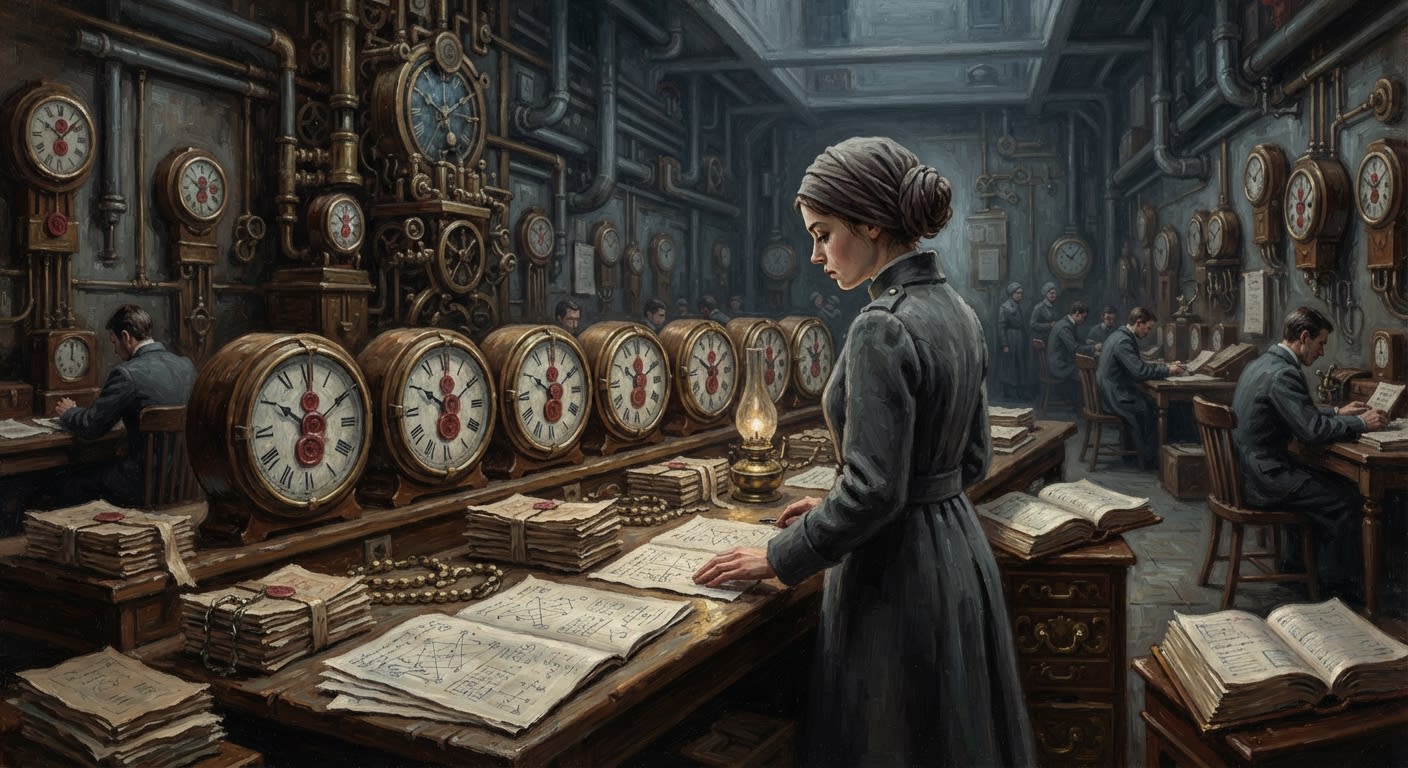
#On the Minute That Went Missing
"Late is the same as false." — Runner Corps maxim. The Ankletown relay houses learned the corollary at their own expense: early can be arranged.
In A.S. 187, two hundred and six arrest bundles arrived at the Ankletown relay houses carrying valid seals and impossible routing times. The wax was genuine. The ciphers answered. The throat-tag impressions matched the day's key, and the receipt chains ran unbroken from window to window, with the proper hands witnessing each handoff. Every instrument of the Index Damnatus that the Bureau had hardened after the False Packet Panic declared the bundles lawful. Only the arithmetic objected.
The bundles had travelled too fast. Each had passed through its relay windows in less time than the route allows a Runner with good lungs, a clear road, and the Creator's personal sponsorship. The paper said they had done it anyway. The paper was sealed. In the Index relay houses, sealed paper is the nearest thing to scripture a clerk may touch without gloves.
Veyl Hark was then a Purity assessor in those houses. She was one of the grey functionaries who check bell-hour stamps against transit tables so that the Runners need not think. She was not famous. Assessors never are, because fame needs witnesses and assessors spend their days proving witnesses wrong. By the following morning she had a reputation. Fourteen years later it would reach Lorn faster than any bundle she ever audited.
#On the Packet Houses
A relay house is a machine for converting time into obedience. The keeper stamps the Runner's throat-tag with the day's cipher, issues the sealed satchel and route token, and logs the departure against the house clock. The next house logs the arrival against its own. Between the two lies the window: the interval allowed by transit tables calculated in Strasbourg and enforced at every node. A bundle that arrives inside its window is lawful. A bundle that arrives outside it is stale, and stale paper goes into the tin basin with yesterday's strips.
Arrest bundles carry more than names. They carry authority to lay hands on a person, and that authority expires on the bell. So does the right to contest it. An appeal against an Index arrest must be lodged within its own window, measured by the same house clocks that measured the bundle's arrival. The condemned man and the packet that condemns him race against one clock. If the clock is honest, the race is merely cruel. If the clock has been instructed, the race is over before either party has laced a boot.
After the False Packet Panic, the Bureau of Purity armoured the packet itself with triple-witness handoffs, tamper-evident seals, daily cipher rotation, and expired strips burned before two witnesses. Every reform guarded the object. None guarded the hour. A forger in A.S. 134 needed wax, a counterfeit hand, and a gatehouse with poor eyesight. A fraud in A.S. 187 needed only for the clocks to agree with one another, and clocks are the most agreeable servants in the Church.
#On Hark's Subtraction
Ankletown's relay captains offered their explanation before anyone asked for it. Forged hands, they said. Someone had counterfeited the receipting signatures along the route so that impossible journeys looked witnessed. It was an excellent explanation. It had precedent, it had a villain in the plural, and it pointed away from every captain in the building.
Hark blamed the clocks.
She did it without flourish. Her first order sealed the relay-window clocks. Their cases were wired shut, their keys surrendered, their faces covered, and their pendulums stopped at whatever hour they then claimed. Her second order sealed the captains, each in a separate room, with no clock in sight and no clerk permitted to tell them the time. Her third order sealed the appeals. Every appeal bundle lodged against the two hundred and six arrests went under Purity wax unread, so that no clock under suspicion could rule it late.
Then she counted. She separated the route boards from the receipts, and the receipts from the keepers who had signed them. She rebuilt each window three times: from the transit tables alone, from the bell-hour stamps alone, and from the Runners' throat-tag impressions, which are stamped by hand under the keeper's cipher for the day. She laid the three reconstructions side by side. Then she struck out every discrepancy that weather, lame horses, shadow legs or ordinary incompetence could explain. Her working sheets are said to survive in the Ankletown relay archive. They are unlovely and exact.
The Inquisition sent a white-mantled observer once word reached it. By then there was nothing left to observe except a young assessor, a long table of intact wax, and eight stopped clocks.
By morning the fraud had confessed without moving a single tongue. Eight relay windows had been altered, each by the same missing minute. No clock had been smashed, and none was conspicuously wrong. Each simply ran one minute short of its lawful setting, and it was the same minute in all eight windows along the route. A single slow clock is a maintenance complaint. Eight clocks losing the identical minute is a liturgy.
CLOCK-ROOM DEPOSITION — ANKLETOWN, A.S. 187 Question: "Who regulated the window clocks in the preceding week?" Answer: "The regulation log is kept by ██████████." Question: "Is the log complete?" Answer: "It is complete. It is in two inks." Marginal note: remainder of deposition withheld under Purity seal.
The minute did its work quietly. Bundles that should have arrived stale were logged fresh, and impossible routes became lawful ones one window at a time. Hark declined to learn from any clock in Ankletown what the same minute had done to the appeals. That was the purpose of the third seal.
#On the Captains' Defence
The captains' theory of forged hands deserves some respect, because it was nearly correct, as all good lies are. There were no forged hands. Every signature on every receipt belonged to the officer who wrote it. Every seal came from a licensed matrix. Every Runner who carried an Ankletown bundle ran his assigned route and delivered where he was told. The hands were lawful. They had been given a false hour to sign against.
The Bureau has since found this distinction tedious to teach. A forged hand is a thief in a borrowed cassock, and comparing strokes will catch him. A lawful hand writing against false time is a priest reading from a corrupted missal. His devotion is sincere and his vestments are his own, yet every word he pronounces in good faith is wrong. The first case needs a handwriting examiner. The second needs someone willing to accuse the clock in a chapel where everyone has prayed for years.
Early Cloister summaries of the Ankletown matter credit Assessor Hark with a flash of "intuition" regarding the relay clocks.
Corrected. Hark rejects intuition. She counts until the lie tires. The word "intuition" has been struck from her file and returned to the novices, who need it more.
Whose instruction the clocks obeyed remains a Purity matter. The Bureau has not published who was held, what charges were finally laid, what became of the two hundred and six persons named in the bundles, or how their appeals were disposed of. I have asked. I was told the counts are "administratively complete," which is Purity's phrase for numbers that would spoil its posture. The Shadow Relay trade and the Name-Merchant alleys each claim, in their separate taverns, to know who bought the minute. Neither claim is on file. Both are worth what taverns charge.
#On the Later Use of Ankletown
The matter made Hark. It did not make her popular. Relay captains across the network learned that an assessor might seal the furniture before questioning the men. They began regulating their clocks in front of witnesses, which briefly created a lucrative trade in witnesses willing to watch clocks. The Runner houses adopted no formal Ankletown reform. The reform was Hark, and she could not be issued to every node.
Her later assignments followed the same grammar. Remove the instrument from the operator. Remove the record from the route. Remove the appeal from the clock that would judge it late. Only then does she summon the suspect, who by that hour has usually run out of places to put his innocence.
In A.S. 201 she holds the office of Inquisitor-Regent under the emergency authority of the Bureau of Purity and the Strasbourg Joint Investigatory Cloister. Her commission covers Lorn's Payroll Spur, Tower Nine and the Hymn-Phase matter. Lorn runs on bell-measure, priority windows and corrected manifests. It is Ankletown with better choirs. Its officers have read the relay-house summary, and the tower callers who now check their lamps twice have read it most closely. They know what she sealed first in A.S. 187. Quietly, they have begun to look at their own walls.
Every clerk in Lorn who owns a timepiece has had it regulated this season. Hark will find that suggestive.