

#On the Office and Its Seat
This survey is compiled in A.S. 201 / 1911 CE from whatever the files will yield on the style "Archbishop of Tithes." It records no founding of the office, because I have found no founding date. It offers no portrait either. Three accounts would each require a different face, and I do not commission paintings to settle disputes between clerks. What remains is a title attached to the government of the Bureau of Tithes, and the rooms where that government is carried on.
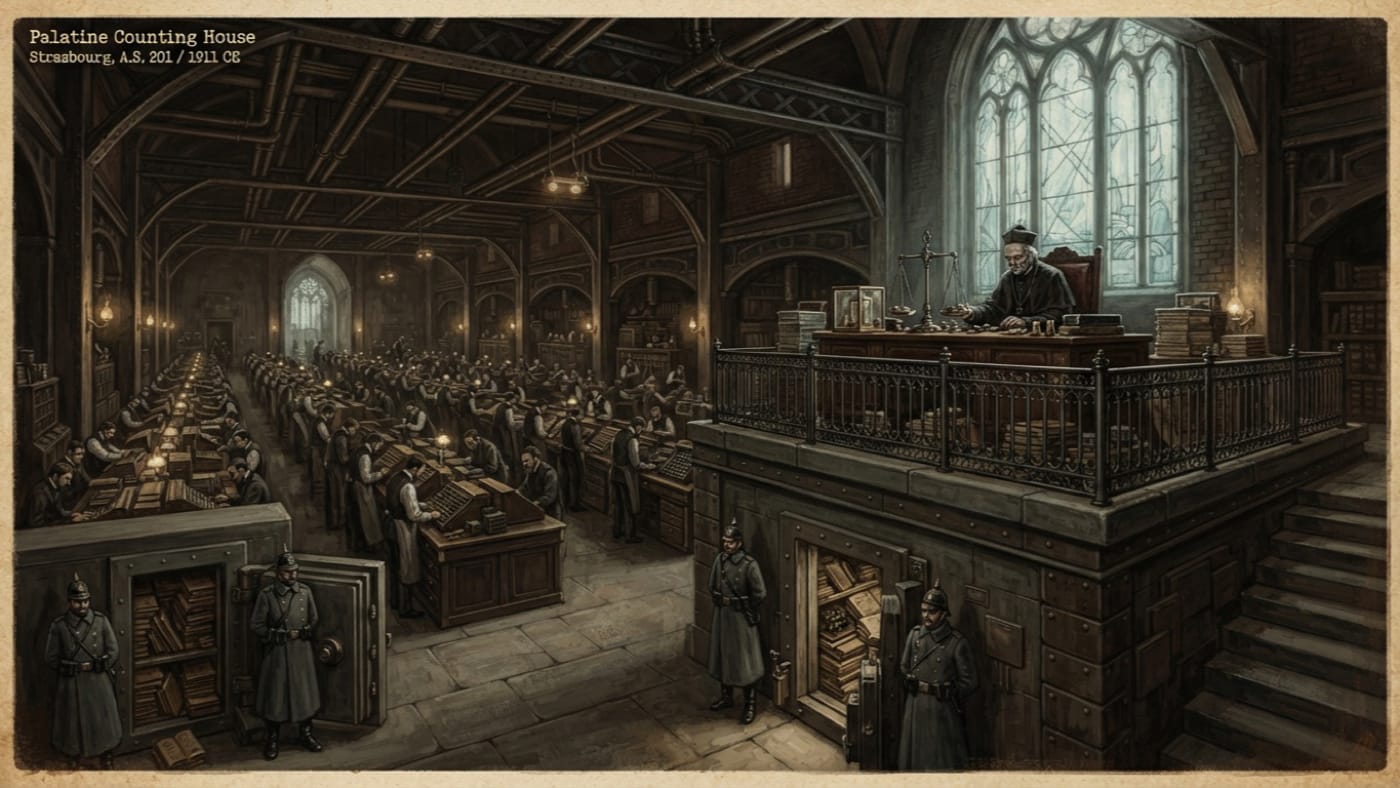
The rooms are in the Palatine Counting House in Strasbourg. It is the Bureau's headquarters and the office's reported working seat. The building is older than the Bureau. It was a Rationalist tax depot before the Church took it over, and the Church changed the hymns and kept the scales. Counting rooms open onto vault corridors. In the weigh-chapels, Assessors calibrate their iron against reliquary-certified standard weights. The deep vaults hold the Fiscal Census. Three watches keep the building working through every hour the bells announce, which in Strasbourg means every hour.
Other archbishops are known by their sees. This one is known by a ledger. The office governs no territorial archdiocese and claims no cathedral. Its province is the account kept against every baptised name in the Synod. Its liturgy is reconciliation, sung three times a day by clerks who refuse to believe the previous watch.
#On What the Office Presides Over
The machinery starts in another Bureau's archive. Records supplies the household roll: names, hearths, births, deaths, and the size of each family. Tithes keeps the liabilities entered against each name. The two archives have disagreed on every figure since the first roll was copied, and the disagreement is one of the few Synodal institutions that has never needed reform.
A Tithe Assessor takes the roll into the diocese. He or she carries calibrated iron scales, a seal-press and a gilded ledger, and travels with an armed escort sized to the parish's reputation. Grain is weighed and livestock counted. Coin is tested against the standard, and labour is reckoned in days owed. Each payment earns a sealed receipt. Any shortfall becomes arrears, which are carried forward and, under present practice, inherited by the debtor's heirs. Arrears left standing long enough end in seizure orders, served with the escort at the door. When a whole parish defaults, the Bureau of Rites places it under spiritual sequestration, and its sacraments wait in the sacristy until its accounts are clear.
The gilded corners of every ledger are consecrated before it leaves Strasbourg. That small ceremony makes collection an act of religion. A peasant who lies to the bearer of the book has lied before the Creator as well as the clerk. Theologians have spent a century admiring the efficiency of that arrangement, and I have been one of the louder ones.
No holder of the office walks the circuit in person, and no file shows an Archbishop of Tithes weighing a family's grain. The office presides over the machinery without turning each crank. I have looked for its vestments, its voting rights in Assembly, its formal qualifications and its place in a complete constitutional order, and the files describe none of them. I therefore list none. The Bureau would invoice me for each invention.
The figures, as the Bureau gives them, are these. The Faith-Tithe is the universal tenth owed by every baptised subject, payable in Crowns of Grace, livestock, grain or labour. Separately, the Bureau reports a total take of about one-sixth of gross productive output, counting every tariff, harbour due, gate toll and surcharge it collects. The Bureau reports that roughly forty percent of its intake goes to the Sagittal Line. These are institutional accounts. I did not audit them for this survey, and nobody offered me the keys.
#On Authority Acquired by Interpretation
The Concordat of Strasbourg constituted the formal Synod in A.S. 90 / 1800 CE. Both founders were already dead. Two years later, in A.S. 92 / 1802 CE, the Concordat Charter formally founded the Bureau of Tithes and codified its fiscal mandate. Whether the Charter names an archbishop, and in what words, I cannot tell you. I have never been shown a complete original. I have been shown the Bureau's account of the original, which the Bureau regards as better. The Charter therefore dates the Bureau and does not date the title. I have found no record of the first time the style was used.
The office's present reach was built later, by administrative act, and the Bureau defends each act as an interpretation of the original mandate. In A.S. 138 / 1848 CE the Assembly of Thrones upheld the Meta-Levy, the charge laid on the cost of collection itself. The ruling confirmed the levy. It does not tell us when the levy began. In A.S. 158 / 1868 CE the Bureau of Agriculture was dissolved and authority over grain allocation passed to Tithes. From that year the Bureau that weighed a family's harvest also decided how much of it the family would eat.
The Concordat Charter of A.S. 92 vested in the Bureau of Tithes full authority over the allocation of grain throughout the Synod.
Corrected, as in this Codex's entry on the Charter. The Charter made grain assessable. Authority over its allocation came to Tithes in A.S. 158, after Agriculture was dissolved. Taxing grain and allocating it are separate powers acquired seventy-six years apart, and anyone who merges them should expect an Assessor's visit.
One saying sits awkwardly on this chronology. The Bureau's own entry carries a remark attributed to Salome Veyrault in which she claims to have dissolved Agriculture herself. The attribution is marked as disputed: attributed, denied, attributed again. The dissolution belongs to A.S. 158. Her reported appointment belongs to A.S. 189. I record the quotation as disputed and leave both dates where they stand. Neither the remark nor the files will be amended to make the other look better.
#On the Names Entered Against the Title
Three accounts attach names, or the lack of a name, to this office. I keep them in separate passages, because joining them would mean inventing evidence.
Pellian. The dossier on Pellian of Rouen reports him as a former Archbishop of Tithes. It describes a brief tenure in which he tried conciliation, a quarter in which gross receipts fell three percent, and his reassignment to devotional arithmetic among elderly penitents. No complete set of his instructions survives. His methods are known secondhand, from cadet training sheets that list them as warnings. His origin, the limits of his tenure, the house that received him and his present condition are not entered. The style "of Rouen" proves neither his birthplace nor any authority over the see of Rouen, whose cathedral has never lent its name to a fiscal prelate.
Veyrault. The Bureau's entry names Salome Veyrault as Archbishop of Tithes in a dated attribution of A.S. 199 / 1909 CE. That entry and her own dossier report her appointment in A.S. 189 / 1899 CE and say she continues to administer the Bureau now. The Pellian and Veyrault dossiers both describe a transition between the two: confirmation at an expedited session of the Assembly, and a deficit closed in nine days by assessing the unused candle-stubs in ecclesiastical storerooms. That is the dossiers' account. I repeat it as theirs and do not stretch it into a full roll of holders. None is filed.
The moneylender's son. My own entry on Strasbourg contains a marginal report that the current Archbishop of Tithes was a moneylender's son, and that he still counts candle offerings with the attention of a man weighing gold. I was reliably informed of this, and I still do not name the informant. The report names no one. It refers to its subject as he, and I have reprinted it as it was given. I do not identify him with Pellian or with Veyrault, or with any relative, deputy or successor of either. I will not move the report to an earlier year so that the three accounts sit comfortably in one drawer.
The three accounts exist side by side, unreconciled. This survey records them in that condition and does not resolve it.
#On Priced Mercy and the Present Account
The cadet sheets describe the methods attributed to Pellian under the heading Not To Be Employed. Arrears were deferred without surcharge. Schedules were negotiated at the door. Families crushed past paying were granted remission on petition. Assessors were asked to write the reason for a seizure in words the debtor could read. Each item is marked in red ink.
The Bureau does not condemn mercy as such. Its ledgers carry exemptions under the Cradle Decree, and a soldier's widow is excused the base levy. Every one of those mercies is entered, priced and countersigned, so that a clerk can tell the Assembly what each kindness cost. What the sheets condemn is mercy that leaves the building without a form. Even the Bureau of Mercy, which treats households after deprivation has done its work, keeps its own accounts and sends its own bills. Compassion that escapes the ledger is classed as a variance, and variances are always charged to someone.
The office continues to operate. The roll arrives from Records. The ledgers are gilded, consecrated and sent out. Receipts are sealed, arrears pass to heirs, and the three watches reconcile each other in rooms built by men who believed in reason and taxed accordingly. Whichever name the next file enters against the title, the Counting House will collect under it.