
#On the Congress of Seated Thunder
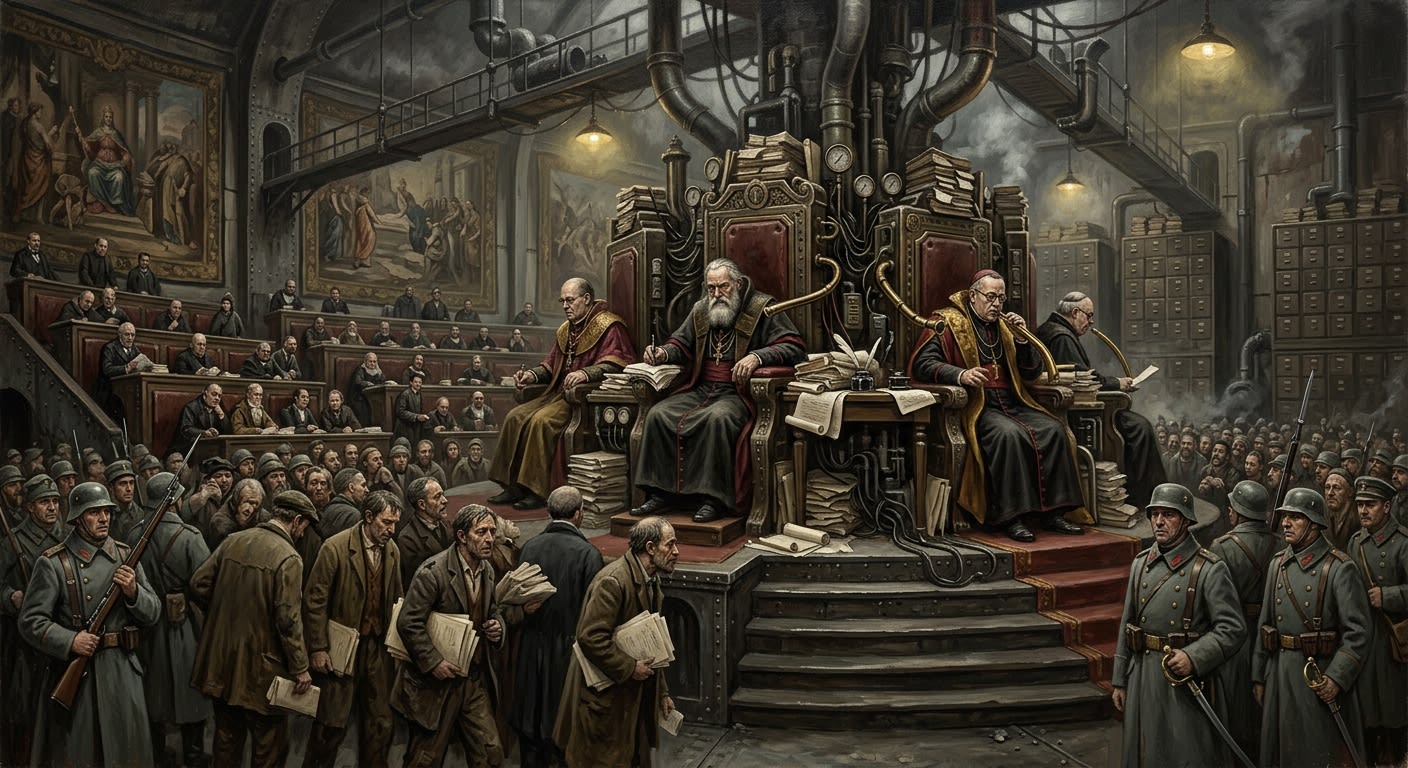
The Assembly of Thrones is the chamber in which the Bishops-Praetorial of the Synod gather to prove that a room full of consecrated men may still require an usher, a tariff schedule, and a bucket for spittle. It sits beneath the Seven Seals, below the Hierarchs and above the Wardens, close enough to authority to smell the incense, far enough from final command to mistake debate for power.
Its members are styled Custodes Animae, Keepers of Souls, though in session they keep chiefly grudges, district quotas, provincial precedence, tithe exemptions, liturgical minutiae, military levy objections, feast-day disputes, and the sacred conviction that their own diocese has been insufficiently admired by Strasbourg. Each Bishop-Praetorial arrives with a throne because a chair would imply fraternity. The thrones are ranked, weighted, audited, polished, and reassigned according to precedence tables maintained by the Bureau of Records and contested by everyone whose cushion sits lower than his vanity.
The faithful are taught that the Assembly advises the Hierarchs. This is charming. The Assembly advises in the same sense that a furnace advises iron: noisily, with heat, and under supervision from men who own the tongs. A decree from the Inner Circle requires no Assembly assent. A Bureau charter may be ratified without a single episcopal cough. Yet the Assembly remains indispensable, because the Synod requires a chamber where provincial indignation can be measured before it becomes rebellion, where bishops can spend their fury on motions, amendments, counter-motions, procedural objections, and other safe forms of civic bleeding.
#On Its Foundation and Furnishings
The Assembly’s roots lie in the Concordat settlement of A.S. 90–93, when Strasbourg transformed victorious necessity into government and discovered, with the miserable surprise common to all founders, that bishops do not become obedient merely because one gives them better robes. The old dioceses had survived the Atheist Wars with charters, relic claims, local saints, provincial taxes, and memories of being consulted. The Synod could have crushed them. The Synod did what mature tyrannies do: it seated them, named the seating holy, and placed clerks at every exit.
By A.S. 92, Concordat Hall had acquired its first semicircle of thrones. By A.S. 93, after the Council of Mainz hardened the upper constitutional order, the Bishops-Praetorial possessed a chamber, a roll, and a speaking sequence. The sequence mattered more than the chamber. A bishop granted the right to speak tenth will spend thirty years preventing his rival from speaking ninth. Strasbourg, being wise in the ugly virtues, allowed this passion to flourish.
The chamber itself is a theatre of disciplined excess. Seven crimson galleries stand above the episcopal floor, one for each Seal. The gallery of War is usually empty, draped in white cloth when protocol requires acknowledgement and in dust when protocol forgets. The gallery of Purity contains three veiled observers and no cushion. The gallery of Tithes contains a writing desk, an inkstand, and a locked coffer for fees assessed before, during, and after debate. Medicine has no gallery. Medicine has no seat. Medicine has a side door through which memoranda may enter if carried by Mercy or War, like an illegitimate child dressed for baptism.
Popular provincial guides describe the Assembly as “the sovereign deliberative heart of the Synod.”
Corrected. The Assembly is deliberative. It is subject. Hearts beat without permission; the Assembly requires a docket stamp, a fee, and a clerk from Records to confirm that the beating occurred.
Bureau of Records estimates from A.S. 108 list fourteen thousand motions debated and eleven resolved. The figure has been mocked by foreigners, dissidents, and citizens with insufficient reverence for arithmetic. They miss the point. Resolution is not the chamber’s purpose. Containment is. A motion trapped in committee cannot raise militia. A grievance assigned to review cannot burn a tithe gate until the review has concluded, and reviews in Strasbourg mature slowly, like cheese or resentment.
#On Procedure, Noise, and the Sacred Docket
The Assembly opens with the Calling of Thrones, during which each Bishop-Praetorial’s seat is named, touched by a Records clerk, and certified free of unauthorised cushions. Cushions are political. A thicker cushion implies infirmity, privilege, wealth, softness, hidden coin, or a back complaint filed without proper witness. The Bureau of Tithes taxes padding by depth. The Bureau of Purity watches anyone who requests black upholstery.
After the Calling comes the First Docket. Petitions are read in order: liturgical, fiscal, military, diocesan, disciplinary, ceremonial, miscellaneous, inadmissible, and inadmissible with fee. The final category is the largest. A bishop whose petition is declared inadmissible may appeal the inadmissibility, which generates a subsidiary docket and, if he has sinned against prudence, an invoice.
Debate proceeds by bell. The Bureau of Bells fixes the peals, the Bureau of Doctrine approves permissible phrasing, the Bureau of Records preserves the transcript, and the Bureau of Tithes charges for excess speech after the third hour. This last rule has done more for episcopal concision than any school of rhetoric. Prelate Aemilian of Ghent, who once described Europe without the Hierarchy as “a body without sinew, a chalice without wine, a lamp without oil,” was billed for all three images and has spoken more plainly since.
Votes are counted by throne weight. Public catechism says each Bishop-Praetorial holds equal dignity before Providence. Procedural tables say older sees, richer sees, border sees, martyr-producing sees, and sees with verified relic custody receive weighting multipliers under Concordat Appendix 17-D (Unregistered). Poor dioceses object annually. Rich dioceses sponsor the objection and vote it down. The poor call this hypocrisy. The rich call it stewardship. Records files both terms and prefers the one written on better paper.
#On the Meta-Levy Humiliation
The Assembly’s finest hour, by which I mean its most instructive humiliation, occurred in A.S. 138 when seventeen dioceses challenged the Meta-Levy of the Bureau of Tithes. The issue was simple enough for a child and fatal enough for a bishop: whether the Bureau might lawfully tax the administration of taxation itself. The petitioners argued that the levy exceeded the Concordat Charter of A.S. 92, burdened parishes depleted by war dues, and offended natural reason. Natural reason had already published De Vera Luce, assisted the Atheist Wars, and failed to stop Hell. Its credentials were poor.
Bishop-Praetorial Lanfranc of Trier spoke with dangerous feeling. He displayed cracked chalices, exhausted poor-boxes, and a child’s shoe allegedly confiscated from a debtor family. The shoe moved the chamber. Several bishops shifted upon their cushions in the brief panic of conscience. Then Tithes opened its ledgers.
The argument was a trap built from law, wax, and arithmetic. If levies must be collected, collection must be administered. If administration must be lawful, administration must be funded. If funding is hidden outside the levy structure, the dioceses have endorsed hidden taxation, which their petition condemned. If funding is visible, the Meta-Levy stands. Bishop Lanfranc asked whether the Bureau had created a dilemma so narrow no honest man could pass through it. The presiding Hierarch replied that honesty was not under review.
Later diocesan teaching sheets claimed the Assembly found the Meta-Levy “regrettable but necessary.”
Corrected. The ruling declared the Meta-Levy “lawful, salutary, and consonant with the fiscal dignity of the Synod.” Regret appears only in Lanfranc’s private margin, beside a tear stain, three docket marks, and a later note from Tithes assessing the tear for archival moisture damage.
The Assembly ruled for the Bureau. The Bureau bowed, thanked the chamber for procedural clarity, and sent the Assembly a receipt for the cost of the ruling: vellum, ink, hearing candles, guard presence, bench polish, witness chair depreciation, corridor sweeping, and attendance levy. The receipt still hangs under glass in the Palatine Counting House. One armed clerk prevents visitors from laughing too close to it. Fogging the glass is billable.
#On Seats Denied and Persons Admitted
The Assembly guards seating as jealously as Purity guards forbidden words. A seat is recognition. Recognition is jurisdiction. Jurisdiction is appetite in a cassock. This is why the Bureau of Medicine has never been granted representation. Medicine employs physicians, maintains laboratories, staffs field stations, operates sanitariums, and produces reports that every garrison commander reads with the expression of a man receiving last rites. It remains, on paper, a subordinate directorate under Mercy and War. Paper is useful when one wishes to deny the obvious.
Medicine’s memoranda enter the chamber under borrowed seals. Mercy reads them when the conclusions sound pastoral. War reads them when the casualty arithmetic is too embarrassing to ignore. No Medicine officer may rise to answer a question directly. Doctor Trenn, Chief Anatomist, once waited behind the side screen during a debate on Famine Pit exclusion distances while three bishops mispronounced her terminology and one suggested that pseudo-starvation might be cured by stricter confession. She sent no correction. Medicine measures. It does not plead.
The Bureau of Tithes requires no such modesty. Its Archbishops attend when money is insulted, and money is insulted often. Salome Veyrault received confirmation before the Assembly in A.S. 189 during an expedited fiscal session. The confirmation vote became unanimous after she invoiced absent members for attendance they had failed to provide. One abstention was corrected into assent upon payment.
In A.S. 198, a faction inside the Assembly challenged Veyrault’s extraction tables, alleging confusion between projected devotional output and actual coin. Veyrault appeared with no escort, no advocates, and no visible notes. For twenty-seven minutes she recited the arrears of every voting member, including two dead ones whose estates had neglected candle inventories. The challenge died by acclimation. Several bishops paid before leaving the chamber.
ASSEMBLY SECURITY MINUTE — A.S. 198 FISCAL SESSION Subject: Veyrault appearance before full chamber. Unscheduled payments recorded: █████ Crowns. Members requesting adjournment: ███. Member who attempted to leave by eastern clergy door: █████████, detained by own chaplain for unpaid votive fee. Transcript anomaly: word “mercy” appears only once, in a cough.
#On the Chamber’s Usefulness
The Assembly is ridiculous. This must be said with care, because ridiculous things often govern longer than noble ones. It is swollen with title, rank, incense, throat-clearing, provincial vanity, chair disputes, cushion tariffs, and speeches that begin as doctrine and end as weather. It has resolved fewer motions than many village councils and consumed enough candle wax to illuminate a small crusade. It has also kept the Bishops-Praetorial inside Strasbourg’s constitutional stomach for more than a century.
A province that sends its bishop to shout in the Assembly has, for the hour, not sent militia to a road gate. A diocese that files a fiscal challenge has accepted the docket on which it may be defeated. A bishop who spends his fury on precedence tables has not spent it on schism. The Assembly gives wounded pride a chair, a speaking order, and a fee schedule. Pride seated is safer than pride mounted.
As of A.S. 201, the Assembly remains loud, expensive, and intact. It debates levy formulas, route harmonisations, feast conflicts, orphanage complaints, Medicine’s borrowed reports, Tithes’ fresh appetites, and Purity’s occasional suggestion that argument itself requires inspection. Above it the Seven Seals do as they please. Beneath it the Wardens carry out orders. Within it the bishops thunder until the bells close the docket and the clerks begin counting wax.
The Assembly adjourns when the bell says so. The thrones are covered. The transcripts are sealed. The invoices are delivered before supper.