
#On the Lower Channels
"What the ovens will not keep, the water carries." — Chalk legend above Sluice-Gate Four. Someone rewrites it after every whitewashing.
The Ash Canalworks lie beneath the kilns of the Ember-Priory of San Vesta, below the Cinder Markets and below the last terrace any pilgrim is permitted to see. They are channels cut through the lower basalt, each as wide as a cart and as deep as a grave. The older ledgers call them the Canalworks of Ashwater. The rakers call them the Throat. The Ledger Cloisters must call them something in triplicate, so they record them as Lower Cooling and Conveyance, Undated. No founding charter survives, and the Bureau of Records declines to issue one retroactively for a hole.
They smell of wet soot. Everything below the Cinder Markets smells of wet soot, but in the Canalworks the smell takes on body. It settles in the cloth of a habit and in the creases of the hands, and it stays at the back of the throat for days after a visitor has climbed back into the air. I went down once, on my second visit, at the Bureau's expense. I recommend that arrangement to any cleric who values his linen.
The channels were cut, or widened, or merely claimed, in the same decades that the Synod's engineers sealed and sanctified the vent beneath the priory. The dating stops there. San Vesta submitted in A.S. 98, eight years after the Concordat of Strasbourg. The tri-compact that governs it was ratified in A.S. 112. Somewhere between the old lava flows and the new stamps, someone understood that a city built on borrowed fire needs a drain for what the fire leaves behind.
#On Water, Heat, and Waste
The arithmetic of San Vesta is heat, and heat must go somewhere. The Great Ovens of Vesta take the primary flow. The Scorch-Cure Infirmary takes the secondary. The Relic-Smoke Kilns take the third and argue about it. None of them can hold the surplus of a vent that has never learned moderation. That surplus is carried off by water drawn from the upper cisterns. The water drops through soot-stained sluices and runs along the basalt under the kiln floors until it comes out, grey and steaming, somewhere the pilgrims cannot see it. The Ash-bread that the Bureau of War has ordered in perpetuity since A.S. 134 is baked over this plumbing. Nobody at the Flour Gate mentions it.
Without the Canalworks, the priory cooks. The Vent-Wardens say so plainly, and the Vent-Wardens say very little plainly.
The sluice-gates open and close on a schedule that the Oven Quartermastery drafts, the Infirmary Tribunal amends, and the Priorate Council signs without reading. Every gate has a keeper and every keeper has a ledger. The ledger records the hour of opening, the hour of closing, the outflow temperature by hand-thermometer, and the colour of the water. The colour is always recorded as grey, whatever colour the water is. One keeper once wrote violet. He was reassigned to the dormitories, and the next shift re-inked his column.
The water carries more than heat. Oven-slag goes down the Throat, along with spent ash, scrapings from the Kiln Hall, soiled dressings from the wards and the rinse of the surgery in the undercroft. So do the failed batches from the Innovation Annex, which the stamps call acceptable losses and the Annex calls somebody else's. In quarantine, the infirmary's overflow drains empty into it as well. The Tribunal has ruled that anything entering a Canalworks channel is "in custody of the flow" from that moment, and no longer the responsibility of the ward that sent it.
The Bureau of Alchemical Standards, in its regional survey, classified the Ash Canalworks as "hydraulic works for the conveyance of cooling water and incidental runoff, of no doctrinal or disciplinary character."
The classification is withdrawn. The Canalworks are four things: hydraulic works; waste custody for the ovens, kilns and wards; a place of labour sentence under the Infirmary Tribunal; and an unofficial passage for persons and goods that the Bureau of Purity has been unable to keep out. The surveyor who filed the original classification did not go below Sluice-Gate Two.
#On the Rakers and the Debt-Bodies
Somebody must keep the channels clear, and that somebody is the canal raker.
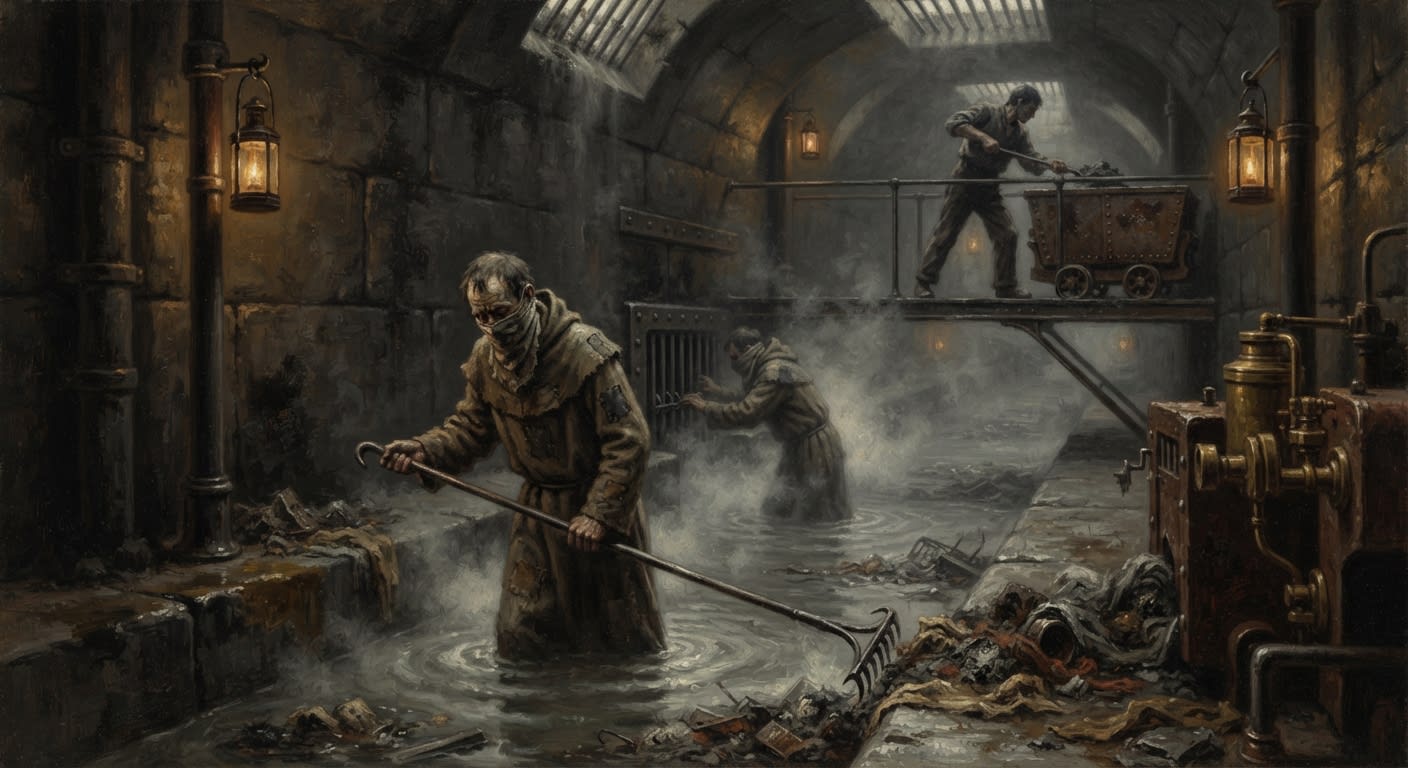
A raker works a long iron rake with a hooked head, standing thigh-deep in outflow. On a good shift the water is bathwater. On a bad one it reaches what the Sister-Physics call scald-onset. The raker drags whatever has fouled the grilles up onto the basalt ledges: slag, clotted ash, wadded dressings and worse. Barrow-men shovel it up and wheel it to the sumps. The vent never stops, so the work never stops. A blocked channel pushes heat back up into the kiln floors within the hour. Twice in living memory, a blocked channel under the ovens has lifted the flagstones.
Few rakers volunteer. Most of the Canalworks labour is recovery service, owed by patients whom the Scorch-Cure has declared well and who now pay the priory in weeks, months or years. The Infirmary Tribunal assigns them by schedule. A lung infection costs six weeks, and six weeks in the Canalworks produces a lung infection. The Tribunal does not call this a closed loop. It calls it a reliable one. Third-Day Debtors who survive their bread are sent down when the ovens have no room for them. The Bureau of Oaths template they signed promises "maintenance duties as required." It does not say what is being maintained.
The Canalworks are San Vesta's punishment disguised as plumbing. Drownings are recorded as drownings. Scaldings are recorded as "thermal incidents during authorised maintenance." Ash-lung is not recorded at all. It arrives after the debt is paid, and by then it is the raker's private affair.
The official cool mask is issued weekly and falls apart in four days. The rakers wear something else: layered cloth, a wad of charcoal and oilskin at the mouth, stitched by hands the Bureau has not licensed. These masks are given to the rakers free. They are paid for in something other than tokens.
#On Tunnels and Unlicensed Mercy
Below the channels run the lava tubes, the vent's old veins, hollow since before the Synod and heading in directions no surveyor has finished drawing. The Canalworks cross them in a dozen places. Wherever a channel crosses a tube there is a grille, and wherever there is a grille there is, sooner or later, a hinge.
This is where the Cool Mask Brotherhood lives. In public it is a respiratory charity. It sews masks for the kilns and the Canalworks from salvaged sacking, charcoal taken from the ovens' own waste, and whatever oilcloth goes missing from a quartermaster's inventory. Its private work is carriage, and every raker knows it, as does the Bureau of Purity. The Brotherhood carries medicine out of the Tribunal's stores and into the dormitories. It carries forged triage slips. It also carries people: patients the Tribunal has quarantined for "atypical recovery patterns." They go down through the overflow drains, along the lava tubes and out onto the cinder-fields, under a moon that does not ask to see their bread tokens.
The Bureau of Purity has sealed eleven tunnels in the past decade. Each seal is basalt-mortar poured over a grille, then blessed, stamped and entered in the register. After each sealing, the next survey counts twelve tunnels. Purity's surveyors blame excavation by the Brotherhood. The Brotherhood blames nothing, because it does not file. Asked privately, the rakers say the tubes open by themselves when the vent runs warm, and the Brotherhood only walks through what the rock provides.
#On the Present Condition
In A.S. 201, San Vesta's troubles show first in the Canalworks, because everything in San Vesta ends up in the Canalworks.
The vent is two degrees warmer than it was in A.S. 199. Up at the ovens, that is a line in the Vent-Wardens' weekly report. Down in the channels, it is a matter of skin. The outflow runs hotter and the steam hangs longer. The rakers work half-shifts, and the Tribunal records them as whole ones. Pilgrim intake has tripled in four years. The wards have overflowed, and the overflow has overflowed into the drains. The Vall de Sal flour convoy is three days late. Quartermaster Odran Ashweight has sealed the gates and begun the count, and the people who cannot be counted have gone down: the tokenless, the administratively absent, and the quarantined who were never supposed to leave.
More grilles have been sealed this season than last, and more stand open. More masks are in circulation, most of them patched. More rakers are missing from roll-call at Sluice-Gate Four. The Tribunal lists them as "transferred to service elsewhere" and does not name the elsewhere.
In the third week of the count, a section of lava tube under the Kiln Hall collapsed into Channel Six. The rakers who cleared the fall recovered ███████ cool masks from the rubble. The masks were warm to the touch, and nobody was wearing them. ██ ███ ████ ██████ a single page torn from a ceramic-bound ledger, its cause of termination column empty. Raker █████ ███ stated that while clearing the fall he heard his own name spoken in the steam, "in the voice they use for the bread." He has been sent to the Cool Rooms. The fall has been sealed. The tunnel count is twelve.
By official finding, the heat-visions have not reached below the kilns. In A.S. 199 the Bureau of Doctrine reclassified them as a Category Two Visual Disturbance, Doctrinal Origin Not Excluded. It made no provision for the Canalworks, reasoning that steam is not smoke. The rakers do not accept the reasoning. They keep their eyes on the rake.
Something lies beneath the vent, waking or feeding or simply warm. The Canalworks are where its heat is poured off, where the priory's debts are worked off, and where San Vesta's unwanted leave by the back stair. The Synod takes the bread. The Throat takes everything else.
Nihil obstat.