
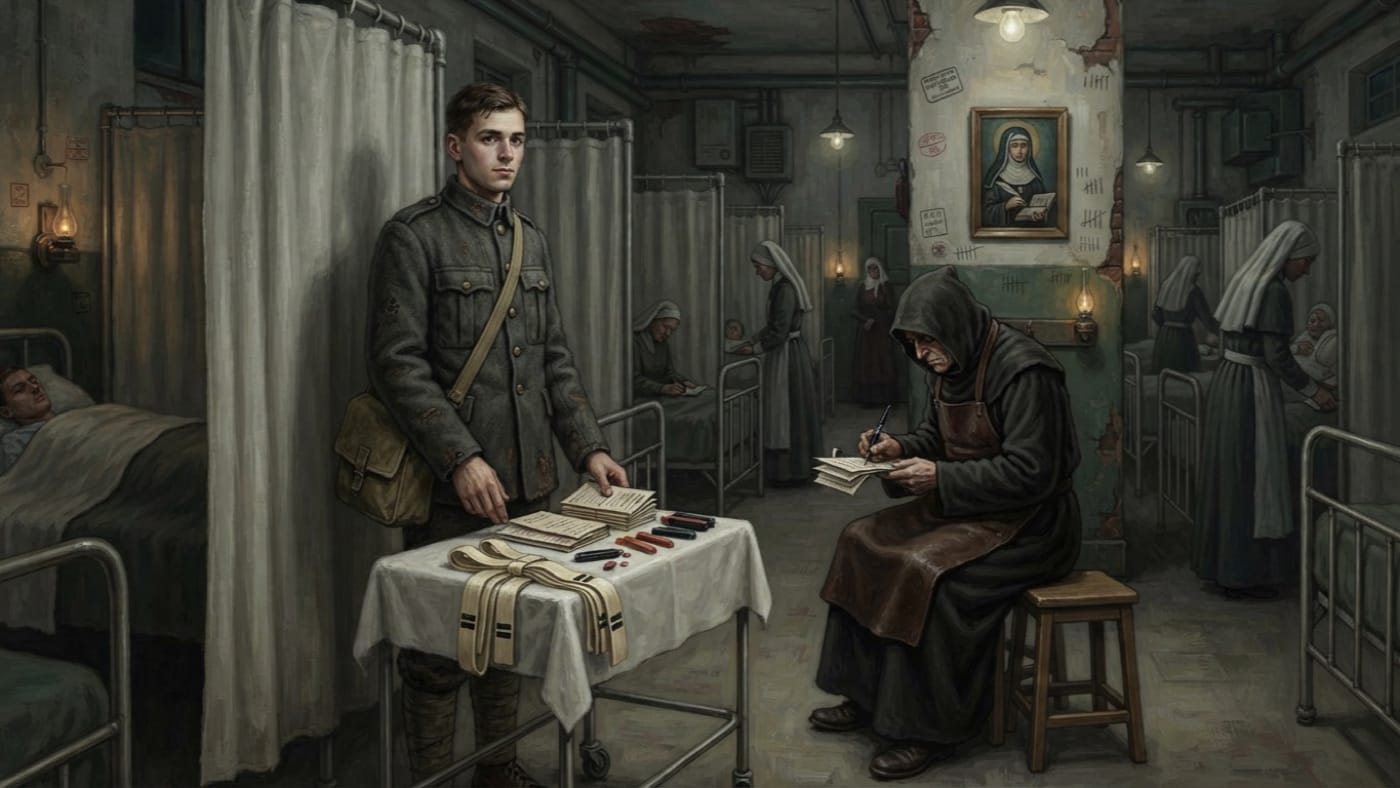
#On the Runner's Station
The Bedside Runner is the lowest rung on the ladder of the Deathbed Confession Harvesters, set closest to the floor, where the basins are. The profession file of the Bureau of Mercy lists the rank as Witness Clerk / Bedside Runner. No office has ever explained the slash between the two names. It may mark one appointment with two names, or two appointments that share a stool, or only a clerk saving ink. The file does not say, and I will not say it on the file's behalf. The Runner carries ribbons. The Runner carries spare wax. The Runner runs forms. Beyond that, the rank does whatever the senior on the stool needs before the sand runs out.
The Runner carries no seal-ring. The Runner wears no narrow white cuff of terminal authority, opens no packet, chooses no destination and alters no line. A Runner stands inside the curtain and hears everything, with nothing in hand that makes any of it official. Every other difficulty of the rank comes from that arrangement.
#On the Second Stool
Terminal recording began in panic. The Lull of Names in A.S. 78 left the infirmaries full of unfiled dead. Emergency reporting followed in A.S. 79, and by A.S. 80 Standing Order 22-C had made terminal confession mandatory in the wards. These orders came from offices still taking shape, ten years before the Concordat of Strasbourg gave the Synod its constitution. They read like the work of men whose corpses outnumbered their pens.
The Confession Reform of A.S. 104 set the procedure in six steps: access, stabilisation, framing, extraction, authentication, packaging. Witnessing already belonged to the fifth step. The ribbon was tied and the bell-time stamped, and in most wards the witness was whoever stood nearest and could hold a pen without shaking.
Then came A.S. 134 and the Mercy Ward Purge. Seventeen Harvesters across the Rhineland ward circuit were convicted of selling the dead in edited portions. The Purge began with a widow in Mainz who paid a Harvester for silence and then paid a Witness Clerk for the same silence a second time. Juniors, you will observe, were already in the chain. The Bureau's remedy was to make the chain longer.
Under the double-witness protocol, no Harvester could extract, authenticate or package alone. A Witness Clerk or ward officer would watch the exchange, countersign the ribbon and record the bell-time in a separate hand. The packet would travel under two seals. The wards changed to match. Curtains widened, stools came in pairs, ribbons were dyed with paired bars, and trays gained a second groove for the countersignature slip.
Every one of those improvements had to be carried. Someone had to fetch the second stool, count the second ribbon, warm the second stick of wax and find the countersignature slip before the patient ran out of breath. So the Bedside Runner, a convenience before the Purge, grew into a permanent rank. Records had asked for honesty and got logistics.
#On Ribbons, Wax, and Forms
Follow a Runner through an ordinary confession, in any ward, in any week. Nothing in it will be remarkable. That is the design.
The route starts at the supply desk, where a registrar who suspects everyone counts the ribbons against the ledger. The ribbons carry paired bars so that an auditor can tell at a glance whether two hands touched the knot. The Runner takes spare wax too. The first stick cracks in cold wards and softens in fever wards, and a Harvester who runs out halfway through a packet has produced what the trade calls a dead stamp. Three kinds of blank form go on the pile, because three versions leave every bedside, and so do countersignature slips for the new groove in the tray. The Runner signs for all of it. That name on the supply register is the first ink the confession receives, and the only ink the Runner can be sure of owning.
Then the corridor. The wards were built before the second stool existed, and the walk from desk to curtain was laid out for one clerk at a stroll. Now a Runner covers it at a trot, dodging Ward-Sisters with their basins and the Broth Runners who answer to them.
At the curtain, the Ward-Sister grants access or refuses it. The Runner waits. Inside, the Harvester has already turned the minuteglass. Breath is the currency, and the Runner carries the purse. The Runner lays ribbons across the tray, sets wax within reach of the ring-hand, squares the forms and puts the countersignature slip in its groove, where the second observer can sign without leaning across the dying. If the second observer is late, the Runner goes to find one. If nobody can be found, the Harvester waits, and the patient does not.
The Runner does not sign. The Witness Clerk or ward officer signs, marks the bell-time in a separate hand and countersigns the ribbon. A junior who holds both titles of the slash may be named as the observer, but only by an appointment made on paper. Fetching the wax earns nothing.
Packaging comes next. The clean transcript goes to the parish ledger and consoles the family. The internal transcript goes to Records. When the dying have named something Purity must hear, the sealed addendum goes there in a waxed packet the Harvester may not read once it is sealed. The Runner folds and stacks the papers, carries them to the courier desk and brings the unused ribbons back to be counted again. The Harvester and the forms decide where each paper goes. The Runner decides how fast it gets there.
#On What the Runner Hears
The curtain is linen. Linen keeps out draughts and preserves modesty, and it does nothing else.
A Runner at the tray hears whatever the Harvester hears, a second or two later and without the protection of rank. The Runner hears the son's name, the unregistered salt and the debt that will send a small estate to a different heir. The Runner hears the sentence that belongs in the sealed addendum, and the sentence the dying man begged to keep out of it. The family waiting at the side door knows that the person in plain clothes carrying the wax heard it too. They also know that someone without a seal-ring is cheaper to approach.
The Mainz Witness Clerk showed the price in A.S. 134, and nothing since has brought it down. The wards use household words for the offer: linen, salt, night tea, candle. A widow offering a Runner a candle is not asking for light.
Pressure comes from above just as surely as from below. The Harvester profession file asks bluntly whom a practitioner sacrifices when an audit tightens, and the first answer it gives is a witness clerk. The auditors always ask first who witnessed. A Harvester with a crooked seal and a junior who handled the wax has an explanation ready before the auditor has finished unrolling the ribbon.
The public circular of the Purge declared that the second witness ensures purity.
Internal correction, retained as already entered against the Purge record: the second witness distributes liability. The Runner who supplies the second witness's ribbon takes a share of that liability simply by standing nearby.
So the Runner learns the one discipline the Bureau cannot print on a card: hear everything, and repeat none of it.
#On the Ward and the Ladder
A Runner is not a ward-hand. Care, triage and the keys to the curtain belong to the Ward-Sisters and Ward-Brothers, whose own ladder begins with Rag-Hands and Broth Runners. Ward staff call terminal clerks leeches. The clerks treat the Sisters as gatekeepers who must be kept sweet with salt and punctuality. The Runner owns neither basin nor seal, and both sides tolerate the Runner without trusting one.
Nor is the Runner a booth clerk. The Confessor-Booth Clerks handle ordinary confession under the rubrics of the Bureau of Rites and keep Receipt Runners of their own. Confuse the two at a hearing and the Rites examiner will correct you with the relish of a man sharpening a knife on your ignorance.
The published ladder runs from witness clerk to junior harvester, full seal harvester and black-zone specialist. A Junior Harvester holds a limited seal under supervision, and full terminal authority sits higher still. The ladder promises nobody the climb. Some Runners are promoted. Some are reassigned to the death-carts of the trenchline harvest. Some come off a black-zone shift coughing and never come back on. At Marrowgate, where the wards are never allowed to close, the quick ones learn to count ribbons in their sleep. The profession file lists that habit among the signs of strain.
The tenderness goes early. It leaves by the side door with the first candle refused, or the first candle taken.
#On the Present Instruction
As of A.S. 201, every licensed Mercy Ward still forbids the solitary seal. The second stool stands and the paired-bar ribbon is tied. The Witness Clerk or ward officer countersigns in a separate hand, and the packet leaves under two seals. Someone must stock all of it before the minuteglass turns, and the Bureau has settled on the cheapest person who can walk quickly and keep quiet.
Blessed Vellum-Anna keeps her place on the ward walls, with quill and compress, grey apron and bedside ledger. The trade calls her patron of its witness ribbons. Her biography and relics remain unauthenticated, and her beginning in the Lull is a ward tale, however often it is told. The shift still opens as the profession file prescribes: wash hands, count ribbons, tap the minuteglass. The Harvester touches the seal to the tongue. The Runner has no seal to taste.