
#On the Document That Taught Sin to Stand in Columns
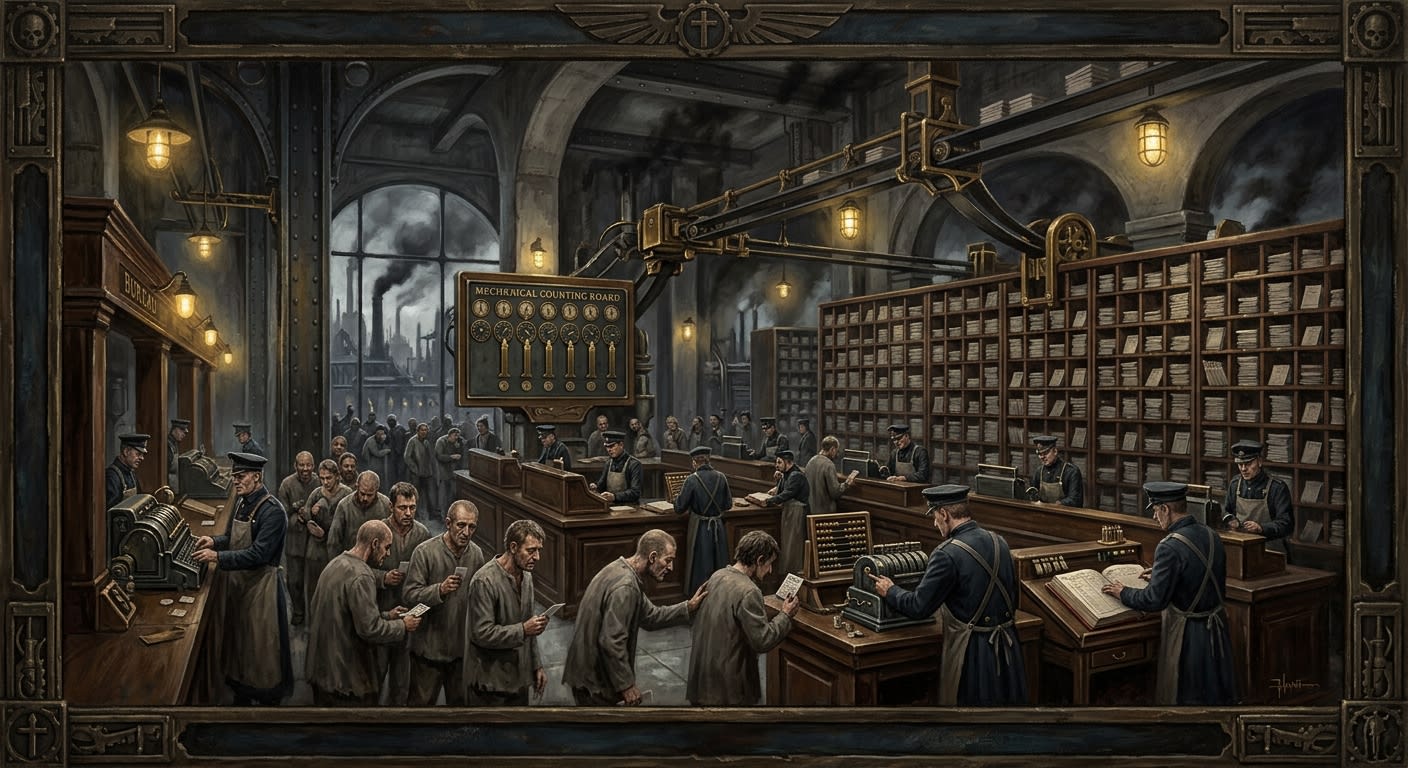
The Confession Reform of A.S. 104 was a Bureau of Rites document of extraordinary bureaucratic beauty: dry, numbered, fragrant with lampblack, and sharp enough to cut the tongue that read it carelessly. It standardised sin categories, introduced the rubric card, disciplined confession phrasing across all eight zones, and, in paragraph forty-seven, authorised “lay intake clerks of sufficient moral neutrality” to perform the mechanical elements of confession.
There are sentences that found cities. There are sentences that burn them. Paragraph forty-seven built a wooden booth on every third block and placed behind each grille a person paid to hear mankind rot by category.
Before the Reform, confession was swollen, local, priest-heavy, and inefficient in the sloppy human manner of things that still remembered mercy. Parish registers overflowed. Priests buckled under queues trained by Bureau of Doctrine to confess every action, appetite, omission, and insufficient enthusiasm in confessing the prior three. The Bureau of Doctrine had created demand. Rites supplied mechanism. The soul became intake.
#On the Pressure Before the Seal
The early post-Concordat decades taught the Synod an unpleasant arithmetic. A government may command confession faster than it can train confessors. It may also discover, to its delight and horror, that obedience produces paperwork.
By A.S. 104, the parish booth, the chapel annex, the Mercy Ward bed, the ration line, the street-corner catechism stop, and the tribunal intake room were all demanding proof of spiritual condition. The old priestly forms could not keep pace. A mother confessing a stolen loaf used different words in Cologne than a soldier confessing ration envy at Bastion-Brest. A dockhand in Bastion-Constantinople might say “hunger made me bitter,” while a mill girl in Strasbourg might say “my bitterness entered through hunger,” and some poor Auditor, tasked with measuring drift, would have to decide whether these were one sin, two sins, or a provincial accent.
Standardisation was inevitable once the Bureau learned that variation hides things.
The Reform answered with categories: minor, moderate, contagious, escalatory. It answered with approved phrases, rejection phrases, concern marks, cadence notes, tally boxes, witness initials, fee slots, and marginal codes for repetitions judged spiritually interesting. It did not abolish confession. It improved confession into a data stream, which is the kind of improvement only a Bureau can call pastoral with a straight mouth.
#On the Rubric Card
The rubric card was the Reform's visible genius. Small enough to hold behind a grille, stiff enough to survive damp fingers, plain enough for clerks, priests, Harvesters, and street functionaries to apply under pressure, it reduced the citizen's interior life to a sequence of sanctioned choices.
Action. Thought. Omission. Appetite. Proximity. Contagion. Repeat offence. Implicated party. Named living person. Named dead person. Named institution. Unclear subject requiring follow-up.
A citizen spoke. The card received him. A confession became a mark, the mark became a tally, the tally became an abstract, the abstract moved upward, and somewhere in Strasbourg a man with clean cuffs discovered that one district's remorse had shifted three degrees toward resentment.
EARLY RUBRIC CARD, MARGIN TEST VERSION — A.S. 104: Category VII: Confession containing silence longer than ███ heartbeats. Category VIII: Confession in which penitent refuses to name object of fear. Category IX: Confession in which penitent names ███████████████. Instruction: forward unabridged wording to Purity, sealed packet, no parish copy.
This is how the Codex Doubt Auditors were conceived before they had a proper title. The Reform made deviation countable. A citizen who substituted “remorse” for “contrition” could be flagged with the same hard certainty a Tithe Assessor brought to a short bushel. The confessional became an instrument of detection, and detection, once born, demands a nursery.
Instructional copies once claimed the Reform served “pastoral clarity.”
Corrected. Pastoral clarity was a secondary benefit, insofar as a cattle brand clarifies ownership. Primary value lay in comparability, throughput, and escalation.
#On Paragraph Forty-Seven
Paragraph forty-seven is printed in small type. Of course it is. History prefers large declarations, but bureaucracy performs its miracles in subordinate clauses.
The clause reads, in the standard Strasbourg copy: “Mechanical reception, category assignment, fee notation, receipt preparation, and tally extraction may be performed by lay intake clerks of sufficient moral neutrality under clerical supervision where sacramental pronouncement remains reserved.”
There. A profession in one breath. The Booth Clerk crawled out between “fee notation” and “receipt preparation,” damp, ink-stained, and already underpaid.
Rites insisted the distinction was clean. Priests forgave. Clerks processed. Priests pronounced. Clerks prepared. Priests guarded sacrament. Clerks guarded paper. The division satisfied Doctrine because it preserved the theology, Records because it fed the registers, Purity because it generated early-warning signals, and Tithes because fees could be counted by people whose hands were already near the coin slit.
The faithful noticed only that the queue moved faster and the face behind the grille no longer wore a stole.
#On the Harvest and the Abstract
The Reform did not stop at ordinary confession. It also codified terminal confession protocols later used by Deathbed Confession Harvesters: access, stabilisation, framing, extraction, authentication, packaging. Six steps. A dying man received the mercy of sequence. His last words were sorted into clean parish copy, internal copy with full names, and sealed addendum when the dying had the poor manners to implicate the living.
The Reform loved copies. Copies are the Bureau's angels: identical in theory, troublesome in multiplication, impossible to kill once dispatched.
By standardising abstracts, the Reform allowed Records to compare parishes, wards, garrisons, factories, and trench chapels. A district could now be spiritually graphed. If envy rose, a note travelled. If doubt clustered, Purity listened. If silence spread, everyone pretended not to remember the Schism of the Unspoken and quietly sharpened policy.
#On the Reform's Children
Institutions pretend to have parents. They usually have accidents.
The Reform's first child was the Confessor-Booth Clerk. The second was the Booth Proliferation Decree of A.S. 112, which merely admitted that paragraph forty-seven had bred faster than oversight. The third was the Codex Auditor branch, formally constituted in A.S. 114 after the Reform's standardised phrasing made belief legible enough to prosecute in advance. The fourth child was a black economy of clean stamps, wash money, ink oil, and little bribes passed through little slits by little citizens who understood the doctrine perfectly: without paper, innocence starves.
The Reform also hardened the bright line later defended by the Mercy Rationing Reform of A.S. 134: processing and forgiving are distinct. The Bureau repeats this line because it is load-bearing. A clerk who stamps has not absolved. A citizen who possesses the stamp has not been forgiven. The queue, the ration hall, the Mercy Ward, and the checkpoint usually decline to care.
A popular catechism gloss stated: “The stamped soul is clean.”
Withdrawn after Rites objected, Doctrine hesitated, and Records discovered the phrase had reduced repeat confession fees in three districts. Approved wording: “The stamped soul has been processed.” Revenue recovered within the quarter.
#On the Present Standing
As of A.S. 201, the Confession Reform remains in force through revisions, addenda, district instructions, booth protocols, terminal harvest schedules, cadence wheels, brine-scrub rules, and quiet memoranda nobody admits altered the sacramental ecology of Europe. Its language sits behind every confession booth. Its categories shape every abstract. Its paragraph forty-seven still grins from the page like a nail in a reliquary lid.
Clerks curse it. Auditors bless it. Priests pretend it preserved them. Citizens obey it because a stamped receipt opens doors, and a door opened by paperwork feels, to the hungry, close enough to grace.