
#On the Year the Dying Outran the Clerks
The Lull of Names was the A.S. 78 plague year in which the southern trench infirmaries learned a lesson the Bureau of Records would later chisel into policy: a dead man who has not spoken on paper is still dangerous.
Plague had visited the Line before. Plague is punctual in war. It arrives after rain, after crowding, after bad bread, after the quartermaster assures the garrison that the barrels are sound. Fever did not make A.S. 78 distinct. Neither did the blackening gums or the wet cough that left brown fans on pillow linen. Those are common vulgarities of disease. A.S. 78 became sacredly intolerable because of silence.
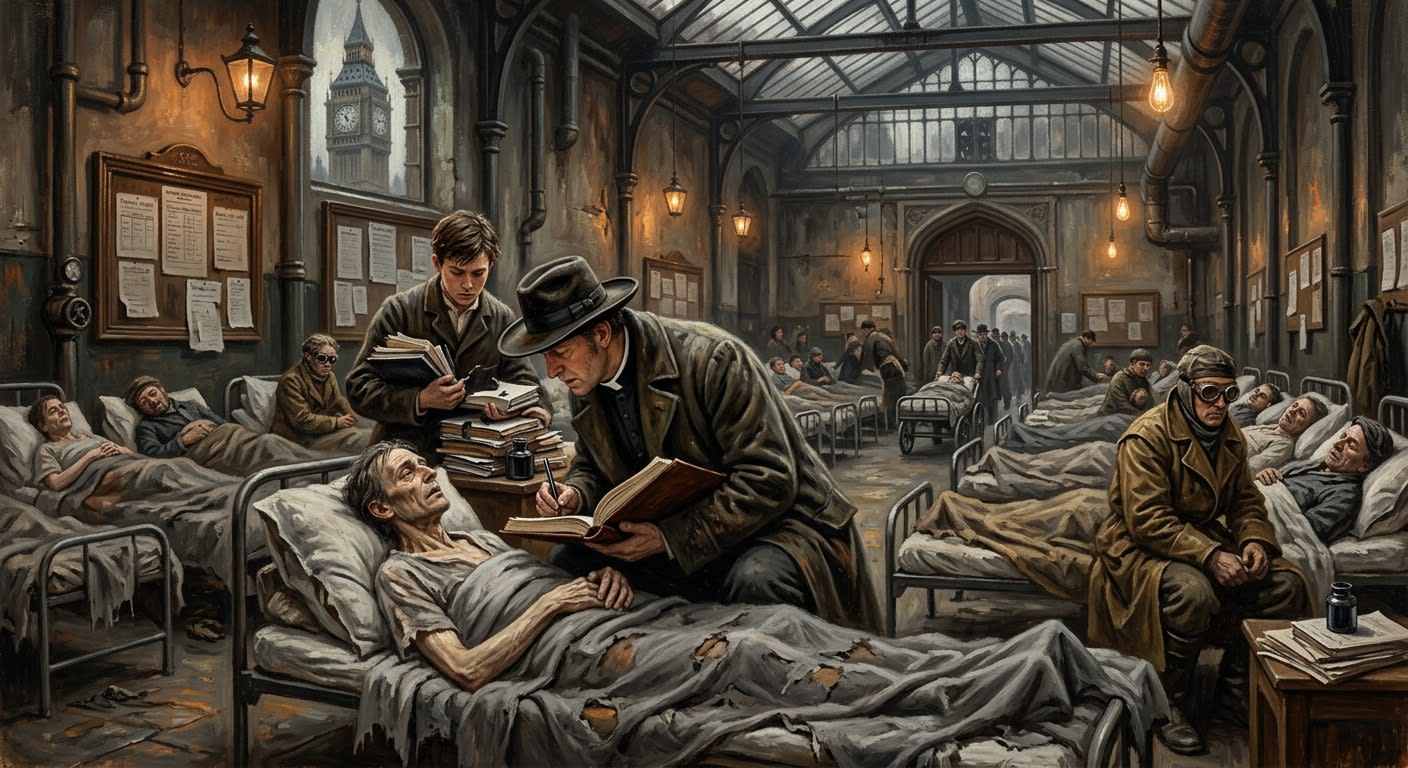
Men died too quickly to be counted. Women attached to laundries, broth kitchens, salvage carts, and Mercy annexes died in borrowed beds under borrowed names. Fever carts arrived with twelve bodies and seven tags. Ward-Sisters wrote until their hands cramped. Field chaplains whispered absolutions into rooms where three patients died during the same sentence. The Deathbed Confession Harvester did not yet exist as a profession, and so the dying took names, debts, accusations, caches, adulteries, ration thefts, unregistered children, and heresies out of the Synod's reach.
By the ninth week, the absence had become measurable. Estate ledgers failed to close. Debt chains snapped. Widows produced two husbands' claims and were believed by neither magistrate nor neighbour. Three quartermaster offices reported missing stores whose only witnesses had expired untranscribed. Fourteen heresy cells survived behind the silence of their dead members. That number is official, which means it is at once too precise, too small, and too convenient.
#On the Southern Wards
The plague moved through the southern wards because the southern wards were built for injury, not breath. A shattered arm can wait in a corridor. A fever cannot. The infirmaries behind Bastion-Irongate, Bastion-Shipka, and the road-annexes feeding Bastion-Constantinople had been improvised from storehouses, chapel vestibules, cart sheds, and once, in a judgement upon architectural optimism, a festival hall. The air went bad before the patients did.
The Bureau of Mercy had protocols for soup, linen, confession queues, dying prayers, and corpse tags. It had no protocol for seven men trying to confess at once while the eighth, already dead, was being named as witness by the second and murderer by the fifth. The Bureau of Rites insisted on proper sequence. The Bureau of War insisted on cots cleared for incoming casualties. The proto-medical men insisted on knives, vinegar, heat, drains, and fewer priests blocking the washbasins. Everyone was correct. Nobody was useful enough.
Blessed Vellum-Anna enters the ward tales here, though the Bureau does not grant ward tales the dignity of proof unless they are profitable. A Mercy novice hears a soldier whisper names and writes them on a prayer-book flyleaf. Seventeen leaves by morning, says the sweet version. Water withheld until the confession seal dried, says the bitter version. Both versions have survived because both perform different work: one comforts the novices, the other instructs the veterans.
The first emergency sheets were ugly things. Names written sideways. Accusations squeezed between broth allocations. Bell-times guessed. Witness ribbons replaced with torn apron hems. One sheet from the Shipka annex preserves only five words: Pavel knows where it is. Pavel was dead by Terce. The object was never found. Three men were hanged for knowing too little.
Early Mercy commemorations called the Lull “the year compassion learned to listen.”
Corrected. Compassion had always listened. The defect lay in transcription capacity. The revised phrase is “the year Mercy learned to write faster.” The choir may keep the sweeter line for children's services if no auditor is present.
#On the Cells That Lived
The fourteen heresy cells discovered after the plague are the hinge of the file. Without them, A.S. 78 would be a medical shame, and the Synod has many of those stacked in cupboards. With them, it became doctrine.
The cells were small: ration-counter doubters, illicit prayer circles, Rationalist readers, one grain-cache fraternity, one nameless chapel group whose members refused to say whether they had believed anything at all, which irritated Purity beyond measure. Their dead had known the living. Their dead would have named doors, routes, hand signs, cache jars, borrowed sermons, hidden presses, and the little sympathetic officials who make every conspiracy viable. Their dead had died into air.
By A.S. 79, Purity had reconstructed the pattern from scraps: a fevered mutter remembered by a Ward-Sister; a half-name on a pillow slate; a debt ledger whose creditor had died before confessing; three bodies buried under wrong tags; a sack of pamphlets found in a laundry drain. The arrests that followed were clumsy. They always are when the dead have been permitted to keep custody of the evidence.
PURITY RECOVERY MEMORANDUM — SOUTHERN INFIRMARY BELT, A.S. 79 Cell count: fourteen confirmed Living implicated: ███ Dead probable witnesses: ████ Missing names: classification withheld Examiner note: “Every silent corpse is a locked archive without a key.” Disposition: burn after indexing; index retained; ash retained; families notified as policy permits
The famous margin note belongs to the Records annual report for A.S. 79: We lost more intelligence to silence than to enemy action. It is quoted now in training halls with that solemn little pause bureaucrats use when stealing eloquence from a better clerk. The author was not a poet. He was a frightened functionary counting absences, and fear, in the right hand, writes better than doctrine.
#On the Making of Standing Order 22-C
Standing Order 22-C did not fall from Heaven. Heaven is rarely that prompt. The order arrived in A.S. 80 after Records, Mercy, Rites, and Purity fought over the remains of the plague year with all the dignity of dogs in a reliquary kitchen.
Records demanded bedside transcription. Mercy demanded ward access discipline. Rites demanded sacramental boundaries. Purity demanded names first, last, and always. War demanded that any new procedure not slow amputations, evacuations, rotations, ration carts, ammunition lifts, or the blessed business of sending men back to the Line before their stitches had finished objecting.
The compromise became terminal confession: no soul departing a licensed ward without words taken, witnessed, stamped, and sent within one bell-cycle. The clean copy consoled the parish. The internal copy fed Records. The sealed addendum fed Purity when the dying had the poor manners to implicate the living. The system was merciful in the way a well-made trap is merciful to the hunter: it ends uncertainty.
The six-step harvest later codified by the Confession Reform — access, stabilisation, framing, extraction, authentication, packaging — was born from these plague scraps. Sequence replaced panic. Forms replaced memory. The quill moved nearer the mouth.
#On the Present Commemoration
The Lull is commemorated badly, which is to say usefully. Mercy wards hang grey ribbons from terminal stools. Harvesters turn the minuteglass before Matins and leave it empty until the first dying patient speaks. In some southern chapels, the choir omits every seventh name from the parish necrology, then chants the omissions after Vespers from behind the screen. Children are told this teaches reverence. It teaches counting.
At Marrowgate, the rite is harsher. A blank folio is carried through the Wagon Quays (Unregistered) and shown to every intake clerk. No sermon accompanies it. None is needed. The blank page is the Enemy's favourite country.
The plague itself remains medically disputed. The Bureau of Medicine calls it a compound ward fever aggravated by crowding, bad drains, and corpse proximity. The Bureau of Mercy calls it a visitation. The Bureau of Doctrine calls both statements admissible when placed in the correct order. The dead, being unavailable for comment, have been assigned agreement.
A.S. 78 also gave the Synod other wounds: the Schism of the Unspoken, the First Ossuary Panic, the first Marrowgate cordons, and a general administrative awakening that made half the Bureaus discover, with charming surprise, that men die faster than paperwork unless paperwork is stationed at the bedside. Grief remains abundant and poorly indexed. The Lull's proper legacy is the stool beside the cot, the grey apron, the witness ribbon, the sealed packet, and Vellum-Anna's quill hovering at the lip.
A devotional broadside once claimed: “No name was ever lost again.”
Withdrawn. Names are lost hourly. The approved claim is narrower and stronger: lost names now constitute an actionable failure with assigned personnel, penalty class, and appeal procedure. Heaven may do better. Heaven does not publish quarterly compliance tables.