
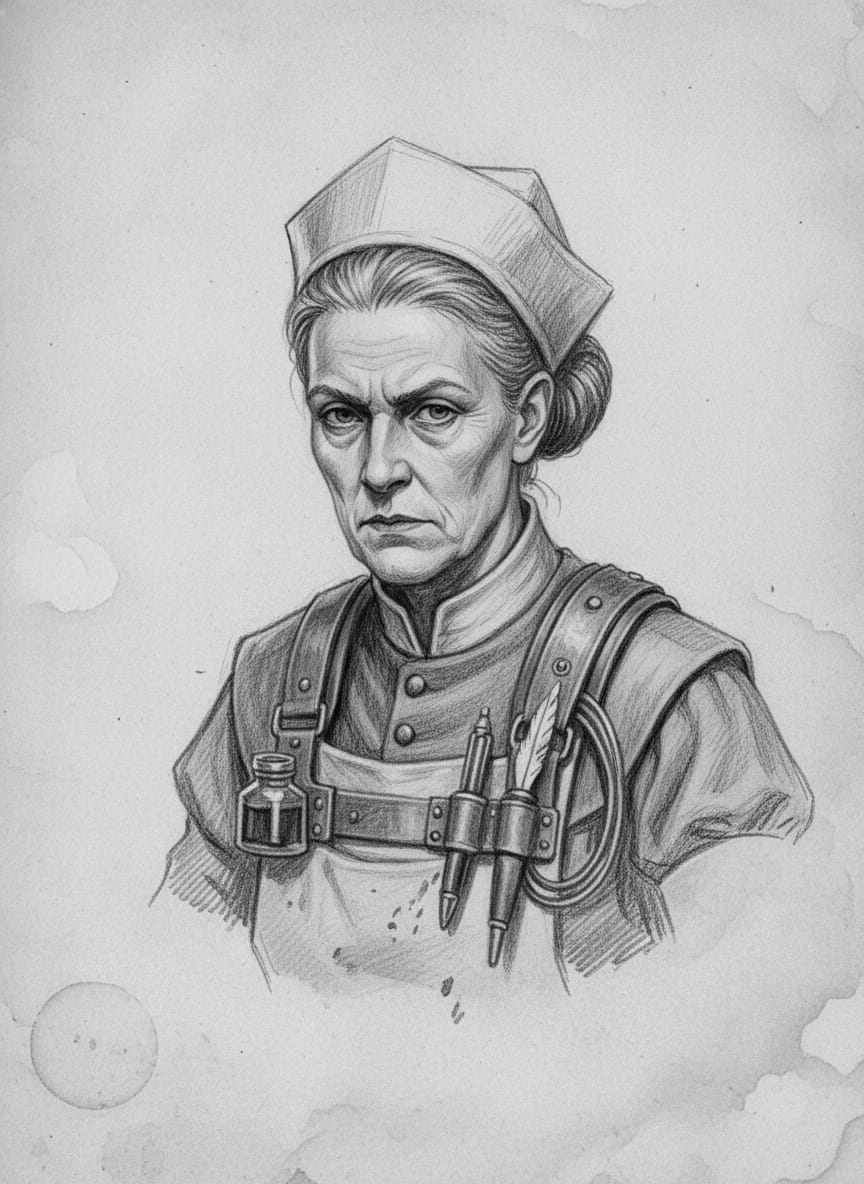
#On Her Station in the Ward
Blessed Vellum-Anna is the patron of the Deathbed Confession Harvesters, which means she presides over that narrow mercy where a man's last breath becomes evidence before it becomes prayer.
Her approved image is familiar in Mercy wards from Königsberg to Constantinople: a woman in a grey apron, head bowed, quill in the right hand, compress in the left, bedside ledger open upon her knee. The dying patient is usually painted serene. The blood is usually tidy. The quill is always nearer the mouth than the compress is to the wound.
The Bureau of Relics has never authenticated her bones, veil, apron, seal-ring, bedside stool, or alleged left thumb, though three parishes claim the thumb and one chapel in Marrowgate claims the stool. The Bureau of Mercy does not require authentication. It requires usefulness. Vellum-Anna is useful, and usefulness has canonised more saints than miracles ever did.
#On the Story the Wards Prefer
The ward tale places Anna during the Lull of Names in A.S. 78, when plague moved through southern trench infirmaries faster than clerks could count, and the dying carried names out of the world unrecorded. In the sweetest version, Anna was a Mercy novice assigned to wash mouths with vinegar water. She heard a soldier whisper a name, then another, then a route, then a cache beneath a chapel stair. No clerk stood near enough. No priest came in time. Anna tore the blank flyleaf from a prayer book and wrote until the man stopped speaking.
By morning she had filled seventeen leaves.
The first leaf named a deserter ring. The second named a fever-cart thief. The third named a child hidden from tithe registry. The fourth named a heresy cell whose living members were arrested by Vespers. The rest contained debts, prayers, lies, one recipe for barley cakes, and the word mother written six times in a hand that trembled toward illegibility. Records kept the useful pages. Mercy kept the recipe. Doctrine kept Anna.
Popular shrine cards describe Vellum-Anna as the founder of the Deathbed Confession Harvester profession.
Corrected. The profession was formalised under Standing Order 22-C in A.S. 80 after Bureau review. Anna supplied the image, the excuse, and the pretty lie that the first act had been tenderness rather than intelligence recovery.
The harsher ward tale is older. It says Anna wrote while men begged for water. It says she held the compress only after the confession was sealed. It says one patient called her thief and she wrote the word thief in the margin with admirable penmanship. The Bureau has not condemned this variant. The Bureau is wise. A saint too gentle for the profession would insult the staff.
#On the Quill and the Compress
The two objects in her icon refuse balance. They are arranged as doctrine.
The compress is Mercy's public claim: relief, pressure, cleanliness, the human hand interposed between blood and sheet. The quill is Records' private victory: transcription, extraction, admissibility, the conversion of pain into file. In Vellum-Anna's hand the two become one authorised gesture. She tends. She records. The patient receives care; the Ledger receives content. Everybody is served except, on several documented occasions, the patient.
Harvesters touch the quill in her image before shift-start. Witness Clerks touch the compress, either from innocence or superstition. Black-Zone Harvesters touch both and then touch the throat charm (Unregistered), because they know that the dying sometimes speak with a second voice, and a patron saint is most useful when the sound in the room has become professionally inconvenient.
WARD FOURTEEN SHRINE LOG — MARROWGATE, A.S. 199 Incident: votive quill found wet after night confession rounds Ink test: negative Blood test: negative Patient testimony: “She wrote what I refused” Disposition: shrine cloth replaced; quill retained under seal; patient expired before authentication
Her feast is observed without music in many wards. Harvesters exchange blank slips folded once. Ward-Sisters place a clean compress beneath the shrine lamp. Senior Examiners sharpen quills and recite the six steps codified by the Confession Reform: access, stabilisation, framing, extraction, authentication, packaging. The order is never altered. Comfort may occur anywhere the schedule permits.
#On Relics, Arguments, and Ward Use
Relics distrusts Vellum-Anna because the evidence is plentiful in all the wrong ways. There are too many quills, too many aprons, too many alleged death leaves, too many bedside stools burnished by kisses from Harvesters who should know better than to kiss institutional furniture. A saint with one relic can be managed. A saint with forty-seven disputed implements becomes a supply problem.
Records prefers the death leaves. Mercy prefers the compresses. Rites prefers the prayer-book story because it keeps a sacramental smell around the profession. Purity prefers the variant in which Anna named the heresy cell, since Purity loves a saint who begins as witness and ends as warrant. The Harvesters themselves prefer the hand. In cheap ward icons, her fingers are long, ink-stained, almost skeletal, and steady above the page.
During the Mercy Ward Purge of A.S. 134, when seventeen Harvesters across the Rhineland wards were convicted of selling redactions, Vellum-Anna's image was carried through disciplinary hearings. The accused were made to swear before the quill and compress. Seven wept. Four lied well. Two confessed to smaller crimes in hope of keeping larger ones buried. One asked whether Anna had ever sold a line herself. The transcript records a pause of nine seconds before the presiding examiner ordered the question struck.
A.S. 134 disciplinary broadsheets claimed Vellum-Anna “abhorred all redaction.”
Revised after Records objected. Vellum-Anna abhors unauthorised redaction. Authorised redaction is custody, and custody is one of the minor sacraments by which civilisation keeps its trousers up.
#On Her Present Cult
As of A.S. 201, Vellum-Anna remains unauthenticated, unquiet, and indispensable. Her icon hangs above terminal stools, seal-cabinets, black-zone doors, transcript trays, and the little curtained corners where families discover that grief has a witness and the witness has forms. Approximately two thousand four hundred Harvesters invoke her across seven hundred and twelve registered wards, including forty-three wards whose reports have not arrived in over a decade and whose personnel, with touching confidence, still draw rations.
The Shepherd faction (Unregistered) asks her to keep their hands gentle. The Butchers ask her to keep their questions sharp. Witness Clerks ask her to make the dying audible. High-Value Examiners ask her to make the implicated living careless. Ward-Sisters ask, more quietly, that she forgive the order in which the quill and compress appear.
The Bureau of Mercy calls her Blessed because the wards need a face. The Bureau of Records tolerates her because she teaches staff to write first. The Bureau of Doctrine approves her because contradiction, properly framed, is catechism: the saint of comfort is also the saint of extraction; the patron of last words is also the patron of useful last words; the woman with a compress in her hand made a profession that reaches for ink.