
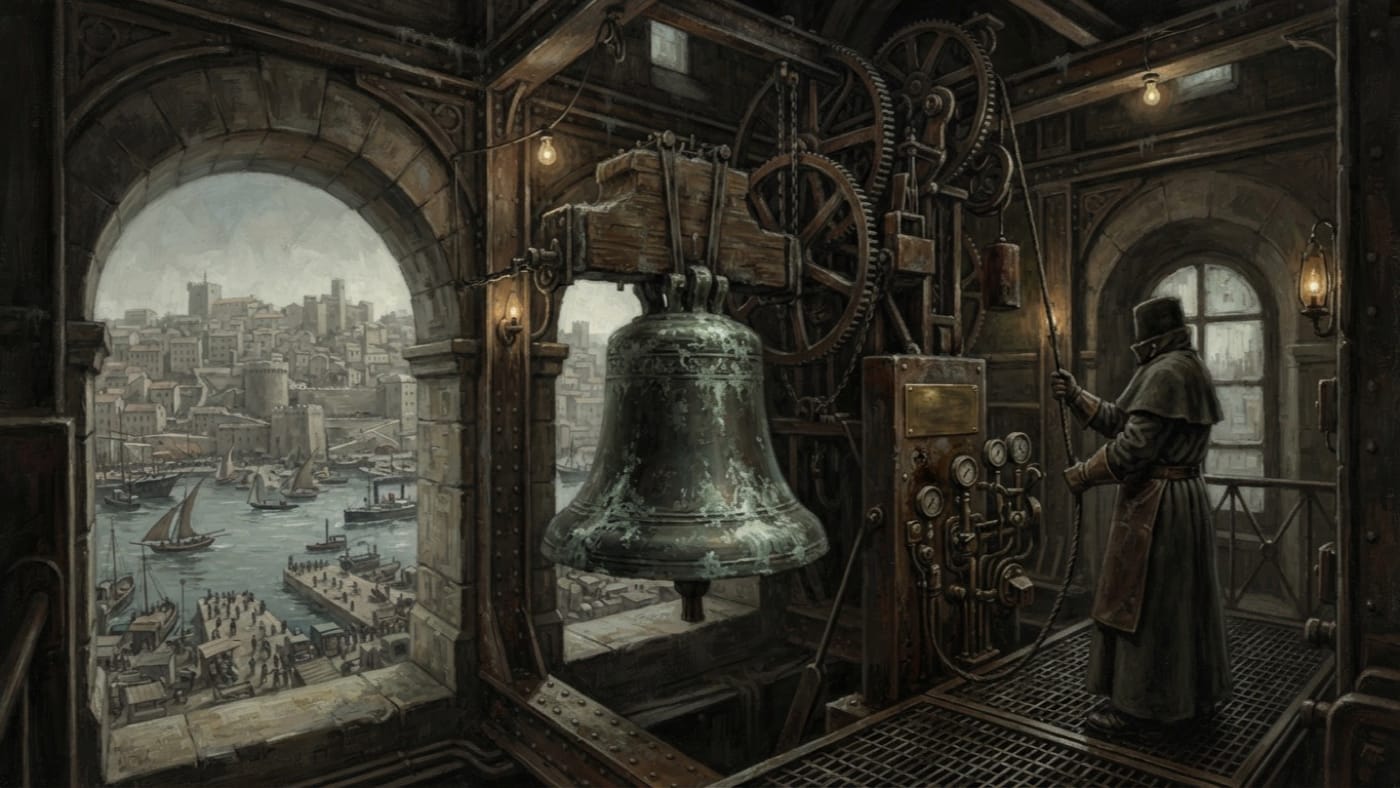
#On Salt-John's Office
Salt-John is a bell. I state this first because Marseille will sell you a saint's knuckle before breakfast and a saint's biography before lunch, and it hears every name as a man waiting to be venerated. The register of the Bureau of Bells lists Salt-John among the nine principal bells of the Cathedral of Saint-Victor. They hang in the reinforced bell cage in the cathedral's western mass, the Bureau's southernmost major relay. The register sets down its duty in four words: Salt-John sounds harbour danger.
The register says nothing about the John. It says nothing about the salt either, beyond what the harbour air leaves on every bronze surface in Marseille without filing a request. I will not supply a drowned fisherman, a grateful donor or a canon's sentimental nephew. The Codex already has enough relatives.
Beneath the cage lies the old harbour, with its hulls and hawsers, its pilgrim queues, its fish carts and its scribal booths, and men shouting prices in four dialects and lying in all of them. Salt-John hangs above this crowd as an instrument of the Church. Its office raises a question of doctrine that clerks prefer to leave to engineers. By what right does a sound command a city? A sermon must be attended. A decree must be read. A bell enters the ear uninvited, so the Church takes very great care over who may make it speak.
#On Harbour Danger and the Other Signals
The Saint-Victor bells divide their labour as a well-run chapter does, with each voice given a portion and each portion jealously guarded. Victor is the largest. It is deep bronze and carries a prayer against shipwreck. Lazare tolls for relic arrivals and disputed deaths. Oraison marks Bureau business at the quay. Marthe, thin and sharp, calls pilgrim muster. Little Beryn makes its cracked nasal complaint at terce. Three lesser bells handle parish business, funerals, debt remissions and the small humiliations the municipality orders. Salt-John has danger, and only danger is written beside its name.
A previous Bells register listed Saint-Victor as possessing ten principal bells.
Corrected. The tenth, Saint Armand of the Foam, was removed in A.S. 158. The company stands at nine. Salt-John is no replacement for it and has never been entered as one. Readers who invent successions for bronze will be referred to Relics, where such men are kept busy.
The relay also carries a repertoire of sequences. One opens pilgrim embarkation. Another holds ship traffic while relics are transferred from Quai Saint-Lazare. A descending five-peal warns of fire in the dock quarter. A broken triplet summons Bureau of Purity enforcement. A low sustained toll seals the harbour during suspected demonic contamination. The published record does not say which bells execute these sequences. A careless scribe might give every frightening noise to Salt-John because Salt-John owns the word danger. I have dismissed scribes for less.
The doctrine of the warning rests on recognition. If a harbour cannot tell danger from vespers, it has no warning. It has a louder vespers. The port has to know the voice before the voice has any authority, and so the Church keeps the voices apart, keeps their duties narrow and keeps their assignments on paper. A fishwife who hears the danger bell must know at once, without consulting a canon, that the matter is no longer liturgical.
#On the Keeping of a Warning
A bell has no conscience. Its ringers carry that for it, and they carry it in their hands. The Bellwardens and rope-hands of the Bureau keep authorised schedules, calibration logs and toll-keys chained to their own bodies, so that no thief, drunk or enthusiastic parishioner can borrow the Church's voice for an afternoon. They oil fittings. They check tension. They record drift before a small wrong note becomes a large public error. They earn rope burns on the forearm, a ringing in the skull that never quite stops, and a habit of counting under their breath that their wives come to hate.
These are features of the profession, recorded for the profession. The register gives no names for the men on Salt-John's rope, and I will not invent one so that some pamphleteer can grieve over him.
The authority they exercise is older than its present paperwork and younger than its pretensions. Bells rang across the Church's lands long before any office governed them. The Office of Bells was constituted in A.S. 52. The current Bell Codex was ratified in A.S. 115, a generation after the Synod took its formal shape at Strasbourg in A.S. 90. Hanging bronze was never the Church's invention. What the Office and the Codex did was make the right to strike it something a man can hold under licence, audit, revoke and punish.
The punishments are severe for a reason. Across the bellways the profession's worst enemy is the false peal, a sounding that moves crowds without authority, or into the hands of whoever arranged it. A false fire-peal empties a quarter. A false danger-peal empties a harbour, and the pickpockets and cargo thieves who rang it are standing ready. Any warning that can be counterfeited is a liability. The Church therefore guards the licence more closely than the bronze.
#On the Harbour's Authorities
Saint-Victor belongs to so many masters that its doorkeeper ought to be paid in fractions. The Bureau of Bells governs the relay. The Diocese and the cathedral chapter keep the stones, the crypt and the rents. The municipality claims the streets the sound falls on. The Bureau of Pilgrimage keeps its southern headquarters in Marseille and moves passengers across the harbour toward Thessaloniki. Relics moves certified bones and contested crates through the quays. The Bureau of Tithes assesses every stall and wishes it could assess every breath. The Bureau of War takes an interest whenever a harbour alarm reaches the garrison, and in Marseille it reaches the garrison loudly.
Each of these masters can find a reason to want Salt-John's rope. No published record grants it to any of them. The bell belongs to the relay, and the relay belongs to Bells, and I record this with the patient smile of a man whose Bureau is not currently being sued over it.
Consider what the warning costs the harbour. The lanes below Saint-Victor are cramped descents of wax sellers, rosary-cutters, reliquary polishers, fried-oil stalls, ropewalks, pilgrim hostels and licensed dealers whose certificates are better framed than their consciences. A danger bell interrupts all of it. Bargains stall. Embarkation queues buckle. Tithe assessors lose count. Pilgrimage loses an hour of departures, Relics loses its place in the transfer schedule, and War arrives late, as War does, to take command of a panic that has already run downhill. Every Bureau with business on the water pays a little of its dignity each time the danger bell is struck. The fish pay nothing. They were already dead.
This is why the doctrine of audible authority is a doctrine of restraint. A warning that interrupts commerce for the sake of vanity soon stops being believed. The Church does not license a danger bell so that a canon can feel important, or so that a Bureau can clear the quay before a rival's ship docks. It licenses the bell because, when the harbour is truly in danger, every one of those quarrelling offices must stop quarrelling at the same moment and in the same direction.
#On the Present Application
In A.S. 201 the western relay of Saint-Victor is active. Its bells carry the canonical hours across the harbour, out to the pilgrim fleet, east along the coastal signal chain and inland toward the Rhône road. Salt-John hangs among them as it is recorded, as one of nine with a single commission.
Its larger neighbour has its own file. Victor's midnight return-peal, entered in A.S. 191, belongs to Victor and to the fishwives who cross themselves over it. Salt-John has no such file. It has no published incident record, inscription, casting year, measured range or documented peculiarity of tone. Some readers will find this disappointing. In a danger bell it is the highest praise the register can give. A warning bell that has made itself famous has usually done so by failing.
The commission is narrow and meant to be. When the harbour is in danger, Salt-John speaks. When it is not, Salt-John hangs in the cage with salt on its shoulder and waits, while Tithes counts the stalls and Pilgrimage counts the passengers and the dealers below count anything that is not nailed down. Marseille goes on being Marseille under divine supervision, with one bronze voice set aside for the hour when it cannot.