
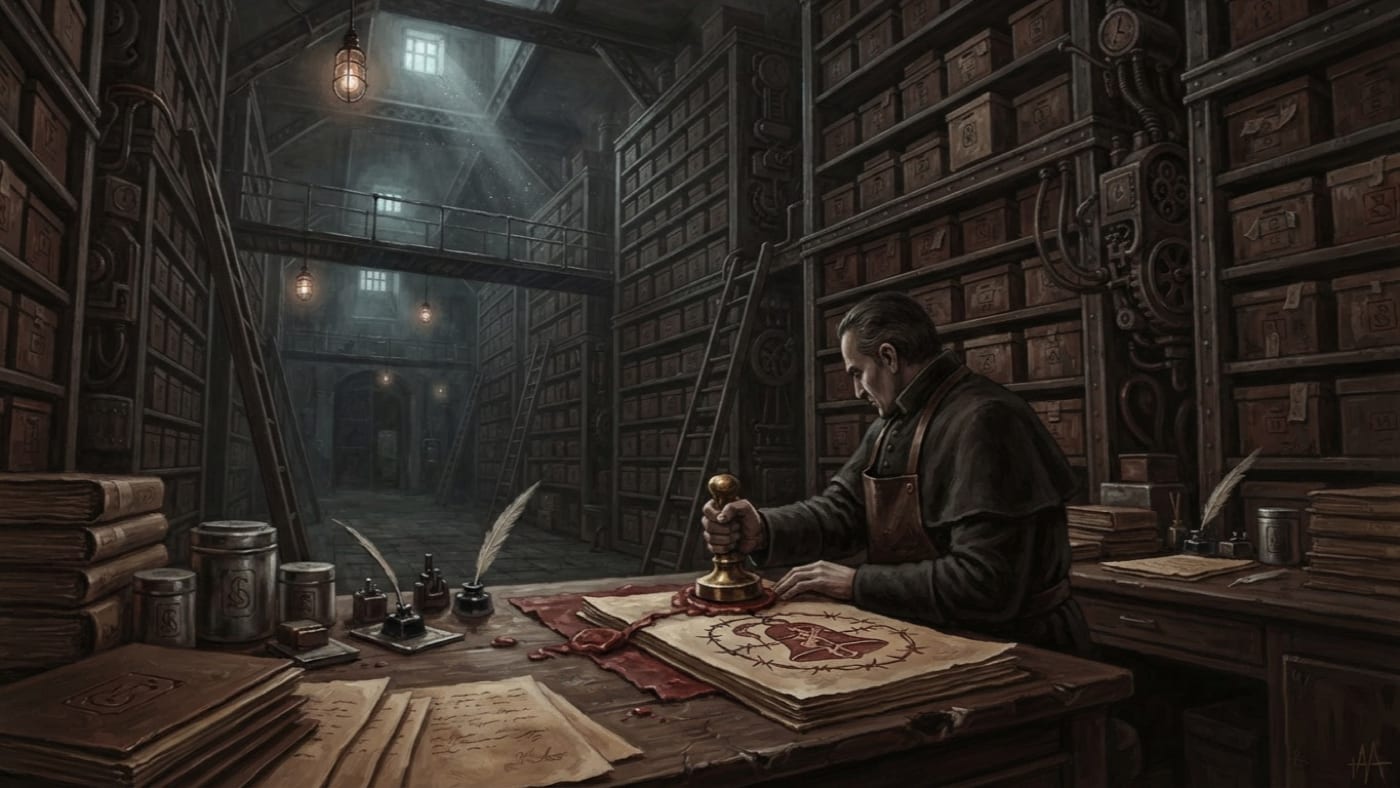
#On the Custody of Testimony
The Codex knows Bell-Silence custody from a single application, and I intend to treat that application with more care than its authors did. In A.S. 184, after the Collapse of Saint Aurelia's Convoy in the market quarter of Rouen, five survivor depositions describing the same affliction were copied, sealed, and placed under the designation. Then the survivors who had given them were burned. The paper went one way and the people another. The paper had the better road.
That is the whole documented record. A lesser commentator would pad it into a code, with founding councils, chamber specifications, lead caskets, deaf wardens, inspection intervals and penalties for the curious. I have looked for such things where such things are kept, and none of them is attached to this designation by name. A tract that invents its own regulations is a forgery with good posture.
What the record supports is this. Bell-Silence custody is sealed documentary custody, invoked at Rouen for testimony about acoustic exposure. It keeps written words about a sound that took command of the people who heard it. On the evidence, it keeps the words and nothing of the sound. The seal was pressed to put off one question: did the offices that applied it fear the paper, or what the paper proved?
#On the Rouen File
The convoy carried authenticated finger-bones of Saint Aurelia of the Third Lamp through the market under Bureau of Relics attestation. With them came guards, pilgrims, three Ash Chaplains and seven choirboys. No Pale Chanter was seen in the square. The procession fell into step with itself although nobody had given a command. Bearers smashed the relics they had been paid to carry, and chaplains strangled the boys they had been ordained to keep. The parent entry gives the rest at a length I will not repeat. One massacre per volume is all the binding budget allows.
The file begins afterward, between the cordon and the pyre. Survivors said the Chanter voices had nested in their ears, worming thought into command. Five depositions preserve the phrase. Five, out of an entire market. That number tells you less about the affliction than about the clock. A clerk can take only so many statements before None when Purity has already sent for the carts.
Purity's field order treated every exposed survivor as an active acoustic carrier. After names were taken, speech was forbidden. Confession was allowed by gesture only, in three minutes at the lime yard behind Saint Cuthbert's Bridge. The ashes were mixed with quicklime and laid under the market paving. The public was told that sanitary necessity required it.
Take the steps in order. A man says his name aloud and a clerk writes it down. If he is one of the five, he describes the voice inside his skull, and that description is written, copied and sealed. Then the same man is forbidden his tongue, signs his sins with his hands, and is burned in a batch small enough to keep the smoke from carrying recognisable words. The words he had already given were carried elsewhere, under wax.
So one emergency produced two dispositions on the same afternoon. The witness was destroyed as a carrier, and his testimony was kept as evidence. Nobody at Rouen wrote down why keeping the second required destroying the first. Nobody since has had the stomach to ask.
Later parish histories recorded the burned survivors as condemned heretics.
Amended. They were not condemned. They were exposed. Their depositions, being neither, were kept.
#On Preservation and Repetition
A burned witness cannot recant or embroider, and no rival Bureau can cross-examine him. A sealed deposition can be pulled out for all three. The Church has always known that testimony outlives the person who gave it. Bell-Silence custody is what the Church does when it wishes it knew this less thoroughly.
Keeping the file was the cheap half of the bargain: make copies, press seals, shelve the file with the rest of what the Synod keeps without reading. The Bureau of Silence sorts texts into tiers: restricted, redacted, destroyed. By every visible sign the Rouen depositions sit in the first. They were retained. Nobody struck a line, and nobody fed them to the furnace, though it was lit, warm and conveniently close.
The nearest comparison belongs to another office. The Auditory Heresy Division keeps a Wax Room of confiscated sound-bearing objects and listening cards in felt-lined drawers. It forbids anyone to play the evidence, chooses its wardens partly for their deafness, and submits to an annual Silence audit. Those are the Division's rules for the Division's seizures. I set them down only because the instinct is the same: keep the proof and refuse the performance. Some reader will otherwise assume that Bell-Silence custody shares the felt, the deaf men and the auditors. The Codex has no record that it does.
The difference from ordinary sound-crime matters. Under Auditory Heresy the Synod prosecutes recognition. A household has been convicted over a lullaby that comforted a child, on proof that they knew it and no proof of harm. Rouen is the reverse: proven harm and no singer anyone could recognise. Relic-bearers broke a saint's bones. Chaplains killed boys. Nobody in the square could name the tune, yet every deponent agreed it was inside them. A charge drafted for whistlers was never going to fit that.
#On the Offices Around the File
Rouen spreads its fear across several offices, so that no Bureau suffers the indignity of owning all of it. Records controls incident copies in the city, and copying five depositions is ordinary Records work. Purity controls burn orders and acoustic-exposure custody, which covers the bodies, the yard and the lime. Bells controls the dawn-listening advisories and ran the later investigation. The Bureau of Doctrine issues classifications. One of them is Standing Order 14-B(Revised) of A.S. 187, which declares the Chanters' output an involuntary sorcerous emission and insists that no Bureau has ever classified it as song. That order came three years after Rouen. By then the depositions had already been sealed under a name with the word Bell in it.
So who holds the key? The published record names the designation and leaves the custodian blank. Records could claim the file because its clerks copied it. Purity could claim it because Purity produced the deponents' ashes. Bells could point to the first syllable on the cover and call that title. Silence licenses libraries and audits indices across the Synod, and it would doubtless claim the file too, if Silence ever admitted to claiming anything. The name sounds like Silence's. The Codex records nothing that puts the file in Silence's hands.
I find the arrangement contemptible and exactly right. When one office keeps a file, sooner or later it must answer for the contents. A file that several offices could plausibly keep has nobody who must answer for it.
#On What Remains Under Seal
In A.S. 186 the Bureau of Bells investigated the plaza and ended a four-page report with this sentence: "We recommend against standing in the plaza at dawn." Locals still say there is singing under the cobbles. That remains their testimony. Bells has neither confirmed nor explained it. Whatever the investigators measured, or chose not to, they recommended distance. That is a strange sequel for a danger officially settled by fire. If the burning was sanitary, the advisory is superfluous. If the advisory is necessary, the burning settled very little apart from who would be left to testify.
Aldric Venn, an assistant copyist of Records, put Rouen beside Prague and Odessa in his comparative memorandum of A.S. 187. He proposed that Chanter cadence might run through existing liturgical channels, and that the Covenant's own emissions might come back through Wound-Sites in hostile cadence. He noted that the relic-bearers had moved in intervals matching procession-step tables. Records withdrew the memorandum forty-seven minutes after it was filed, citing improper acoustic jurisdiction among other curtains, and sent Venn to the Paper Mines of Ulm. The hypothesis is his. It is unproven and suppressed, and I attach it to nothing.
I note only what lies on the table. Five sealed statements describe a voice that knew its way into the ear. The square was full of sanctified procession, and that voice entered it without a visible throat. The offices responsible for sacred acoustics would be very uncomfortable if a deposition ever confirmed the copyist's inference. The custody goes on. The plaza is paved over lime. The fish-sellers set up their boards above it at dawn, on the advice of nobody in particular.