
#On the Crime the Ear Commits
The ear is the one organ the Synod cannot close by decree, so it has been made liable instead. — Auditory Heresy Division, preface to the instruction manual
Auditory Heresy is the charge the Bureau of Orison and Song uses to turn unlicensed sound into spiritual contamination, a danger to the public and proof of intent. It was built in pieces after the Orison Licensing Acts of A.S. 94. In A.S. 96 it was given a division and a uniform, and in A.S. 112 it was handed the case it still teaches from. It covers more than smuggling and less than everything Orison governs. A licensed hymn sung correctly in a licensed loft is ordinary Orison business. The same hymn sung a half-step flat in a laundry is Auditory Heresy.
The Acts did the seizing. Under the placards No private hymn and Rhythm is a leash, all sound was sorted into five classes: licensed devotional, licensed functional, licensed comfort, suspended and criminal. The fifth class kept growing. A work-bar fell into it when its permit lapsed. A hymn fell into it when someone altered an interval. A lullaby without Mercy approval was criminal from the start. "Auditory Heresy" is simply what the Bureau calls the fifth class when it wants to sound like a church and not a landlord.
The theological case has some truth in it, which makes it more useful to the Bureau. Certain cadences really do draw hostile attention from beyond the Sagittal Line. The Great Deceiver has used music when music served. Orison takes that one real danger and stretches it over every throat in the Church, the way a tanner stretches one hide over a drum.
Early instruction manuals define Auditory Heresy as "the use of frequencies dangerous to the soul or to the Line."
Corrected for internal use. The category covers dangerous frequencies, harmless frequencies and frequencies that demonstrably comfort. The last kind is prosecuted hardest, because it competes with licensed supply.
#On Melody Intent
What makes this category special is its rule of evidence. Ordinary heresy needs someone to say something, which means a mouth has to open. Auditory Heresy prosecutes a person for recognizing a tune before any performance happens. Melody Intent, the subcharge that fills most of the docket, allows conviction for an incomplete song, or for no song at all, so long as the accused can be shown to know one.
Knowing a tune leaves traces. A line of notation on a laundry receipt. A stitch-score counted into a cuff. A music-box drum pinned with three forbidden bars. A hum under the breath. A flinch when the wrong interval sounds on the landing. A finger tapping the right rhythm against a cup. A child asleep at an hour when licensed comfort has never once managed sleep. A household that goes quiet when Orison boots reach the stair: Division doctrine holds that the innocent have nothing to stop doing.
The Eleven Laundry-Women of Candlewick gave the charge its first public form in A.S. 94. They carried complete lullabies written on laundry receipts. The Bureau executed them, burned the receipts and filed the matter under sanitation. Within a week the tenements had learned the songs by heart. Orison studied this carefully and drew the wrong lesson from it: paper had been the weak point, so the law would have to reach past paper into the memories that outlived it. Melody Intent is that reach.
#On the Instruments of Detection
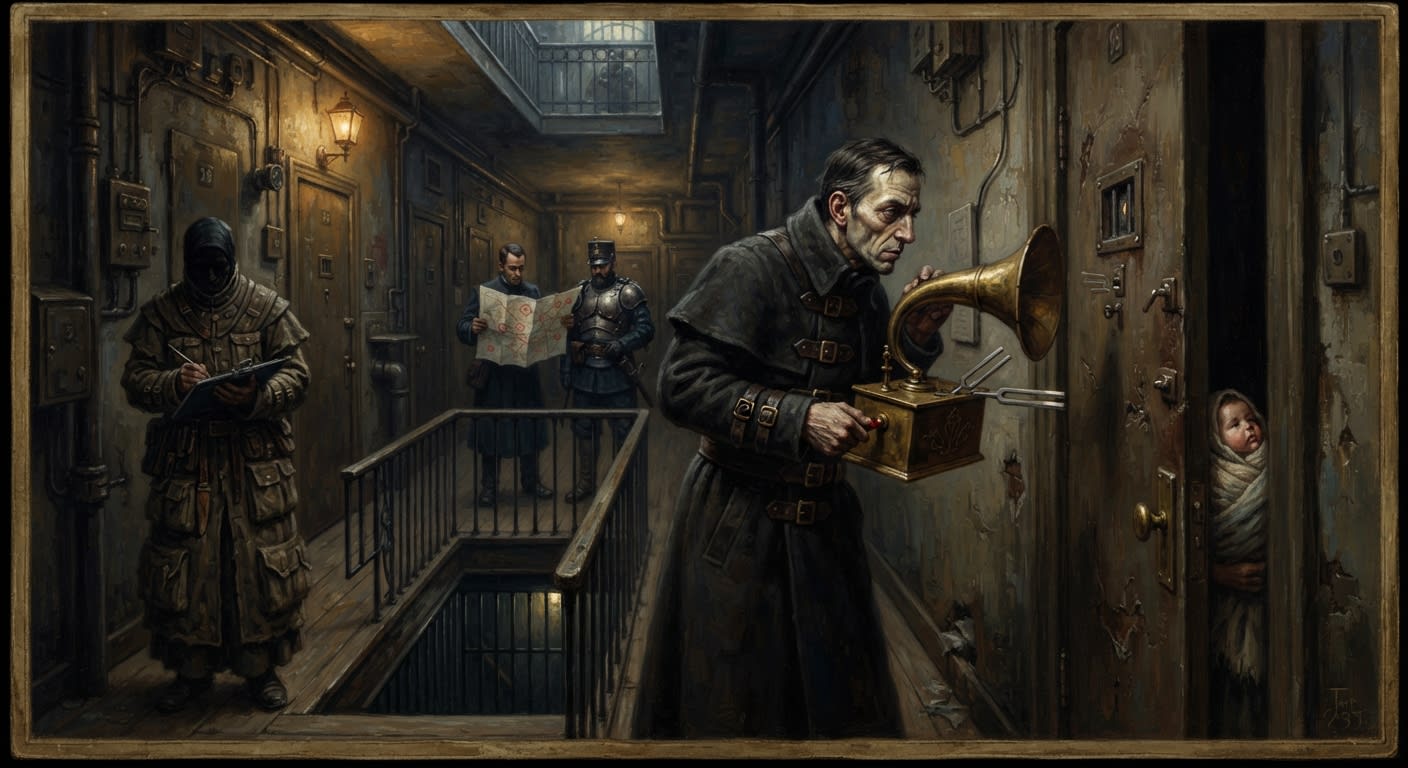
The first instrument was denunciation, and it was the worst. Neighbours heard humming from tenants who owed them money. Landlords heard sedition in rent disputes. Orison wanted a witness expensive enough that magistrates would stop asking questions, so in A.S. 96 it built one. The Tone Inquisitors of the Auditory Heresy Division were recruited from failed Orison Signal Engineers. These were Dustcasters whose lungs the saint-dust had scarred and whose hearing the broadcast coils had sharpened past any hope of rest. Their new trade was taught at the Cloister of Calibrated Breath, where they had first learned to keep the Synod's voice clean. Now they learned to find private voices dirty enough to seize. The Synod wastes nothing, and damaged people least of all.
They carry calibrated tuning forks, hand-cranked resonance boxes, waxed listening cards, prosecution slates and warrants the Bureau of Purity has signed in advance. The resonance box plays the bait-cadence, a scrap of forbidden melody played wrong enough to pass for an accident and right enough to hurt anyone who remembers it. The box is set at the corner of a landing and cranked. The Inquisitor watches for a flinch, and the clerk fills in the card.
The Sky-Sermon Attendance Auditors draw the map. During broadcast hours they count lit windows and work out the Choir Rate. They mark any block where the response runs thin, or where the Orison Hour comes back with a household tune murmuring under the official line. The Auditor works in suspicion by the street, the quarter and the percentage. The Inquisitor works door by door. Every Bureau admires how neatly the work is divided: one office finds out that a neighbourhood is guilty, and the other finds out which mothers.
The smugglers answered detection by breaking songs into pieces. Since Candlewick, no competent Unauthorized Melody Smuggler carries a whole tune. Whisper Runners carry the openings. Stitch-Score Couriers carry the middle bars in their hems. Listening Cell Hosts sing the endings, mouth to ear, in rooms whose walls are padded with coats. Music-box drums travel in boot linings. The Division answered by lowering its standard of proof, so that one fragment now counts as possession of the entire song. The law assumes the whole tune from one piece the same way it assumes a whole soul is corrupt from one damaged part.
AUDITORY HERESY DIVISION — ASSET SCHEDULE (EXTRACT) Carriers permitted to run under Division sufferance: ███ routes, ███ cells. Raid timing to follow ████████████████ transfer. Purpose of retention: ██████████████████████████████████. Not to be cited in Melody Intent proceedings.
#On Vienna as the Training Case
The Vienna Incident of A.S. 112 is taught as case law. It is one case, not the whole of Auditory Heresy, though Orison schools teach it as if the category had spent its whole life waiting for that month.
A lullaby about rain and barley spread through the pilgrim quarters near the Donaukanal because it made children sleep. It was provincial, older than the Concordat, and now survives only in fragments that contradict one another. The Auditors marked the blocks and the Inquisitors played bait-cadences in the stairwells. One woman corrected the rhythm under her breath and was seized before she finished. By the end of the month five thousand mothers had been branded, their tongues charred black with hymn-fire. The Bureau of Mercy took their children to the Orphanarii under the heading of protective transfer.
The finding is the precedent. The lullaby was "an unsanctioned cadence exhibiting potential for doctrinal contamination." Every Division magistrate learns that sentence the way seminarians learn the Creed. "Potential" meant no harm had to be shown. "Doctrinal" made it a matter of theology. "Contamination" made it catching, which justified taking the children away as carriers.
Division training digests state that the Vienna lullaby "produced measurable spiritual degradation in affected households."
Withdrawn from internal editions. No measurement survives. The file proves that children slept, that the tune spread, that neighbours helped each other and that the Bureau was afraid. Instructors are to cite the finding of potential instead, since potential needs no measurement and has never been embarrassed by one.
#On Licensed Comfort and Its Failure
If licensed comfort worked, the category would wither. It does not work. In A.S. 134 Mercy and Orison approved the Dormition Canticle, four bars written by committee to replace what the branding irons had taken. It was tested on forty infants at the Strasbourg Central Orphanarium. Two slept, and both were later found to be deaf. The other thirty-eight were classified as "compliant rest."
This is what keeps Auditory Heresy running, and the Division would rather I had not described it. A mother whose child lies rigid through the approved four bars has every reason to buy thirty seconds of contraband humming. A ward-sister who taps a crib rail after the auditor leaves has committed Melody Intent. Any change to the Canticle can be prosecuted, however small and however well it works. The Bureau creates the shortage, criminalizes the remedy, and then counts the arrests as proof that more enforcement is needed. Tithes has called this efficient, and on that point Tithes is right.
#On Present Enforcement
As of A.S. 201, Auditory Heresy is an active charge in every Orison district, in the River-belt ports, in the Candlewick tenements, on the pilgrim roads and in the rear-towns behind the Line. Vienna is taught in Orison schools and in Purity interview manuals. Melody Intent case law now fills eleven volumes, plus a supplementary index of incriminating flinches. Since A.S. 118, first possession has been punished by tongue-branding. Leading a network that implicates more than twelve households can get a person erased from the Great Ledger of Souls.
The trenches are the embarrassment. Soldiers keep scraps of songs from home the way other men keep rosaries. At Bastion-Przemyśl in A.S. 199, the Bureau of War put off prosecutions because desertion was already doing more damage than heresy. Orison lodged a protest, carefully written in prose so that nothing in it could be mistaken for verse.
In the Underchords beneath Bastion-Irongate, a fragment of melody works as a bond, a password and a coin. It is trusted precisely because carrying it is a crime. The state set the song's price, and the underworld pays it.
That leaves Saint Hessa of the Closed Mouth. Doctrine calls her a composite. She has never been canonized or condemned. She is patron of the one practice the charge cannot touch: a song passed on without any sound. Four taps, a pause, two taps, then a hand pressed on the cradle. The fork hears nothing, and the child falls asleep.