

#On a Name Denied in Ink
The Bureau of Heraldry denies the Black Calipers. The same Bureau reads their seized notebooks under seal. Both statements stand in my own entry on Form 14-G, one after the other, and no one has asked me to withdraw either. This survey was compiled in A.S. 201 under the Bureau of Doctrine, and it adds nothing to that pair of facts that the evidence cannot carry. The date at the head of the stamp is the date of the survey, the year in which I looked. No one has told me when the Black Calipers began to write, and I will not guess in public under the Bureau's wax.
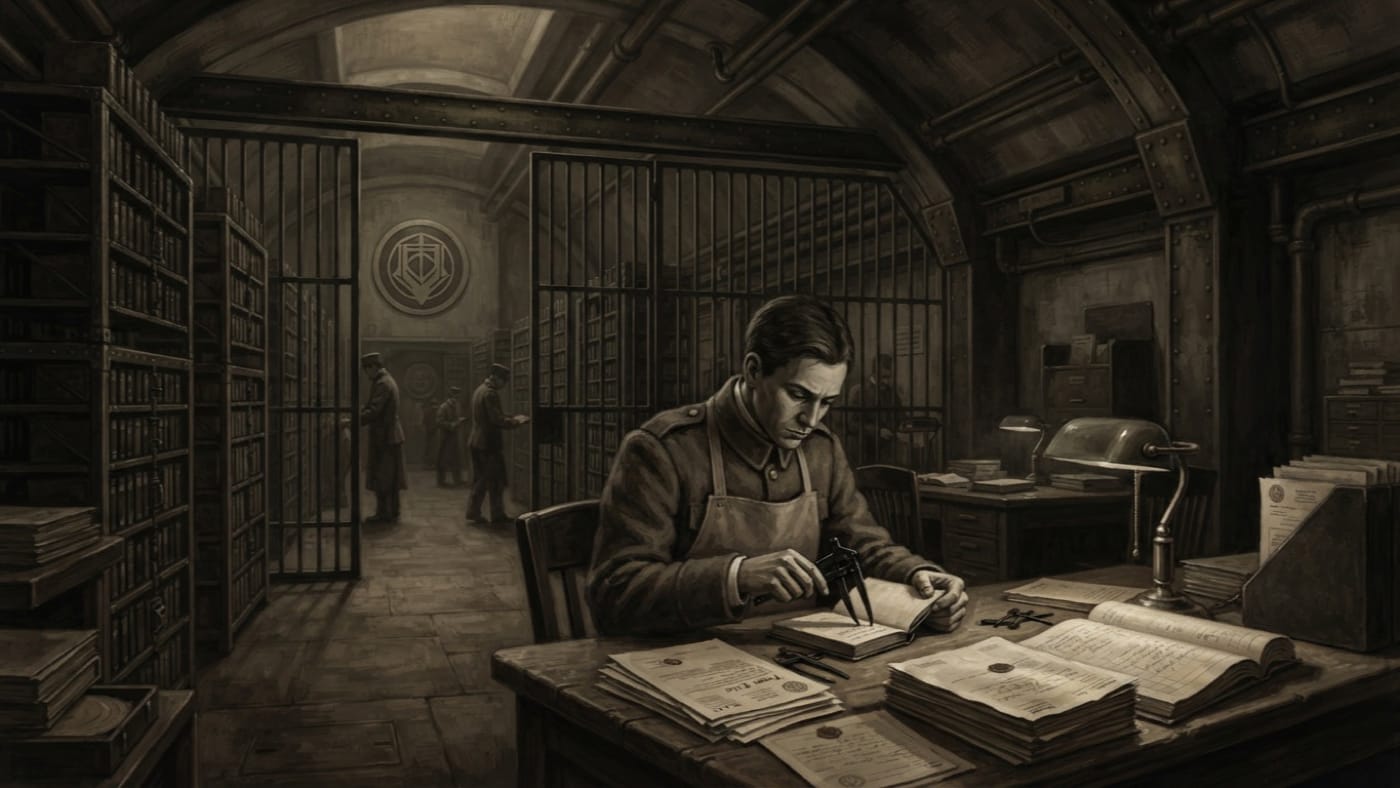
A faction entry is expected to open with a founder, a hall, a banner and a grievance. The Black Calipers supply none of these. They supply a habit: private copies of measurements that the Synod says must be taken once, filed, and never touched again.
#On the Body as Proof
The Geometry Brand-Smith Corps burns triangles into living skin because paper can be stolen, forged, or rained upon. Class, levy, penance, passage and guilt are measured onto the body with serialized irons, measuring frames, witness seals and a ledger entry that treats the scar as notarized property. The promise was simple. Flesh would testify.
Form 14-G exists for the occasions when the testimony moves. It was formalised in A.S. 147, during the quarrel between Heraldry and the Bureau of Purity over lawful marks that drifted after application. Purity files the phenomenon as Category Two Demonic Interference with Heraldic Instruments. Heraldry files it as Geometric Instability, Under Investigation. The Bureau of Records keeps both columns. None of the three has settled what moves the mark, and this survey will not settle it for them.
The A.S. 199 revision is narrow and severe. A Brand-Smith who sees drift in a mark applied within the preceding seventy-two hours must seal the subject, notify Purity, suspend further marking, and refrain from re-examination until cleared by an Inquisitor of the Third Degree. Standing Order 14-G governs the formal response. The rule asks a craftsman trained to measure to stop measuring at the exact moment measurement becomes interesting.
Every later sin in this article answers that sentence.
#On Three Habits of the Forbidden Re-read
Re-inspection Brand-Smiths call Form 14-G the Forbidden Re-read, and with cause. My account of the form records three responses to its prohibition. The Obedient seal the cell and leave. They live longer and know less. The Measuring Hands take one second reading before Purity arrives, usually without witnesses. The Black Calipers keep private copies.
I called these three schools. The word was too generous.
"The forbidden re-read has produced three schools."
Clarified. The Form 14-G account distinguishes three habits of response among those who observe drift. It does not establish that any of the three has a charter, a roll, a rule of admission, a teacher, a meeting place, or a leader. "School" remains in the original entry as a description of manner. It is withdrawn here as a finding of organisation.
Nothing in the record says the three exclude one another. A Brand-Smith may be Obedient on Tuesday and a Measuring Hand on the night the Inquisitor is late. Does a Measuring Hand who writes the second reading down thereby become a Black Caliper? That is a question of definition. The Bureau has not been asked it, and would refuse if it were. My account separates the reading taken from the reading kept. The first is a sin of the moment. The second is a sin with a spine and stitched gatherings.
#On the Six Columns
The account names six classes of private entry, and I give them as named. I give no figures. None are in my possession under any seal I am permitted to break, and a ratio invented for colour is still a forgery.
Drift ratios. A ratio needs at least two measurements: the geometry as burned and the geometry as found. The official sheet already asks for both, in Box 3 (Original Geometry) and Box 7 (Observed Deviation). The private copy keeps the comparison after the sheet has gone to red routing.
Tool histories. The official form asks for the tool serial and heat witness in Box 9. Iron custody is the daily liturgy of a Brand-Smith's chapel. A history goes further than a serial: it is the life of one iron across many bodies. The account says the Calipers keep such histories. It does not say what any of them shows.
Scar age. The account records the column and nothing more. Age is a category of entry. On present evidence it is no cause of anything.
Prayer response and bell response. Here a careless reader will confuse two documents. Box 17 of the official form asks whether the mark answered touch, lamp, bell, prayer, or silence. The filer answers it once, in a sealed cell, before a witness, and hands the sheet over. The private entries attributed to the Calipers keep prayer response and bell response as columns of their own, separate from the rest and kept after the form has left the room. The official question is surrendered with the sheet. The private record stays with whoever wrote it.
Subject survival. Heraldry likes this column least. A drift ratio concerns geometry. Survival concerns what became of the person after Purity arrived. The account says the Calipers record it. It does not say how they learn it, whether any keeper followed a subject past the cell door, or what any tally would read.
The temptation is plain. Set scar age beside survival and bell response beside drift, and the hand reaches for a law. Brand-Smith superstition has built whole theologies on less, and Heraldry forbids those theologies. This survey records categories of entry. Causes belong to whichever Bureau can prove one, and none has.
#On Denial and the Sealed Reading
Heraldry's denial comes with a document. My Form 14-G entry quotes Heraldry Circular 14-G/199, which held that no unofficial drift-ratio notebooks are kept by licensed personnel. That circular now stands clarified: it covers only the places Heraldry has chosen to inspect during announced hours. I claim nothing more about it.
Then there are the seized notebooks. My account says Heraldry reads them under seal. It does not say from whom they were taken, which office took them, in which bastion, how many there were, or whether any two came from hands that knew each other. A notebook proves that a notebook exists. A dozen notebooks, if there are a dozen, prove a dozen people breaking the same rule in the same direction. Rules exist to produce exactly such people.
Everyone would prefer otherwise, so it must be said plainly. A denial is no evidence of a secret charter. A Bureau will deny an organisation it fears, an organisation it has invented, and an organisation that was never more than scattered private habits of hand. The denial fits all three, and so does the seal. The record does not say whether private copies passed between keepers, whether a network in any full sense exists, or whether "Black Calipers" is a name the keepers use or one given to them by others. I will not put words in its mouth. Why Heraldry reads what it denies is Heraldry's business, and its reasons are under the same seal as the notebooks.
The Inquisitors are absent from every line of this. The rule names an Inquisitor of the Third Degree as the only lawful second pair of eyes. The account names no Inquisitor who has read, seized, or kept a Caliper notebook. I will not supply one.
#On the Present Survey
As of A.S. 201, Form 14-G remains in force. The seventy-two-hour rule stands. In every Licensed Chapel the iron is cooled, labelled and laid in its tray, and the filer leaves with a clean conscience and nothing written down. In every field shed where Quick Burners work the queue, the rule is honoured as far as the road allows. Where Mercy Branders bend geometry softly enough to slip past a first reading, a second reading is the last thing anyone wants kept.
By the only account the Codex holds, the Black Calipers keep what the form surrenders. Heraldry denies them and reads them. The Bureau of Doctrine records both positions in this survey and reconciles neither, which is its oldest skill and its best paid.