
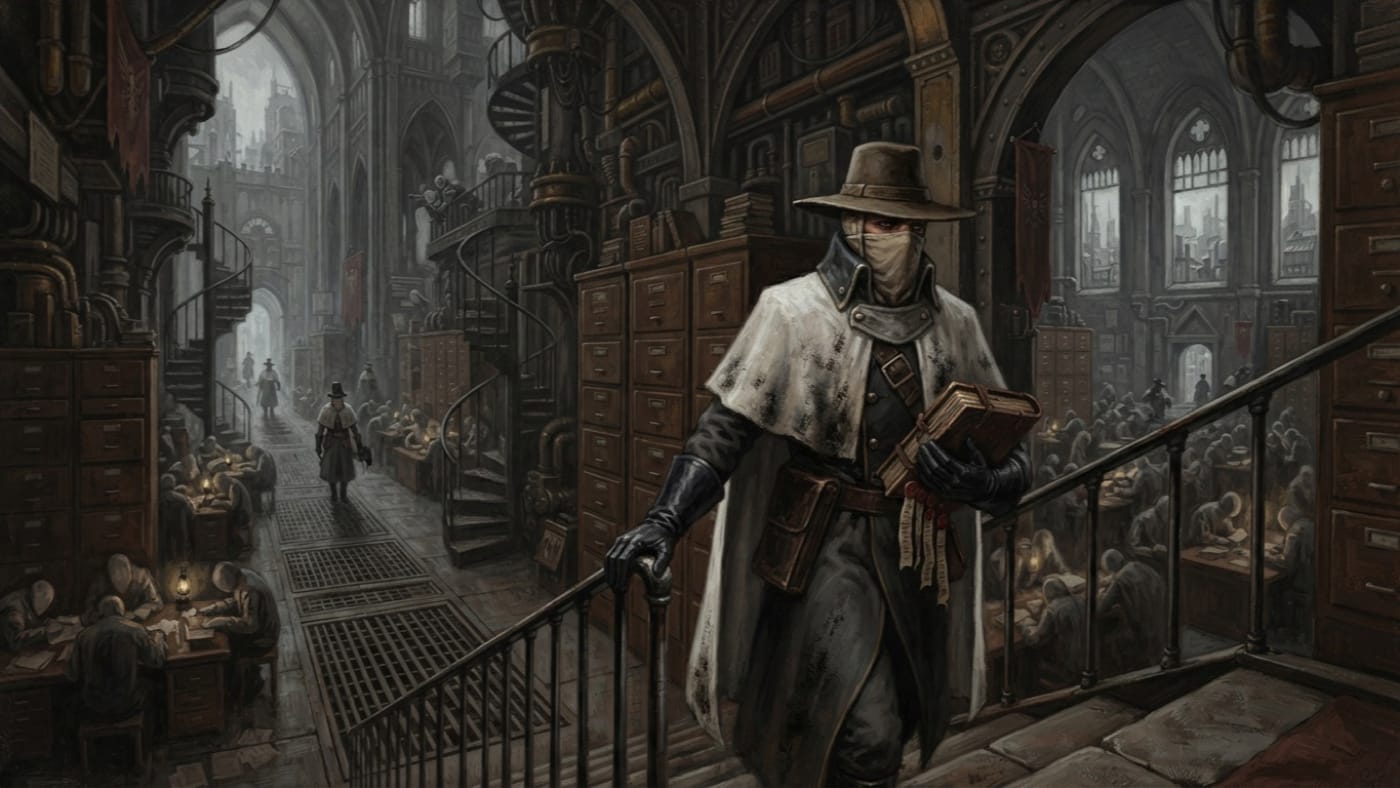
Ignis Mentem Revelat. Fire reveals the mind. — cut above the door of every interrogation chamber in the Church's keeping
#On the Office
An inquisitor is a person carrying a writ, and a writ is a sentence still looking for its subject. The Inquisition as an institution belongs to another folio, with its orders, its feuds and its masked summit. This entry concerns the officers. They arrive at the door with the paper and put the questions. Then they decide which answers will be entered as evidence and which will be entered as the person who gave them.
The street calls them Inquisitors of the Flame, or the white cloaks, or nothing at all, which is the safest name. The White-Mantled Inquisitor, Purity's travelling examiner of words, is the face most villages know. A Lictor with a flensing knife and an Ordinary of Severity governing a diocese draw on the same authority. Neither would thank you for mistaking him for a man who checks shop signs.
Two entries in this Codex mention these officers in passing. The Bureau of War says they enforce the Levy. The Ash-Mothers entry says they traced an enemy regiment back to its mother. One office takes a household's sons. The same office counted a woman's.
#On the Writ and Its Superiors
On paper the inquisitor stands beneath the province's Bishop-Praetorial, who is styled Custos Animae, Keeper of Souls. In practice the inquisitor cites mandates as old as the Night of Black Decrees of A.S. 58, and the Bishop remembers urgent business in another parish.
The writ's ancestry is a matter of pious dispute. The Inquisition's own histories say it was formed after Saint-Malo, A.S. 10, when there was no Synod to form anything. They credit its sanctification to the Edict of Worms-Below, an instrument whose date I have looked for and will not invent. The firmer ground lies later. Records was transformed in A.S. 78. Purity and its Index took shape around A.S. 80, and the Synod became formal in A.S. 90. Purity says it was born in fire in the Witch-Hunts of Toulouse, A.S. 93. To call earlier functionaries inquisitors is a courtesy the present extends to the past.
Authority runs through three hands. Doctrine defines what may be said. Purity enforces it, and the inquisitors are its instrument. Records preserves the consequence in triplicate, often under contradictory seals.
Above all of it sits the sacred exception. An inquisitor's seal opens any door. His questions permit any cruelty. His judgment admits no appeal. So the institution says, and so I have written elsewhere, with more enthusiasm than I now recall feeling. The officers are said to answer to the High Censor of Strasbourg. Some describe the Censor as a man, and others as a mask passed around the Council of Veils. I have no ruling on either story.
The exception is also crowded. The Order of Ash purges whole towns. The Shroud specializes in disappearance. The Root pursues bloodlines. Severance hunts heresy among clergy and officials, which is to say among us. Below the Grand Inquisitors and the Ordinaries stand two further ranks. The Lictors interrogate and make guilt visible on the body. The Penitential Shadows listen. I record what is said of the Shadows' glass eyes and their manufacture as hearsay. Every one of these jurisdictions believes itself final. They settle the question in the usual way.
#On Evidence
Evidence begins as talk. The confessarii walk taverns and markets in plain clothes and come back with phrases. The parish Confessor-Penal, a separate officer in a separate stole, urges the faithful to confess their neighbours' suspicions along with their own sins. Denunciation slips arrive by the sackful. None of it is evidence until an inquisitor says so.
The White-Mantled examiner shows the method best, because he wears it. His mantle is starched white and takes soot as readily as a reputation does. His hood has an ash filter sewn into the lining. A black glove covers his sealing hand so that wax never touches bare skin. His pockets hold strips of the Index Claritatis, the rolling compendium of permitted words, amended weekly. He also carries chalk for dirty signage, wax and a censor knife. The glass chain goes around his wrist or his neck.
The procedure has seven movements:
- Identify the suspect phrase.
- Compare it against the current Index and the local errata.
- Determine how it spread: by print, song, chant, wall or rumour.
- Contain the source.
- Extract the chain of who taught whom.
- Decide the disposition. It may be recantation, redaction, immurement, erasure or watched release.
- Rewrite the case narrative so that Doctrine remains true.
The seventh takes longest.
Whatever the examiner condemns goes into the Index Damnatus, Purity's register of forbidden texts, relics, songs and names. One index says what you may say. The other says what you have said. A condemnation in one town is only an opinion in the next. It becomes law there when an Index Damnatus runner carries the amendment to the checkpoint and the registry. Street inquisitors take particular pleasure in catching runners with stale paper.
The profession keeps its own ladder. The Chalkling reads signs and does not speak. The Mantle Examiner raids and interrogates. The Chainmaster keeps a district's quotas and informants. The Glass-Canon handles the phrases said to make the glass sing. These ranks sit inside Purity's larger hierarchy without replacing it. The profession's parties are older than its ranks. Purists burn first. Pragmatists correct, contain and keep the city working. A Shadow Crew sells protection and invents denunciations when the quota runs thin. Every Chainmaster swears he employs none of the third kind.
#On the Household's Sons
The Bureau of War raises the Continental Levy once a generation: a tenth of every household's sons. War musters them, drills them, baptizes them in mud and marches them to the Line. War does not knock on the door of a family that has hidden its tenth son in the attic. That knock belongs to the inquisitor.
The distinction is theological, and it is guarded jealously. The Levy is an offering. An offering withheld is a sin of omission against the Creator, and sin is Purity's business. So the inquisitor does not ask where the boy is hiding. He asks why the family loves him more than it loves the Church. Records holds the Levy roll under seal, and the roll is the evidence. Refusal is punished with excommunication. The family's name is struck from the census of salvation and the sacraments are withdrawn. The neighbours are forbidden to cross the threshold. Most families produce the son before the second visit.
War's officers call an inquisitor's interference "a necessary defilement of due process" when they are being polite. The crimson sash commands the soldier once he arrives. The white mantle makes sure he arrives. Neither office commands the other, and both take care that families never learn which one to petition.
#On the Black Census
The Black Census of Metz bears no date I can certify, so it stays undated here. The oldest account runs to three sentences. Inquisitors found that an entire regiment of Thralls could be traced to a single Ash-Mother. Her surviving descendants numbered in the thousands. Her ashes had been mixed into the mortar of the enemy's bastion.
The published Ash-Mothers entry adds the rest. By its account, the inquisitors were taking a census of captured Thralls after a battle. The regiment numbered four hundred and eleven, and every soldier bore the same brand. The tracing used what the entry calls "sorcery-genealogical methods." The inquisitors then demolished the bastion, and the mortar screamed as it broke. The same entry says that after this census the Bureau of Medicine made "Ash-Mother," until then a soldiers' nickname, a formal classification.
I do not know how the method worked, and no file open to me names the inquisitors who used it. A census of prisoners is ordinary inquisitorial work, the same work done at a parish font. Whose child are you? Who taught you? Whose name do you carry? At Metz the first question returned the same answer four hundred and eleven times.
Three parties hold an official position on the screaming. The inquisitors inside the walls testified that the mortar screamed and the walls wept milk. The Bureau of Engineering classified the noise as "structural stress vocalisation." Doctrine still describes Ash-Mother installations as "isolated instances of enemy barbarism." The Ledger keeps all three statements and certifies none.
When an installation is discovered, Standing Order 88-F, issued jointly by War and Medicine, divides the work. Troops secure the site. Surviving mothers go under medical supervision to the recovery facilities of the Bureau of Mercy. Purity examines the infants for signs of sorcerous corruption. The published entry gives a clearance rate of seventeen per cent. It says the rest pass through a channel listed as "closed adoption, ecclesiastical." The inquisitor's part is the examination, a narrow part with a large consequence. The published entry admits it does not know where the channel ends. Neither do I.
Inquisitorial staff appear on the Third Tier distribution list for Classification 7-F. A name on that list confers the right to request a file. It does not grant the request.
#On Correction
The writ also reaches those who carry it. Severance prosecutes its own colleagues. A Doctrine Auditor may arrive in the middle of an interrogation and ask an examiner to define a word he has used for twenty years. Mantles are inspected for soot, which shows where a man has been, and chains are examined for chips. Evidence seals are checked first. A failed audit means demotion to sign patrol, public readings of shame, the night watch over the glass, or erasure. Chalklings and convenient printers are offered up before any Chainmaster, as the custom of every office requires.
The officers can be reached. The record of what they did cannot. The Inquisition keeps archives, and I have seen the volumes, but they cannot be requested, audited or cited. A family that wants to know why its name was struck may consult the striking.
It is said that the Inquisition leaves no archives.
The Inquisition's records exist. They cannot ordinarily be requested, audited or cited. The Warden regrets the earlier phrasing, which was kinder.