
#On the Softer Angle
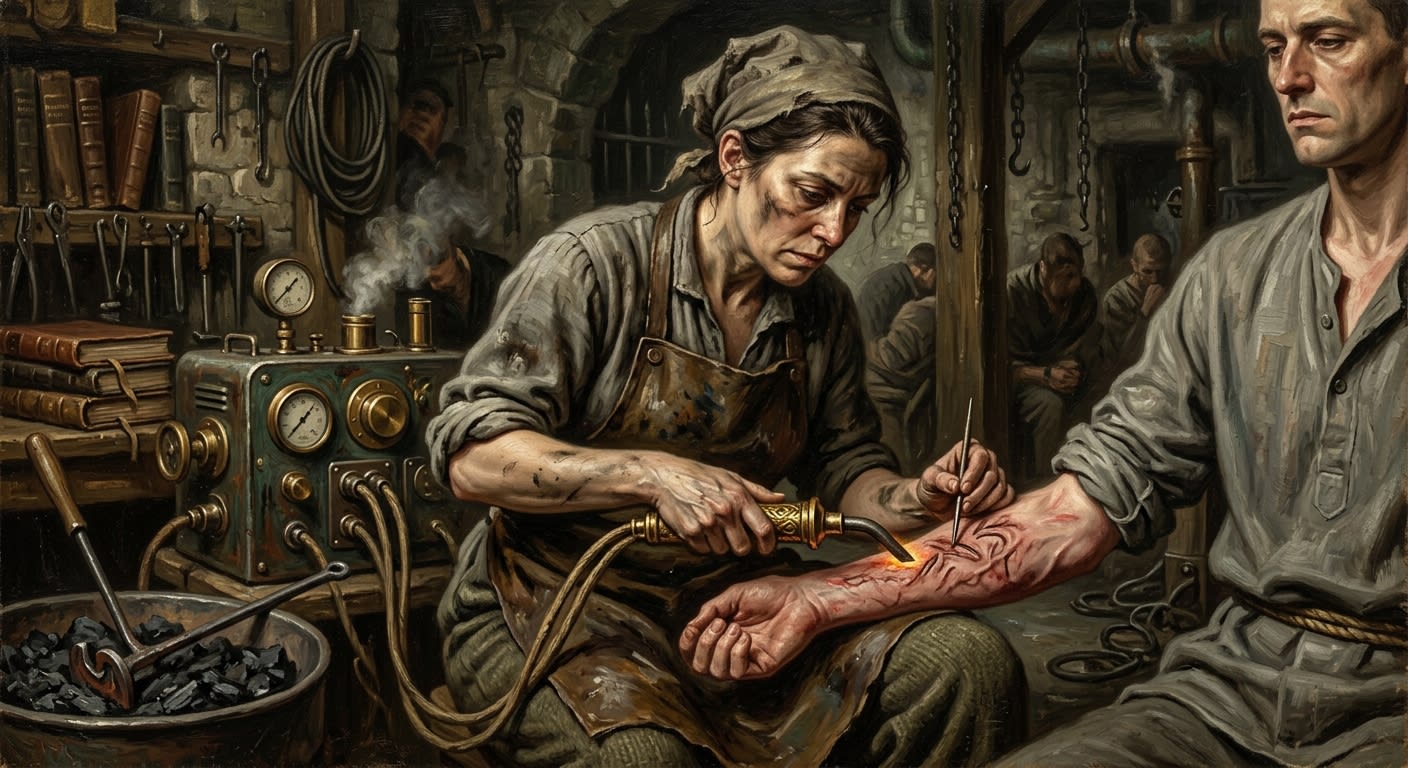
The Mercy Branders are licensed Geometry Brand-Smiths who commit compassion in units small enough to pass audit. Erasure belongs to the Shadow Angle crews, to acid, to cellars, to fools with money and no patience for infection. Open pardon belongs to courts, prelates, and other theatrical arrangements by which power dresses itself as discernment. Mercy Branders do something more dangerous. They turn the triangle a little kinder.
A condemned mark becomes penitent. A second-category heresy brand becomes first. A levy sign is softened toward civilian incapacity. A ward-mark is adjusted toward apprenticeship. A guild refusal becomes a provisional guild scar that might survive two gates if the guard is tired, charitable, drunk, bribed, or blessed with poor eyesight. The client calls it rescue. The Bureau calls it falsification. The Mercy Brander calls it correction before catastrophe.
They operate between the Licensed Chapel and the Quick Burners, despised by both. The Chapel purist sees sacrilege: authorised geometry bent by private conscience. The Quick Burner sees delay: a sentimental hand slowing the line. Re-inspection Brand-Smiths see future trouble. Purity sees a confession waiting for heat.
The people see a chance.
#On the Birth of Quiet Mercy
The Mercy Brander did not appear before the Compulsory Marking Decree because there was not yet enough branded misery to require a specialty in softening it. Before A.S. 113, branding remained narrower: heresy, condemnation, guild oath, certain court orders, inquisitorial display, the old iron alphabet of guilt. After the Paper Plague of A.S. 112, Heraldry won its argument against paper, and flesh became the preferred file.
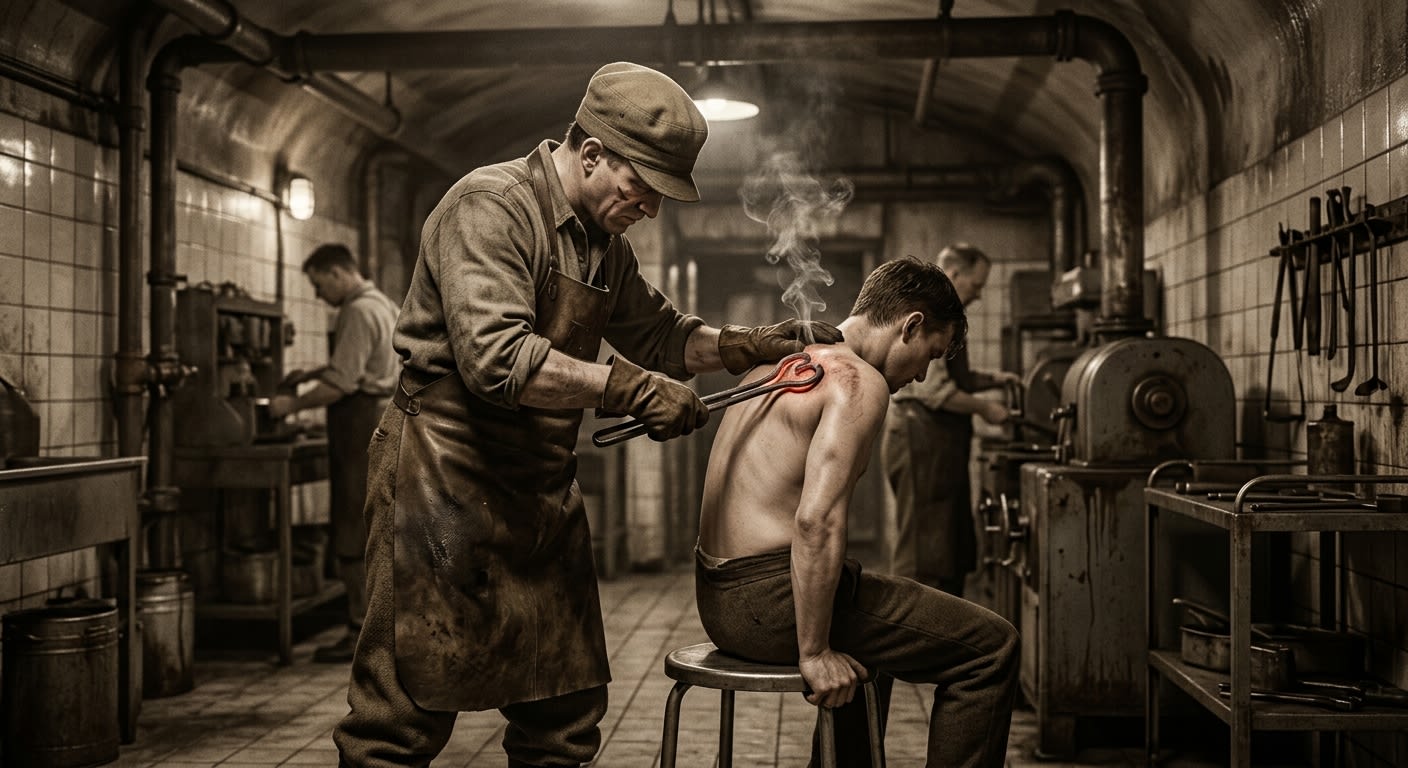
Forward checkpoints demanded seven classes: civilian, military, clerical, ward, penitent, pilgrim, condemned. Every class opened one passage and closed another. A mark could grant rations, deny work, summon a Lictor, remove a child, seize a son, or send a man to a labour cart before his explanation had finished forming in his mouth. The Brand-Smith Corps tripled. Competence did not.
The first Mercy Branders were tired chapel hands and frightened Frame-Hands (Unregistered) who had seen too many harsh marks applied to people whose crimes were smaller than the punishment's appetite. A widow classified as condemned because her husband's debt ledger arrived before his death notice. A boy branded levy-fit with a lung that whistled. A kitchen sister marked ward-property after Mercy lost her adoption file. A penitent upgraded to second-category heresy because a street-vicar disliked the way he answered the Third Confession (Unregistered).
A soft angle began as a hesitation. The iron descended a degree shy of severity. The witness entry used a class term broad enough to breathe through. The seal cooled before the clerk noticed the mark's mercy. By A.S. 119, after the Angle Riots proved that lawful geometry could condemn 1,400 civilians by miscalibrated accident, Mercy Branders gained a private doctrine: if the state may err harshly, the hand may err tenderly.
A Heraldry circular of A.S. 121 described Mercy Branders as “unlicensed criminal imitators embedded within chapel practice.”
Corrected in confidential classification. Most Mercy Branders are licensed. That is the scandal. Their irons are serialised, their badges valid, their witness rosters present, and their mercy harder to prosecute than any alley fraud.
#On the Art of Downgrading
The Mercy Brander's craft is not crude falsification. Crude falsification belongs to novices, criminals, and administrators in a hurry. Mercy requires a scar that can pass as lawful ambiguity.
The simplest method is class softening. A mark is applied with a point rounded by a hair's breadth, a line weighted toward a lesser category, a triangle seated where swelling will obscure severity during the first gate read. The ledger entry supports the softer reading: “penitent labour,” “civilian provisional,” “ward pending apprenticeship,” “clerical dependant,” “pilgrim under review.” Bureau language has more hiding places than a charnel field.
The second method is delayed witness capture. The iron touches skin before the final witness tag is tied, allowing the Brander to select, misselect, or “discover” the appropriate tag after seeing how the client bleeds. This is illegal. It is also common enough that Heraldry training manuals warn against it in tones usually reserved for masturbation and unauthorised psalmody.
The third method is healing correction. The Mercy Brander prescribes salve, vinegar, binding angle, sleeve pressure, sleeping posture, and nine days of careful neglect so that the mark heals into the softer interpretation. A harsh mark can be taught, during healing, to mumble.
SEIZED NOTEBOOK — MERCY REVIEW CELL, STRASBOURG, A.S. 187 “Widow M. — right forearm, condemned debt; soften lower point, ledger as penitent arrears. Boy T. — levy wrist; lung mark absent from War file; burn shallow, salve thick. Ward 6 — inner arm; move apprenticeship line before Mercy audit. Do not use Sister J. as witness again. She weeps into ink.” Disposition of notebook owner: █████████████ Disposition of listed clients: mixed; do not enumerate
Every Mercy Brander learns which guards read scar, which clerks read ledger, which Lictors read fear, and which re-inspectors read everything twice because they have no friends. A soft angle that passes in Brest may fail at Irongate. A ward downgrade that survives Strasbourg intake may die under Shipka time-fog when the mark appears older than the paperwork. Mercy must know geography. Sentiment without geography is how people get dragged from queues.
#On Whom They Save
Mercy Branders save the over-sentenced, which is a large category because the Synod sentences with the appetite of a furnace fed by committee. They save badly, partially, expensively, and at risk. It remains saving.
They save debt widows whose household marks tilt toward condemnation after a husband's accounts vanish into Records. They save levy-age boys whose bodies will not survive the line but whose wrists read available. They save wards who have found kitchens, trades, parish families, illicit aunts, or any refuge more merciful than official Mercy. They save workers who need guild access before hunger teaches them criminal grammar. They save penitents whose sins have been promoted by a clerk eager to meet a purity quota.
They do not save everyone. The condemned with a public face cannot be softened; too many eyes have already purchased certainty. The third-category heretic cannot be made clean by a kinder line; the scaffold reads large print. A mark already entered into three Bureau ledgers is heavy enough to crush charity. A client under active Purity review is poison. A moving mark is not mercy work. A moving mark is a summons.
The most disputed practice is the child angle: softening ward-property marks toward apprenticeship before Bureau of Mercy reclassification. Licensed Chapels call it abduction by geometry. Quick Burners call it wasted table time. Mercy Branders call it the only reason some children live long enough to learn a trade instead of becoming inventory with a pulse.
Public sermons have claimed Mercy Branders “free children from lawful guardianship.”
Clarified. Mercy Branders do not free. They alter the class of captivity. The difference matters to the law, to the child, and to the official who prefers a softer verb than theft.
#On Their Enemies
Licensed Chapels hate Mercy Branders because the Chapel's authority rests on the claim that full witness protocol purifies the act. Mercy work proves the protocol can be obeyed by a hand that has already betrayed the sentence. Nothing embarrasses a ritual like a conscience hidden inside it.
Quick Burners hate them because Mercy Branders make the line slower and the audit thicker. A trench muster cannot pause while a Brand-Smith wonders whether the seventeenth boy in rain might be spared by a shallow wrist. The Quick Burner counts bodies, wrists, heat, cooling, next. The Mercy Brander counts consequences. Both counts are correct. That is why they hate each other.
Re-inspection Brand-Smiths hate them because soft angles generate work that cannot be named honestly. Is the mark erroneous, merciful, criminal, or locally acceptable? The answer changes by district, patron, and whether Purity is standing in the room. Re-inspection likes proof arguing with proof only when it can charge the argument to someone else.
Shadow Angle crews hate them with commercial intimacy. Illegal downgrading sells best when legal mercy fails. Every Mercy Brander who saves a client inside the chapel steals from the cellar. Every cellar downgrade that goes septic makes chapel mercy look indistinguishable from crime. The two trades spit at each other across the same wound.
Purity hates them most purely, which is to say most usefully. A Mercy Brander is not an external criminal. He is a licensed contradiction. His badge is valid; his hand is suspect. He can stand in a chapel beneath authorised lamps and commit mercy with state property. This makes him intolerable to inquisitors, who prefer evil to be considerate enough to stand outside the door.
#On the Price of Pity
A Mercy Brander lives by concealment. The fee may be coin, ration chits, saint-candles, soap, morphine, passage, a favour owed, or the silence of the client's entire stairwell. Some refuse money from children. Some charge children double because children bring attention. Saints and monsters share tools more often than hymnals admit.
The usual punishment is public badge stripping followed by trial for false measure. Severe cases become immurement, especially where a softened mark allowed a fugitive through a gate or embarrassed Purity in front of witnesses. A Mercy Brander who alters a recorded class after ledger confirmation may be charged with body fraud. If a client later commits violence, the softened angle becomes conspiracy retroactively, with interest.
The craft leaves its own scar on the practitioner. Brand-Smith burnout is common enough to have jokes. Mercy burnout has prayers instead. The Brander begins by saving one client from an absurd severity and ends by seeing absurd severity in every queue. He starts measuring wrists before faces. He hears the hiss before the name. He keeps two ledgers: the official book and the private book of people who might have died harder.
The private book is usually burned. The ashes are usually searched.
#On the Present Condition
As of A.S. 201, the Mercy Branders remain faction, rumour, practice, and disciplinary category rather than acknowledged order. Heraldry knows they exist. Purity knows where several work. Records denies the term while maintaining form codes that plainly anticipate it. The Bureau of Mercy condemns them in sermons and quietly benefits whenever a softened ward-mark prevents a dormitory scandal from becoming public arithmetic.
Their strongest presence lies in chapel districts near forward checkpoints, orphanage intake offices, debt courts, levy yards, and the poorer approaches to bastions where law arrives faster than food. Strasbourg has them. Brest has them. Irongate has too many ghosts to avoid them. Constantinople has everything twice, once official and once below the stairs. Shipka has Mercy Branders who refuse to work during fog, which is how one recognises sanity.
They are not heroes. Heroism is too clean a garment for people who burn altered law into the desperate. They take money. They misfile. They lie. They sometimes save the wrong person, sometimes doom the right one, sometimes soften a predator because the predator's mother wept convincingly and paid in silver. Mercy performed by sinners remains mercy only until the invoice clears.
The final doctrine remains unwritten because Doctrine dislikes sentences that would expose the machine. The Mercy Brander persists wherever the official mark cuts deeper than the offence, wherever a mother has coin, wherever a child has a wrist, wherever the gate reads skin and the skin needs to lie kindly.