
#On the Form That Names a Moving Scar
Form 14-G exists because flesh, having been drafted into service as paper, developed the insolence to behave like flesh again.
The official title is Form 14-G: Anomalous Geometry, Flesh-Based. The Bureau of Heraldry prefers the full title because long names calm committees. Brand-Smiths call it the Crawling Sheet. Quick Burners call it the Stop-the-Line. Re-inspection Brand-Smiths call it the Forbidden Re-read. Citizens call it nothing if they are wise, because a citizen whose mark begins to move has already attracted enough vocabulary.
It was formalised in A.S. 147, during the long quarrel between Purity and Heraldry over bodily marks that drifted after lawful application. The background is familiar to all civilized sufferers of the Synod. The Geometry Brand-Smith Corps had transformed identity into burned geometry: triangles for class, status, penance, passage, levy, guilt, and permitted movement. Paper lied. Flesh would testify. That was the promise.
Then the testimony began revising itself.
A single triangle lengthened at one corner after Vespers. A ward-mark rotated beneath the skin while the ledger remained correct. A condemned brand flattened into pilgrim geometry when the bell rang over water. A fresh mark at Bastion-Shipka aged eleven years before Sext and cracked like old plaster. At Bastion-Przemyśl, the Wire Orchard demanded classification before dawn while scar, tag, and gate-book disagreed in three hands and one body.
The question is not whether the mark is wrong. The Bureau can survive wrongness; it manufactures enough of it to keep clerks employed. The question is whether the mark has moved without permission. Wrong proof may be corrected. Moving proof suggests agency.
#On the Quarrel of Bureaus
Purity says Form 14-G records Category Two Demonic Interference with Heraldic Instruments. Heraldry says it records Geometric Instability, Under Investigation. Records says the distinction must be maintained in separate columns until a final determination is reached. Doctrine says the final determination has always been imminent. The mark crawls.
This disagreement has endured since A.S. 147 because each office protects a different vanity. Purity needs the mark to be demonic, since demonic interference justifies quarantine, interrogation, confiscation, and the pleasant constitutional music of doors locking from the outside. Heraldry needs the mark to be unstable, since demonic interference with Heraldry instruments suggests the triangle can be answered by Hell, and that thought makes the Seventh Directorate sweat through its collars. Records needs the form legible. Records is often the most frightening Bureau because its desires are so pure.
Initial Form 14-G instructions ordered Brand-Smiths to “determine whether drift is natural, procedural, or infernal.”
Withdrawn after seven Brand-Smiths asked what natural drift in a burned classification mark would mean and three Purity assessors threatened to answer. Current language requires only observation, sealing, notification, and the sacred cowardice of deferred interpretation.
The A.S. 199 revision did not settle the quarrel. It refined the choreography. Any Brand-Smith observing drift in a mark applied within the preceding seventy-two hours must seal the subject, notify Purity, suspend further marking, and refrain from re-examination until cleared by an Inquisitor of the Third Degree. The revised form adds check-boxes for angular, linear, rotational, proliferative, vanishing, duplicated, vocal, mirrored, and unclassifiable drift. Most competent Brand-Smiths select unclassifiable. Competence, in this narrow field, consists of leaving the room with both hands and no opinions.
#On the Physical Sheet
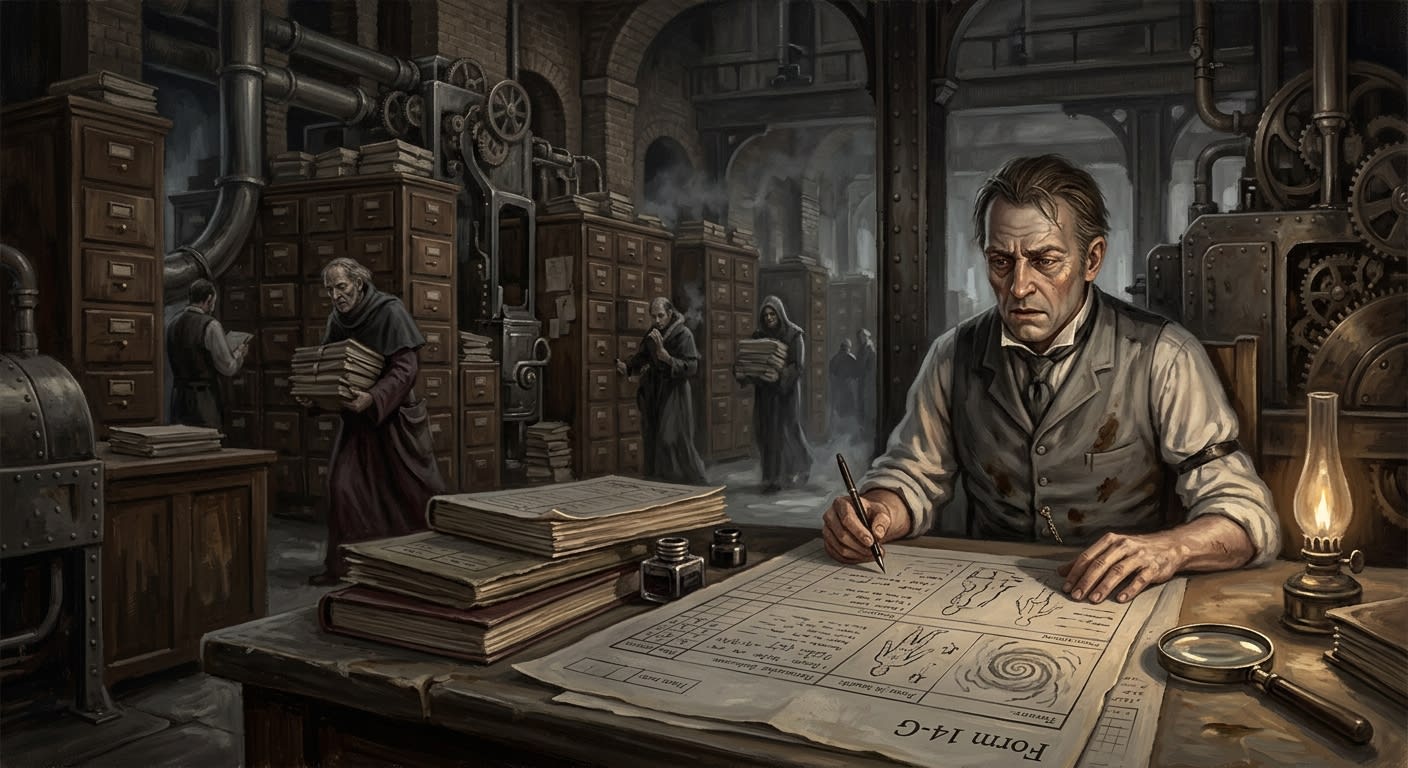
Form 14-G is printed on grey rag-vellum treated with vinegar mordant and heat-brown ink, so that a trembling hand cannot easily smudge the confession of its own inadequacy. The upper left corner carries the Heraldry knot. The upper right bears a Purity countersignature field that Purity insists is mandatory and Heraldry insists is conditional. The middle of the sheet contains the body diagram: cheek, wrist, forearm, palm, brow, shoulder, sternum, ankle, and the blank outline labelled other, which has ruined sleep in more clerks than any demon.
The filer must enter the original classification, tool serial, application time, witness seal, subject name, subject claimed name, subject ledger name, subject’s response to mark drift, and whether the response matched age, sex, wound, and known language. The final page asks whether the mark appeared to resist measurement. A yes answer triggers red routing. A no answer is seldom believed.
There is a space for sketching the deviation. Artists do badly here. Clerks do worse. A moving mark resents portraiture. It changes while drawn, which forces the filer to decide whether the sketch records the first shape, the last shape, or the moment when everyone in the cell stopped pretending the difference mattered. Quick Burners often draw arrows. Chapel Masters draw carefully and lie with beautiful line weight. Re-inspectors draw twice, then burn the first sketch.
#On Chapel Practice and Field Panic
A Licensed Chapel can perform the rite of cowardice properly. Doors close. The subject is fixed. A witness clerk is summoned. A Purity bell is pulled. The iron is cooled, labelled, and placed in a tray as if it were a sleeping viper. The Brand-Smith washes his hands, files Form 14-G, and says nothing that might later be used as thought. Tiles receive the screaming. Incense improves the official smell.
A field shed has no such luxury. A Quick Burner may see drift while three hundred people press forward, rain wrecks the ledger, a guard captain asks whether the line has stopped, and artillery begins making punctuation in the road behind the carts. The rules say seal the subject. The road says move the queue. The scar says something else entirely. This is why unofficial addenda exist, though Heraldry denies them with the offended dignity of a man whose own handwriting appears on the copy.
UNOFFICIAL FIELD ADDENDUM — QUICK BURNER COPY, ORIGIN DISPUTED If mark drifts before bandage: isolate subject if guards permit. If mark drifts after convoy release: notify next checkpoint by sealed runner. If subject screams in a voice not matching age, sex, wound, or known language: stop listening. If queue becomes aware: resume ordinary marking at once. Line five: ██████████████████████████████████ Disposition of copy: burned; quoted from memory by three men who disagreed on the ash colour.
The worst field cases are never the spectacular ones. Spectacle is easy to quarantine. A triangle that opens like a mouth will clear a shed quickly. A brow-mark that whispers the true name of the clerk will receive decisive attention. The dangerous cases are slight: a line one degree off, a corner that swells under candlelight, a pilgrim mark that appears correct until the bearer faces east, a ward-triangle that crawls only when the child sleeps.
Those cases enter the road. The road has poor ethics.
#On Re-inspection and the Forbidden Re-read
Re-inspection Brand-Smiths hate Form 14-G because it forbids the one thing their hands are trained to do. They verify. They measure. They amend. They turn proof against proof and burn lawful correction through failed geometry. Form 14-G tells them to stop at the threshold of the most interesting scar in the room.
The A.S. 199 revision is explicit: do not re-examine after drift is confirmed until clearance by an Inquisitor of the Third Degree. This is sensible. It is also futile. No craftsman can resist the thing that disproves his craft. Re-inspectors look again. They call it safety. They call it confirming the initial observation. They call it checking the lamp. A man can sin three times before breakfast if each sin has a procedural name.
The forbidden re-read has produced three schools. The Obedient seal the cell and leave. They live longer and know less. The Measuring Hands take one second reading before Purity arrives, usually without witnesses, usually with the calm expression of men placing their fingers between teeth. The Black Calipers keep private copies of drift ratios, tool histories, scar age, prayer response, bell response, and subject survival. Heraldry denies the Black Calipers. Heraldry also reads their seized notebooks under seal.
Heraldry Circular 14-G/199 states that no unofficial drift-ratio notebooks are maintained by licensed personnel.
Clarified. No unofficial drift-ratio notebooks are maintained by licensed personnel in any location where Heraldry has chosen to look during announced inspection hours.
#On Known Patterns
The Bureau has identified patterns because terror becomes more manageable when placed in columns.
Angular drift is most common after hurried work: one corner pulls, as if the scar were being read by a different compass. Linear drift occurs in old cold sectors, especially near Shipka, where a side of the triangle lengthens overnight and the mark begins to resemble a route. Rotational drift appears in river cities and bridge checkpoints; the mark turns by degrees toward water, bells, or the nearest gate. Proliferative drift is rare and hated: fourth points, fifth points, small satellite cuts that appear around the main geometry like children around a corpse. Vanishing drift belongs to fog, fever, bribery, or mercy. Mirrored drift is assigned to Purity before anyone finishes speaking.
The subject’s condition offers little comfort. The innocent drift. The guilty drift. Children drift. Condemned men drift. Pilgrims drift in clusters during bad weather. A tool may mark fifty bodies cleanly and produce the fifty-first as a theological insult. A scar may hold for nine days, thirty days, three gates, and one oath hearing, then crawl during supper because a spoon struck a bowl with the wrong note.
Przemyśl’s Wire Orchard keeps the cruellest statistics. The Orchard cares nothing for theological quarrels. It asks whether the body may pass. A drifting mark at the first gate becomes a held subject. At the second gate, a liability. At the wire, an answer. Orchard clerks developed the phrase let the wire read him during A.S. 147. Doctrine has discouraged the phrase. The wire remains eloquent.
#On What the Form Conceals
The terror beneath Form 14-G is not that Hell can alter a scar. That terror is almost tidy. Demons interfere; the faithful respond; Purity locks the door and everyone feels employed. The deeper insult is that the Synod may have misunderstood what branding marks.
Brand-Smith superstition says the iron does not mark flesh alone. It marks something beneath flesh: guilt, office, oath, fear, hunger, some under-name the Bureau has not catalogued because the catalogue would need to look back. When the geometry drifts, that under-thing answers. A triangle burned as classification becomes correspondence. The body receives a letter from itself, from Hell, from the Creator, from bad salve, from a misheated iron, from whatever waits in the little red chapel under the skin.
Heraldry forbids this theology. Purity encourages the useful parts. Doctrine files both positions and permits me to sound magnificent while no one solves the problem.
As of A.S. 201, Form 14-G remains active, revised, feared, misused, and necessary. Standing Order 14-G controls formal response. Three missing irons from A.S. 200 complicate tool custody. Shadow Angle crews imitate field marks. Mercy Branders bend geometry softly enough to escape first reading. Quick Burners overburn from fear. Re-inspectors look twice. Citizens hide scars under sleeves, ash, bandage, hair, lies, prayer cards, and the old human hope that a thing unseen is a thing untrue.
The form waits in every brand chapel, every forward shed, every Re-inspection drawer, every intake gate where a lamp burns late and a hand shakes above a line. It is grey. It is numbered. It has boxes for horrors too specific to be imaginary and too common to be myth. At the bottom, beneath the signature field, the revised edition carries the instruction that every filer remembers and no filer obeys with comfort:
Do not correct what is still moving.