
#On the Chapel That Makes Flesh Official
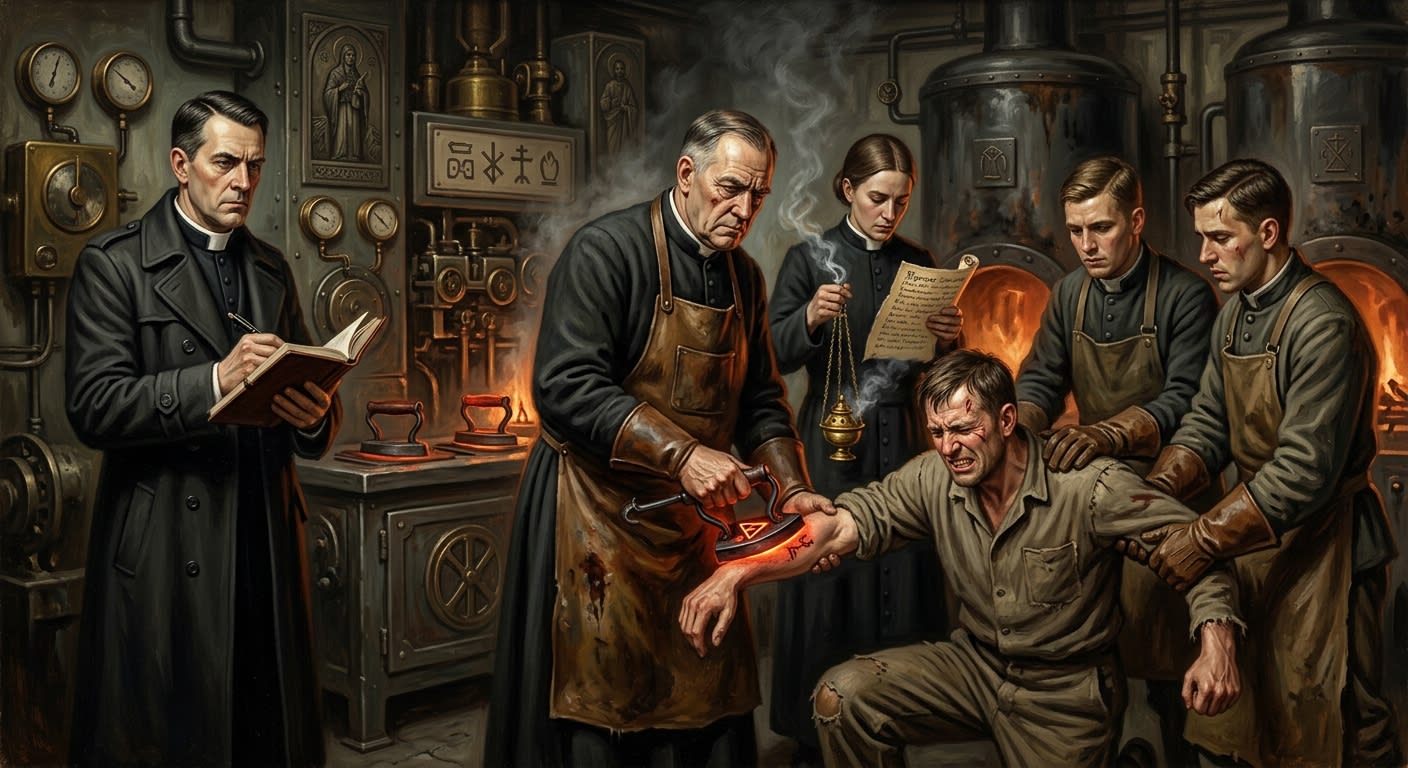
The Licensed Chapel Brand-Smiths are the respectable face of bodily proof, which is to say they perform mutilation beneath lamps authorised by the Bureau of Heraldry and call the difference civilisation. They operate in sanctioned brand chapels: tiled rooms with drains discreetly angled toward reliquary grates, wall-mounted swatch plates, witness benches, tool cupboards with serial locks, prayer cards in laminated vellum, and a small icon of the Triune Measure (Unregistered) placed where the client must stare while the iron heats.
They are the purists of the Geometry Brand-Smith Corps. Full witness protocol. Full prayer sequence. Full ledger entry before heat, during heat, after heat, and again after the first bandage. They believe the angle must be exact because the mark is a sacrament of classification. They believe the witness must stand close enough to smell hair singe because distance breeds error. They believe speed is an invitation to riot, pity is an invitation to fraud, and the alley is the chapel's bastard child.
Their formal rivals are the Quick Burners, those trench-yard hands who brand levy lines, cart columns, road queues, pilgrim chains, and condemned batches wherever throughput matters more than ceremony. Their criminal opposite is the Shadow Angle crew. Their most irritating cousin is the Mercy Brander, who uses a valid chapel badge to bend what the Chapel insists cannot bend. Their nightmare is the Angle Riots, because Irongate proved that lawful tools can lie, and purists sleep badly beside that fact.
#On Origin and Chapel Authority
The Chapel faction emerged from A.S. 104, when the Brand-Smith Corps itself was constituted under the Catechism Third Revision. The old inquisitorial brands had varied too widely: pyre-cross here, tongue-stump there, guilt applied by temperament, district custom, and whatever iron a Lictor found near the stove. Heraldry's answer was geometry. A triangle could be measured. Measurement could be recorded. Recorded measurement could be enforced. Enforced measurement could be taxed, audited, appealed, denied, and expanded. The Bureau was delighted.
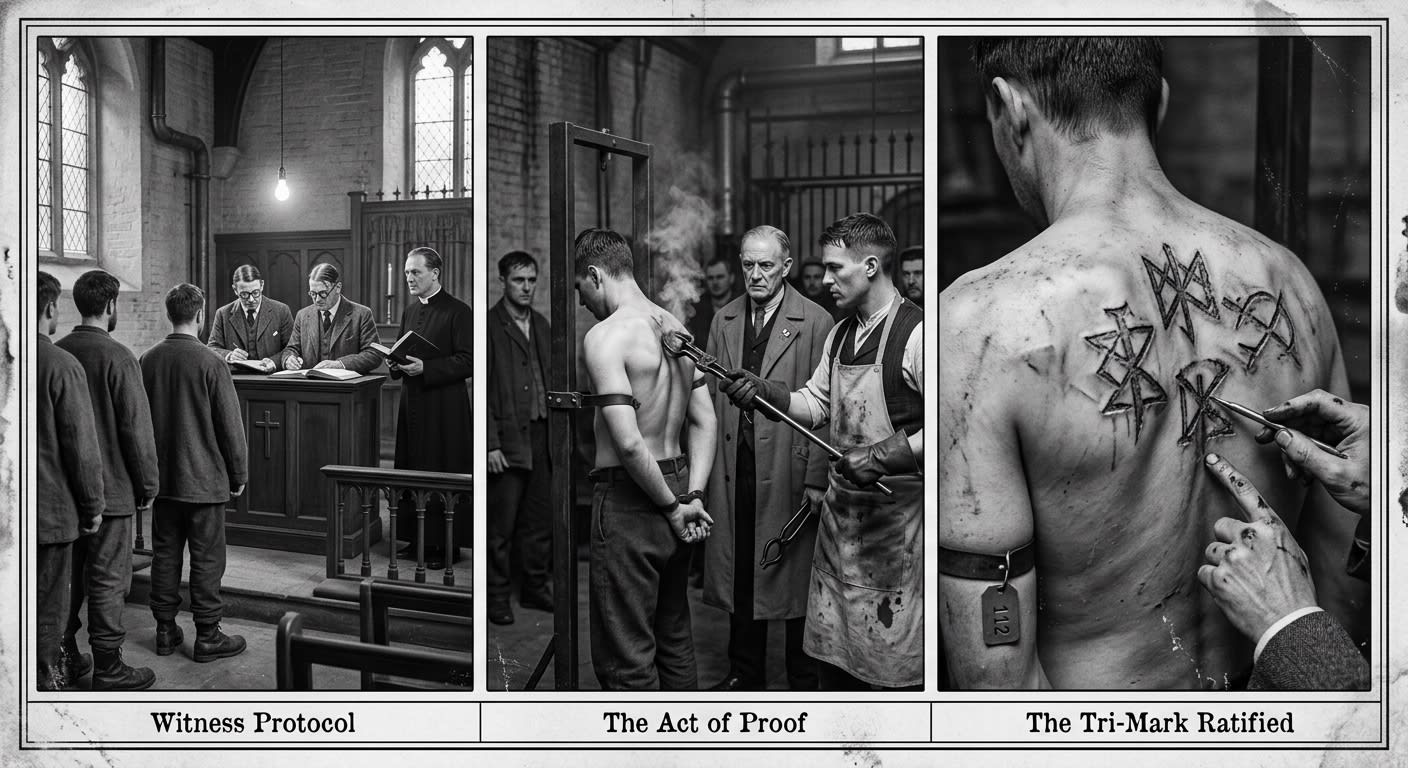
The first brand chapels were court annexes and converted confession rooms. A condemned man could be tried in one chamber, classified in the next, branded under witness, and passed to the scaffold with a record plate cooling beside him before the clerk's tea lost its steam. Efficiency acquired incense. Violence acquired grout.
The Paper Plague of A.S. 112 changed the scale. When forged transit passes carried false identities through Bastion-Przemyśl and left eighty-seven dead, Heraldry converted bodily marks from specialised punishment into general identity authentication. The Compulsory Marking Decree of A.S. 113 required seven classes of forward-zone tri-mark: civilian, military, clerical, ward, penitent, pilgrim, condemned. Brand chapels multiplied near gates, ration arches, orphanage intake halls, depot courts, and bastion roads.
The Licensed Chapel faction took its shape in protest against the flood. They argued that an expanded Corps required stricter premises, tighter witness discipline, longer rites, cleaner tools, and more elaborate custody books. They were correct. This did not make them popular. Correctness rarely does, unless it arrives with bread.
Early Heraldry summaries described Licensed Chapel practice as “the original and universal mode of Brand-Smith operation.”
Corrected. Chapel practice became dominant where infrastructure permitted it. Field carts, trench sheds, court yards, levy roads, and emergency intakes branded bodies before the Chapel faction acquired enough marble to pretend priority.
#On the Rite of Lawful Heat
A Chapel branding begins before the client enters. The iron is drawn from the locked cupboard under two signatures. The serial is read aloud. The swatch plate is uncovered. The lamp is trimmed. The record plate is set beside the ledger. The witness bench receives its assigned clerk, its independent observer, and, where Purity has taken an interest, a white-cloaked shadow whose face says nothing useful.
The client is washed. The word client is tender nonsense; condemned men, wards, levy boys, pilgrims under correction, debtors, and suspects are rarely clients in any commercial sense, but the Chapel uses polite terms because politeness costs less than reform. The Frame-Hand sets the measuring frame. The Ledger-Scriber reads class, authority, site, tool serial, witness names, and allowable aftercare. The prayer card is held where the client can hear it even through the first attempt not to scream.
The Master Brand-Smith speaks the Triune Formula: Measure, Witness, Refusal. The iron descends. Flesh answers.
CHAPEL INCIDENT REPORT — BREST GATE ANNEX, A.S. 173 Class intended: ward-property pending transfer Witnesses present: █ Iron serial: valid Prayer sequence: complete Client movement during application: severe Resulting mark: partial double, lower point torn Immediate classification dispute: █████████ Disposition of child: transferred before re-read Disposition of Brand-Smith: admonished for clamp leniency
The Chapel claims that the complete rite protects the subject and the state alike. This is half true, which is the ratio at which most durable lies become architecture. Full protocol reduces lost irons, false tags, infection, class drift, and later disputes. It also gives every mistake a procession of witnesses, seals, prayers, and custody forms, making the error harder to admit because so many respectable persons watched it become official.
#On Theology, Geometry, and Other Forms of Vanity
The Licensed Chapel insists that angle measurement is theology. A single degree is more than craft error. It is a doctrinal wobble, a small apostasy of the wrist. The triangle's three points signify Order, Sacrifice, and Obedience; or Measure, Witness, and Refusal; or Purity, Authority, and Legibility, depending on which instructor one had and whether the Bureau of Doctrine has recently revised the classroom cards. Contradiction does not trouble the Chapel. All three formulations require expensive training.
Chapel purists polish swatch plates like relics. They keep rejected irons in locked cabinets for moral instruction. They write tool custody logs in hands so neat they appear printed by malice. They correct apprentices for breathing across the gauge. They speak of crooked angles as if discussing venereal disease among bishops: quietly, technically, with excessive detail and an evident wish to be overheard.
Their private devotion centres on Saint Caldrin the Measured (Unregistered), the vocational patron claimed by several Brand-Smith schools. Chapel tradition says Caldrin branded his own palm to testify against a corrupt Judge, then held the mark to the court window so that sunlight could pass through the blister and prove the angle true. This is unlikely, beautiful, and administratively useful. The Bureau accepts all three qualities in a saint.
The Chapel's oath is plain: a line unmeasured is a lie. It sounds admirable until one remembers who decides which bodies require lines.
A.S. 146 chapel catechisms asserted that perfect geometry prevents spiritual contamination.
Withdrawn after Form 14-G cases multiplied in otherwise impeccable chapels. Current doctrine: perfect geometry prevents culpable procedural deviation. It does not prevent demonic interference, client panic, witness bribery, scar drift, bad salve, corrupt assignment, or the Creator's more acidic jokes.
#On Rivals Within the Corps
The Chapel hates the Quick Burner first because the Quick Burner is vulgar in a way the Chapel cannot metabolise. Quick Burners brand in rain, mud, cart-shadow, trench shed, depot yard, and levy queue, sometimes with hands so cold the measuring frame sticks to the skin. Their marks are often good enough. Good enough is poison to the Chapel mind. Good enough means a body passes the gate. Good enough means the rite has been reduced to outcome. Good enough means the marble room may be less necessary than the marble room's invoices imply.
Quick Burners answer with the arithmetic of survival. A bastion gate cannot wait for three witnesses and a polished prayer card while the road behind it curdles into panic. A levy line of four hundred wrists cannot be processed by men who pause to mourn each degree. A pilgrim column cannot sleep on the road because the Chapel wishes to trim its lamps. The Quick Burner calls the Chapel a perfume shop for pain.
The Chapel hates Mercy Branders as traitors wearing clean aprons. A Shadow Angle criminal can be named and bricked into a wall. A Mercy Brander may stand at the next bench, logged, licensed, devout, softening a ward-mark by one degree while reciting the same formula as everyone else. The Chapel depends on the idea that protocol and obedience are married. Mercy Branders conduct adultery in the family chapel.
The Chapel hates Shadow Angle crews as profaners. Here the hatred is almost pure. The alley steals chapel grammar: frames, ghost points, slit-lamps, class terms, witness gestures, even the little breath the Master takes before heat. The criminal imitates the rite closely enough to sell it. No priest ever forgives a convincing parody.
#On Irongate and the Chapel's Permanent Wound
The A.S. 119 Angle Riots remain the Chapel faction's chosen horror and favourite weapon. At Bastion-Irongate, hastily trained Brand-Smiths used a miscalibrated iron during a Purity sweep and applied inverted doubles where identity singles should have stood. 1,400 civilians were mis-marked. Three hundred detained. Forty-seven transferred to the Paper Mines of Ulm. Eleven executed under Standing Order 22-D before correction caught up with murder.
Licensed Chapels cite Irongate in every argument against speed. Haste deforms justice. Field custody conceals bad irons. Three-week Frame-Hands do not produce reliable sacrament. Improvised heat makes riots. A chapel bench, a swatch plate, two witnesses, and a proper re-read would have prevented the southern districts from wearing the wrong sin.
This claim is comforting. It is not quite safe.
Irongate's terror lies in lawful force outrunning truth, and lawful force does not require mud. A Licensed Chapel can misread a ledger. A Master can trust a forged authority. A witness can be bribed. A client can move under pain. A perfectly calibrated iron can apply a wicked sentence with radiant accuracy. The Chapel prevents many errors and consecrates the rest.
#On the Present Condition
As of A.S. 201, Licensed Chapel Brand-Smiths dominate rear cities, court annexes, orphanage intake halls, debt tribunals, and major checkpoint complexes where architecture can keep pace with authority. Strasbourg trains them. Brest resents them. Przemyśl uses them where the queues can be caged long enough. Irongate funds them as penance and denies the word. Shipka distrusts them because fog makes every schedule theological fiction. Constantinople contains more chapels than any map admits, since every dock quarter wishes its own scars to count first.
Their numbers hide inside the general figure of roughly 6,400 licensed Brand-Smiths. Heraldry does not publish faction counts, partly from policy, partly because classification would trigger demands from the Quick Burners, Mercy Branders, and re-inspection cells, and partly because the Bureau has learned that naming an internal quarrel gives it shoes.
The Chapel remains necessary. This will irritate the reader who prefers moral tidiness. Necessary things are often ugly. The Chapel keeps irons traceable, witnesses present, marks readable, infections lower, and appeal records possible. It also provides the state with a beautiful room in which to make the body confess its category.
The Chapel's final defence is always the same: without us, the alley wins. The answer is equally plain: because of them, the alley has a language to steal. Both sentences are true. The Ledger tolerates many truths when all of them require fees.